Share This Page
Drug Sales Trends for BENAZEPRIL
✉ Email this page to a colleague
Payment Methods and Pharmacy Types for BENAZEPRIL (2014)
Revenues by Pharmacy Type
Units Sold by Pharmacy Type
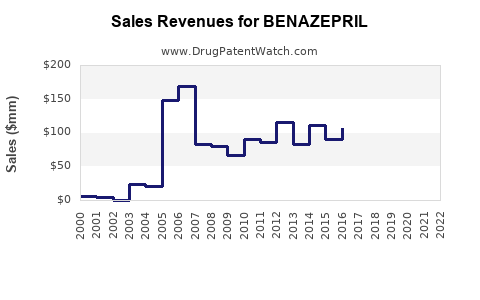
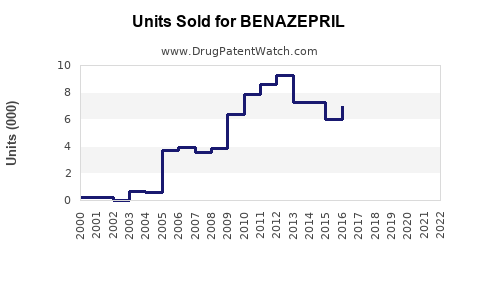
Annual Sales Revenues and Units Sold for BENAZEPRIL
| Drug Name | Revenues (USD) | Units | Year |
|---|---|---|---|
| BENAZEPRIL | ⤷ Start Trial | ⤷ Start Trial | 2022 |
| BENAZEPRIL | ⤷ Start Trial | ⤷ Start Trial | 2021 |
| BENAZEPRIL | ⤷ Start Trial | ⤷ Start Trial | 2020 |
| BENAZEPRIL | ⤷ Start Trial | ⤷ Start Trial | 2019 |
| BENAZEPRIL | ⤷ Start Trial | ⤷ Start Trial | 2018 |
| >Drug Name | >Revenues (USD) | >Units | >Year |
Benazepril Market Analysis, Sales Projections, Patent Status, and Generic Competition
Benazepril is a mature, low-cost generic ACE inhibitor with limited commercial growth potential. U.S. sales are driven by generic prescriptions for hypertension, while benazepril/hydrochlorothiazide combinations add a smaller volume segment. The brand Lotensin has no meaningful current commercial position. No active patent barrier is expected to prevent generic competition, and biosimilar risk does not apply because benazepril is a synthetic small-molecule drug.
A base-case model projects low-single-digit annual revenue erosion through 2030 as prescribers favor newer guideline-preferred therapies, fixed-dose combinations, and alternative renin-angiotensin drugs. Volume should remain relatively stable in some markets because of low pricing and continued use in patients already controlled on benazepril.
What is benazepril and how is it used?
Benazepril hydrochloride is an orally administered angiotensin-converting enzyme inhibitor. It is converted in vivo to benazeprilat, the active metabolite that inhibits formation of angiotensin II.
In the United States, benazepril tablets are approved for the treatment of hypertension. Available strengths generally include 5 mg, 10 mg, 20 mg, and 40 mg tablets. Benazepril is also marketed in combination with hydrochlorothiazide for hypertension.[1]
| Attribute | Benazepril |
|---|---|
| Therapeutic class | ACE inhibitor |
| Active ingredient | Benazepril hydrochloride |
| Primary U.S. indication | Hypertension |
| Original brand | Lotensin |
| Combination brand | Lotensin HCT |
| Dosage forms | Oral tablets |
| U.S. regulatory status | Generic prescription drug |
| Biosimilar exposure | None |
| Main competitors | Lisinopril, enalapril, ramipril, losartan, valsartan |
| Commercial lifecycle | Mature generic |
Benazepril is not generally a first-line growth product in U.S. hypertension markets. Lisinopril has broader prescribing familiarity, lower generic pricing, and higher prescription volume. Angiotensin receptor blockers such as losartan and valsartan compete for patients who develop ACE-inhibitor cough or prefer an ARB-based regimen.
How large is the benazepril market?
No current public filing provides a reliable standalone global revenue figure for generic benazepril. Generic manufacturers usually report sales by portfolio or therapeutic category rather than by molecule. Market sizing therefore requires a prescription-volume and net-price model.
The commercial market has three components:
- U.S. generic benazepril tablets.
- U.S. benazepril/hydrochlorothiazide tablets.
- International branded and generic sales, which vary by country and reimbursement system.
The U.S. market is likely the most transparent from a regulatory perspective but is not necessarily the largest by patient volume. Benazepril has established use in parts of Europe and Asia, while local ACE inhibitors and ARBs dominate other markets.
Estimated U.S. market structure
The following estimates are analytical ranges rather than reported manufacturer revenue.
| Segment | Estimated annual U.S. prescriptions | Estimated net revenue range | Market characteristics |
|---|---|---|---|
| Benazepril tablets | 1.0 million to 2.5 million | $10 million to $35 million | Highly commoditized |
| Benazepril/HCTZ | 0.2 million to 0.7 million | $3 million to $12 million | Smaller combination segment |
| Total U.S. benazepril franchise | 1.2 million to 3.2 million | $13 million to $47 million | Low-margin generic market |
The wide range reflects differences in payer mix, dispensing channel, manufacturer gross-to-net deductions, and whether pharmacy-level retail value or manufacturer net sales is measured.
What are the benazepril sales projections through 2030?
The base case assumes stable-to-declining prescription volume, continued price compression, and no major clinical event that increases ACE-inhibitor use. The revenue index is set at 100 for 2024 and represents estimated manufacturer net revenue, not pharmacy sales.
| Year | Bear case | Base case | Upside case |
|---|---|---|---|
| 2024 | 100 | 100 | 100 |
| 2025 | 94 | 97 | 101 |
| 2026 | 88 | 94 | 102 |
| 2027 | 82 | 91 | 103 |
| 2028 | 76 | 88 | 104 |
| 2029 | 71 | 85 | 105 |
| 2030 | 66 | 82 | 106 |
| Implied 2024-2030 CAGR | -6.5% | -3.2% | 1.0% |
Base-case interpretation
The base case implies approximately 18% cumulative revenue contraction from 2024 through 2030. The main causes are:
- Generic price erosion.
- Prescriber migration to lisinopril and ARBs.
- Greater use of fixed-dose combinations involving other antihypertensives.
- Reduced promotional support for benazepril.
- Pharmacy benefit manager substitution among generic ACE inhibitors.
Prescription volume may decline more slowly than revenue. Existing patients who are stable on benazepril can remain on treatment for years, limiting abrupt volume loss.
What could produce the upside case?
The upside scenario requires one or more of the following:
- Supply disruption affecting competing ACE inhibitors.
- A manufacturer securing preferred formulary placement.
- Higher use of combination therapy involving benazepril.
- Growth in markets where ACE inhibitors remain inexpensive first-line therapy.
- A strategic acquisition that consolidates manufacturing and improves distribution.
The upside case does not imply a return of brand-level pricing. Benazepril lacks the exclusivity or clinical differentiation needed to support substantial price expansion.
Which companies compete in the benazepril market?
Competition is fragmented among generic manufacturers, contract manufacturers, and pharmacy suppliers. The relevant competitive set includes companies that sell benazepril tablets or benazepril/hydrochlorothiazide combinations in particular jurisdictions.
Potential U.S. supply participants have historically included large generic manufacturers such as Teva, Sandoz, Lupin, Dr. Reddy's Laboratories, Zydus, Glenmark, and other approved applicants, depending on product strength and current marketing status. Product availability changes as manufacturers discontinue, transfer, or launch abbreviated new drug applications.
The more important competitive comparison is therapeutic rather than manufacturer-specific.
| Drug | Competitive position | Commercial effect on benazepril |
|---|---|---|
| Lisinopril | High-volume generic ACE inhibitor | Strongest direct pressure |
| Enalapril | Established generic ACE inhibitor | Competes in hypertension and cardiac use |
| Ramipril | Generic ACE inhibitor with cardiovascular familiarity | Competes in selected guideline-driven uses |
| Losartan | High-volume ARB | Captures ACE-intolerant patients |
| Valsartan | Generic ARB with broad combination use | Competes in hypertension and heart failure |
| Benazepril | Mature generic ACE inhibitor | Retains niche and maintenance use |
Lisinopril is the principal volume benchmark. Benazepril may retain use where patients are stable, clinicians have prior experience, or local formularies favor the product.
What is the FDA regulatory and Orange Book status of benazepril?
Benazepril is an FDA-approved small-molecule prescription drug. Generic versions are approved through the abbreviated new drug application pathway, demonstrating pharmaceutical equivalence and bioequivalence to the relevant reference product.
The original U.S. reference product was Lotensin, approved by the FDA in 1989. The FDA label identifies benazepril hydrochloride tablets for hypertension and includes dosing, contraindications, fetal toxicity warnings, and drug-interaction information.[1]
The Orange Book is relevant for identifying reference listed drugs, therapeutic-equivalence ratings, and any patent or exclusivity information associated with approved products.[2] Benazepril is a mature generic product, and no current market strategy should assume meaningful brand exclusivity.
FDA market implications
- No new chemical entity exclusivity remains.
- Historical patent protection has expired.
- Generic substitution is established.
- ANDA competition limits sustainable pricing.
- Regulatory value is concentrated in manufacturing reliability, product availability, and supply-chain execution.
FDA enforcement and manufacturing compliance remain important. A supplier with a warning letter, import alert, or recurring shortage issue can lose pharmacy and wholesaler share even when the active pharmaceutical ingredient is commoditized.
What patents protect benazepril?
The core benazepril composition and original product patents are expired or commercially exhausted. No biosimilar pathway is relevant because benazepril is a synthetic chemical compound.
Patent value today is more likely to arise from:
- Manufacturing processes.
- Polymorphs or crystalline forms.
- Purification methods.
- Stable tablet formulations.
- Combination products.
- Regional formulation claims.
These rights would need to be evaluated claim-by-claim and jurisdiction-by-jurisdiction. They are unlikely to recreate broad market exclusivity for standard benazepril tablets.
Patent strength assessment
| Patent category | Current commercial relevance | Risk to generic entry |
|---|---|---|
| Original compound patent | Expired | None |
| Original formulation patent | Expired or exhausted | Low |
| Standard tablet formulation | Usually weak and crowded | Low |
| Benazepril/HCTZ combination | Mature product space | Low |
| Manufacturing process patent | Potentially relevant | Low to moderate |
| Polymorph or solid-form patent | Product-specific | Low unless narrowly enforced |
| Method-of-use patent | Limited for standard hypertension use | Low |
| Pediatric exclusivity | Expired | None |
Any Paragraph IV challenge would have been most relevant before generic entry. At the current lifecycle stage, litigation risk is more likely to concern manufacturing, supply contracts, antitrust claims, or product liability than core molecule exclusivity.
When did benazepril lose exclusivity?
Benazepril lost practical U.S. exclusivity years ago. Lotensin entered the market in the late 1980s, and generic versions subsequently established competitive supply. The exact legal expiration dates for historical patents should be checked against the relevant Orange Book editions and patent records because patent term adjustments, terminal disclaimers, and product-specific listings can affect individual dates.
Commercially, the key conclusion is clear: benazepril has no remaining brand-level exclusivity capable of supporting premium pricing.
What patent litigation and Paragraph IV risks affect benazepril?
Current Paragraph IV risk is low because generic entry has already occurred and the product is widely commoditized. A new entrant would generally face ordinary ANDA review and approval requirements rather than a meaningful patent thicket.
Potential legal issues include:
- A formulation or process patent asserted against a specific ANDA.
- Product labeling disputes.
- Manufacturing-site compliance.
- Distribution or supply agreements.
- Antitrust claims involving generic competition.
- Product liability claims involving fetal toxicity, angioedema, renal impairment, or hyperkalemia.
No major active litigation is necessary to explain the market outlook. Pricing and supply execution are more material than patent enforcement.
What formulations are protected by benazepril patents?
Standard immediate-release benazepril tablets have limited defensible differentiation. A manufacturer may seek protection for a particular solid form, excipient system, dissolution profile, or combination formulation, but these claims usually provide narrow protection.
Benazepril/HCTZ products are commercially important because they improve treatment convenience, yet fixed-dose combination claims do not create durable exclusivity when the underlying ingredients and combinations are already established.
The strongest practical barrier is not formulation IP. It is regulatory and operational execution: validated manufacturing, consistent dissolution performance, reliable API supply, and uninterrupted distribution.
What licensing deals affect benazepril?
Benazepril has no widely reported current licensing transaction comparable to the licensing structures seen for newer specialty medicines. The original brand rights were associated with the innovator business behind Lotensin, while current commercial activity is primarily generic and may involve contract manufacturing, authorized distribution, or portfolio acquisitions.
Licensing value is therefore limited. A transaction involving benazepril would likely be structured around:
- A broader generic cardiovascular portfolio.
- Manufacturing capacity.
- Regional registration rights.
- API supply.
- Combination-product distribution.
- Market access in emerging markets.
A standalone benazepril license would have limited strategic value unless it included a broader hypertension portfolio or a supply advantage.
What generic launch scenarios exist for benazepril?
Base scenario
Existing suppliers maintain availability while prices decline gradually. Prescription volume falls modestly, and revenue decreases by approximately 3% annually.
Downside scenario
Multiple manufacturers compete aggressively, one or more large buyers consolidate procurement, and reimbursement shifts favor alternative ACE inhibitors. Revenue declines 5% to 7% annually.
Supply-disruption scenario
A manufacturing interruption among competing suppliers creates temporary pricing and volume upside. The benefit is short-lived because other generic manufacturers can usually enter or expand supply.
Geographic expansion scenario
A company grows sales in markets with expanding hypertension diagnosis and low-cost generic treatment. This can stabilize volume, but local registration, tender pricing, and reimbursement constraints limit margins.
How strong is the benazepril commercial opportunity?
Benazepril is a defensive generic opportunity, not a high-growth pharmaceutical asset.
| Factor | Assessment |
|---|---|
| Demand stability | Moderate |
| Revenue growth | Low |
| Margin potential | Low |
| Patent protection | Very weak |
| Regulatory complexity | Low to moderate |
| Supply-chain importance | High |
| Competitive intensity | High |
| Litigation exposure | Low for core product |
| Acquisition attractiveness | Portfolio-dependent |
| Biosimilar threat | Not applicable |
The asset can support predictable volume, especially in a broader cardiovascular portfolio. It is poorly suited as a standalone investment thesis based on price growth, exclusivity, or innovation.
Key Takeaways
- Benazepril is a mature generic ACE inhibitor used primarily for hypertension.
- The original Lotensin franchise has no meaningful remaining exclusivity.
- U.S. manufacturer net sales are estimated at roughly $13 million to $47 million across benazepril tablets and benazepril/HCTZ, with no reliable public standalone figure.
- Base-case revenue is projected to decline about 3.2% annually from 2024 through 2030.
- Lisinopril, enalapril, ramipril, losartan, and valsartan are the main competitive alternatives.
- Patent risk is low for standard tablets; manufacturing and formulation claims may create narrow, product-specific issues.
- Biosimilar competition does not apply.
- The commercial opportunity depends on manufacturing reliability, formulary access, and portfolio synergies rather than patent exclusivity.
FAQs
Is benazepril still profitable for generic manufacturers?
Yes, but usually only at portfolio scale. Low prices and intense competition make standalone profitability limited.
Does benazepril have an Orange Book patent blocking generic entry?
No current broad patent barrier is expected to block generic benazepril tablets. Historical patents have expired or lost practical commercial relevance.
Is benazepril safer than lisinopril?
Neither drug is universally safer. Both can cause cough, hyperkalemia, renal effects, angioedema, and fetal toxicity. Product choice depends on patient-specific factors and clinician judgment.[1]
Can a company obtain new exclusivity for a benazepril formulation?
A company may obtain patent protection for a novel formulation or manufacturing process if statutory requirements are met. Such protection would likely be narrow and would not restore compound-level exclusivity.
Will benazepril sales increase through 2030?
A sustained increase is unlikely in the United States. Growth is possible in selected international markets, but the global franchise is more likely to remain flat to declining in value.
References
- U.S. Food and Drug Administration. (2016). Lotensin (benazepril hydrochloride) tablets: Prescribing information. FDA.
- U.S. Food and Drug Administration. (2024). Approved drug products with therapeutic equivalence evaluations, 44th edition. FDA.
- U.S. Food and Drug Administration. (2024). Drugs@FDA: FDA-approved drugs database. FDA.
- National Library of Medicine. (2024). DailyMed: Benazepril hydrochloride labeling. U.S. National Library of Medicine.
- Whelton, P. K., Carey, R. M., Aronow, W. S., et al. (2018). 2017 ACC/AHA guideline for the prevention, detection, evaluation, and management of high blood pressure in adults. Hypertension, 71(6), e13-e115.
More… ↓
