Share This Page
Drug Sales Trends for clopidogrel
✉ Email this page to a colleague
Payment Methods and Pharmacy Types for clopidogrel (2013)
Revenues by Pharmacy Type
Units Sold by Pharmacy Type
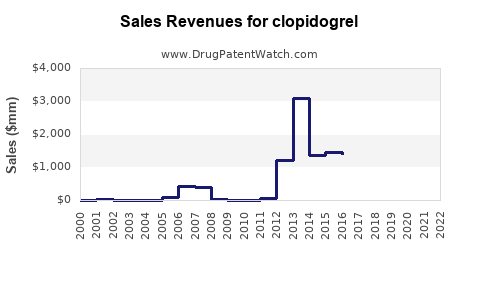
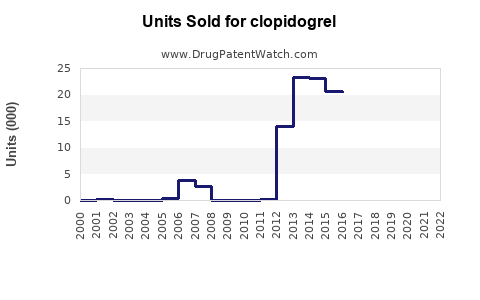
Annual Sales Revenues and Units Sold for clopidogrel
| Drug Name | Revenues (USD) | Units | Year |
|---|---|---|---|
| CLOPIDOGREL | ⤷ Start Trial | ⤷ Start Trial | 2022 |
| CLOPIDOGREL | ⤷ Start Trial | ⤷ Start Trial | 2021 |
| CLOPIDOGREL | ⤷ Start Trial | ⤷ Start Trial | 2020 |
| CLOPIDOGREL | ⤷ Start Trial | ⤷ Start Trial | 2019 |
| CLOPIDOGREL | ⤷ Start Trial | ⤷ Start Trial | 2018 |
| >Drug Name | >Revenues (USD) | >Units | >Year |
Clopidogrel Market Analysis, Sales Projections, Patent Status, and Competitive Landscape
Clopidogrel is a mature, low-cost antiplatelet medicine with broad global use in coronary artery disease, acute coronary syndrome, ischemic stroke, and peripheral arterial disease. The branded product Plavix lost U.S. exclusivity in 2012, and clopidogrel has no meaningful U.S. composition-of-matter patent protection remaining. The market is now driven by generic volume, hospital protocols, cardiovascular disease incidence, procurement pricing, and competition from ticagrelor and prasugrel.
Global clopidogrel sales are likely in the low-single-digit billions of dollars at manufacturer and channel value, with unit demand remaining high but average selling prices declining. A reasonable base-case forecast is low-single-digit annual volume growth and flat-to-low-single-digit value growth through 2029, subject to regional pricing pressure.
What is clopidogrel and how is it used?
Clopidogrel is an oral thienopyridine P2Y12 platelet inhibitor. Its active metabolite irreversibly inhibits the platelet P2Y12 receptor, reducing ADP-mediated platelet activation and aggregation.
The drug is approved or widely used for:
- Acute coronary syndrome
- Recent myocardial infarction
- Recent ischemic stroke
- Established peripheral arterial disease
- Prevention of stent thrombosis after percutaneous coronary intervention
- Dual antiplatelet therapy with aspirin after selected cardiovascular events
The usual adult maintenance dose is 75 mg once daily. A loading dose of 300 mg or 600 mg is used in selected acute coronary syndrome and PCI settings. Treatment duration depends on the indication, ischemic risk, bleeding risk, stent type, and clinical guidelines.
Clopidogrel is a prodrug requiring hepatic activation, principally through CYP2C19. Patients with reduced CYP2C19 function may have lower exposure to the active metabolite and reduced antiplatelet response. The FDA label includes a boxed warning concerning reduced effectiveness in poor CYP2C19 metabolizers and identifies genetic testing as one method of identifying patients at higher risk of inadequate response. [1]
How large is the clopidogrel market?
The market is large by volume but fragmented by geography, manufacturer, dosage form, and procurement channel. Public disclosures rarely report global clopidogrel revenue separately after the loss of Plavix exclusivity.
Historical branded sales
Sanofi and Bristol-Myers Squibb reported peak annual Plavix sales of approximately $9 billion before generic competition. Sanofi reported Plavix sales of approximately €2.2 billion in 2011, followed by a sharp decline after U.S. generic entry in May 2012. [2]
The commercial trajectory was:
| Period | Market condition | Commercial effect |
|---|---|---|
| Before 2012 | Plavix held major branded share | High price and concentrated revenue |
| 2012-2014 | U.S. generic entry | Rapid erosion in branded sales |
| 2015-2019 | Generic consolidation | Lower prices and broad access |
| 2020-2024 | Mature generic market | High prescription volume, limited pricing power |
| 2025-2029 | Continued generic use | Stable demand with modest value growth |
The branded franchise is no longer the main commercial opportunity. Current value is distributed across generic manufacturers, wholesalers, institutional contracts, and national reimbursement systems.
Current market estimate
A practical market model places annual global clopidogrel product sales in the approximate range of $1.5 billion to $3.0 billion, depending on whether the estimate includes retail and hospital channel markups, combination products, and markets with limited public pricing data.
The range is more reliable than a single point estimate because:
- Company filings often aggregate clopidogrel with broader cardiovascular portfolios.
- Generic prices vary by more than an order of magnitude across countries.
- Hospital procurement prices are materially lower than retail prices.
- Some market reports measure revenue, while others measure prescription volume or ex-manufacturer sales.
- Combination products, including clopidogrel with aspirin, may be included or excluded.
A base-case commercial estimate is shown below.
| Year | Estimated global value, base case | Volume outlook | Main driver |
|---|---|---|---|
| 2024 | $1.8-$2.5 billion | Stable to modest growth | Broad generic access |
| 2025 | $1.8-$2.6 billion | 1%-3% growth | Cardiovascular disease burden |
| 2026 | $1.9-$2.7 billion | 1%-3% growth | Growth in emerging markets |
| 2027 | $1.9-$2.8 billion | 1%-3% growth | Continued secondary prevention |
| 2028 | $2.0-$2.9 billion | 1%-3% growth | Aging populations |
| 2029 | $2.0-$3.0 billion | 1%-3% growth | Stable maintenance demand |
These figures are market projections rather than reported company sales. The value forecast assumes modest unit growth offset by price erosion in mature generic markets.
What are the main clopidogrel sales drivers?
Cardiovascular disease prevalence
Global cardiovascular disease remains the primary demand driver. The World Health Organization estimates that cardiovascular disease causes approximately 17.9 million deaths annually, making secondary prevention a large and recurring treatment market. [3]
Demand is supported by:
- Population aging
- Increased diagnosis of coronary artery disease
- More PCI procedures in developing markets
- Expansion of hospital capacity
- Wider use of post-stroke antiplatelet therapy
- Increased access to low-cost generic medicines
Post-PCI treatment
Clopidogrel remains widely used after coronary stent placement, particularly where cost controls favor generic therapy. Ticagrelor and prasugrel may be preferred in certain acute coronary syndrome populations, but clopidogrel remains important in stable coronary disease, high-bleeding-risk patients, elderly patients, and markets with constrained budgets.
Government procurement
National formularies and hospital tenders have a significant effect on price. Large contracts can produce high unit volumes but thin margins. Manufacturers with reliable regulatory compliance, multiple manufacturing sites, and established distribution networks have an advantage in tender-driven markets.
Combination products
Fixed-dose clopidogrel and aspirin products can support differentiation, especially where adherence is a commercial or clinical priority. Combination products may also compete with separate-tablet regimens, although prescribing practices and reimbursement rules vary by country.
How does clopidogrel compare with ticagrelor and prasugrel?
Clopidogrel competes primarily with ticagrelor and prasugrel in P2Y12 inhibitor therapy. The competitive position depends on clinical risk, treatment setting, cost, bleeding risk, dosing convenience, and local guidelines.
| Attribute | Clopidogrel | Ticagrelor | Prasugrel |
|---|---|---|---|
| Drug class | Thienopyridine | Cyclopentyl-triazolopyrimidine | Thienopyridine |
| Activation | Prodrug | Direct-acting | Prodrug |
| Dosing | Usually once daily | Usually twice daily | Once daily |
| Generic availability | Broad | Increasing, but less mature | Available in many markets |
| Cost | Lowest | Higher in many markets | Higher than clopidogrel in many markets |
| Onset | Slower and variable | Rapid | Rapid |
| Main limitation | CYP2C19 variability | Bleeding, dyspnea, twice-daily dosing | Bleeding and patient restrictions |
| Commercial position | Volume leader | Premium or guideline-driven alternative | Niche ACS and PCI use |
The major commercial threat is not total displacement. It is selective substitution in higher-risk acute coronary syndrome and PCI patients. Clopidogrel retains a cost advantage and a larger addressable maintenance market.
The FDA-approved labeling for ticagrelor includes use in acute coronary syndrome and prior myocardial infarction, while prasugrel is restricted by clinically important bleeding considerations, including contraindication in patients with prior stroke or transient ischemic attack. [4,5]
What patents protect clopidogrel?
The original clopidogrel composition-of-matter protection has expired. The commercial product has no meaningful U.S. patent barrier preventing ordinary generic clopidogrel bisulfate or clopidogrel hydrogen sulfate entry.
Core patent history
| Patent or protection | Subject | Status |
|---|---|---|
| Original clopidogrel compound patents | Active ingredient and related chemistry | Expired |
| Plavix formulation and salt protection | Bisulfate salt and pharmaceutical formulation | Expired or no longer commercially blocking |
| Pediatric or secondary-use protection | Limited regulatory or method claims | Expired or commercially immaterial |
| U.S. market exclusivity | Branded product protection | Ended with generic entry in 2012 |
The active ingredient is commonly marketed as clopidogrel bisulfate. Generic products may differ in salt form, excipients, manufacturing route, packaging, and dosage presentation, but these differences generally do not create a durable barrier to competition.
What is the Orange Book status of clopidogrel?
The Orange Book historically listed patents associated with Plavix and related branded approvals. Those patents no longer provide an effective exclusivity period for the U.S. market.
The relevant regulatory position is:
- Generic clopidogrel products are approved under abbreviated new drug applications.
- Generic manufacturers demonstrate pharmaceutical equivalence and bioequivalence.
- Paragraph IV certifications were relevant during the original generic challenge period.
- New entrants generally face approval, manufacturing, supply, and commercial execution risks rather than an active composition patent.
- There is no current branded Orange Book listing that supports a new long-duration monopoly for ordinary clopidogrel tablets.
FDA-approved generic products remain subject to current manufacturing, labeling, stability, dissolution, and pharmacovigilance requirements. [6]
When did clopidogrel lose exclusivity?
Clopidogrel lost effective U.S. market exclusivity in 2012.
Apotex launched an authorized or contested generic version in the United States in May 2012 after patent litigation and settlement developments. Other generic manufacturers entered afterward. The entry caused a rapid decline in Plavix sales and shifted the market from branded pricing to generic procurement economics.
The main exclusivity milestones were:
| Milestone | Timing |
|---|---|
| Original Plavix launch | 1990s |
| U.S. patent and regulatory extensions | Through the early 2010s |
| First major U.S. generic entry | May 2012 |
| Broad generic competition | 2012 onward |
| Current market status | Mature generic market |
No biosimilar pathway applies because clopidogrel is a small-molecule chemical drug, not a biologic.
Which companies manufacture or sell clopidogrel?
The supplier base is broad and differs by country. Major generic participants have included:
- Teva Pharmaceutical Industries
- Mylan, now part of Viatris
- Sandoz
- Dr. Reddy’s Laboratories
- Cipla
- Sun Pharmaceutical Industries
- Aurobindo Pharma
- Zydus Lifesciences
- Torrent Pharmaceuticals
- Accord Healthcare
- Lupin
- Hikma Pharmaceuticals
- Regional contract manufacturers and local generic companies
The original branded rights were associated with Sanofi and Bristol-Myers Squibb. Sanofi remains the principal historical brand owner, but generic manufacturers now control most unit supply in many markets.
Market shares are difficult to compare because companies often report clopidogrel within broader cardiovascular portfolios or disclose only country-level sales.
What patent litigation affected clopidogrel?
The principal litigation concerned the validity, enforceability, and scope of Plavix patents before generic entry. The disputes centered on the clopidogrel bisulfate salt, polymorphism, formulation, and related patent claims.
The largest commercial event was the resolution of patent disputes that enabled generic entry before the full end of the commercial life of the branded product. Following entry, the economic significance of the litigation declined because the core exclusivity period had ended and multiple suppliers entered.
Current litigation risk is more likely to involve:
- Product liability
- Manufacturing defects
- Recall-related claims
- Antitrust or pay-for-delay disputes
- Patent disputes over new combination products
- Regulatory enforcement involving manufacturing quality
A new entrant should not assume that expired core patents eliminate all legal risk. The remaining risks are product-specific and operational rather than based on active ingredient exclusivity.
What generic entry risks exist for clopidogrel?
The key risk is not patent blocking. It is low-margin competition.
Commercial risks
- Price compression from tender competition
- Customer concentration among wholesalers and hospital systems
- Short supply if a manufacturing site is disrupted
- Active pharmaceutical ingredient dependence on limited suppliers
- Recalls caused by dissolution, impurity, or stability failures
- Substitution by ticagrelor or prasugrel in selected indications
- Regulatory inspection failures
- Inventory losses from aggressive procurement forecasting
Manufacturing and intellectual property barriers
Clopidogrel synthesis is established, and the molecule does not present a high technical barrier relative to complex drugs. Manufacturing barriers remain relevant because process control, impurity management, polymorphism, and supply reliability affect approval and profitability.
The strongest practical advantages are:
- Low-cost API sourcing
- Multi-site manufacturing
- Validated analytical methods
- Strong regulatory history
- Reliable tablet production
- Local registration and reimbursement access
- Government tender relationships
The market does not support substantial price premiums for ordinary immediate-release clopidogrel tablets.
What are the clopidogrel sales projections through 2029?
Base case
The base case assumes:
- Global volume growth of 1%-3% annually
- Continued generic price erosion of 1%-3% annually in mature markets
- Higher volume growth in India, China, Latin America, Southeast Asia, and parts of the Middle East
- Stable or modestly declining use in some high-income markets
- No major safety signal or guideline reversal
- Continued use in secondary prevention and cost-sensitive PCI care
Under this scenario, global value rises from approximately $1.8-$2.5 billion in 2024 to $2.0-$3.0 billion by 2029.
Upside case
The upside case assumes:
- Faster cardiovascular diagnosis in emerging markets
- Greater access to PCI and stroke care
- Continued reimbursement preference for low-cost therapy
- Increased use of fixed-dose aspirin combinations
- Supply disruptions affecting competitors
- Stable guideline support for clopidogrel in selected treatment populations
Potential value growth would be approximately 3%-5% annually, driven mainly by volume rather than price.
Downside case
The downside case assumes:
- Accelerated substitution by ticagrelor or prasugrel in ACS and PCI
- Deeper generic tender price reductions
- Increased use of alternative antiplatelet strategies
- Manufacturing recalls or API shortages
- Reduced duration of dual antiplatelet therapy
- Greater use of genotype-guided treatment that redirects poor metabolizers to alternatives
Under this scenario, market value could decline 2%-5% annually despite stable or rising prescription volume.
How strong is the clopidogrel patent estate?
The patent estate is commercially weak because the core compound and principal branded protections have expired. Patent strength is therefore low for ordinary clopidogrel tablets.
| Category | Patent strength | Commercial assessment |
|---|---|---|
| Active ingredient | None of practical significance | Generic entry permitted |
| Standard tablets | Low | Limited differentiation |
| Salt and polymorph | Expired or nonblocking | Historical importance |
| Combination products | Potentially moderate if claims are active | Product-specific review required |
| Manufacturing process | Potentially narrow | Usually avoidable or nonblocking |
| Method of use | Low for established indications | Most key uses are known |
| Brand protection | Low | No durable premium |
The commercial moat is based on scale, quality, registration coverage, and distribution rather than patent exclusivity.
What is the investment outlook for clopidogrel?
Clopidogrel is a defensive generic pharmaceutical opportunity, not a high-growth branded asset. Attractive investment characteristics include:
- Large installed patient base
- Low development risk
- Established clinical demand
- Broad global regulatory precedent
- Low manufacturing complexity
- Recurring volume from chronic cardiovascular treatment
The principal disadvantages are:
- Minimal pricing power
- Heavy competition
- Low brand loyalty
- Limited patent protection
- Tender-driven margins
- Exposure to supply-chain disruptions
- Competition from newer P2Y12 inhibitors
For manufacturers, the strongest strategy is a low-cost, high-reliability supply model with multiple geographic registrations. For licensors, formulation, combination-product, packaging, or adherence innovations offer more differentiation than the basic clopidogrel molecule.
Key Takeaways
- Clopidogrel is a mature generic antiplatelet market with high unit demand and low pricing power.
- Historical Plavix sales reached approximately $9 billion annually before generic erosion.
- The U.S. market lost effective branded exclusivity in 2012.
- Core composition, salt, and formulation patent protection is expired or commercially nonblocking.
- No biosimilar risk applies because clopidogrel is a small-molecule drug.
- Global annual market value is reasonably estimated at $1.5 billion-$3.0 billion, depending on channel and geography.
- Base-case global value is projected to reach approximately $2.0 billion-$3.0 billion by 2029.
- Growth will come primarily from patient volume in emerging markets, not price increases.
- Ticagrelor and prasugrel are the principal therapeutic competitors.
- The strongest commercial barriers are manufacturing quality, supply reliability, regulatory registrations, and procurement scale.
FAQs
Is clopidogrel still profitable for generic manufacturers?
Yes, but profitability depends on manufacturing cost, tender access, scale, and supply reliability. Ordinary clopidogrel tablets generally do not support premium pricing.
Can a company obtain a new patent on clopidogrel?
A new patent may be possible for a genuinely novel formulation, combination product, manufacturing process, or delivery system. A patent on the known clopidogrel molecule or standard tablet is unlikely to provide meaningful protection.
Is clopidogrel included in Medicare and national reimbursement programs?
Clopidogrel is widely reimbursed in major healthcare systems, including U.S. Medicare Part D plans and national formularies in many countries. Coverage and preferred-tier status vary by jurisdiction and indication.
Will ticagrelor replace clopidogrel?
Ticagrelor may replace clopidogrel in selected acute coronary syndrome and high-risk PCI patients, but broad replacement is unlikely because clopidogrel is cheaper, familiar, widely available, and effective for many maintenance and secondary-prevention settings.
Does clopidogrel require genetic testing before treatment?
Routine genetic testing is not required for all patients. CYP2C19 testing may be considered in selected patients, particularly when treatment failure, high ischemic risk, or an alternative P2Y12 inhibitor is under evaluation.
References
- U.S. Food and Drug Administration. (2024). Plavix (clopidogrel bisulfate) prescribing information.
- Sanofi. (2012). 2011 annual report.
- World Health Organization. (2023). Cardiovascular diseases fact sheet.
- U.S. Food and Drug Administration. (2024). Brilinta (ticagrelor) prescribing information.
- U.S. Food and Drug Administration. (2024). Effient (prasugrel) prescribing information.
- U.S. Food and Drug Administration. (2024). Approved drug products with therapeutic equivalence evaluations.
More… ↓
