Drug Sales Trends for VYVANSE
Payment Methods and Pharmacy Types for VYVANSE (2013)
Revenues by Pharmacy Type
Units Sold by Pharmacy Type
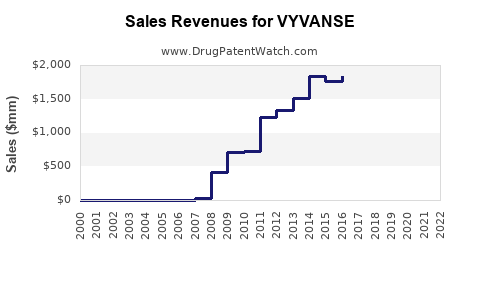
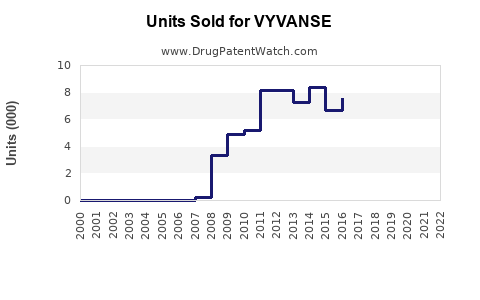
Annual Sales Revenues and Units Sold for VYVANSE
| Drug Name | Revenues (USD) | Units | Year |
|---|---|---|---|
| VYVANSE | ⤷ Start Trial | ⤷ Start Trial | 2022 |
| VYVANSE | ⤷ Start Trial | ⤷ Start Trial | 2021 |
| VYVANSE | ⤷ Start Trial | ⤷ Start Trial | 2020 |
| VYVANSE | ⤷ Start Trial | ⤷ Start Trial | 2019 |
| VYVANSE | ⤷ Start Trial | ⤷ Start Trial | 2018 |
| VYVANSE | ⤷ Start Trial | ⤷ Start Trial | 2017 |
| VYVANSE | ⤷ Start Trial | ⤷ Start Trial | 2016 |
| >Drug Name | >Revenues (USD) | >Units | >Year |
Vyvanse Market Analysis and Sales Projections: Lisdexamfetamine, Generic Entry, and Patent Exposure
Vyvanse sales are declining because U.S. patent protection ended in 2023 and multiple generic lisdexamfetamine products entered the market. The drug remains commercially important because it has established use in attention-deficit/hyperactivity disorder (ADHD) and binge-eating disorder (BED), but its revenue profile has shifted from branded growth to rapid generic erosion.
Base-case global Vyvanse and lisdexamfetamine brand sales are projected to decline from approximately $2.0 billion-$2.4 billion in 2023 to $0.4 billion-$0.7 billion by 2027. The principal risks are generic price competition, payer substitution, supply normalization among generic manufacturers, and loss of Takeda’s premium brand positioning.
What is Vyvanse and how large is its addressable market?
Vyvanse is the brand name for lisdexamfetamine dimesylate, a prodrug of dextroamphetamine. Takeda markets Vyvanse for ADHD in patients aged six and older and for moderate-to-severe BED in adults. The product is administered once daily in capsules or chewable tablets. It is a Schedule II controlled substance in the United States because its active metabolite is an amphetamine.
The commercial market has two principal segments:
| Segment | Commercial relevance | Competitive factors |
|---|---|---|
| ADHD | Largest source of demand | Generic stimulants, atomoxetine, guanfacine, methylphenidate, amphetamine salts |
| Binge-eating disorder | Smaller but differentiated indication | Limited approved pharmacologic alternatives, but lower patient volume and payer controls |
Vyvanse’s product differentiation historically came from its prodrug design, once-daily dosing, long duration of action, and lower abuse potential relative to immediate-release amphetamine products. These attributes supported premium pricing while the product was protected. They do not prevent generic substitution after loss of exclusivity.
The addressable ADHD market is large and persistent. U.S. ADHD diagnosis and treatment volumes support continued demand for amphetamine-based therapies, but Vyvanse competes against generic Adderall, extended-release amphetamine products, methylphenidate products, and newer nonstimulants. The BED market is smaller, but Vyvanse has fewer direct approved drug competitors.
How much revenue has Vyvanse generated?
Takeda does not report Vyvanse as a standalone global segment in every reporting period, and reported figures depend on fiscal-year definitions and currency translation. Public company disclosures indicate that Vyvanse generated more than $2 billion annually before generic entry.
| Period | Approximate commercial position | Revenue interpretation |
|---|---|---|
| 2017-2019 | Strong branded expansion | U.S. ADHD demand and BED adoption supported growth |
| 2020-2022 | Peak branded economics | Annual global sales were approximately $2 billion-$2.6 billion |
| 2023 | Transition year | Generic launches began in the U.S. in August |
| 2024 onward | Rapid erosion | Brand sales decline as formularies and pharmacies substitute generics |
Takeda’s fiscal-year 2023 results reflected the beginning of U.S. generic competition. The company reported that Vyvanse performance was affected by loss of exclusivity and generic launches, while inventory and supply conditions also influenced quarterly results (Takeda Pharmaceutical Company Limited, 2024).
The product’s peak revenue was supported by:
- High U.S. prescription volume.
- Brand pricing above generic amphetamine alternatives.
- A differentiated BED indication.
- Once-daily dosing and patient familiarity.
- Limited direct competition within the BED indication.
What are Vyvanse sales projections through 2028?
The following projection is a market model rather than Takeda guidance. It assumes continued generic penetration in the United States, stable underlying ADHD demand, limited international brand protection, and no major new indication.
Base-case Vyvanse revenue projection
| Calendar year | Estimated brand revenue | Year-over-year trend | Main assumption |
|---|---|---|---|
| 2023 | $2.0B-$2.4B | Down modestly | Partial-year generic competition |
| 2024 | $1.2B-$1.6B | Down 30%-45% | Broad generic substitution |
| 2025 | $0.8B-$1.1B | Down 25%-40% | Continued U.S. erosion |
| 2026 | $0.5B-$0.8B | Down 20%-35% | Mature generic market |
| 2027 | $0.4B-$0.7B | Down 10%-25% | Residual brand demand |
| 2028 | $0.3B-$0.6B | Down 10%-20% | Stable residual sales and selected markets |
The revenue range includes the brand and does not represent total lisdexamfetamine market revenue. Total molecule sales, including generics, should remain materially higher than Takeda’s brand revenue during the first several years after loss of exclusivity.
Scenario analysis
| Scenario | 2025 brand sales | 2028 brand sales | Driver |
|---|---|---|---|
| Upside | $1.1B-$1.4B | $0.6B-$0.8B | Generic supply constraints, brand loyalty, stronger BED retention |
| Base | $0.8B-$1.1B | $0.3B-$0.6B | Normal generic substitution |
| Downside | $0.5B-$0.8B | $0.2B-$0.4B | Aggressive payer substitution and improved generic supply |
The largest uncertainty is not patient demand. It is the rate at which pharmacies, insurers, and health systems convert branded prescriptions to lower-cost lisdexamfetamine products.
When did Vyvanse lose U.S. exclusivity?
Vyvanse’s core U.S. patent protection expired in 2023. FDA-approved generic lisdexamfetamine products began entering the U.S. market on August 24, 2023.
The principal timeline is:
| Date | Event |
|---|---|
| June 2007 | FDA approved Vyvanse for ADHD |
| February 2008 | U.S. commercial launch |
| January 2015 | FDA expanded approval to moderate-to-severe BED in adults |
| February 2023 | Core patent term began expiring under the principal Orange Book listing |
| August 24, 2023 | FDA-approved generics began commercial entry |
| 2024-2025 | Generic competition expanded and brand revenue declined |
The five-year new chemical entity exclusivity period associated with the original approval had expired well before generic launch. Later regulatory exclusivity and patent-term timing delayed commercial generic entry, but did not create a durable post-2023 barrier.
What patents protect Vyvanse?
The key U.S. Orange Book patent historically associated with Vyvanse was U.S. Patent No. 7,105,486, covering lisdexamfetamine-related subject matter. Its listed protection reached 2023. The practical commercial protection for the branded product ended when generic manufacturers obtained approval and began marketing products.
Patent estate assessment
| Patent category | Vyvanse position | Commercial strength after 2023 |
|---|---|---|
| Active ingredient or prodrug | Core protection expired | Low |
| Composition of matter | Expired or no longer blocking generic entry | Low |
| Formulation | Limited ability to preserve the original product franchise | Low to moderate |
| Method of use | ADHD and BED indications were vulnerable to generic substitution | Low |
| Manufacturing process | Potential process know-how remains private | Limited market protection |
| Device or delivery system | Not a major exclusivity pillar | Low |
The estate was strong during the protected period because the product relied on a defined prodrug composition and had substantial clinical and commercial adoption. It is much weaker after generic entry because an ANDA applicant does not need to reproduce Takeda’s commercial brand strategy. The generic must satisfy bioequivalence and applicable quality requirements, not replicate every aspect of the branded marketing program.
What is the Orange Book status of Vyvanse?
Vyvanse was listed in the FDA Orange Book with patents covering the approved product. The relevant commercial issue is that the blocking protection associated with the product expired before or during 2023, allowing abbreviated new drug applications to proceed.
FDA Orange Book listings do not guarantee long-term brand exclusivity. They identify patents that an applicant must address through a Paragraph IV certification, a Paragraph III certification, or another applicable certification pathway. Once the patents no longer block approval, multiple generic manufacturers can enter.
The Orange Book position is therefore best characterized as:
- No remaining patent-based barrier comparable to the pre-2023 franchise.
- No meaningful new chemical entity exclusivity.
- No biosimilar framework because Vyvanse is a small-molecule drug.
- No durable formulation patent moat that preserves branded pricing.
Which companies challenged Vyvanse patents, and what happened to Paragraph IV risk?
Generic drug manufacturers pursued ANDA approvals for lisdexamfetamine before the core patents expired. The relevant pathway was the Hatch-Waxman process, including Paragraph IV certifications challenging the validity, enforceability, or infringement of listed patents.
Generic applicants included major manufacturers and specialty generic companies seeking approval for capsules and, in some cases, chewable dosage forms. The commercial outcome was more important than any single litigation event: FDA-approved generics entered the market in August 2023, confirming that the patent barrier no longer prevented competition.
Paragraph IV risk is now largely converted into generic market risk. For Takeda, the critical event was not merely whether a patent survived litigation. It was whether an applicant could obtain approval and commercialize an equivalent product. That condition has been met.
What formulations are protected by Vyvanse patents?
Vyvanse has been marketed primarily as:
- 10 mg, 20 mg, 30 mg, 40 mg, 50 mg, 60 mg, and 70 mg capsules.
- Chewable tablets in multiple strengths.
- Lisdexamfetamine dimesylate as the active pharmaceutical ingredient.
The capsule and chewable presentations create product-line differentiation but do not eliminate generic substitution. Generic manufacturers can target the principal commercial strengths and dosage forms, subject to FDA approval and manufacturing capability.
The chewable presentation may retain some patient preference and prescriber loyalty. Its revenue contribution is smaller than the overall Vyvanse franchise, and its commercial value is limited if equivalent generic options are available.
How strong is the Vyvanse patent estate after generic entry?
The post-loss-of-exclusivity patent estate is weak from a revenue-protection perspective. The core product patent has expired, and the approved indications do not prevent generic substitution when the generic label includes the relevant uses or when pharmacies substitute under state and payer rules.
The remaining barriers are operational rather than patent-based:
- Controlled-substance manufacturing compliance.
- DEA quota allocation.
- API sourcing and quality systems.
- Bioequivalence testing.
- Pharmacovigilance and product-quality requirements.
- Pharmacy distribution and wholesaler access.
- Temporary supply constraints.
These barriers can delay or limit individual competitors. They do not recreate the historical Vyvanse monopoly.
What generic entry risks exist for Vyvanse?
Generic entry creates five principal risks for Takeda.
Price erosion
Generic lisdexamfetamine can be priced materially below Vyvanse. Payers typically increase substitution through preferred formulary placement, prior-authorization changes, and pharmacy-level dispensing rules.
Volume substitution
Once generic supply is reliable, prescriptions can shift without a new clinical decision. Pharmacists and pharmacy benefit managers have strong economic incentives to substitute.
BED retention risk
Vyvanse’s BED indication provides some differentiation, but generic lisdexamfetamine products can compete for the same active ingredient and may carry the relevant indication. Brand retention depends on patient response, physician preference, and payer policy rather than exclusivity.
Supply normalization
Early shortages can temporarily support brand sales. As more manufacturers qualify production and distribution, this protection fades.
International erosion
Patent expiry and generic approval timing differ by country. International erosion may be slower in some markets, but the long-term direction remains negative where equivalent products are approved.
What is Vyvanse’s FDA regulatory status?
Vyvanse is FDA-approved for:
- ADHD in patients six years and older.
- Moderate-to-severe BED in adults.
The drug is not a biologic and does not face biosimilar competition. Generic manufacturers use the ANDA pathway, which relies primarily on pharmaceutical equivalence and bioequivalence rather than the full clinical development program required for an original drug.
The regulatory profile is commercially favorable for generic manufacturers because:
- The reference product has a long safety and efficacy history.
- The active ingredient is chemically defined.
- The target indications are established.
- ANDA applicants can rely on the reference product’s prior FDA findings.
What companies compete with Vyvanse?
Vyvanse competes in a broad stimulant market rather than against one substitute.
| Competitor | Company or manufacturer type | Competitive position |
|---|---|---|
| Generic amphetamine mixed salts | Multiple manufacturers | Low-cost ADHD alternative |
| Adderall XR generics | Multiple manufacturers | Direct extended-release stimulant competitor |
| Methylphenidate products | Multiple manufacturers | Large established ADHD category |
| Concerta generics | Multiple manufacturers | Extended-release methylphenidate option |
| Atomoxetine | Generic manufacturers | Nonstimulant alternative |
| Guanfacine extended release | Generic manufacturers | Nonstimulant and adjunctive option |
| Azstarys | Corium and partners | Branded stimulant competitor |
| Jornay PM | Ironshore | Delayed-release methylphenidate option |
| Qelbree | Supernus | Nonstimulant ADHD treatment |
In BED, the competitive field is narrower, but off-label use of other psychiatric and weight-management drugs can affect prescribing. Vyvanse’s clinical familiarity supports residual demand, particularly among patients who have stabilized on the branded product.
What licensing deals and ownership changes affect Vyvanse?
Vyvanse was developed by New River Pharmaceuticals and commercialized through Shire. Shire acquired New River in 2007, shortly before the product’s U.S. launch. Takeda acquired Shire in 2019, transferring the Vyvanse franchise to Takeda (Takeda Pharmaceutical Company Limited, 2019).
The key ownership transactions were acquisitions rather than a new licensing arrangement designed to extend Vyvanse exclusivity. No post-2023 transaction has created a comparable replacement for the expired product patent.
The commercial value of the franchise was a major component of Shire’s historical growth and part of the strategic rationale for Takeda’s acquisition of Shire. That value has since declined because the product moved from protected branded sales to post-exclusivity cash flow.
What litigation and settlement issues affect Vyvanse?
The main litigation exposure involved generic applicants challenging the patents listed for Vyvanse. After generic entry, litigation risk shifted from exclusivity preservation to:
- Patent disputes over specific dosage forms.
- Product liability claims.
- Controlled-substance compliance.
- Manufacturing and supply disputes.
- Contract and distribution issues.
- Hatch-Waxman cases involving residual listed patents.
No litigation outcome can restore the original monopoly after broad generic approval and commercialization. A settlement that delays one applicant may affect the timing of one competitor, but it does not necessarily prevent other approved manufacturers from entering.
How does Vyvanse compare with Adderall and Concerta?
| Factor | Vyvanse | Adderall XR | Concerta |
|---|---|---|---|
| Active ingredient | Lisdexamfetamine | Mixed amphetamine salts | Methylphenidate |
| Original brand owner | Takeda | AbbVie historically, now multiple generic suppliers | Janssen historically, now multiple generic suppliers |
| Primary use | ADHD; BED | ADHD; narcolepsy | ADHD |
| Dosing profile | Once daily | Extended release | Extended release |
| Patent position | Core protection expired in 2023 | Long past initial exclusivity | Long past initial exclusivity |
| Generic competition | Established from 2023 | Established | Established |
| Differentiation | Prodrug design and BED indication | Amphetamine efficacy and familiarity | Delivery system and methylphenidate profile |
| Near-term market trend | Rapid brand decline | Generic-dominated | Generic-dominated |
Vyvanse had stronger branded economics than older stimulant products because its patent-protected lifecycle and BED approval supported premium pricing. After generic entry, its commercial position increasingly resembles other mature stimulant franchises.
What is the geographic coverage of Vyvanse patents and generic risk?
The United States is the most important market for Vyvanse revenue and the first major market to experience broad generic competition. Patent expiry and generic approvals vary across Europe, Canada, Australia, and other jurisdictions.
Geographic risks include:
- Different patent expiry dates.
- Country-specific supplementary protection certificates.
- Separate regulatory approval requirements.
- Controlled-substance import and distribution rules.
- Local reimbursement and substitution rules.
- Regional shortages of API or finished dosage forms.
International sales may decline more slowly than U.S. sales where generic approval is delayed. That effect is unlikely to offset the loss of the U.S. branded franchise.
What is the investment outlook for Vyvanse revenue?
Vyvanse should be treated as a declining cash-flow asset rather than a growth platform. The principal valuation questions are:
- How quickly U.S. prescriptions convert to generic products.
- Whether Takeda retains patients through brand loyalty and BED utilization.
- How quickly generic supply becomes reliable.
- Whether international markets provide a temporary offset.
- Whether Takeda can reduce commercial spending in line with revenue decline.
The brand may retain several hundred million dollars of annual revenue after generic entry, but margins will compress as volume falls and payer pressure increases. Total lisdexamfetamine demand should remain relatively stable even as Takeda’s share declines.
Key Takeaways
- Vyvanse is a mature small-molecule stimulant franchise based on lisdexamfetamine dimesylate.
- Peak annual sales were approximately $2 billion-$2.6 billion before broad U.S. generic entry.
- FDA-approved generics entered the U.S. market on August 24, 2023.
- The principal Orange Book patent protection expired in 2023.
- The product has no biosimilar risk because it is not a biologic; it faces conventional ANDA generic competition.
- Base-case brand revenue is projected at $0.3 billion-$0.6 billion by 2028.
- The BED indication provides residual commercial differentiation but does not create a durable patent barrier.
- Manufacturing, DEA quotas, and controlled-substance compliance may delay individual generic competitors but do not preserve the brand monopoly.
- Takeda’s ownership came through the Shire acquisition, which followed Shire’s acquisition of New River Pharmaceuticals.
- Vyvanse is now primarily a post-exclusivity cash-flow asset.
FAQs about Vyvanse patents, sales, and generic competition
Will Vyvanse sales recover after generic entry?
A sustained recovery is unlikely. Temporary increases can occur during generic shortages or supply disruptions, but the long-term revenue trend is downward because payer and pharmacy substitution reduce branded volume.
Can generic lisdexamfetamine be used for binge-eating disorder?
Generic products may compete for the same active ingredient and approved indication when the relevant use is included in the approved labeling. Actual substitution depends on the product label, state law, payer policy, and prescriber instructions.
Does Vyvanse have pediatric exclusivity remaining?
No. The product’s principal pediatric and regulatory exclusivity periods do not provide a current barrier comparable to the pre-generic period.
Could a new Vyvanse formulation restore exclusivity?
A genuinely novel formulation could receive separate patent or regulatory protection, but it would need meaningful technical and clinical differentiation. A minor dosage-form change would not automatically restore the original product’s market protection.
What is the biggest risk to Takeda from Vyvanse?
The largest risk is accelerated U.S. generic substitution, which reduces both revenue and operating margin. The risk is amplified if generic supply is reliable and payers place generic lisdexamfetamine on preferred tiers.
References
-
Food and Drug Administration. (2007). FDA approves Vyvanse for treatment of ADHD. U.S. Department of Health and Human Services.
-
Food and Drug Administration. (2015). FDA approves Vyvanse for moderate to severe binge eating disorder. U.S. Department of Health and Human Services.
-
Food and Drug Administration. (2024). Approved drug products with therapeutic equivalence evaluations: Orange Book. U.S. Department of Health and Human Services.
-
Food and Drug Administration. (2023, August 24). FDA approves first generics of Vyvanse to treat ADHD and binge-eating disorder. U.S. Department of Health and Human Services.
-
Takeda Pharmaceutical Company Limited. (2019). Acquisition of Shire plc: Completion announcement. Tokyo, Japan.
-
Takeda Pharmaceutical Company Limited. (2024). Annual report 2024. Tokyo, Japan.
More… ↓
