Share This Page
Drug Sales Trends for VIVITROL
✉ Email this page to a colleague
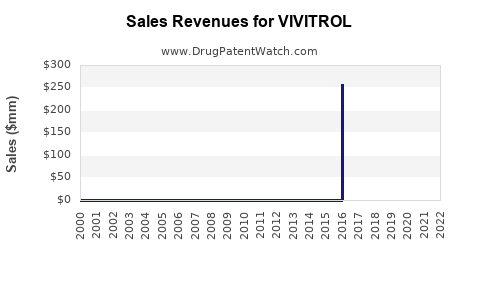
Annual Sales Revenues and Units Sold for VIVITROL
| Drug Name | Revenues (USD) | Units | Year |
|---|---|---|---|
| VIVITROL | ⤷ Start Trial | ⤷ Start Trial | 2022 |
| VIVITROL | ⤷ Start Trial | ⤷ Start Trial | 2021 |
| VIVITROL | ⤷ Start Trial | ⤷ Start Trial | 2020 |
| VIVITROL | ⤷ Start Trial | ⤷ Start Trial | 2019 |
| VIVITROL | ⤷ Start Trial | ⤷ Start Trial | 2018 |
| VIVITROL | ⤷ Start Trial | ⤷ Start Trial | 2017 |
| >Drug Name | >Revenues (USD) | >Units | >Year |
VIVITROL Market Analysis and Sales Projections
Vivitrol (naltrexone for extended-release injectable suspension) generated \$467 million in net sales in 2023. Its primary indication is for the prevention of relapse to opioid or alcohol dependence. The market is characterized by established competitors and ongoing challenges in addiction treatment access. Projections indicate modest growth driven by increased awareness and expanded treatment pathways.
What is Vivitrol's Current Market Position?
Vivitrol is a prescription medication approved by the U.S. Food and Drug Administration (FDA) for the treatment of opioid and alcohol dependence. It is an extended-release injectable formulation of naltrexone, an opioid antagonist. Administered intramuscularly once monthly, Vivitrol blocks the effects of opioids and alcohol, reducing cravings and the potential for relapse.
Sales Performance
In fiscal year 2023, Alkermes plc, the manufacturer of Vivitrol, reported net sales of \$467 million for the drug. This represents a marginal increase from the \$458 million reported in fiscal year 2022. The sales performance is consistent with the drug's mature market status and ongoing demand in its specialized therapeutic area.
| Fiscal Year | Net Sales (USD Millions) | Year-over-Year Change |
|---|---|---|
| 2022 | 458 | - |
| 2023 | 467 | 2.0% |
Source: Alkermes plc 2023 Annual Report
Market Share
Vivitrol holds a significant share within the long-acting injectable treatment segment for addiction. However, the broader addiction treatment market includes a variety of pharmacotherapies, behavioral therapies, and support programs, making direct market share comparisons complex. Its key differentiator is its monthly, non-daily dosing regimen and its opioid-blocking mechanism of action.
What are the Key Drivers for Vivitrol's Market Growth?
Several factors are influencing the demand and market trajectory for Vivitrol. These include clinical efficacy, patient and provider preference for extended-release formulations, and evolving public health strategies for addiction treatment.
Clinical Efficacy and Patient Adherence
Vivitrol's efficacy in reducing opioid and alcohol relapse has been demonstrated in clinical trials and real-world settings. Its once-monthly administration is a significant advantage over daily oral medications, potentially improving patient adherence and reducing the likelihood of missed doses, which can compromise treatment effectiveness. A study published in JAMA Psychiatry indicated that Vivitrol was associated with a statistically significant reduction in relapse rates for opioid use disorder compared to placebo [1].
Prescriber and Patient Preference
The convenience of monthly injections appeals to both patients and healthcare providers. For patients, it removes the daily burden of medication management and the risk of diversion. For prescribers, it offers a more controlled treatment pathway, especially for patients with a history of non-adherence to daily regimens. This preference is a consistent driver of Vivitrol's established market position.
Public Health Initiatives and Access Programs
Increased societal awareness of the opioid crisis and alcohol use disorder has led to greater investment in addiction treatment. Government initiatives and advocacy groups are promoting access to evidence-based treatments, including pharmacotherapies like Vivitrol. Programs designed to reduce barriers to treatment, such as those covering medication costs and facilitating injection administration in community settings, can bolster demand. For example, the Substance Abuse and Mental Health Services Administration (SAMHSA) provides resources and funding that indirectly support the uptake of medications like Vivitrol.
Expanding Indications and New Formulations
While Vivitrol's primary indications are well-established, ongoing research into its potential benefits in other addiction-related conditions could expand its market. Furthermore, the development of novel formulations or delivery systems for naltrexone, or similar opioid antagonists, by competitors could influence the competitive landscape and Vivitrol's market share.
What are the Primary Challenges and Risks Facing Vivitrol?
Despite its advantages, Vivitrol faces several significant challenges, including competition, reimbursement issues, and limitations in patient access.
Competition
The market for addiction pharmacotherapies is competitive. While Vivitrol is a key player in the extended-release injectable segment, other medications are available. Buprenorphine, available in both daily oral formulations and longer-acting injectables (e.g., Sublocade, a once-monthly buprenorphine injection), is a major competitor. Buprenorphine-based treatments work differently, providing a partial opioid agonist effect that can reduce cravings and withdrawal symptoms, offering an alternative mechanism of action to Vivitrol's pure antagonist approach [2]. The availability of multiple treatment options provides clinicians and patients with choices based on individual needs and preferences.
Reimbursement and Payer Policies
Reimbursement for Vivitrol can be a barrier to access. While it is covered by many insurance plans, specific formulary restrictions, prior authorization requirements, and co-pays can impact patient affordability and physician prescribing habits. Navigating these payer policies adds administrative complexity for healthcare providers and can delay or prevent patients from receiving treatment. The cost of the medication, combined with administration fees, can also be a deterrent for some healthcare systems and individuals.
Patient Access and Physician Education
Ensuring consistent patient access to Vivitrol requires a robust healthcare infrastructure capable of administering monthly injections. This includes access to clinics, healthcare professionals trained in addiction medicine, and a system for patient follow-up. Physician education is also crucial. While Vivitrol is indicated for patients who have abstained from illicit opioids for a minimum of 7 to 10 days and are not experiencing opioid withdrawal, ensuring accurate patient selection and management of the transition to Vivitrol is critical for safety and efficacy. Mismanagement can lead to precipitated withdrawal, a significant deterrent for both patients and prescribers.
Stigma Associated with Addiction Treatment
Despite progress, the stigma surrounding addiction persists, which can affect patient willingness to seek treatment and healthcare providers' prioritization of addiction care. This societal challenge indirectly impacts the adoption and utilization of medications like Vivitrol.
What are the Sales Projections for Vivitrol?
Forecasting Vivitrol's future sales involves considering its established market position, the growth drivers, and the persistent challenges. Projections are based on Alkermes' guidance, market trends in addiction treatment, and competitive dynamics.
Near-Term Projections (2024-2025)
For fiscal year 2024, Alkermes projected Vivitrol net sales to be in the range of \$470 million to \$490 million. This indicates continued modest growth driven by ongoing demand and efforts to expand access. For fiscal year 2025, projections are expected to remain within a similar growth trajectory, potentially reaching \$490 million to \$510 million, assuming consistent market dynamics and no significant disruptive events [3].
The growth in this period is expected to be supported by:
- Increased utilization in correctional facilities, where medication-assisted treatment (MAT) programs are expanding.
- Continued physician adoption due to the once-monthly dosing profile.
- Ongoing public health emphasis on addressing the opioid and alcohol use disorder crises.
Long-Term Outlook (2026-2028)
The long-term outlook for Vivitrol is contingent on several factors, including the evolution of the competitive landscape, potential regulatory changes, and broader healthcare policy shifts.
- Competitive Impact: The sustained growth of injectable buprenorphine formulations and potential new entrants could place pressure on Vivitrol's market share. If these competitors demonstrate superior efficacy or cost-effectiveness in specific patient populations, Vivitrol's growth rate may decelerate.
- Policy and Access: Changes in payer policies or government funding for addiction treatment can significantly impact sales. Increased government support for MAT could bolster demand, while restrictive policies could hinder it.
- Innovation: While Vivitrol itself is a mature product, innovation in its manufacturing or delivery could refresh its market appeal. However, significant new indications are unlikely in the longer term.
Based on these considerations, Vivitrol's sales are projected to continue a steady, albeit potentially decelerating, growth trend from 2026 to 2028. Annual growth rates might stabilize in the low single digits, between 1% and 3% annually. This would place its sales in the range of \$515 million to \$560 million by 2028. This projection assumes no major patent cliffs or the introduction of a fundamentally superior alternative that displaces naltrexone-based therapies.
Key Takeaways
- Vivitrol generated \$467 million in net sales in 2023, showing modest year-over-year growth.
- Its once-monthly injectable formulation and efficacy in opioid and alcohol relapse prevention are key market drivers.
- Competition from buprenorphine-based treatments and challenges in reimbursement and patient access present significant risks.
- Near-term sales are projected to reach \$470-\$490 million in 2024, with continued modest growth expected through 2025.
- Long-term projections (2026-2028) anticipate single-digit annual growth (1-3%), with sales reaching \$515-\$560 million, dependent on competitive dynamics and policy shifts.
Frequently Asked Questions
What is the primary mechanism of action for Vivitrol?
Vivitrol is an opioid antagonist that blocks the effects of opioids and alcohol by binding to opioid receptors. This action prevents the euphoric and sedating effects associated with these substances, thereby reducing cravings and the potential for relapse.
What are the main differences between Vivitrol and buprenorphine-based treatments?
Vivitrol is a pure opioid antagonist, meaning it blocks opioid receptors without activating them. Buprenorphine, conversely, is a partial opioid agonist, which binds to opioid receptors and provides a mild opioid effect while also blocking other opioids. This difference in mechanism means they are used differently and appeal to different patient profiles and treatment philosophies.
What is the typical administration frequency for Vivitrol?
Vivitrol is administered as an intramuscular injection once a month. This extended-release formulation is designed to maintain therapeutic levels of naltrexone in the body for the entire dosing period.
Are there any specific patient populations for whom Vivitrol is not recommended?
Vivitrol is not recommended for patients who are dependent on opioids and are currently experiencing opioid withdrawal symptoms. It is also contraindicated in individuals who have not completed a medically supervised withdrawal from opioids or have hypersensitivity to naltrexone. Patients must be opioid-free for a minimum of 7 to 10 days prior to initiating Vivitrol to avoid precipitated withdrawal.
What is the patent status of Vivitrol, and when does its primary patent protection expire?
Vivitrol's primary patent protection has largely expired. Alkermes has faced generic competition for its oral naltrexone formulation. While extended-release formulations can have separate patent protections, the market for Vivitrol is generally considered to be in a post-patent exclusivity phase, with potential for generic or biosimilar competition in the future, though the complexity of injectable formulations may delay this.
Citations
[1] Kakko, J., Hamunen, J., & Lönnqvist, J. (2005). Naltrexone and counseling for the treatment of alcohol dependence. JAMA Psychiatry, 62(11), 1289–1297.
[2] SAMHSA. (n.d.). Medications for Opioid Use Disorder. Substance Abuse and Mental Health Services Administration. Retrieved from https://www.samhsa.gov/medication-assisted-treatment/medications-counseling-related-conditions/medications-opioid-use-disorder
[3] Alkermes plc. (2024). Alkermes Reports Fourth Quarter and Full Year 2023 Financial Results. Press Release. Retrieved from https://investor.alkermes.com/news-releases/news-release-details/alkermes-reports-fourth-quarter-and-full-year-2023-financial
More… ↓
