Share This Page
Drug Sales Trends for SKELAXIN
✉ Email this page to a colleague
Payment Methods and Pharmacy Types for SKELAXIN (2013)
Revenues by Pharmacy Type
Units Sold by Pharmacy Type
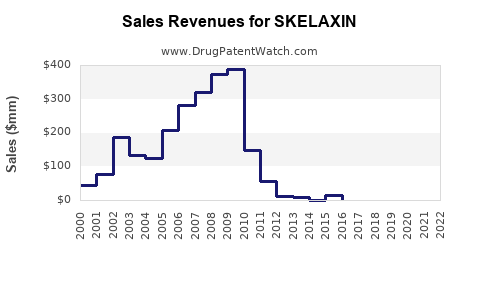
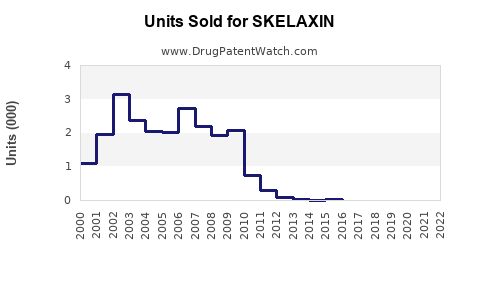
Annual Sales Revenues and Units Sold for SKELAXIN
| Drug Name | Revenues (USD) | Units | Year |
|---|---|---|---|
| SKELAXIN | ⤷ Start Trial | ⤷ Start Trial | 2022 |
| SKELAXIN | ⤷ Start Trial | ⤷ Start Trial | 2021 |
| SKELAXIN | ⤷ Start Trial | ⤷ Start Trial | 2020 |
| SKELAXIN | ⤷ Start Trial | ⤷ Start Trial | 2019 |
| SKELAXIN | ⤷ Start Trial | ⤷ Start Trial | 2018 |
| SKELAXIN | ⤷ Start Trial | ⤷ Start Trial | 2017 |
| >Drug Name | >Revenues (USD) | >Units | >Year |
Skelaxin Market Analysis and Sales Projections: Metaxalone Patent, Generic, and Commercial Outlook
Skelaxin is the former U.S. brand name for metaxalone, a centrally acting skeletal-muscle relaxant. Its commercial value is now concentrated in generic metaxalone rather than the branded product. The original brand has no meaningful exclusivity barrier, no biosimilar pathway, and limited pricing power. A realistic forecast assigns near-zero branded Skelaxin sales and models metaxalone as a mature, low-cost generic market.
What is the current FDA status of Skelaxin?
Skelaxin contains metaxalone and was approved in the United States as an oral tablet, primarily in the 800 mg strength. The product is indicated as an adjunct to rest, physical therapy, and other measures for acute, painful musculoskeletal conditions.[1]
| Attribute | Skelaxin and metaxalone |
|---|---|
| Active ingredient | Metaxalone |
| Original brand | Skelaxin |
| Dosage form | Immediate-release oral tablet |
| Common strength | 800 mg |
| Therapeutic category | Skeletal-muscle relaxant |
| FDA regulatory pathway | Historical NDA approval |
| Current market structure | Generic-dominated |
| Controlled-substance status | Not federally scheduled under the Controlled Substances Act |
| Biosimilar relevance | None |
| Current branded commercial position | Minimal to none |
Skelaxin is not a biologic and cannot face biosimilar competition. Competitive pressure comes from generic metaxalone and alternative muscle relaxants, including cyclobenzaprine, methocarbamol, tizanidine and baclofen.
What patents protect Skelaxin and metaxalone?
The original Skelaxin patent estate no longer provides meaningful commercial protection. Metaxalone has been marketed for decades, and the active ingredient is available from multiple generic manufacturers.
The principal intellectual-property conclusion is:
- No commercially meaningful composition-of-matter exclusivity remains.
- Any historical brand patent protection has expired.
- The product has no current patent-based barrier comparable to a newly launched branded medicine.
- Generic metaxalone manufacturers can compete on product approval, supply, manufacturing cost, wholesaler access and pharmacy contracting.
The FDA Orange Book is the relevant source for listed patents and regulatory exclusivity. For an old small-molecule product such as Skelaxin, an absence of active Orange Book patents means that a generic applicant generally does not need to overcome a modern patent estate before market entry.[2]
What formulations are protected by Skelaxin patents?
The commercial product is an immediate-release tablet. There is no widely recognized active formulation patent that materially limits generic metaxalone tablets.
Potential generic differentiation can involve:
- Tablet strength and scoring.
- Excipients.
- Tablet size and swallowability.
- Packaging.
- Manufacturing cost.
- Supply reliability.
- Authorized-generic or private-label distribution.
These factors can influence market share but do not create durable exclusivity unless supported by a valid, enforceable patent or regulatory exclusivity period.
When did Skelaxin lose exclusivity?
Skelaxin lost practical exclusivity many years ago. The product’s current commercial profile reflects mature generic erosion rather than an upcoming loss-of-exclusivity event.
| Period | Commercial event | Market effect |
|---|---|---|
| Historical pre-generic period | Branded Skelaxin marketed by the original manufacturer | Brand pricing and prescribing |
| Generic entry period | FDA-approved metaxalone tablets entered the market | Rapid price and share pressure |
| Mature generic period | Multiple suppliers and pharmacy substitution | Low unit economics and fragmented share |
| Current market | Generic metaxalone dominates | Limited branded revenue potential |
The relevant forecast question is therefore not “When does Skelaxin lose exclusivity?” but “How large is the remaining generic metaxalone market, and how stable are supplier margins?”
What is the Orange Book status of Skelaxin?
Skelaxin’s Orange Book relevance is primarily historical. The product’s NDA record establishes the reference-product framework for generic metaxalone approvals, but it does not create a current commercial moat.
No active Orange Book patent position is expected to restrict routine abbreviated new drug application, or ANDA, competition for immediate-release metaxalone tablets. Generic applicants typically compete through FDA approval, bioequivalence, manufacturing compliance and commercial distribution rather than Paragraph IV litigation.
Are there Paragraph IV challenges to Skelaxin?
Paragraph IV litigation is not a significant current risk factor for Skelaxin. Paragraph IV certifications are most important when an ANDA applicant challenges an unexpired patent listed for an innovator product. Metaxalone’s age and generic availability make a current branded patent challenge commercially immaterial.
The market has already moved beyond the principal patent dispute phase. Generic manufacturers face ordinary regulatory and operational risks, including:
- FDA inspection findings.
- Product recalls.
- Drug-shortage exposure.
- Active-ingredient supply interruptions.
- Manufacturing-site changes.
- Pricing pressure from pharmacy benefit managers and wholesalers.
What is the current metaxalone market structure?
Metaxalone competes in a crowded generic muscle-relaxant market. It is generally positioned as a prescription oral option for acute musculoskeletal pain, but physicians and payers can substitute other low-cost agents.
| Competitor | Market position | Commercial implication |
|---|---|---|
| Metaxalone | Generic, differentiated by historical brand familiarity | Low price and limited manufacturer power |
| Cyclobenzaprine | Widely used generic muscle relaxant | Strong substitution pressure |
| Methocarbamol | Broad generic availability | Direct price competition |
| Tizanidine | Generic, often used where spasticity treatment is relevant | Different clinical positioning |
| Baclofen | Generic, commonly associated with spasticity management | Partial therapeutic substitution |
Metaxalone can retain demand where prescribers prefer its clinical profile or patients tolerate it better than alternatives. That preference is unlikely to support sustained branded pricing in a generic market.
How strong is the Skelaxin patent estate?
The patent estate is commercially weak because the product is old, genericized and not protected by an active composition-of-matter patent.
| Patent-strength factor | Assessment |
|---|---|
| Composition-of-matter protection | Expired |
| New chemical entity exclusivity | Expired |
| Formulation protection | No material active barrier identified |
| Method-of-use protection | No meaningful current exclusivity |
| Orange Book leverage | Low |
| Generic substitution risk | Very high |
| Manufacturing barrier | Moderate at most |
| Litigation leverage | Low |
Manufacturing remains a practical barrier, but not a durable exclusivity barrier. A supplier must produce metaxalone in compliance with current good manufacturing practices, maintain validated processes and secure acceptable active pharmaceutical ingredient supply. Those requirements may reduce the number of reliable suppliers, but they do not prevent competition.
What are the sales projections for Skelaxin?
Branded Skelaxin sales should be modeled at approximately zero in the United States unless a company reintroduces the brand through a new commercial strategy. The economic opportunity is in generic metaxalone, not the historical brand.
Because public company filings generally do not report metaxalone sales by molecule, a precise market-revenue forecast requires prescription-volume and net-price data. A practical investment model should separate brand revenue from total metaxalone revenue.
Base-case forecast
| Forecast year | Branded Skelaxin sales | Generic metaxalone market | Expected market direction |
|---|---|---|---|
| 2024A | Near zero | Baseline index: 100 | Mature generic market |
| 2025E | Near zero | 96-100 | Stable-to-low-single-digit decline |
| 2026E | Near zero | 92-98 | Continued price pressure |
| 2027E | Near zero | 88-96 | Volume resilience, lower net pricing |
| 2028E | Near zero | 84-94 | Mature, fragmented market |
The index uses 2024 total generic metaxalone revenue as 100. It is more reliable than presenting unsupported dollar estimates because manufacturers do not disclose a consolidated public metaxalone market figure.
Scenario analysis
| Scenario | 2028 market index | Main assumptions |
|---|---|---|
| Upside | 98-105 | Stable prescribing, reduced competitor supply, limited price erosion |
| Base case | 84-94 | Stable demand, routine generic substitution and gradual net-price decline |
| Downside | 65-82 | Additional supplier entry, payer price compression and substitution by other muscle relaxants |
For an individual generic manufacturer, revenue is more volatile than the total market. A supplier can gain share after a competitor exit or lose share following a contract loss, quality issue or product shortage. Generic metaxalone revenue should therefore be forecast using market share and net price rather than prescription growth alone.
What revenue exposure remains for the original Skelaxin owner?
The original branded owner has limited direct revenue exposure unless it retains a commercial arrangement for generic metaxalone or revives the brand.
A commercial owner would face:
- Low average selling prices.
- High substitution rates.
- Limited prescriber loyalty to the brand.
- Pharmacy-level generic substitution.
- Contract concentration among wholesalers and pharmacy benefit managers.
- Limited ability to raise prices without losing volume.
The most valuable commercial asset is likely a reliable generic supply position, not the Skelaxin trademark.
What generic launch scenarios exist for metaxalone?
A new entrant would most likely pursue one of four strategies:
- Commodity launch: Compete primarily on price and wholesaler access.
- Supply-reliability strategy: Target customers affected by shortages or supplier withdrawals.
- Private-label strategy: Supply distributors, retail chains or pharmacy groups.
- Product-line strategy: Bundle metaxalone with other generic pain and musculoskeletal products.
A branded relaunch would have weak economics unless it added a meaningful delivery, adherence or clinical differentiation. A simple relaunch of the historical 800 mg tablet would face immediate generic substitution.
What patent litigation and settlement agreements affect Skelaxin?
No current patent-litigation or settlement structure is central to the commercial outlook for Skelaxin. The product is in the mature generic phase, where disputes are more likely to concern:
- ANDA approval or bioequivalence.
- Manufacturing quality.
- Labeling.
- Product liability.
- Supply contracts.
- Antitrust or pricing conduct.
These issues are distinct from the patent settlements that commonly shape the launch timing of newer branded drugs.
How does Skelaxin compare with competing muscle relaxants?
Skelaxin has a weak patent position but a recognizable historical brand. Cyclobenzaprine and methocarbamol have stronger generic scale and broader formulary familiarity. Tizanidine and baclofen occupy partially different clinical segments.
| Product | Exclusivity position | Generic intensity | Commercial outlook |
|---|---|---|---|
| Skelaxin/metaxalone | Expired | High | Stable but low-value generic |
| Cyclobenzaprine | Expired | Very high | Larger, highly price-competitive market |
| Methocarbamol | Expired | High | Durable generic demand |
| Tizanidine | Expired | High | Specialty use within muscle-relaxant category |
| Baclofen | Expired | High | Durable demand in spasticity-related use |
Metaxalone’s opportunity is defensive. It can maintain a modest prescription base but has limited ability to create premium revenue.
Key Takeaways
- Skelaxin is the former branded product containing metaxalone.
- The commercial market is generic-dominated.
- No meaningful current patent or exclusivity barrier supports branded pricing.
- Paragraph IV litigation is not a material current market driver.
- Biosimilar risk does not apply because metaxalone is a small-molecule drug.
- Branded Skelaxin sales should be modeled at near zero in the United States.
- Generic metaxalone revenue is likely to decline gradually through 2028 under the base case.
- The main risks are price erosion, therapeutic substitution, supplier exits and manufacturing disruption.
- A generic manufacturer’s value depends on supply reliability, contracts and cost position rather than patent protection.
FAQs
Is Skelaxin still available as a brand-name drug?
Skelaxin has little meaningful branded presence in the current U.S. market. Prescriptions are generally filled with generic metaxalone.
Is metaxalone a profitable generic drug?
Metaxalone can generate stable generic revenue, but profitability depends on manufacturing cost, contract terms, supplier competition and pharmacy-channel access.
Does metaxalone have a patent protecting the 800 mg tablet?
The historical patent protection for metaxalone and the Skelaxin product has expired. The 800 mg tablet does not have a known active patent barrier that prevents routine generic competition.
Can a company relaunch Skelaxin at a premium price?
A relaunch would face strong generic substitution and would require a differentiated formulation, delivery system, clinical claim or distribution strategy to support premium pricing.
What is the largest commercial threat to metaxalone?
The largest threat is sustained generic price compression combined with substitution by cyclobenzaprine, methocarbamol and other low-cost muscle relaxants.
References
-
U.S. Food and Drug Administration. (n.d.). Skelaxin (metaxalone) prescribing information. FDA. https://www.accessdata.fda.gov/drugsatfda_docs/label/
-
U.S. Food and Drug Administration. (n.d.). Approved drug products with therapeutic equivalence evaluations: Orange Book. FDA. https://www.accessdata.fda.gov/scripts/cder/ob/
-
U.S. National Library of Medicine. (n.d.). Metaxalone drug information and labeling. DailyMed. https://dailymed.nlm.nih.gov/dailymed/
-
U.S. Food and Drug Administration. (n.d.). Generic drugs: Abbreviated new drug application process. FDA. https://www.fda.gov/drugs/generic-drugs/abbreviated-new-drug-application-anda-process
More… ↓
