Drug Sales Trends for PREMPRO
Payment Methods and Pharmacy Types for PREMPRO (2013)
Revenues by Pharmacy Type
Units Sold by Pharmacy Type
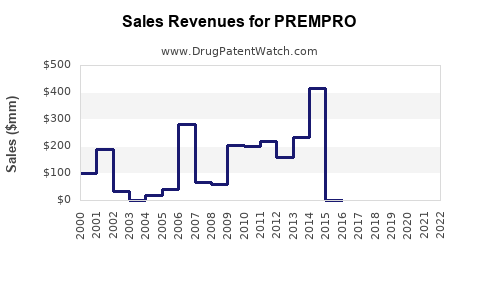
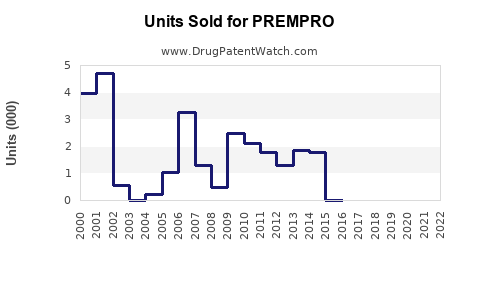
Annual Sales Revenues and Units Sold for PREMPRO
| Drug Name | Revenues (USD) | Units | Year |
|---|---|---|---|
| PREMPRO | ⤷ Start Trial | ⤷ Start Trial | 2022 |
| PREMPRO | ⤷ Start Trial | ⤷ Start Trial | 2021 |
| PREMPRO | ⤷ Start Trial | ⤷ Start Trial | 2020 |
| PREMPRO | ⤷ Start Trial | ⤷ Start Trial | 2019 |
| PREMPRO | ⤷ Start Trial | ⤷ Start Trial | 2018 |
| PREMPRO | ⤷ Start Trial | ⤷ Start Trial | 2017 |
| >Drug Name | >Revenues (USD) | >Units | >Year |
Prempro Market Analysis, Sales Projections, Patent Exclusivity, and Generic Risk
Prempro is a mature, declining menopausal hormone therapy containing conjugated estrogens and medroxyprogesterone acetate. Pfizer does not publicly report Prempro sales as a standalone product, so precise product-level revenue cannot be verified from company filings. The commercial outlook is a low-growth or declining prescription market shaped by generic competition, safety concerns surrounding systemic hormone therapy, and continued demand from symptomatic menopausal patients.
A reasonable base case is a 4% annual decline in Prempro-equivalent sales through 2029. An upside case assumes stable demand from appropriately selected patients, while a downside case assumes faster conversion to generics and lower use of systemic combination therapy.
What is Prempro and how is it used?
Prempro is an oral fixed-dose combination of conjugated estrogens and medroxyprogesterone acetate. It is marketed in multiple strengths and is prescribed primarily for menopausal symptoms in women with an intact uterus.
| Attribute | Prempro |
|---|---|
| Active ingredients | Conjugated estrogens and medroxyprogesterone acetate |
| Drug class | Systemic estrogen-progestin hormone therapy |
| Dosage form | Oral tablets |
| Reference company | Pfizer, following Wyeth acquisition |
| Main indications | Vasomotor symptoms, vulvar and vaginal atrophy, osteoporosis prevention in selected patients |
| FDA pathway | New Drug Application |
| Biosimilar exposure | None |
| Generic exposure | High |
| Primary competitors | Generic conjugated estrogens/medroxyprogesterone, Premarin, Estrace, progesterone combinations, transdermal estrogen products |
FDA labeling limits treatment to the shortest duration consistent with treatment goals and individual patient risks. Estrogen-progestin therapy has boxed warnings covering cardiovascular events, invasive breast cancer, stroke, and venous thromboembolism. The Women’s Health Initiative results materially affected prescribing behavior and long-term demand for systemic hormone therapy.[1][2]
What are Prempro’s FDA indications and regulatory status?
FDA approved Prempro for moderate-to-severe vasomotor symptoms associated with menopause, moderate-to-severe vulvar and vaginal atrophy, and prevention of postmenopausal osteoporosis when the potential benefits justify the risks and alternative treatments are not appropriate.[3]
The product remains an approved prescription therapy. It is not a biologic and does not face biosimilar substitution. Its main regulatory risk is not loss of approval but continued safety-related prescribing restrictions and the availability of lower-dose, transdermal, local, and nonhormonal alternatives.
FDA regulatory factors affecting demand
| Regulatory factor | Commercial effect |
|---|---|
| Boxed warning for estrogen-progestin therapy | Suppresses routine or preventive use |
| Shortest-duration treatment language | Limits duration of therapy |
| Individualized risk assessment | Reduces broad population prescribing |
| Generic approvals | Increases payer substitution |
| Continued FDA approval | Preserves the branded market |
| No biosimilar pathway | Eliminates biologic-style regulatory competition |
FDA’s current labeling position supports use in selected symptomatic patients rather than broad preventive treatment. This limits market expansion even when menopause-related healthcare utilization rises.
How large is the Prempro market?
Standalone Prempro sales are not disclosed in Pfizer’s public annual reports. Pfizer reports selected products and product families, but Prempro is generally grouped with other legacy women’s health and established-product revenue. Public filings therefore do not establish a reliable Prempro-specific revenue figure.[4]
The addressable market remains substantial in patient volume but modest in branded revenue. Prempro competes in a mature therapeutic category with:
- Generic conjugated estrogens/medroxyprogesterone products.
- Estrogen-only therapy for women without a uterus.
- Oral estradiol and micronized progesterone combinations.
- Transdermal estrogen patches, gels, and sprays.
- Local vaginal estrogen products.
- Nonhormonal therapies such as SSRIs, SNRIs, gabapentin, and fezolinetant.
- Compounded hormone products, although these do not have the same FDA approval status as Prempro.
Prempro’s commercial value is concentrated in brand-prescribing patients, formulary positions, physician familiarity, and patients who remain stable on the product. The product is less attractive for new starts when a generic or lower-risk delivery option is available.
What are Prempro’s sales projections through 2029?
Because Pfizer does not report Prempro separately, the most defensible projection is an indexed forecast. The model sets estimated 2024 Prempro-equivalent sales at 100 and applies category-specific annual growth rates.
| Scenario | Annual change | 2025 index | 2026 index | 2027 index | 2028 index | 2029 index |
|---|---|---|---|---|---|---|
| Downside | -8% | 92 | 85 | 78 | 72 | 66 |
| Base case | -4% | 96 | 92 | 88 | 85 | 82 |
| Upside | +1% | 101 | 102 | 103 | 104 | 105 |
The base case implies an 18% reduction in sales over five years. The downside case implies a 34% reduction. The upside case requires stable branded persistence, limited further generic erosion, and sustained demand from patients for whom systemic combination therapy remains clinically appropriate.
If 2024 Prempro revenue is represented by the variable R, projected 2029 revenue is:
- Downside: 0.66R
- Base case: 0.82R
- Upside: 1.05R
This approach avoids attributing Pfizer’s broader Premarin-family revenue to Prempro, which would overstate the product’s standalone sales.
Main sales drivers
The strongest positive factors are:
- A large menopausal population entering treatment age.
- Persistent vasomotor symptoms that are inadequately controlled by nonhormonal therapy.
- Brand loyalty among established users.
- Physician familiarity with a fixed estrogen-progestin regimen.
- Limited clinical need for complex titration in some patients.
The strongest negative factors are:
- Generic substitution.
- Safety concerns related to breast cancer and cardiovascular outcomes.
- Increased use of transdermal estrogen and separate progesterone regimens.
- Greater use of nonhormonal therapies.
- Insurer restrictions on branded hormone therapy.
- Prescribing limits that discourage long-term use.
When does Prempro lose exclusivity?
Prempro’s original product and core active ingredients are long past the period of meaningful regulatory exclusivity. The relevant commercial issue is not pending loss of exclusivity but the already-mature generic market.
Prempro’s core composition does not provide a current barrier comparable to a recently approved drug. Any original composition, formulation, or manufacturing patents associated with the product would have expired or become commercially weak by this stage of the product life cycle. The product is therefore exposed to generic substitution and therapeutic alternatives.
Exclusivity timeline
| Event | Commercial significance |
|---|---|
| Initial FDA approval | Established Prempro as a systemic estrogen-progestin therapy |
| Patent and regulatory exclusivity period | Protected the original branded product |
| Generic entry period | Reduced price and prescription share |
| Current market | Mature branded product with limited exclusivity value |
| 2025-2029 outlook | Generic erosion and category substitution dominate |
Current Orange Book analysis should focus on whether any unexpired patents remain listed for the relevant Prempro NDA and strength. Given the product’s age, an active patent blocking ordinary generic substitution would be unusual. The principal commercial conclusion is that Prempro has no defensible modern exclusivity moat based on its active ingredients.
What patents protect Prempro?
Prempro’s principal protection historically came from patents covering the product’s composition, dosage form, manufacturing processes, and possibly specific hormone combinations. Those rights are not expected to provide meaningful current market exclusivity.
The active ingredients are established small molecules:
- Conjugated estrogens are a complex mixture of estrogenic compounds.
- Medroxyprogesterone acetate is a well-known synthetic progestin.
Any remaining patent risk would most likely concern a narrow formulation, manufacturing process, or product-specific claim rather than the broad therapeutic combination. Such claims generally do not prevent all generic competition unless they are listed in the Orange Book, unexpired, and successfully enforced.
What formulations are protected by Prempro patents?
Potential historical claim categories include:
- Fixed-dose oral tablets.
- Specific estrogen-to-progestin ratios.
- Tablet coatings and excipients.
- Stability and dissolution characteristics.
- Manufacturing methods for conjugated estrogen components.
- Packaging or storage conditions.
These categories can create litigation or regulatory friction, but they do not necessarily preserve a premium brand position. A generic manufacturer can sometimes design around a narrow formulation claim or challenge the patent through a Paragraph IV certification.
Are there Paragraph IV challenges to Prempro?
Paragraph IV challenges are a potential route for generic manufacturers seeking approval before listed patent expiration. For a product as old as Prempro, the practical relevance of Paragraph IV litigation is limited unless an unexpired, Orange Book-listed patent remains.
Generic competition has already established the central market dynamic. A new Paragraph IV case would be more likely to affect a specific formulation or strength than to restore broad exclusivity to the branded product.
The commercial risk from generics is therefore structural rather than event-driven. Investors should not treat Prempro as a product awaiting a single future patent cliff. The market has already passed its principal exclusivity event.
What patent litigation affects Prempro?
No current, high-value Prempro patent dispute can be identified from the publicly established commercial profile of the product. The key litigation risk is historical or formulation-specific rather than a major pending challenge to a recently issued patent.
The absence of a current blocking dispute does not eliminate ordinary generic litigation. Generic manufacturers can contest listed patents, pursue noninfringement positions, or enter after patent expiration. The likely outcome of such activity is further price pressure rather than a change in the underlying market structure.
Which companies compete with Prempro?
Prempro faces competition from both direct generic products and clinically substitutable therapies.
| Competitor category | Examples | Threat to Prempro |
|---|---|---|
| Generic estrogen-progestin combinations | Generic conjugated estrogens/medroxyprogesterone products | High |
| Estrogen-only brands | Premarin | Moderate, limited to women without a uterus |
| Oral estradiol | Generic estradiol products | High |
| Micronized progesterone combinations | Estradiol plus progesterone regimens | High |
| Transdermal estrogen | Patches, gels, sprays | High |
| Local vaginal estrogen | Creams, tablets, rings | Moderate, indication-specific |
| Nonhormonal drugs | SSRIs, SNRIs, fezolinetant | Moderate to high |
| Compounded hormones | Compounded estrogen and progesterone | Low to moderate, with regulatory limitations |
Prempro’s most direct threat is not another branded tablet. It is the shift toward generic estradiol, separate progesterone, transdermal delivery, and nonhormonal treatment.
How strong is the Prempro patent estate?
Prempro’s current patent estate is weak from an investment perspective. The product has:
- No new molecular entity protection.
- No biosimilar barrier.
- Long-established active ingredients.
- Mature generic competition.
- Limited ability to command a durable brand premium.
- No evident platform technology that extends beyond the product.
The remaining value lies in manufacturing quality, brand recognition, distribution, and patient persistence. Those assets can support cash flow but do not create high switching costs or substantial legal protection.
Are there licensing deals involving Prempro?
Pfizer’s ownership of Prempro derives from its acquisition of Wyeth in 2009. Publicly reported Pfizer disclosures do not identify a major current Prempro-specific licensing transaction that materially changes the product’s competitive position.[5]
Any commercial arrangements involving distributors, wholesalers, or generic manufacturers would not be equivalent to a strategic license covering core Prempro intellectual property. The product’s value is primarily an established-product portfolio asset.
What generic launch risks exist for Prempro?
Generic launch risk is high and ongoing. The main mechanisms are:
- Automatic or near-automatic substitution under state pharmacy laws.
- Formulary preference for lower-cost alternatives.
- Generic pricing discounts.
- Therapeutic substitution to estradiol and progesterone.
- Payer pressure on branded prescriptions.
- Physician acceptance of generic hormone regimens.
Brand retention can remain higher among existing patients than among new starts. The most resilient segment is likely patients who are stable, satisfied, and reluctant to change therapy. The least resilient segment is new patients subject to prior authorization or step therapy.
What is the revenue exposure for Pfizer?
Prempro is unlikely to represent a material portion of Pfizer’s consolidated revenue. Pfizer’s financial results are dominated by large innovative medicines and vaccines, while legacy women’s health products contribute a smaller established-product stream.
Prempro’s value to Pfizer is more likely measured through:
- Incremental cash generation.
- Portfolio breadth in women’s health.
- Manufacturing and distribution scale.
- Cross-selling within established prescription channels.
- Low development costs relative to new products.
The product’s revenue decline would not materially affect Pfizer’s corporate earnings unless combined with broader weakness in the Premarin-family portfolio.
What is the likely Prempro launch scenario through 2029?
The most likely scenario is continued branded availability with declining volume and price. Pfizer is unlikely to withdraw the product solely because of generic competition if manufacturing and distribution remain economical.
| Scenario | Expected market outcome |
|---|---|
| Base case | 4% annual sales decline, persistent generic substitution, continued brand availability |
| Downside | 8% annual decline, faster conversion to generic and nonhormonal therapy |
| Upside | Stable sales, supported by patient persistence and renewed menopause-treatment demand |
| Strategic event case | Portfolio divestiture or licensing to an established-products company |
A new indication or major formulation innovation could alter this outlook, but no such event is part of the established Prempro profile.
Key Takeaways
- Prempro is an FDA-approved oral estrogen-progestin therapy for selected menopausal indications.
- Pfizer does not publicly disclose Prempro-specific revenue.
- The product has passed its principal patent and exclusivity period.
- Generic and therapeutic substitution risk is high.
- No biosimilar risk applies because Prempro is a small-molecule tablet.
- The base-case forecast is an indexed 4% annual sales decline through 2029.
- Prempro’s current value depends on brand persistence, manufacturing efficiency, and established distribution rather than patent exclusivity.
- Pfizer’s consolidated revenue exposure is limited because Prempro is a mature portfolio product.
- The main competitive threats are generic estradiol, progesterone combinations, transdermal estrogen, and nonhormonal therapies.
FAQs
Does Prempro still have patent protection?
Prempro’s original product protection is no longer a meaningful commercial barrier. Any remaining claims would likely be narrow formulation or manufacturing claims rather than broad composition claims.
Is Prempro still sold by Pfizer?
Prempro remains associated with Pfizer’s established women’s health portfolio. Pfizer’s public reporting does not provide a standalone Prempro revenue line.
Is there a generic version of Prempro?
Generic estrogen-progestin alternatives exist and create substantial substitution pressure. Availability can vary by strength, manufacturer, payer, and pharmacy.
Is Prempro more exposed to competition than Premarin?
Yes. Prempro faces both direct generic combination competition and substitution to separate estrogen-progesterone regimens. Premarin has a different patient profile because estrogen-only therapy is generally used in women without a uterus.
Are biosimilars a risk to Prempro?
No. Prempro is a conventional small-molecule oral tablet. Its competitive risk comes from generic drugs and therapeutic alternatives, not biosimilars.
References
-
Food and Drug Administration. (2024). Prempro prescribing information. U.S. Department of Health and Human Services.
-
Rossouw, J. E., Anderson, G. L., Prentice, R. L., LaCroix, A. Z., Kooperberg, C., Stefanick, M. L., Jackson, R. D., Beresford, S. A. A., Howard, B. V., Johnson, K. C., Kotchen, J. M., & Ockene, J. (2002). Risks and benefits of estrogen plus progestin in healthy postmenopausal women. JAMA, 288(3), 321-333.
-
Food and Drug Administration. (2024). Drugs@FDA: Prempro. U.S. Department of Health and Human Services.
-
Pfizer Inc. (2024). Annual report pursuant to Section 13 or 15(d) of the Securities Exchange Act of 1934. Pfizer Inc.
-
Pfizer Inc. (2009). Pfizer completes acquisition of Wyeth. Pfizer Inc.
More… ↓
