Share This Page
Drug Sales Trends for OXYCONTIN
✉ Email this page to a colleague
Payment Methods and Pharmacy Types for OXYCONTIN (2013)
Revenues by Pharmacy Type
Units Sold by Pharmacy Type
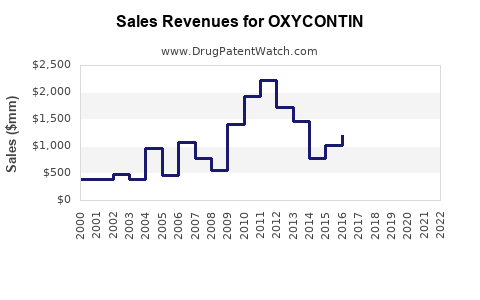
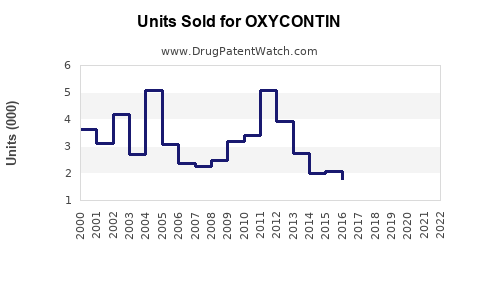
Annual Sales Revenues and Units Sold for OXYCONTIN
| Drug Name | Revenues (USD) | Units | Year |
|---|---|---|---|
| OXYCONTIN | ⤷ Start Trial | ⤷ Start Trial | 2022 |
| OXYCONTIN | ⤷ Start Trial | ⤷ Start Trial | 2021 |
| OXYCONTIN | ⤷ Start Trial | ⤷ Start Trial | 2020 |
| OXYCONTIN | ⤷ Start Trial | ⤷ Start Trial | 2019 |
| OXYCONTIN | ⤷ Start Trial | ⤷ Start Trial | 2018 |
| OXYCONTIN | ⤷ Start Trial | ⤷ Start Trial | 2017 |
| OXYCONTIN | ⤷ Start Trial | ⤷ Start Trial | 2016 |
| >Drug Name | >Revenues (USD) | >Units | >Year |
OxyContin Market Analysis, Patent Exclusivity, and Sales Projections
OxyContin remains a commercially important oxycodone extended-release product, but its market has contracted sharply from its 2010 peak. U.S. sales are constrained by opioid prescribing restrictions, payer controls, state litigation, generic oxycodone extended-release competition, and Purdue Pharma’s bankruptcy and restructuring. The base-case outlook is continued decline, with U.S. branded OxyContin revenue likely remaining a small fraction of historical peak sales.
What is OxyContin and who markets it?
OxyContin is Purdue Pharma’s branded extended-release oxycodone hydrochloride product. The FDA approved the original product in 1995 under NDA 020553 for the management of pain severe enough to require a continuous, around-the-clock opioid analgesic when alternative treatments are inadequate.[1]
The product is supplied in extended-release tablets at multiple strengths. Its abuse-deterrent formulation was approved in 2010 after Purdue replaced the original formulation. The reformulated tablets are designed to resist crushing and certain forms of manipulation, but the FDA does not classify them as abuse-proof.[2]
| Item | Detail |
|---|---|
| Active ingredient | Oxycodone hydrochloride |
| Dosage form | Extended-release oral tablet |
| Original FDA approval | 1995 |
| Reformulated product | Approved 2010 |
| NDA | 020553 |
| Original manufacturer | Purdue Pharma |
| Current commercial structure | Purdue Pharma and successor restructuring entities |
| Therapeutic category | Opioid analgesic |
| Primary market | United States |
| Main competitors | Generic oxycodone ER, Xtampza ER, Hysingla ER and other long-acting opioids |
Purdue’s marketing position has weakened since the company entered bankruptcy proceedings in 2019. The company’s restructuring plan transferred or reorganized assets through a public-benefit framework associated with opioid-abatement activities. Commercial reporting is therefore less transparent than for publicly traded pharmaceutical companies.[3]
How much did OxyContin sales decline from their peak?
OxyContin sales peaked at approximately $3 billion annually around 2010, before the reformulated product, the federal opioid crackdown, payer restrictions and litigation materially reduced demand.[4]
Publicly reported estimates indicate a steep decline after the peak:
| Period | Estimated OxyContin commercial position |
|---|---|
| 2009-2010 | Approximately $3 billion in annual global sales at peak |
| 2012-2015 | Declining branded sales amid reformulation and opioid scrutiny |
| 2016-2018 | Substantially below peak; U.S. prescriptions continued to fall |
| 2019 onward | Reduced demand, bankruptcy-related disruption and limited public disclosure |
| 2024-2025 | Low-growth or declining mature-product market |
Exact current OxyContin revenue is not consistently disclosed in public filings because Purdue is privately held and its restructuring entities do not provide the same revenue detail as a listed pharmaceutical company. Current sales should therefore be modeled from prescription volume, wholesale acquisition price, payer mix and product share rather than from a reported company revenue line.
The key commercial change is the decline in opioid utilization. IQVIA data cited by the FDA and other public agencies show that U.S. opioid prescriptions fell materially from their 2011 peak through the early 2020s.[5] OxyContin’s decline has been faster than the broader prescription market because it is a high-risk, high-cost branded extended-release opioid with extensive generic and therapeutic substitution.
What are the OxyContin sales projections through 2030?
A reasonable U.S. projection is a continuing low-single-digit to high-single-digit annual revenue decline, depending on pricing, product access and the pace of generic substitution. The forecast below is an analytical scenario rather than company guidance.
Base-case OxyContin revenue projection
| Year | Estimated U.S. branded revenue index | Base-case annual change |
|---|---|---|
| 2024 | 100 | - |
| 2025 | 94 | -6% |
| 2026 | 88 | -6% |
| 2027 | 82 | -7% |
| 2028 | 76 | -7% |
| 2029 | 70 | -8% |
| 2030 | 64 | -9% |
The index treats 2024 branded U.S. revenue as 100 because audited current revenue is not publicly available. If 2024 net sales were assumed to be $100 million, the base case would imply approximately $64 million in 2030. If 2024 net sales were $200 million, the same model would produce approximately $128 million in 2030.
Scenario analysis
| Scenario | Main assumptions | 2030 revenue versus 2024 |
|---|---|---|
| Upside | Stable chronic-pain demand, limited switching, modest net-price increases | 80-90 |
| Base case | Continued volume decline, stable access and gradual generic pressure | 60-70 |
| Downside | Faster generic substitution, payer exclusions, supply disruption or further regulatory restrictions | 35-50 |
Revenue risk is greater than unit-volume risk because OxyContin’s list price and net price can remain relatively high while utilization declines. Price increases could temporarily offset prescription losses, but public and payer scrutiny limits the durability of that strategy.
What patents protect OxyContin?
OxyContin’s original composition and controlled-release patent protection has largely expired. The current patent position is more relevant to the abuse-deterrent formulation, manufacturing processes and listed methods of use than to basic oxycodone chemistry.
| Patent category | Commercial relevance | Current risk |
|---|---|---|
| Original controlled-release oxycodone patents | Protected the first-generation product | Expired or no longer sufficient to block generic entry |
| Abuse-deterrent formulation patents | Protect tablet architecture and resistance to manipulation | Potentially important, but scope depends on claim construction and Orange Book status |
| Manufacturing patents | May protect tablet production, excipients or processing steps | Can create technical barriers without blocking all competing products |
| Method-of-use patents | May cover opioid dosing or treatment uses | Limited value where prescribing information and generic labeling overlap |
| Trademarks and trade dress | Protect brand identity | Do not prevent generic oxycodone ER approval |
One historically important patent was U.S. Patent No. 5,656,295, which covered controlled-release oxycodone technology associated with the original OxyContin product. Its patent term expired before the current market period.[6]
The reformulated product is associated with later Purdue patent filings covering abuse-deterrent controlled-release dosage forms. Patent numbers, expiration dates and listing status can change through expiration, terminal disclaimers, patent-term adjustments, litigation outcomes and Orange Book delisting. The controlling source for an abbreviated new drug application analysis is FDA’s current Orange Book listing for NDA 020553, combined with USPTO patent records.[7]
When does OxyContin lose exclusivity?
OxyContin has already lost the exclusivity that protected its original controlled-release oxycodone technology. The remaining commercial protection is narrower and depends on the status of formulation and method-of-use patents.
The main exclusivity events are:
- Original controlled-release technology: expired.
- OxyContin reformulation: protected by later patents and regulatory exclusivity mechanisms, but not by a single perpetual composition patent.
- Generic oxycodone ER: approved after the loss of key original protection.
- Abuse-deterrent substitution: depends on whether a generic product demonstrates equivalent abuse-deterrent properties or competes as a non-abuse-deterrent extended-release product.
- Market exclusivity: weakened by the availability of generic oxycodone ER and alternative extended-release opioids.
The FDA approved generic versions of extended-release oxycodone products after the original OxyContin exclusivity period. Generic approval does not necessarily create automatic substitution for the reformulated abuse-deterrent product if the generic does not have equivalent product characteristics or state-level substitutability.
What is the Orange Book status of OxyContin?
OxyContin is listed in the FDA Orange Book under NDA 020553. The Orange Book identifies approved drug products, therapeutic equivalence information and certain patents or exclusivity data submitted by the NDA holder.[7]
For commercial analysis, the critical questions are:
- Which patents remain listed for the specific OxyContin strengths?
- Are listed patents formulation patents, method-of-use patents or both?
- Do the patents expire before a proposed generic launch date?
- Has Purdue submitted any patent-use codes?
- Is a generic product rated therapeutically equivalent to OxyContin?
- Does the generic replicate the abuse-deterrent technology?
An Orange Book listing does not prove that a patent is valid or infringed. A generic applicant may challenge listed patents through a Paragraph IV certification.
Which companies are challenging OxyContin exclusivity?
Generic-drug manufacturers have challenged or entered the oxycodone extended-release market over time. The competitive set has included large generic companies such as Teva, Actavis, Endo and other ANDA sponsors, although the exact active applicant and litigation status depends on the patent and product period being examined.
The competitive threat comes from three sources:
- Generic oxycodone ER tablets.
- Alternative extended-release opioids.
- Abuse-deterrent products with different oxycodone or hydrocodone formulations.
The most relevant substitute products include Xtampza ER, an abuse-deterrent extended-release oxycodone product marketed by Collegium Pharmaceutical, and Hysingla ER, an extended-release hydrocodone product associated with Purdue. These products do not have automatic therapeutic equivalence to OxyContin and compete through prescriber preference, payer coverage and clinical positioning.
What Paragraph IV challenges affect OxyContin?
A Paragraph IV certification states that a listed patent is invalid, unenforceable or not infringed by the proposed generic product. A Paragraph IV filing can trigger patent litigation and a 30-month stay of FDA approval under the Hatch-Waxman framework, subject to statutory exceptions and litigation developments.[8]
OxyContin’s Paragraph IV exposure is concentrated in:
- Abuse-deterrent formulation patents.
- Tablet manufacturing patents.
- Method-of-use patents listed for chronic pain indications.
- Patents covering specific strengths or release profiles.
The commercial significance of a Paragraph IV challenge depends on whether the challenged patent is the final enforceable barrier, whether the generic uses the same abuse-deterrent technology and whether a court grants an injunction. A successful challenge could accelerate entry, while a non-infringement or invalidity ruling could remove a major barrier to generic competition.
What patent litigation affects OxyContin?
OxyContin has been involved in extensive patent, product-liability and opioid-marketing litigation. Patent litigation has focused on reformulation and generic entry. The larger legal exposure has involved federal, state and municipal opioid claims, including allegations concerning Purdue’s marketing practices and the social costs of opioid misuse.[3]
The bankruptcy process has a direct commercial effect. It can affect:
- Asset ownership.
- Licensing of OxyContin trademarks and technology.
- Settlement rights.
- Litigation releases.
- Distribution of future proceeds.
- Corporate control of the commercial business.
Patent litigation should therefore be analyzed separately from opioid-liability litigation. A patent win may preserve product revenue, but it does not remove the demand, reimbursement and regulatory constraints affecting the brand.
How strong is the OxyContin patent estate?
The OxyContin estate is moderate for the reformulated product and weak for the underlying active ingredient and original controlled-release concept.
| Patent-strength factor | Assessment |
|---|---|
| Active ingredient protection | Weak; oxycodone is long generic |
| Original controlled-release protection | Largely expired |
| Abuse-deterrent formulation | More relevant, but claim scope and expiration are decisive |
| Manufacturing know-how | Potentially meaningful but difficult to quantify |
| Regulatory switching barriers | Moderate |
| Brand recognition | High, but commercially negative in some payer and prescribing settings |
| Generic entry barrier | Moderate to low over the long term |
| Long-term durability | Limited |
The strongest remaining protection is likely practical rather than purely legal: manufacturing know-how, supply reliability, product familiarity and the ability to maintain a regulated abuse-deterrent formulation. These factors can delay switching but rarely support durable monopoly pricing once core patents expire.
What generic launch risks exist for OxyContin?
The likely generic launch scenarios are:
Authorized or licensed generic
A Purdue-linked authorized generic could preserve manufacturing economics while reducing branded sales. This approach can capture value from price-sensitive payers and limit third-party generic share.
Non-abuse-deterrent generic oxycodone ER
A non-abuse-deterrent generic can compete on price but may not be therapeutically equivalent to the abuse-deterrent OxyContin formulation for all substitution purposes. Its impact depends on state pharmacy rules, payer formularies and prescriber direction.
Abuse-deterrent generic
An equivalent abuse-deterrent generic would create the highest direct risk to OxyContin. It would compete on price while preserving the same broad formulation positioning.
Therapeutic substitution
Payers can move patients to Xtampza ER, Hysingla ER, transdermal opioids or non-opioid pain treatments without waiting for a direct OxyContin generic. This is already a material source of market erosion.
What is the FDA regulatory status of OxyContin?
OxyContin remains an FDA-approved prescription opioid under a risk-management framework. The FDA has required opioid labeling changes, postmarketing studies and abuse-deterrent labeling standards across the class.[2,9]
The product does not have biosimilar risk because it is a small-molecule drug, not a biologic. Its relevant regulatory threats are ANDA-based generic competition, labeling restrictions, opioid safety controls and changes in prescribing guidance.
FDA approval of abuse-deterrent labeling does not establish that abuse cannot occur. It means the product has properties intended to make certain forms of manipulation more difficult than with the original formulation.[2]
How does OxyContin compare with Xtampza ER and generic oxycodone ER?
| Factor | OxyContin | Xtampza ER | Generic oxycodone ER |
|---|---|---|---|
| Active ingredient | Oxycodone | Oxycodone | Oxycodone |
| Release profile | Extended release | Extended release | Extended release |
| Abuse-deterrent positioning | Yes, reformulated product | Yes | Depends on product |
| Brand price | Higher | Higher | Lower |
| Direct substitution | Product-specific | Product-specific | Depends on equivalence rating |
| Main advantage | Established brand and prescriber familiarity | Abuse-deterrent formulation and alternative technology | Price |
| Main weakness | Litigation, payer pressure and declining opioid use | Smaller commercial base | Potentially different abuse-deterrent profile |
OxyContin retains brand recognition and a large installed prescriber base. Xtampza ER provides a branded abuse-deterrent alternative. Generic oxycodone ER has the strongest price advantage but can face formulation and substitutability limitations.
What is OxyContin’s revenue exposure?
OxyContin’s direct revenue exposure is concentrated in the U.S. branded extended-release opioid market. Its indirect exposure is larger because the product is linked to Purdue’s broader restructuring, settlement and opioid-abatement obligations.
The main revenue variables are:
- Prescription volume.
- Net price after rebates and discounts.
- Generic share.
- Payer formulary status.
- Chronic-pain treatment patterns.
- State opioid policies.
- Product availability.
- Litigation-related commercial restrictions.
A long-term valuation model should avoid using historical peak sales as a baseline. A more defensible approach is to use current estimated net sales, apply a declining volume curve, model flat-to-low price growth, and stress-test rapid generic substitution.
Key Takeaways
- OxyContin sales peaked near $3 billion annually around 2010 and have since declined sharply.
- The original controlled-release oxycodone patent estate no longer provides meaningful exclusivity.
- Remaining protection centers on the abuse-deterrent formulation, manufacturing technology and listed methods of use.
- The product remains FDA approved under opioid risk-management requirements.
- Generic oxycodone ER, Xtampza ER and other long-acting opioids create ongoing competitive pressure.
- A base-case model supports a 30% to 40% decline in branded U.S. revenue from 2024 through 2030.
- Current exact revenue is difficult to verify because Purdue is privately held and does not provide standard public-company sales reporting.
- The highest-value legal question is whether an abuse-deterrent generic can obtain approval and therapeutic substitution status before the remaining formulation patents expire.
- OxyContin has no biosimilar risk; its relevant threats are generic, regulatory, payer and therapeutic substitution risks.
FAQs
Does OxyContin still have patent protection?
Yes, later patents associated with the abuse-deterrent formulation and related technology may remain relevant, but the original controlled-release oxycodone protection has expired.
Can a generic oxycodone ER automatically substitute for OxyContin?
Not necessarily. Automatic substitution depends on FDA therapeutic-equivalence ratings, formulation characteristics, state law and payer policy.
Is OxyContin still a billion-dollar drug?
No reliable public evidence supports current billion-dollar annual sales. The product is far below its approximately $3 billion peak.
Is OxyContin a biologic or subject to biosimilar competition?
No. OxyContin is a small-molecule oxycodone hydrochloride product and faces ANDA-based generic competition rather than biosimilar competition.
What is the largest risk to OxyContin sales through 2030?
The largest risk is the combination of declining opioid prescribing and generic or therapeutic substitution, particularly if an abuse-deterrent generic gains broad payer access.
References
-
U.S. Food and Drug Administration. (1995). OxyContin prescribing information and NDA 020553 approval materials. FDA.
-
U.S. Food and Drug Administration. (2015). Abuse-deterrent opioid analgesics: Evaluation and labeling. FDA.
-
United States Bankruptcy Court for the Southern District of New York. (2021). In re Purdue Pharma L.P., Chapter 11 plan and confirmation materials. U.S. Bankruptcy Court.
-
U.S. Government Accountability Office. (2020). Opioids: Corporate and market information concerning Purdue Pharma and OxyContin. GAO.
-
Centers for Disease Control and Prevention. (2024). U.S. opioid dispensing rate maps and prescribing data. CDC.
-
U.S. Patent and Trademark Office. (1997). U.S. Patent No. 5,656,295: Controlled release oxycodone formulation. USPTO.
-
U.S. Food and Drug Administration. (2024). Approved drug products with therapeutic equivalence evaluations, Orange Book. FDA.
-
U.S. Food and Drug Administration. (2023). Hatch-Waxman amendments and abbreviated new drug applications. FDA.
-
U.S. Food and Drug Administration. (2022). Opioid analgesic risk evaluation and mitigation strategy. FDA.
More… ↓
