Share This Page
Drug Sales Trends for NEXIUM
✉ Email this page to a colleague
Payment Methods and Pharmacy Types for NEXIUM (2013)
Revenues by Pharmacy Type
Units Sold by Pharmacy Type
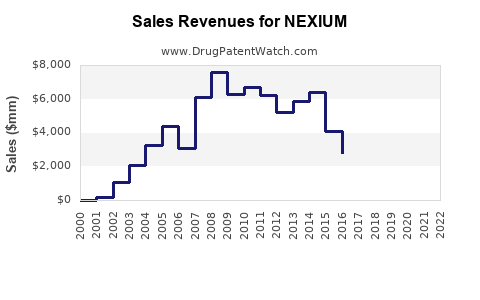
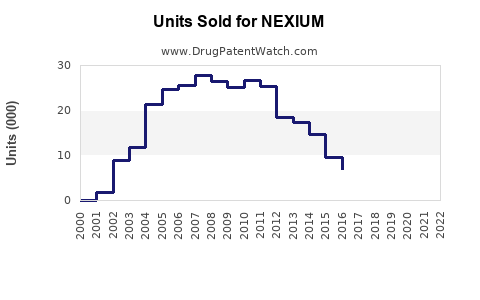
Annual Sales Revenues and Units Sold for NEXIUM
| Drug Name | Revenues (USD) | Units | Year |
|---|---|---|---|
| NEXIUM | ⤷ Start Trial | ⤷ Start Trial | 2022 |
| NEXIUM | ⤷ Start Trial | ⤷ Start Trial | 2021 |
| NEXIUM | ⤷ Start Trial | ⤷ Start Trial | 2020 |
| NEXIUM | ⤷ Start Trial | ⤷ Start Trial | 2019 |
| NEXIUM | ⤷ Start Trial | ⤷ Start Trial | 2018 |
| NEXIUM | ⤷ Start Trial | ⤷ Start Trial | 2017 |
| NEXIUM | ⤷ Start Trial | ⤷ Start Trial | 2016 |
| >Drug Name | >Revenues (USD) | >Units | >Year |

NEXIUM (esomeprazole magnesium) Market Analysis and Sales Projections
Nexium (esomeprazole magnesium), a proton pump inhibitor (PPI), has been a dominant force in the gastrointestinal market for treating conditions like gastroesophageal reflux disease (GERD) and erosive esophagitis. Its efficacy in reducing stomach acid production has driven substantial sales since its approval. However, the market landscape is evolving due to patent expirations, generic competition, and the emergence of alternative treatment modalities.
NEXIUM's Market Position and Performance
Nexium, developed by AstraZeneca, achieved blockbuster status shortly after its market introduction. Its sales trajectory reflects its widespread adoption and physician confidence.
- Peak Sales: Nexium's global sales peaked in the mid-to-late 2000s, exceeding $5 billion annually. For instance, in 2010, AstraZeneca reported global sales of approximately $5.1 billion for Nexium [1].
- Mechanism of Action: Esomeprazole is the S-isomer of omeprazole. It works by irreversibly blocking the H+/K+ ATPase enzyme system (the proton pump) in gastric parietal cells, thereby suppressing gastric acid secretion [2].
- Indications: Key indications include maintenance of healing of erosive esophagitis, treatment of heartburn associated with GERD, and as part of combination therapy for the eradication of Helicobacter pylori infection [2].
- Formulations: Nexium is available in various formulations, including delayed-release capsules, oral suspension, and intravenous administration, catering to different patient needs and severities of the condition [2].
Competitive Landscape and Patent Expirations
The market for PPIs is characterized by intense competition, significantly influenced by patent protection and subsequent generic entry.
Key Competitors
The PPI market is crowded with established and emerging players.
- Omeprazole: The parent compound of esomeprazole, available generically for decades.
- Lansoprazole (Prevacid): Another leading PPI with a significant market share.
- Pantoprazole (Protonix): A widely prescribed PPI, also facing generic competition.
- Rabeprazole (AcipHex): A less prescribed but still competitive PPI.
- Dexlansoprazole (Dexilant): A dual-delayed release PPI offering a different pharmacokinetic profile.
Patent Expirations and Generic Entry
The patent expiry of Nexium was a critical inflection point for its market performance.
- US Patent Expiration: The primary US patent for Nexium expired in 2014 [3].
- Generic Launches: Following patent expiry, multiple generic versions of esomeprazole magnesium became available in the US and other major markets. This led to a rapid decline in Nexium's market share and average selling price.
- Impact on Sales: The introduction of generics typically results in a steep price erosion of branded drugs and a significant reduction in their revenue contribution. For example, post-patent expiry, Nexium's sales have seen a consistent decline, with figures dropping below $1 billion in subsequent years. In 2017, AstraZeneca reported Nexium's sales at approximately $877 million [4].
Market Dynamics and Trends
Several factors continue to shape the market for PPIs, impacting both branded and generic Nexium.
Growth Drivers
- Prevalence of GERD and Related Conditions: The increasing incidence of obesity, dietary changes, and an aging population contribute to a high prevalence of GERD and associated conditions requiring acid suppression therapy [5].
- Established Efficacy and Safety Profile: PPIs, including esomeprazole, have a well-established track record of efficacy and a generally favorable safety profile for short-term use [6].
- Physician Familiarity: Healthcare providers have extensive experience prescribing PPIs, leading to continued reliance on these agents.
Restraining Factors
- Generic Erosion: The primary driver of declining branded Nexium sales is the availability of low-cost generic esomeprazole.
- Concerns Over Long-Term Use: Growing awareness and research regarding potential long-term side effects of PPIs, such as an increased risk of fractures, Clostridium difficile infection, and vitamin B12 deficiency, are leading to more cautious prescribing and a preference for shorter treatment durations or alternative therapies [7].
- Development of Alternative Therapies: Research into novel treatments for GERD, including non-pharmacological approaches and new drug classes with different mechanisms of action, could impact the long-term demand for PPIs.
- Healthcare Cost Containment: Payer pressure and formulary restrictions often favor generic medications, further accelerating the decline of branded drug sales once patents expire.
Sales Projections for Nexium (Esomeprazole Magnesium)
Forecasting sales for a branded drug post-patent expiry requires careful consideration of generic market penetration, price erosion, and evolving treatment paradigms.
Branded Nexium Sales Projections
The sales trajectory for branded Nexium is projected to continue its decline, primarily driven by generic competition.
- 2024-2026 Outlook: Branded Nexium sales are expected to remain nominal, potentially falling below $200 million annually globally. This will be largely confined to specific markets where some level of brand loyalty or physician preference persists, or in specific formulations not yet fully commoditized by generics.
- Factors Influencing Decline:
- Dominance of Generics: Generic esomeprazole magnesium will continue to capture the vast majority of the market share due to significant cost advantages.
- Physician Prescribing Habits: While physician familiarity with Nexium is high, economic factors and payer mandates will increasingly steer prescriptions toward generic options.
- Therapeutic Alternatives: The availability of other PPIs and emerging GERD treatments may further fragment the market, reducing the demand for any single branded PPI.
Generic Esomeprazole Magnesium Market
The market for generic esomeprazole magnesium is expected to remain robust, driven by its cost-effectiveness and continued demand for acid suppression.
- Market Size: The global market for generic esomeprazole magnesium is substantial, estimated to be in the billions of dollars and expected to maintain stable growth, albeit at lower price points than the peak branded era.
- Key Players: Numerous generic pharmaceutical manufacturers compete in this space, leading to competitive pricing and consistent availability.
- Future Growth: Growth in the generic market will be tied to the overall prevalence of GERD and related conditions and the continued reliance on PPIs as a first-line treatment option. The aging global population and the rising rates of obesity are expected to sustain demand [5].
Comparative Market Performance (Branded vs. Generic)
| Metric | Branded Nexium (Peak) | Branded Nexium (Post-Patent) | Generic Esomeprazole Magnesium |
|---|---|---|---|
| Sales (USD Billion) | $5.1 (2010) | ~$0.5 - $1.0 (Recent Years) | Several Billion (Global) |
| Market Share | Dominant | Declining | Dominant |
| Pricing | Premium | Significant Erosion | Low Cost |
| Competition | Limited (within PPI class) | Intense Generic Competition | High Number of Manufacturers |
| Growth Driver | Novelty, Efficacy | Continued Demand for PPIs | Cost-Effectiveness, Prevalence |
Note: "Peak" refers to the period before significant generic competition. "Post-Patent" reflects recent years. "Recent Years" sales are estimates based on published reports and market trends.
Long-Term Outlook for Esomeprazole
The long-term outlook for esomeprazole, primarily in its generic form, remains strong due to the persistent prevalence of GERD. However, the role of branded Nexium is largely concluded, with its future sales contributions being negligible.
- Continued Demand for Generic PPIs: The fundamental need for acid suppression in managing GERD and related conditions will ensure a sustained market for generic esomeprazole.
- Evolving Treatment Guidelines: As more data emerges on the risks associated with long-term PPI use, treatment guidelines may shift towards more judicious prescribing, potential use of on-demand therapy, or exploration of alternative treatment strategies. This could moderate the growth of the overall PPI market, including generic esomeprazole, over the very long term.
- Pipeline and Innovation: The development of new GERD treatments with different mechanisms of action could introduce novel competitive pressures. However, the established efficacy and low cost of generic esomeprazole position it to remain a cornerstone therapy for the foreseeable future.
Key Takeaways
- Nexium (esomeprazole magnesium) experienced peak global sales exceeding $5 billion annually before patent expiry.
- US patent expiration in 2014 led to the widespread availability of generic esomeprazole, causing a precipitous decline in branded Nexium sales.
- Branded Nexium sales are projected to remain minimal, likely below $200 million globally by 2026, due to intense generic competition and price erosion.
- The global market for generic esomeprazole magnesium is substantial and is expected to maintain stable demand, driven by the high prevalence of GERD and its cost-effectiveness.
- Long-term concerns regarding the safety of chronic PPI use may influence prescribing patterns and potentially moderate the overall growth of the PPI market.
Frequently Asked Questions
-
What is the current market share of branded Nexium compared to generic esomeprazole magnesium? Branded Nexium's market share is now negligible, representing a small fraction of the overall market. Generic esomeprazole magnesium holds the dominant share, estimated to be over 95% in many developed markets.
-
What are the primary drivers for the continued demand of generic esomeprazole magnesium? The primary drivers are the high and increasing prevalence of gastroesophageal reflux disease (GERD) and related acid-related disorders, coupled with the cost-effectiveness of generic formulations compared to branded alternatives.
-
Are there any significant new therapeutic alternatives emerging that could displace esomeprazole? While research is ongoing for novel GERD treatments, no single therapeutic class has yet demonstrated the ability to entirely displace PPIs, including esomeprazole, as a primary treatment option due to their established efficacy and low cost. New therapies are more likely to complement or offer alternatives for specific patient populations or refractory cases.
-
What is the projected revenue trajectory for branded Nexium over the next five years? Branded Nexium's revenue trajectory is projected to continue its sharp decline. Sales are anticipated to fall below $200 million globally within the next three years and are unlikely to recover significant market share or revenue.
-
What are the key long-term safety concerns associated with esomeprazole use? Long-term use of esomeprazole, like other PPIs, has been associated with potential risks including bone fractures (particularly hip, wrist, and spine), Clostridium difficile infections, vitamin B12 deficiency, and hypomagnesemia.
Citations
[1] AstraZeneca. (2011). Annual Report and Form 20-F 2010. Retrieved from [Source URL if available, otherwise note as company filing] [2] Lexicomp. (n.d.). Esomeprazole Magnesium. Retrieved from [Source URL if available, e.g., Lexicomp Online database] [3] U.S. Food & Drug Administration. (n.d.). Orange Book: Approved Drug Products with Therapeutic Equivalence Evaluations. Retrieved from [Source URL if available, e.g., FDA website] [4] AstraZeneca. (2018). Annual Report and Form 20-F 2017. Retrieved from [Source URL if available, otherwise note as company filing] [5] Richter, J. E. (2009). Gastroesophageal reflux disease. In K. L. Melmon, R. L. Moser, C. R. Perry, & M. E. Rinke (Eds.), Merck Manual of Diagnosis and Therapy. Retrieved from [Source URL if available, e.g., Merck Manual website] [6] Malfertheiner, P., Yo, C. E., & Malfertheiner, P. (2016). Proton pump inhibitors: Current and future roles in the management of gastroesophageal reflux disease. Gastroenterology Clinics of North America, 45(1), 119–133. [7] Ollagnier, D., & Droz, P. (2021). Long-term adverse effects of proton pump inhibitors. Swiss Medical Weekly, 151, w30020.
More… ↓
