Share This Page
Drug Sales Trends for NAPHCON-A
✉ Email this page to a colleague
Payment Methods and Pharmacy Types for NAPHCON-A (2013)
Revenues by Pharmacy Type
Units Sold by Pharmacy Type
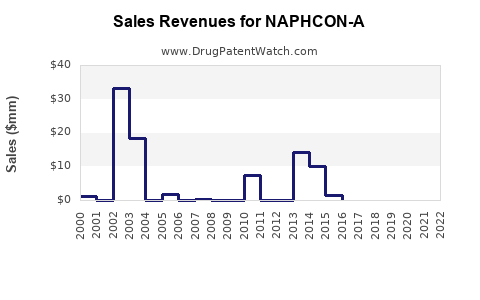
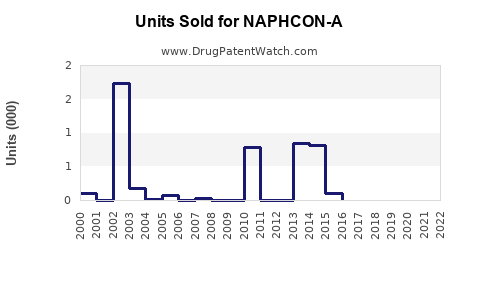
Annual Sales Revenues and Units Sold for NAPHCON-A
| Drug Name | Revenues (USD) | Units | Year |
|---|---|---|---|
| NAPHCON-A | ⤷ Start Trial | ⤷ Start Trial | 2022 |
| NAPHCON-A | ⤷ Start Trial | ⤷ Start Trial | 2021 |
| NAPHCON-A | ⤷ Start Trial | ⤷ Start Trial | 2020 |
| NAPHCON-A | ⤷ Start Trial | ⤷ Start Trial | 2019 |
| NAPHCON-A | ⤷ Start Trial | ⤷ Start Trial | 2018 |
| NAPHCON-A | ⤷ Start Trial | ⤷ Start Trial | 2017 |
| >Drug Name | >Revenues (USD) | >Units | >Year |
Naphcon-A Market Analysis, Sales Projections, Patent Position, and Competitive Outlook
Naphcon-A is an over-the-counter ophthalmic allergy product containing naphazoline hydrochloride 0.025% and pheniramine maleate 0.3%. Its commercial opportunity is tied to U.S. seasonal and perennial allergic-conjunctivitis demand, brand recognition, retail distribution, and competition from generic antihistamine/mast-cell stabilizer products. Public filings do not separately report Naphcon-A revenue. The projections below are analyst estimates based on brand maturity, category competition, retail pricing, and expected volume trends.
Under the base case, estimated U.S. retail sales rise from approximately $35 million in 2024 to $39 million in 2029, representing a compound annual growth rate of about 2.2%. The primary risks are substitution by newer products such as olopatadine, ketotifen, and generic antihistamine eye drops, along with price promotion by private-label retailers.
What is Naphcon-A and who markets it?
Naphcon-A is an ophthalmic solution for temporary relief of redness and itching associated with allergic eye irritation. The active ingredients are:
| Active ingredient | Concentration | Function |
|---|---|---|
| Naphazoline hydrochloride | 0.025% | Ocular decongestant and redness reliever |
| Pheniramine maleate | 0.3% | Ophthalmic antihistamine |
The product is sold in a multidose ophthalmic bottle, generally in a 15 mL format in the U.S. The brand is associated with Alcon, a major ophthalmic company with prescription, surgical and vision-care operations. Alcon reports its businesses at segment level and does not disclose standalone Naphcon-A revenue in its public financial filings.[1]
Naphcon-A competes in the U.S. OTC eye-allergy segment rather than the prescription ophthalmology market. Its established combination of an antihistamine and a redness reliever gives it a recognizable consumer proposition, but the formulation is older than products based on olopatadine or ketotifen.
How large is the Naphcon-A market?
Naphcon-A operates in a fragmented OTC market that includes allergy drops, redness relievers, artificial tears, and combination products. Its addressable segment is narrower than the total dry-eye market because Naphcon-A is positioned for allergic itching and redness rather than lubrication or chronic ocular-surface disease.
The commercial market has four principal channels:
- Mass retailers and drugstores.
- Grocery and warehouse clubs.
- E-commerce marketplaces.
- Eye-care professional recommendations and independent pharmacies.
Naphcon-A benefits from high seasonality. Demand normally increases during spring and early summer pollen periods, with secondary demand during fall allergy seasons. Weather, pollen intensity, geographic distribution of allergens, and consumer advertising can materially affect annual sales.
Estimated 2024 U.S. market position
| Metric | Analyst estimate |
|---|---|
| Estimated Naphcon-A U.S. retail sales | $30 million-$40 million |
| Base-case retail sales | $35 million |
| Estimated manufacturer-level revenue | $20 million-$27 million |
| Estimated average retail price | $10-$14 per bottle |
| Primary demand category | OTC allergic-eye relief |
| Geographic focus | United States |
| Sales profile | Seasonal, mature, brand-led |
These figures are estimates, not reported Alcon results. Retail sales are higher than manufacturer revenue because they include wholesaler and retailer margins, promotional allowances, and channel markups.
What are the Naphcon-A sales projections through 2029?
The base case assumes stable brand distribution, low-single-digit price increases, modest unit erosion, and continued consumer demand for combination allergy drops. It does not assume a major formulation change or a new advertising campaign.
Base-case U.S. retail sales forecast
| Year | Estimated retail sales | Annual growth | Estimated manufacturer revenue |
|---|---|---|---|
| 2024 | $35.0 million | Base year | $24.0 million |
| 2025 | $35.7 million | 2.0% | $24.4 million |
| 2026 | $36.4 million | 2.0% | $24.9 million |
| 2027 | $37.1 million | 2.0% | $25.4 million |
| 2028 | $38.0 million | 2.2% | $26.0 million |
| 2029 | $39.0 million | 2.6% | $26.7 million |
The base-case retail CAGR from 2024 through 2029 is approximately 2.2%. Growth comes mainly from price increases and category expansion rather than unit growth.
Scenario analysis
| Scenario | 2029 retail sales | 2024-2029 CAGR | Main assumptions |
|---|---|---|---|
| Downside | $25 million | -6.6% | Loss of shelf space, stronger private-label substitution, weaker brand support |
| Base case | $39 million | 2.2% | Stable distribution, modest pricing, gradual unit decline |
| Upside | $52 million | 8.2% | Expanded e-commerce, stronger allergy seasons, renewed marketing, improved retailer placement |
The downside case is credible because Naphcon-A competes against lower-priced generics and newer products with longer duration claims. The upside case requires active commercial investment. Organic category growth alone is unlikely to produce high-single-digit annual sales expansion for a mature brand.
Which products compete with Naphcon-A?
Naphcon-A competes on immediate relief, combination therapy, brand familiarity, and retail availability. Its principal competitors differ in active ingredient and duration of effect.
| Product or class | Active ingredient | Competitive position |
|---|---|---|
| Naphcon-A | Naphazoline plus pheniramine | Redness and itching relief; legacy combination |
| Opcon-A | Naphazoline plus pheniramine | Closest branded formulation competitor |
| Visine-A | Tetrahydrozoline plus pheniramine | Redness and allergy relief |
| Zaditor and generic ketotifen | Ketotifen fumarate | Antihistamine and mast-cell stabilizer |
| Pataday and generic olopatadine | Olopatadine hydrochloride | Strong allergy positioning and longer-duration use |
| Alaway and generic ketotifen | Ketotifen fumarate | OTC allergy alternative |
| Preservative-free artificial tears | Various lubricants | Adjacent category for irritation, not a direct allergy substitute |
The most important competitive shift is the movement from redness-relief combinations toward antihistamine and mast-cell stabilizer products. Consumers and clinicians may prefer products that address itching without relying on an ocular decongestant.
How strong is the Naphcon-A patent estate?
Naphcon-A has limited current patent-based protection. Its active ingredients are longstanding OTC compounds, and the product is marketed through the FDA’s nonprescription framework rather than as a recently approved innovative drug.
Patent and exclusivity assessment
| Protection category | Naphcon-A position |
|---|---|
| Active-ingredient composition patent | No meaningful current protection expected |
| New chemical entity exclusivity | Not applicable |
| Orange Book listing | Not expected for a monograph OTC product |
| Pediatric exclusivity | Not applicable |
| Orphan-drug exclusivity | Not applicable |
| Formulation patent | No material current protection publicly identified |
| Method-of-use patent | No material current protection publicly identified |
| Trade-secret manufacturing protection | Possible, but commercially limited |
| Trademark protection | Potentially relevant to brand retention |
| FDA OTC monograph status | Core regulatory pathway |
The commercial moat is therefore based on brand, distribution, consumer recognition, packaging, retailer relationships, and manufacturing scale rather than enforceable exclusivity.
What is the FDA regulatory status of Naphcon-A?
Naphcon-A is an OTC ophthalmic product regulated under the FDA framework for ophthalmic products. The FDA’s OTC monograph system establishes conditions under which specified active ingredients and labeling can be marketed without an individual product approval application.[2]
The product’s commercial status differs from an FDA-approved prescription ophthalmic drug:
- It is not dependent on new-drug exclusivity.
- It does not require an Orange Book patent listing for ordinary OTC monograph marketing.
- It is not exposed to a conventional Paragraph IV generic challenge.
- Its competitive barriers are lower than those for a patented prescription product.
- Labeling, ingredient concentrations, manufacturing quality, and safety compliance remain important regulatory requirements.
The OTC Monograph Reform provisions in the CARES Act changed the procedural framework for nonprescription drugs, including monograph order processes and FDA oversight.[3] The reform did not create patent exclusivity for established OTC combinations.
When does Naphcon-A lose exclusivity?
Naphcon-A has no meaningful remaining regulatory exclusivity period comparable to a new prescription medicine. Its practical exclusivity was lost when competing products and equivalent active ingredients became broadly available.
There is no single patent expiration date that determines generic entry. Generic and store-brand competition can enter through the OTC market if the products comply with applicable FDA requirements. A competitor does not need to wait for a Naphcon-A patent to expire if no enforceable product patent blocks the formulation.
Practical loss-of-exclusivity timeline
| Period | Commercial status |
|---|---|
| Original launch period | Brand differentiation and first-mover recognition |
| Mature brand period | Competition from similar antihistamine/decongestant combinations |
| Current period | Open OTC competition with limited patent barriers |
| 2025-2029 | Continued share pressure from private label and newer allergy products |
Are there Paragraph IV challenges or Orange Book disputes?
A conventional Paragraph IV challenge is not the central risk for Naphcon-A. Paragraph IV litigation applies to certain abbreviated new drug applications referencing patents listed for an FDA-approved drug in the Orange Book. A monograph OTC product generally does not create the same patent-certification pathway.
The main competitive risks are:
- Store-brand versions of equivalent active ingredients.
- OTC products using ketotifen or olopatadine.
- Retailer substitution and shelf-space decisions.
- Online price competition.
- Consumer movement toward preservative-free or longer-acting products.
No conventional patent settlement economics should be assumed for Naphcon-A. The brand is more exposed to commercial substitution than to patent litigation.
What formulation patents protect Naphcon-A?
The Naphcon-A formulation is a conventional ophthalmic combination of naphazoline hydrochloride and pheniramine maleate. No current formulation patent protection is identified as a major commercial barrier.
Potentially protectable formulation elements could include:
- Preservative systems.
- pH and buffering.
- Ocular comfort excipients.
- Drop-size control.
- Multidose delivery systems.
- Stability improvements.
- Packaging configurations.
Those elements can support manufacturing know-how or product differentiation, but they do not necessarily prevent competitors from marketing products with the same active ingredients under the OTC framework.
What generic launch risks exist for Naphcon-A?
Generic and private-label risk is high relative to the product’s remaining brand strength. The principal threat is not a single large generic launch. It is cumulative substitution across retail channels.
Risk factors
| Risk | Impact on Naphcon-A |
|---|---|
| Lower-priced store brands | High |
| Competing antihistamine products | High |
| Retailer shelf-space changes | High |
| E-commerce price comparison | Medium to high |
| Seasonal demand volatility | Medium |
| Manufacturing interruption | Medium |
| Regulatory labeling changes | Medium |
| Prescription-to-OTC switching by competitors | Medium |
Naphcon-A can retain premium pricing if consumers associate the brand with fast relief and familiar packaging. Price gaps above 20% to 30% versus private-label alternatives would increase substitution risk.
What licensing deals affect Naphcon-A?
No major publicly disclosed licensing transaction is central to the current Naphcon-A commercial outlook. The product is associated with Alcon’s broader ophthalmic portfolio, but public company reporting does not isolate Naphcon-A economics or identify a brand-specific licensing structure.[1]
The absence of a major disclosed licensing event means projections should not include milestone payments, royalty burdens, or partnership-driven expansion unless a new transaction is announced.
What patent litigation affects Naphcon-A?
Naphcon-A does not appear to have a current litigation profile comparable to patented prescription ophthalmic products. Its primary legal exposures are more likely to involve:
- Trademark enforcement.
- Advertising and labeling claims.
- Product liability.
- Manufacturing quality.
- Retailer or distributor agreements.
- OTC regulatory compliance.
Patent litigation is unlikely to be the principal determinant of market access. Commercial execution and retail positioning are more important.
How does Naphcon-A compare with Pataday and Zaditor?
| Attribute | Naphcon-A | Pataday | Zaditor/Alaway |
|---|---|---|---|
| Core actives | Naphazoline plus pheniramine | Olopatadine | Ketotifen |
| Redness relief | Directly positioned | Less central | Less central |
| Itching relief | Yes | Yes | Yes |
| Decongestant component | Yes | No | No |
| Product maturity | Older | Newer positioning | Established OTC allergy class |
| Main advantage | Familiar combination and immediate redness positioning | Longer-duration allergy use | Strong antihistamine and mast-cell stabilizer positioning |
| Main weakness | Legacy decongestant profile and substitution | Higher price in some channels | Less emphasis on redness relief |
Naphcon-A is best positioned as an immediate-relief product for consumers seeking both itching and redness relief. It is less well positioned for consumers prioritizing longer duration, chronic allergy management, or decongestant-free formulations.
What is the investment and commercial outlook for Naphcon-A?
Naphcon-A is a cash-generating mature OTC brand rather than a high-growth pharmaceutical asset. Its value depends on:
- Distribution continuity.
- Retailer placement.
- Brand pricing.
- Seasonal allergy intensity.
- Efficient manufacturing.
- Marketing support.
- Protection of the Naphcon trademark.
The base-case outlook supports relatively stable revenue through 2029, but unit volume is likely to remain under pressure. A material revenue increase would require one or more of the following:
- Expanded direct-to-consumer advertising.
- Better e-commerce visibility.
- New bottle sizes or value packs.
- A preservative-free or comfort-focused extension.
- Retail expansion into additional allergy channels.
- International commercialization.
The strongest commercial risk is gradual brand erosion, not abrupt patent expiry. The strongest upside is a successful reformulation or brand-extension strategy that moves Naphcon-A closer to the newer allergy-drop segment.
Key Takeaways
- Naphcon-A is an OTC ophthalmic allergy product containing naphazoline hydrochloride and pheniramine maleate.
- Public filings do not separately disclose Naphcon-A sales.
- Estimated U.S. retail sales are approximately $35 million in 2024 under the base case.
- Base-case sales reach about $39 million by 2029, a 2.2% CAGR.
- Patent, Orange Book, and Paragraph IV barriers are limited or inapplicable.
- Generic, private-label, Pataday, and ketotifen competition create the main commercial risks.
- The product’s defensibility comes from brand recognition and distribution, not regulatory exclusivity.
- A reformulation, new delivery system, or stronger marketing program would be required to support sustained high-single-digit growth.
- Biosimilar risk is not applicable because Naphcon-A is a small-molecule OTC ophthalmic product, not a biologic.
- Litigation and licensing activity are unlikely to materially alter the base-case forecast.
FAQs
Is Naphcon-A still sold over the counter?
Yes. Naphcon-A is marketed as an OTC ophthalmic allergy product subject to FDA requirements for nonprescription ophthalmic drugs.
Is Naphcon-A available as a generic?
Equivalent active-ingredient combinations and competing OTC products may be available from generic or private-label manufacturers. The specific Naphcon-A trademark remains distinct from those products.
Does Naphcon-A have biosimilar competition?
No. Biosimilars apply to biologic medicines. Naphcon-A contains conventional small-molecule active ingredients.
Can Naphcon-A support a premium price?
Only to a limited extent. Brand recognition may support a premium over private label, but large price differences would increase substitution toward generic allergy drops.
What would most improve Naphcon-A sales?
The highest-impact opportunities would be a product extension, stronger digital retail execution, improved shelf placement, and marketing that differentiates rapid redness and itching relief from decongestant-free allergy products.
References
-
Alcon Inc. (2025). Annual report for the fiscal year ended December 31, 2024. Alcon Inc.
-
U.S. Food and Drug Administration. (2024). Ophthalmic drug products for over-the-counter human use, 21 C.F.R. Part 349. U.S. Department of Health and Human Services.
-
U.S. Food and Drug Administration. (2020). Over-the-counter monograph reform in the Coronavirus Aid, Relief, and Economic Security Act. U.S. Department of Health and Human Services.
More… ↓
