Drug Sales Trends for LOTENSIN
Payment Methods and Pharmacy Types for LOTENSIN (2013)
Revenues by Pharmacy Type
Units Sold by Pharmacy Type
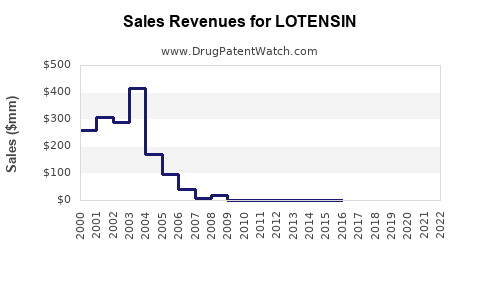
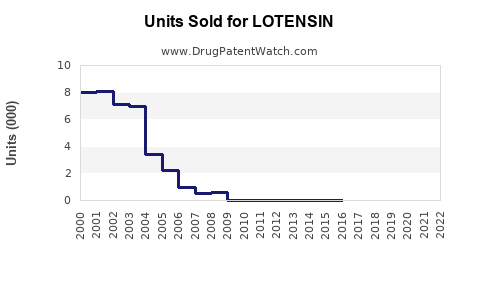
Annual Sales Revenues and Units Sold for LOTENSIN
| Drug Name | Revenues (USD) | Units | Year |
|---|---|---|---|
| LOTENSIN | ⤷ Start Trial | ⤷ Start Trial | 2022 |
| LOTENSIN | ⤷ Start Trial | ⤷ Start Trial | 2021 |
| LOTENSIN | ⤷ Start Trial | ⤷ Start Trial | 2020 |
| LOTENSIN | ⤷ Start Trial | ⤷ Start Trial | 2019 |
| LOTENSIN | ⤷ Start Trial | ⤷ Start Trial | 2018 |
| LOTENSIN | ⤷ Start Trial | ⤷ Start Trial | 2017 |
| >Drug Name | >Revenues (USD) | >Units | >Year |
Lotensin (Benazepril) Market Analysis, Patent Status, and Sales Projections
Lotensin, the brand name for benazepril hydrochloride, is a mature angiotensin-converting enzyme inhibitor used primarily for hypertension and, in some markets, heart-failure management. Its U.S. brand franchise has little commercial value because generic benazepril has been available for decades, regulatory exclusivity has expired, and no meaningful brand-driven growth platform remains. Future market value is concentrated in low-cost generic tablets, combination therapy, and institutional supply contracts.
Public companies do not report standalone Lotensin revenue. The projections below therefore estimate the U.S. benazepril opportunity rather than audited Lotensin brand sales.
What is Lotensin and how is it used?
Lotensin contains benazepril hydrochloride, a prodrug converted to benazeprilat, which inhibits the renin-angiotensin system. The FDA-approved indication is hypertension, either alone or with other antihypertensive agents. The usual adult starting dose is 10 mg once daily, with maintenance dosing generally ranging from 20 mg to 40 mg daily depending on response and clinical use (U.S. Food and Drug Administration [FDA], 2013).
Lotensin is available in 5 mg, 10 mg, 20 mg, and 40 mg tablets. Lotensin HCT combines benazepril with hydrochlorothiazide and was approved as a fixed-dose combination product.
Key product facts
| Attribute | Lotensin |
|---|---|
| Active ingredient | Benazepril hydrochloride |
| Drug class | ACE inhibitor |
| Original sponsor | Ciba-Geigy, later Novartis |
| U.S. approval | 1991 |
| Primary indication | Hypertension |
| Dosage forms | Oral tablets |
| Strengths | 5 mg, 10 mg, 20 mg, 40 mg |
| Combination product | Lotensin HCT |
| Current U.S. commercial status | Generic-dominated market |
| Main competitors | Lisinopril, enalapril, ramipril, perindopril, losartan and other antihypertensives |
What is the FDA regulatory status of Lotensin?
Lotensin was approved under FDA NDA 019851 in the early 1990s. Its active ingredient, benazepril hydrochloride, is now widely available through abbreviated new drug applications. Generic manufacturers market the product in the same principal strengths as the original brand.
The product does not have meaningful remaining FDA regulatory exclusivity. Any commercial protection is based on manufacturing scale, wholesaler access, product quality, contract pricing, and supply reliability rather than brand exclusivity.
FDA status and regulatory implications
| Regulatory issue | Assessment |
|---|---|
| Original NDA exclusivity | Expired |
| New chemical entity exclusivity | Expired |
| Pediatric exclusivity | No current commercial relevance |
| Generic availability | Established |
| Brand growth potential | Very limited |
| Regulatory barrier to entry | Low to moderate |
| Main regulatory risk | Product quality, supply interruptions, and manufacturing compliance |
The FDA label identifies standard ACE-inhibitor risks, including fetal toxicity, angioedema, hyperkalemia, renal-function changes, and symptomatic hypotension. Lotensin is contraindicated in patients with a history of ACE-inhibitor-related angioedema and in pregnancy because renin-angiotensin system blockade can cause fetal injury (FDA, 2013).
What patents protect Lotensin and when did they expire?
The original Lotensin composition and product patents expired years ago. The basic compound, tablet formulation, and core hypertension indication are no longer protected by enforceable commercial exclusivity in the United States.
Publicly available regulatory records do not indicate a current U.S. patent barrier that would prevent additional generic entry for standard benazepril tablets. Any residual patent questions would relate to specific combination products, manufacturing processes, or foreign-market rights rather than the basic U.S. Lotensin product.
Patent estate assessment
| Patent category | Commercial position |
|---|---|
| Benazepril active ingredient | Expired |
| Standard tablet formulation | Expired or commercially irrelevant |
| Hypertension method of use | Expired |
| Lotensin HCT core protection | Expired |
| Current Orange Book blocking patent | No material blocking protection identified for standard tablets |
| Paragraph IV risk | Low relevance because the product is already genericized |
| Manufacturing process patents | Potentially relevant to individual suppliers, not generally market-blocking |
Because Lotensin is a legacy small molecule, it does not face biosimilar litigation. Biosimilar rules apply to biologic products, while benazepril is a conventional chemically synthesized small molecule approved through the ANDA pathway.
What is the Orange Book status of Lotensin?
The Orange Book historically listed the Lotensin NDA and related approved products. The practical Orange Book position is now genericized: the reference product establishes the regulatory reference, while multiple manufacturers can rely on abbreviated applications for bioequivalent tablets.
For commercial analysis, the important question is not whether the original NDA remains listed, but whether an unexpired patent or exclusivity period blocks ANDA approval. For standard benazepril tablets, that barrier has ended.
Paragraph IV challenges and litigation
Lotensin is not a current high-value Paragraph IV target. Paragraph IV litigation typically arises when a generic applicant certifies that an Orange Book-listed patent is invalid, unenforceable, or not infringed. That mechanism mattered during the launch period for benazepril but has little relevance to current market entry.
No major active U.S. patent dispute is generally associated with standard Lotensin tablets. Any future litigation would more likely involve:
- Manufacturing quality or supply disputes
- Trademark or trade dress claims
- Product liability
- Contract pricing
- Distribution arrangements
- A new formulation or combination product
How large is the benazepril and Lotensin market?
The U.S. market for benazepril is small relative to leading ACE inhibitors and angiotensin receptor blockers. Lisinopril has substantially greater prescribing volume because of earlier generic availability, extensive clinical familiarity, low price, and broad formulary coverage.
Benazepril retains a niche among patients already stabilized on therapy, clinicians who prefer the molecule, and combination regimens that include a thiazide diuretic. Its use is constrained by substitution into other ACE inhibitors and by continued movement toward ARBs when cough or tolerability is an issue.
Competitive market comparison
| Product | Class | Relative U.S. market position | Commercial pressure |
|---|---|---|---|
| Lisinopril | ACE inhibitor | Very high | Lowest generic pricing and broad use |
| Enalapril | ACE inhibitor | High | Mature generic competition |
| Losartan | ARB | Very high | Strong use where ACE cough is a concern |
| Benazepril | ACE inhibitor | Low | Limited volume and low price |
| Ramipril | ACE inhibitor | Moderate | Stronger cardiovascular-outcomes positioning |
| Perindopril | ACE inhibitor | Lower in the U.S. | Limited U.S. availability relative to leading agents |
Benazepril has no clear product-level differentiation that supports a premium price. Its commercial position depends on availability and contracting rather than clinical exclusivity.
What are the sales projections for Lotensin and generic benazepril?
There is no publicly disclosed, reliable standalone revenue figure for Lotensin. Novartis does not report Lotensin as a material current product line, and generic manufacturers generally report broader portfolios rather than benazepril-specific revenue.
The following scenario estimates apply to U.S. manufacturer sales across brand and generic benazepril tablets. They are analytical market estimates, not company-reported forecasts.
U.S. benazepril sales projection
| Scenario | 2024 estimated manufacturer sales | 2025 | 2026 | 2030 | 2024-2030 trend |
|---|---|---|---|---|---|
| Low case | $8 million | $7.5 million | $7.0 million | $5.5 million | -5.9% CAGR |
| Base case | $15 million | $14.3 million | $13.6 million | $10.5 million | -5.7% CAGR |
| High case | $25 million | $24.5 million | $24.0 million | $21.5 million | -2.4% CAGR |
These estimates assume:
- No branded relaunch with meaningful promotion.
- Continued generic substitution.
- Stable or declining prescription volume.
- Annual net-price erosion of approximately 2% to 6%.
- No material supply disruption.
- No major new indication.
- Continued reimbursement preference for lower-cost ACE inhibitors and ARBs.
The base case implies a U.S. market of approximately $10 million to $15 million in annual manufacturer sales during the second half of the decade. Retail pharmacy revenue could be higher because it includes wholesaler, pharmacy, and dispensing margins.
Global sales outlook
Global benazepril sales are difficult to isolate because local brands, generic suppliers, and public tender systems report limited molecule-level revenue. The international opportunity is likely larger than the U.S. market in unit volume but remains low value per prescription.
A reasonable commercial range for global benazepril manufacturer sales is approximately $30 million to $75 million annually, with most value generated through generic supply rather than the original Lotensin brand. The range reflects differences in reporting, market inclusion, and the treatment of combination products.
What is the commercial value of Lotensin’s formulation and combination products?
Lotensin tablets use conventional oral immediate-release technology. The formulation does not contain a delivery system, extended-release mechanism, complex device, or biologic component that would create a durable technical barrier.
Lotensin HCT offers benazepril plus hydrochlorothiazide, but fixed-dose combinations also face generic substitution and therapeutic alternatives. Generic manufacturers can compete through separate tablets or equivalent fixed-dose products, subject to FDA approval and bioequivalence requirements.
Formulation protection
| Product attribute | Commercial assessment |
|---|---|
| Immediate-release tablet | Easily reproducible |
| Complex formulation technology | None material |
| Device or delivery-system protection | None |
| Fixed-dose combination | Genericizable |
| Manufacturing complexity | Low to moderate |
| Supply-chain differentiation | More important than formulation IP |
The main operational barriers are active pharmaceutical ingredient sourcing, validated tablet production, packaging, FDA compliance, and pharmacy-channel access. These are execution barriers, not durable patent barriers.
Which companies compete with Lotensin?
Competition is divided between benazepril suppliers and therapeutic substitutes.
Generic benazepril suppliers
U.S. generic competition has historically included large and mid-sized ANDA manufacturers such as:
- Teva Pharmaceuticals
- Mylan, now part of Viatris
- Sandoz
- Dr. Reddy’s Laboratories
- Lupin
- Rising Pharmaceuticals
- Solco Healthcare
- Zydus Pharmaceuticals
- Torrent Pharmaceuticals
- Amneal Pharmaceuticals
Supplier participation changes over time because generic companies may discontinue low-volume products, consolidate manufacturing, or retain abbreviated applications without active commercial distribution.
Therapeutic competitors
The most important substitutes are lisinopril, enalapril, ramipril, losartan, valsartan, irbesartan, and combination antihypertensive products. ARBs exert particular pressure where patients experience ACE-inhibitor cough or where clinicians prefer ARB tolerability.
How strong is the Lotensin patent estate?
The Lotensin patent estate is commercially weak because the primary compound, standard dosage forms, and principal method of use are long past their effective exclusivity periods.
Patent-strength scorecard
| Factor | Rating | Reason |
|---|---|---|
| Composition-of-matter protection | 0/5 | Expired |
| Core formulation protection | 0/5 | Expired or nonblocking |
| Method-of-use protection | 0/5 | Expired |
| Manufacturing know-how | 2/5 | May support individual suppliers |
| Regulatory exclusivity | 0/5 | Expired |
| Brand recognition | 1/5 | Limited in a generic market |
| Supply and contracting position | 2/5 | Can matter during shortages |
The estate could have modest defensive value in a historical or litigation review, but it does not support premium pricing or meaningful exclusion of generic competitors.
What generic entry risks exist for Lotensin?
Generic entry is already established. The relevant risk is continued price and volume erosion rather than a first generic launch.
Base-case market risks
- Additional low-cost suppliers can reduce average selling prices.
- Pharmacy benefit managers can substitute other ACE inhibitors.
- Hospitals and government tenders can favor the lowest compliant bidder.
- Manufacturers may exit if margins fall below economic thresholds.
- Benazepril may lose prescriptions to ARBs and lisinopril.
- A quality recall or API shortage can cause temporary share shifts.
- Low volume can make the product vulnerable to intermittent availability.
A supply disruption could produce short-term price increases, but it would not restore durable brand value. Other ACE inhibitors provide readily available therapeutic alternatives.
What licensing deals and settlements affect Lotensin?
No major current licensing transaction or settlement is generally associated with the commercial Lotensin franchise. The molecule is old, widely genericized, and not positioned as a strategic branded asset.
Historical agreements may have governed original development, marketing rights, or generic distribution, but these arrangements do not create a current market-entry barrier. There is also no meaningful biosimilar settlement landscape because benazepril is not a biologic.
What is the likely generic launch scenario?
A new generic supplier would not face the classic risk of launching into a protected brand market. The likely commercial launch would be a low-price, low-promotion strategy focused on pharmacy wholesalers, group purchasing organizations, Medicaid channels, and retail contracts.
Launch economics
| Launch factor | Expected condition |
|---|---|
| Approval pathway | ANDA |
| Patent certification risk | Low for standard tablets |
| Promotional requirement | Minimal |
| Price strategy | Competitive discount to established generics |
| Market-share ceiling | Limited by small molecule demand |
| Margin outlook | Low |
| Success determinant | Reliable supply and channel access |
A supplier entering with all four tablet strengths could capture meaningful unit share, but revenue would remain constrained by low prices. A single-strength launch would reduce manufacturing exposure but provide limited commercial scale.
How does Lotensin compare with lisinopril?
Lisinopril is the stronger commercial product. It has broader historical prescribing, more established generic supply, greater formulary familiarity, and larger total demand. Benazepril can compete clinically in selected patients but does not have a clear economic advantage.
| Metric | Lotensin/benazepril | Lisinopril |
|---|---|---|
| Brand status | Legacy brand | Legacy brand |
| Generic depth | Established | Very deep |
| U.S. demand | Smaller | Much larger |
| Unit price | Low | Very low |
| Promotion opportunity | Minimal | Minimal |
| Patent strength | Expired | Expired |
| Long-term outlook | Gradual decline | Stable high-volume generic |
Key Takeaways
- Lotensin is a mature benazepril brand with no meaningful remaining U.S. exclusivity.
- Generic benazepril tablets dominate the commercial market.
- Standard tablet patents and regulatory exclusivities have expired.
- No current patent estate appears capable of blocking ordinary generic entry.
- Lotensin has no biosimilar risk because benazepril is a small-molecule drug.
- Public companies do not report standalone Lotensin revenue.
- Estimated U.S. benazepril manufacturer sales are approximately $8 million to $25 million annually, with a base case near $15 million in 2024.
- Base-case U.S. sales decline to approximately $10 million to $11 million by 2030.
- Commercial value depends on supply reliability, contracting, and low-cost manufacturing.
- Lisinopril, enalapril, ARBs, and fixed-dose combinations are the principal competitive pressures.
- A generic launch is legally feasible but economically modest.
FAQs about Lotensin market size, patents, and generic competition
Is Lotensin still sold in the United States?
The Lotensin brand has limited commercial significance, while generic benazepril hydrochloride remains available through multiple suppliers and pharmacies.
Does Lotensin have an unexpired patent?
No material unexpired patent is generally recognized as blocking generic benazepril tablets in the United States. Core composition, formulation, and use protections have expired.
Is benazepril a biologic subject to biosimilar competition?
No. Benazepril is a chemically synthesized small molecule approved through the ANDA framework, not a biologic approved under the Public Health Service Act.
Can a company launch a generic version of Lotensin without a Paragraph IV lawsuit?
For standard benazepril tablets, the relevant patent barriers are largely expired. A new applicant would typically face an established generic market rather than a protected reference-product launch.
Will Lotensin sales increase through combination therapy?
A sustained increase is unlikely. Benazepril-hydrochlorothiazide combinations can retain niche demand, but generic substitution and competition from other antihypertensive combinations limit revenue growth.
References
-
U.S. Food and Drug Administration. (2013). Lotensin (benazepril hydrochloride) tablets: Prescribing information. FDA.
-
U.S. Food and Drug Administration. (2024). Approved drug products with therapeutic equivalence evaluations: Orange Book. FDA.
-
U.S. Food and Drug Administration. (2024). Drugs@FDA: FDA-approved drugs database. FDA.
-
National Library of Medicine. (2024). DailyMed: Benazepril hydrochloride tablet labeling. U.S. National Library of Medicine.
-
Novartis Pharmaceuticals Corporation. (2013). Lotensin product information. Novartis.
More… ↓
