Drug Sales Trends for KAPVAY
Payment Methods and Pharmacy Types for KAPVAY (2013)
Revenues by Pharmacy Type
Units Sold by Pharmacy Type
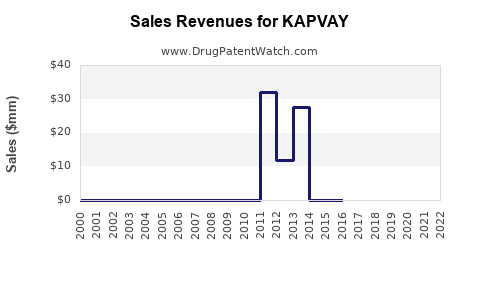
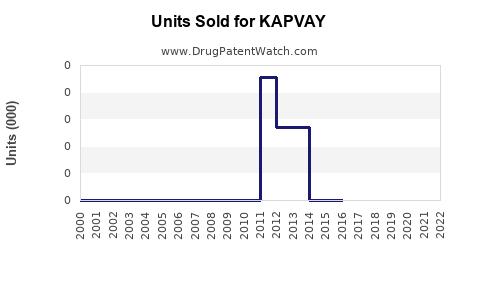
Annual Sales Revenues and Units Sold for KAPVAY
| Drug Name | Revenues (USD) | Units | Year |
|---|---|---|---|
| KAPVAY | ⤷ Start Trial | ⤷ Start Trial | 2022 |
| KAPVAY | ⤷ Start Trial | ⤷ Start Trial | 2021 |
| KAPVAY | ⤷ Start Trial | ⤷ Start Trial | 2020 |
| KAPVAY | ⤷ Start Trial | ⤷ Start Trial | 2019 |
| >Drug Name | >Revenues (USD) | >Units | >Year |
KAPVAY Market Analysis, Sales Projections, Patent Status, and Generic Entry Outlook
KAPVAY is a niche ADHD product containing extended-release clonidine hydrochloride. Its commercial opportunity is limited by low pricing, generic availability, sedation-related tolerability issues, and competition from stimulant and nonstimulant alternatives. The remaining market is concentrated in adjunctive treatment for pediatric ADHD, particularly patients with sleep disturbance, tics, aggression, or inadequate response to stimulants.
No current standalone net-sales figure for branded KAPVAY is publicly reported. A reasonable U.S. market model places annual sales for all clonidine extended-release products at approximately $20 million to $40 million, with branded KAPVAY representing little or none of that value. The base-case U.S. market is expected to remain broadly flat through 2029.
What is KAPVAY and how is it used?
KAPVAY is the branded formulation of clonidine hydrochloride extended-release tablets. The FDA approved KAPVAY in 2010 for:
- Monotherapy for attention-deficit/hyperactivity disorder
- Adjunctive treatment with stimulant medications
The approved strengths are 0.1 mg and 0.2 mg tablets. KAPVAY is administered orally and is titrated in divided doses, generally with an equal or larger dose administered at bedtime. The extended-release formulation is not interchangeable with immediate-release clonidine on a milligram-for-milligram basis. [1]
Clonidine is an alpha-2 adrenergic receptor agonist. Its ADHD effect is associated with reduced sympathetic activity and improved impulse control, hyperactivity, and attention in selected patients. Sedation, somnolence, fatigue, hypotension, bradycardia, and rebound hypertension after abrupt discontinuation constrain its use. [1]
Which patients drive KAPVAY demand?
The most commercially relevant patient groups are:
- Children and adolescents with ADHD who do not tolerate stimulants.
- Patients receiving stimulant therapy who have residual impulsivity or hyperactivity.
- Patients with ADHD and sleep-onset problems.
- Patients with tics, aggression, or stimulant-associated insomnia.
- Patients whose families prefer a nonstimulant treatment.
KAPVAY competes with guanfacine extended-release, atomoxetine, viloxazine extended-release, generic stimulants, and branded stimulant products. Its strongest clinical position is as an adjunctive or symptom-specific therapy rather than as a broad first-line ADHD treatment.
How large is the KAPVAY market?
The U.S. ADHD treatment market is large, but clonidine extended-release captures a small share. The CDC reported that approximately 7.1 million U.S. children and adolescents aged 3 to 17 had ever received an ADHD diagnosis during 2022. [2] Only a limited subset receives extended-release clonidine.
Estimated U.S. clonidine extended-release market
| Metric | Low case | Base case | High case |
|---|---|---|---|
| Annual treated patients | 100,000 | 165,000 | 250,000 |
| Average annual net revenue per patient | $180 | $240 | $360 |
| Estimated annual market revenue | $18 million | $40 million | $90 million |
| Generic share of volume | 85% | 93% | 97% |
| Branded KAPVAY share of revenue | 5% | 2% | 0%-5% |
The modeled range reflects prescription volume, generic pricing, payer mix, refill persistence, and the declining contribution of any branded product. The high case assumes stronger use as adjunctive therapy and higher average reimbursement. It is not a forecast of reported manufacturer revenue.
The principal limitation on market expansion is therapeutic substitution. Physicians can prescribe generic immediate-release clonidine, guanfacine extended-release, atomoxetine, or viloxazine. Many payers also require a stimulant trial before covering a nonstimulant ADHD product.
What are the KAPVAY sales projections through 2029?
The following projection covers the U.S. market for clonidine extended-release products, not confirmed net sales of branded KAPVAY.
Base-case U.S. revenue projection
| Year | Estimated treated patients | Average net revenue per patient | Market revenue |
|---|---|---|---|
| 2025 | 165,000 | $240 | $39.6 million |
| 2026 | 168,000 | $235 | $39.5 million |
| 2027 | 170,000 | $230 | $39.1 million |
| 2028 | 171,000 | $225 | $38.5 million |
| 2029 | 170,000 | $220 | $37.4 million |
The base case implies a compound annual growth rate of approximately negative 1.4% from 2025 through 2029. Patient volume is expected to remain stable or increase modestly, while generic price erosion reduces revenue.
Scenario analysis
| Scenario | 2029 market revenue | Key assumptions |
|---|---|---|
| Downside | $18 million-$25 million | Further price compression, declining brand availability, substitution to guanfacine and viloxazine |
| Base case | $35 million-$40 million | Stable pediatric use and continued generic dispensing |
| Upside | $55 million-$75 million | Greater adjunctive use, improved payer access, stronger persistence in patients with sleep or tic comorbidities |
Branded KAPVAY revenue is likely to remain below $5 million annually in the base case unless a manufacturer repositions the product, obtains a new indication, or develops a differentiated delivery system. A relaunch based only on the existing approved tablet would face limited pricing power.
What is the FDA regulatory status of KAPVAY?
KAPVAY was approved through a 505(b)(2)-style development history associated with an extended-release formulation of clonidine. The approval established the product for ADHD treatment as monotherapy and in combination with stimulants. [1]
The FDA label includes important safety restrictions:
- Do not discontinue abruptly because of the risk of rebound hypertension.
- Monitor blood pressure and heart rate.
- Warn patients about somnolence and sedation.
- Use caution with other central nervous system depressants.
- Consider dose adjustments in patients with cardiovascular disease or renal impairment.
The product has no biologic component and does not face biosimilar competition. Its principal competitive threat is generic substitution and therapeutic substitution by other ADHD drugs.
What is the Orange Book status of KAPVAY?
KAPVAY's commercial exclusivity has ended. The product was approved in 2010, and generic clonidine extended-release products subsequently entered the U.S. market. The relevant commercial question is therefore not whether a basic KAPVAY patent blocks entry, but whether any current formulation, manufacturing, or method-of-use patent remains enforceable and listed in the FDA Orange Book.
For market modeling, no material branded exclusivity premium should be assumed after 2025. Any active Orange Book listing would need to be evaluated patent by patent for:
- Expiration date
- Listed claims
- Pediatric-use coverage
- Paragraph IV certification
- Litigation status
- Whether the patent covers the approved product or only a narrower formulation or use
The Orange Book is the controlling source for current listed patents and approved therapeutic-equivalence information. [3]
When did KAPVAY lose exclusivity?
KAPVAY lost practical market exclusivity after the introduction of generic clonidine extended-release tablets. The original product is now an off-patent or effectively off-exclusivity therapy from a commercial perspective.
The exclusivity timeline is:
| Period | Commercial status |
|---|---|
| 2010 | FDA approval of KAPVAY |
| Early post-approval period | Branded product with limited nonstimulant ADHD positioning |
| Subsequent generic approvals | Generic clonidine extended-release competition |
| 2025 onward | Generic-dominated market with limited brand pricing power |
The exact launch date and number of generic applicants can vary by strength and applicant. FDA approval records and the current Orange Book should be used to confirm each product-level status. [3,4]
Are there Paragraph IV challenges against KAPVAY?
Paragraph IV risk is no longer the primary commercial issue for KAPVAY. Generic entry has already occurred, and any historic patent challenges have largely been resolved through expiration, settlement, or loss of practical relevance.
A Paragraph IV certification is significant when a generic applicant asserts that a listed patent is invalid, unenforceable, or not infringed. For KAPVAY, the business impact of a new Paragraph IV filing would be limited unless it involved a later-listed patent covering a differentiated formulation or a commercially important strength.
Potential litigation value is therefore low for the legacy tablet. The more relevant risks are:
- ANDA competition from additional generic manufacturers
- Price discounting by existing suppliers
- Supply interruptions
- FDA manufacturing observations
- Substitution by guanfacine extended-release and newer nonstimulants
What formulations are protected by KAPVAY patents?
The commercial differentiation of KAPVAY is based on extended release rather than the clonidine molecule itself. Clonidine has been used for decades, and immediate-release clonidine is available generically.
Potentially protectable technical elements include:
- Extended-release matrix design
- Release profile over the dosing interval
- Tablet composition and excipients
- Manufacturing process
- Dose strengths
- Methods of treating ADHD with adjunctive stimulant therapy
Most of these protections have limited remaining value for the original KAPVAY tablet. A new formulation could create stronger protection if it offered a clinically meaningful benefit, such as once-daily dosing, reduced morning sedation, lower cardiovascular effects, or improved adherence.
How strong is the KAPVAY patent estate?
The legacy KAPVAY patent estate is commercially weak relative to newer branded ADHD products.
| Patent-estate factor | Assessment |
|---|---|
| Active ingredient protection | Weak; clonidine is long established |
| Extended-release formulation | Limited remaining value after generic entry |
| Method-of-use protection | Narrow and difficult to enforce commercially |
| Manufacturing protection | Potentially relevant but unlikely to block all generic supply |
| Regulatory exclusivity | Expired |
| Biosimilar protection | Not applicable |
| Litigation leverage | Low |
| Pricing protection | Low |
A stronger commercial estate would require a new patent family tied to a differentiated formulation or clinically supported use. Patent claims that merely repeat the existing extended-release tablet profile would face validity, obviousness, and infringement challenges.
Which companies compete with KAPVAY?
KAPVAY competes across several product categories rather than against one direct brand.
Direct and near-direct competitors
- Generic clonidine extended-release tablets
- INTUNIV, the branded guanfacine extended-release product
- Generic guanfacine extended-release
- Qelbree, viloxazine extended-release
- Strattera, atomoxetine, and generic atomoxetine
- Generic methylphenidate and amphetamine products
- Vyvanse, now facing generic competition in the U.S.
- Concerta and other extended-release methylphenidate products
Guanfacine extended-release is the closest pharmacologic competitor. It is also an alpha-2 adrenergic agonist, but it has a different pharmacologic profile and is often perceived as less sedating than clonidine. Stimulants remain the dominant treatment class because of efficacy, clinical familiarity, and broad payer coverage.
What generic launch risks exist for KAPVAY?
Generic entry has created a permanent reduction in KAPVAY's revenue potential. The principal generic risks are commercial rather than legal:
- Price erosion. Additional ANDA approvals can reduce pharmacy reimbursement and manufacturer net price.
- Formulary substitution. Payers can prefer generic clonidine ER or generic guanfacine ER.
- Pharmacy substitution. Approved therapeutically equivalent products can replace branded KAPVAY.
- Supply concentration. A small number of suppliers can create shortages or abrupt share shifts.
- Low adherence. Sedation and hypotension can reduce persistence.
- Therapeutic substitution. Physicians can move patients to atomoxetine, viloxazine, or stimulants without waiting for a patent event.
A generic manufacturer can achieve attractive returns only with efficient manufacturing, reliable supply, and controlled marketing costs. The small market limits the opportunity for extensive promotional spending.
What is the commercial outlook for KAPVAY?
KAPVAY has a defensible clinical niche but a weak standalone commercial profile. Its demand is supported by continued ADHD diagnosis, use in stimulant combination therapy, and utility in patients with sleep or tic-related symptoms. Revenue is constrained by generic competition, low unit prices, sedation, and alternative nonstimulants.
The most credible commercial strategies are:
- Generic manufacturing at low cost
- A co-packaged stimulant-plus-clonidine regimen
- A reformulated product with lower sedation
- A pediatric adherence program
- A new once-daily or abuse-deterrent delivery system
- Licensing to a company with an established pediatric CNS sales force
A simple relaunch of legacy KAPVAY without clinical differentiation is unlikely to support a high-value licensing transaction. A reformulation with new clinical data could support a larger opportunity, but development and regulatory costs would materially change the risk profile.
Key Takeaways
- KAPVAY is an extended-release clonidine product approved for ADHD monotherapy and adjunctive stimulant treatment.
- The U.S. market for clonidine extended-release products is likely in the $20 million-$40 million annual range.
- Base-case market revenue is projected to decline modestly from about $39.6 million in 2025 to $37.4 million in 2029.
- Branded KAPVAY likely captures little of the current market because generic competition has eliminated most pricing power.
- The strongest demand comes from adjunctive therapy and patients with sleep disturbance, tics, or stimulant intolerance.
- Generic and therapeutic substitution are more important than future Paragraph IV litigation.
- The legacy patent estate has limited commercial strength; a differentiated reformulation would be required to restore meaningful exclusivity.
- KAPVAY has no biosimilar risk because it is a small-molecule drug.
- The most attractive business opportunity is low-cost generic supply or a clinically differentiated next-generation formulation.
FAQs
Is KAPVAY still sold as a brand?
KAPVAY's commercial availability has been overshadowed by generic clonidine extended-release tablets. Brand availability and pharmacy stocking can vary by market and supplier.
Is clonidine extended-release approved for adults with ADHD?
The FDA approval is for ADHD treatment without an adult-specific indication in the original KAPVAY labeling. Adult use may occur under physician-directed prescribing, but it is not the core FDA-labeled market.
Is KAPVAY more effective than guanfacine extended-release?
No broad superiority conclusion is established. The products differ in pharmacology, dosing, sedation profile, and patient response. Guanfacine extended-release is often preferred when clinicians seek an alpha-2 agonist with less sedation.
Can KAPVAY be substituted with immediate-release clonidine?
The extended-release and immediate-release products should not be substituted on a milligram-for-milligram basis. Their pharmacokinetic profiles, dosing schedules, and withdrawal considerations differ. [1]
What could increase KAPVAY market value?
A reformulated product with lower sedation, improved once-daily control, stronger adherence, or a new protected indication could increase value. The existing tablet alone has limited capacity to support premium pricing.
References
- U.S. Food and Drug Administration. (2010). KAPVAY (clonidine hydrochloride) extended-release tablets prescribing information. FDA.
- Centers for Disease Control and Prevention. (2024). Data and statistics on ADHD. U.S. Department of Health and Human Services.
- U.S. Food and Drug Administration. (2025). Approved drug products with therapeutic equivalence evaluations: Orange Book. FDA.
- U.S. Food and Drug Administration. (2025). Drugs@FDA: FDA-approved drugs database. FDA.
More… ↓
