Share This Page
Drug Sales Trends for EVISTA
✉ Email this page to a colleague
Payment Methods and Pharmacy Types for EVISTA (2013)
Revenues by Pharmacy Type
Units Sold by Pharmacy Type
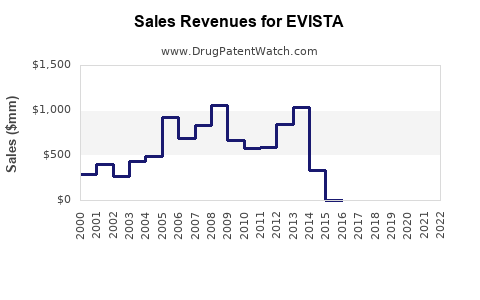
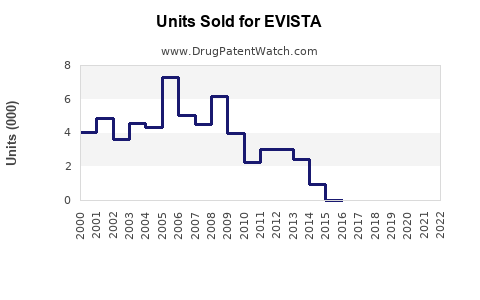
Annual Sales Revenues and Units Sold for EVISTA
| Drug Name | Revenues (USD) | Units | Year |
|---|---|---|---|
| EVISTA | ⤷ Start Trial | ⤷ Start Trial | 2022 |
| EVISTA | ⤷ Start Trial | ⤷ Start Trial | 2021 |
| EVISTA | ⤷ Start Trial | ⤷ Start Trial | 2020 |
| EVISTA | ⤷ Start Trial | ⤷ Start Trial | 2019 |
| EVISTA | ⤷ Start Trial | ⤷ Start Trial | 2018 |
| >Drug Name | >Revenues (USD) | >Units | >Year |
Evista Market Analysis, Raloxifene Sales Projections, Patent Expiration and Generic Competition
Evista, Eli Lilly’s brand of raloxifene hydrochloride, is a mature selective estrogen receptor modulator with limited remaining branded revenue. Its commercial value is concentrated in generic raloxifene, postmenopausal osteoporosis treatment, and breast-cancer risk reduction. The U.S. market has been generic for many years, and future growth is likely to come from prescription persistence, guideline-driven use, and low-cost access rather than branded price expansion.
What is Evista and how is it used?
Evista contains raloxifene hydrochloride, a selective estrogen receptor modulator. The FDA-approved indications are:
- Treatment and prevention of postmenopausal osteoporosis.
- Reduction in the risk of invasive breast cancer in postmenopausal women with osteoporosis or elevated breast-cancer risk.
Evista is not approved to treat breast cancer. Its label carries boxed warnings for increased risk of venous thromboembolic events and death from stroke in certain high-risk populations. The product is administered orally at 60 mg once daily. [1]
| Product | Active ingredient | Dosage form | Primary indications | Original sponsor |
|---|---|---|---|---|
| Evista | Raloxifene hydrochloride | 60 mg tablet | Osteoporosis; invasive breast-cancer risk reduction | Eli Lilly |
| Generic raloxifene | Raloxifene hydrochloride | 60 mg tablet | Same FDA-approved indications, subject to labeling | Multiple manufacturers |
Raloxifene competes with oral bisphosphonates, denosumab, teriparatide, abaloparatide, romosozumab and, in selected patients, tamoxifen for breast-cancer risk reduction. Its clinical differentiation is the combination of bone-density benefits and reduced invasive breast-cancer risk, although thromboembolic risk limits use in some patients.
When did Evista lose market exclusivity?
Evista lost meaningful U.S. market exclusivity when generic raloxifene entered the market in the late 2000s. Generic competition followed patent litigation involving Barr Laboratories and other applicants, with generic products subsequently approved by the FDA.
The commercial exclusivity timeline is:
| Milestone | Approximate timing | Commercial effect |
|---|---|---|
| FDA approval of Evista | 1997 | U.S. branded launch |
| Osteoporosis indication expanded | 1999 | Broader postmenopausal market |
| Breast-cancer risk-reduction indication | 2007 | Expanded clinical utility |
| Generic raloxifene approvals and launch | Late 2000s | Rapid erosion of branded pricing |
| Current market | 2024-2025 | Predominantly generic |
Eli Lilly’s historical patent estate no longer provides practical U.S. market exclusivity. The original composition-of-matter and formulation protections have expired or become commercially irrelevant because generic products are widely available. Current commercial analysis should focus on generic supply, reimbursement, manufacturing economics and prescribing behavior rather than patent expiry.
What patents protect Evista and raloxifene?
The principal historical protection covered raloxifene, its pharmaceutical compositions and therapeutic uses. The relevant U.S. patent families included compound and formulation claims associated with Eli Lilly’s development program. The exact status of individual patents depends on patent family, terminal disclaimers, pediatric extensions, jurisdiction and Orange Book listing history.
The current patent position can be summarized as follows:
| Patent category | Historical role | Current commercial relevance |
|---|---|---|
| Raloxifene compound patents | Protected active pharmaceutical ingredient | Expired |
| Pharmaceutical composition patents | Covered tablet compositions and excipients | Expired or commercially weak |
| Osteoporosis method-of-use patents | Protected use in postmenopausal women | Expired or readily avoided |
| Breast-cancer risk-reduction patents | Supported later indication | Limited practical blocking power |
| Manufacturing patents | May cover process or intermediate chemistry | Potentially relevant to suppliers, not branded market control |
| New formulation patents | No established high-value U.S. exclusivity platform | Low |
The FDA Orange Book remains the controlling source for listed patents and regulatory exclusivity. Evista’s product record is NDA 020815. A patent listed for a mature product does not automatically prevent generic launch if the applicant files a Paragraph IV certification, uses a non-infringing process or waits for patent expiry. [2]
What is the Orange Book status of Evista?
Evista is a legacy small-molecule NDA product. It does not have biologic exclusivity, biosimilar protection or the 12-year reference-product exclusivity available to biologics under the Public Health Service Act.
The relevant regulatory characteristics are:
| Regulatory issue | Evista status |
|---|---|
| FDA product type | Small-molecule prescription drug |
| NDA | 020815 |
| Reference product | Evista |
| Generic pathway | ANDA under section 505(j) |
| Biosimilar pathway | Not applicable |
| Pediatric exclusivity | No current commercial significance |
| Orphan exclusivity | None identified as a core commercial driver |
| Orange Book relevance | Historical patents and current generic-substitution framework |
Generic applicants generally demonstrate bioequivalence rather than repeat the full clinical development program. This lowers barriers to entry relative to products requiring new clinical trials.
How large is the Evista and raloxifene market?
The branded Evista market is now small compared with its historical peak. Eli Lilly has not consistently reported Evista as a material standalone growth product in recent annual reporting, which indicates that the brand no longer contributes significant revenue relative to Lilly’s major products. [3]
The economically relevant market is generic raloxifene. Public market reports vary widely because some count only active pharmaceutical ingredient sales, while others include retail pharmacy revenue, hospital channels, global sales or the broader osteoporosis market.
A practical market segmentation is:
| Segment | Current commercial profile | Growth outlook |
|---|---|---|
| U.S. branded Evista | Minimal and vulnerable to substitution | Declining or flat |
| U.S. generic raloxifene | Established low-cost market | Flat to modest growth |
| European raloxifene | Generic and reimbursement-driven | Flat |
| Emerging markets | Greater price sensitivity and variable access | Low single-digit growth |
| Global osteoporosis therapies | Much larger than raloxifene | Growth concentrated in newer agents |
| Breast-cancer prevention use | Underpenetrated relative to eligible population | Selective upside |
Raloxifene is unlikely to regain a large branded share without a new delivery system, combination product, materially improved safety profile or a new indication. The largest unmet commercial opportunity is not patent-based. It is increased uptake among women eligible for chemoprevention but unwilling to use tamoxifen or unable to access newer osteoporosis products.
What are the sales projections for Evista?
Public company guidance for future Evista sales is not available. The following projections are analytical estimates for the commercial product category, not Eli Lilly guidance.
Branded Evista projection
| Year | Estimated branded U.S. sales direction | Expected market condition |
|---|---|---|
| 2024 | Very low | Generic substitution dominates |
| 2025 | Flat to down | Limited brand loyalty and low reimbursement preference |
| 2026 | Down | Further formulary pressure |
| 2027 | Down | Brand becomes primarily residual or cash-pay |
| 2028 | Down or immaterial | No known exclusivity catalyst |
A reasonable base case is a 5% to 15% annual decline in branded Evista revenue, with the product approaching immateriality in major commercial channels. The decline could be slower in markets where branded prescribing persists, but the U.S. branded trajectory remains structurally weak.
Generic raloxifene projection
| Scenario | 2025-2028 annual growth | Key assumptions |
|---|---|---|
| Bear case | -3% to -6% | Continued decline in osteoporosis prescriptions; price compression |
| Base case | 0% to 3% | Stable generic demand and modest use in breast-cancer prevention |
| Bull case | 4% to 7% | Higher chemoprevention adoption and improved persistence |
The base case implies a broadly stable global raloxifene market through 2028. Volume growth may be offset by lower net prices. Generic manufacturers should expect a mature-market profile: predictable demand, limited pricing power and periodic supply-driven volatility.
Which companies are challenging Evista?
Generic competition is distributed across multiple manufacturers and suppliers. U.S. ANDA availability has historically included products from companies such as Teva, Mylan, Watson/Actavis, Sandoz and other generic manufacturers, depending on the period and product status.
Competition occurs primarily on:
- Wholesale acquisition cost.
- Pharmacy benefit manager reimbursement.
- Product availability.
- Manufacturing reliability.
- Contract pharmacy relationships.
- Ability to maintain FDA-compliant supply.
Because raloxifene is a relatively old and technically straightforward oral tablet, the principal barriers are regulatory compliance, quality systems and reliable low-cost manufacturing. The market does not require advanced drug-delivery technology.
What generic entry risks exist for Evista?
Generic entry risk is already realized rather than pending. The principal commercial risks are therefore substitution and price erosion.
Generic risk assessment
| Risk | Severity | Analysis |
|---|---|---|
| ANDA competition | High | Multiple generic suppliers have operated in the market |
| Paragraph IV litigation | Low current impact | Historical issue; no obvious remaining exclusivity event |
| Brand-to-generic substitution | High | Pharmacies and payers favor lower-cost products |
| Price erosion | High | Mature oral solid dosage market |
| Supply interruption | Moderate | Low-margin manufacturing can reduce supplier participation |
| New indication competition | Moderate | Prevention use may expand, but competing therapies remain |
| Biosimilar competition | None | Raloxifene is a small molecule, not a biologic |
A new Paragraph IV wave would have limited strategic importance unless it involved a newly approved formulation or a newly listed patent. The current risk is commercial erosion, not a litigation-driven cliff.
What formulation patents protect raloxifene?
No formulation platform associated with Evista is known to create a material current barrier to generic substitution. Generic raloxifene tablets generally rely on conventional immediate-release oral dosage technology and demonstrate bioequivalence to the reference product.
Potential formulation opportunities include:
- Reduced-dose regimens.
- Improved adherence packaging.
- Combination therapy with calcium or vitamin D.
- Modified-release tablets.
- Transdermal or localized delivery.
- Formulations designed to reduce thromboembolic risk.
These approaches would require new clinical, regulatory and intellectual-property investment. A new formulation could receive patent protection, but it would not automatically eliminate competition to existing generic 60 mg tablets.
How does Evista compare with competing osteoporosis drugs?
| Therapy | Main advantage | Main limitation | Competitive effect on raloxifene |
|---|---|---|---|
| Alendronate and other bisphosphonates | Low cost; extensive clinical use | Adherence and gastrointestinal concerns | Strong price competition |
| Denosumab | Potent antiresorptive effect; twice-yearly administration | Higher cost; rebound risk after discontinuation | Strong in higher-risk patients |
| Teriparatide and abaloparatide | Anabolic bone formation | Injectable; expensive | Used in severe disease |
| Romosozumab | Potent fracture-risk reduction | Cardiovascular warning and cost | Premium specialist competition |
| Tamoxifen | Breast-cancer risk reduction | More adverse effects for some patients | Competes in chemoprevention |
| Raloxifene | Bone benefit plus reduced invasive breast-cancer risk | Venous thromboembolism risk; limited fracture profile | Retains niche positioning |
Raloxifene is most defensible in patients who need osteoporosis prevention or treatment and also value reduced invasive breast-cancer risk, particularly when low cost and oral dosing matter.
What licensing deals affect Evista?
No current major licensing transaction is a known driver of Evista’s market outlook. Eli Lilly originally controlled the product, while generic manufacturers commercialize raloxifene through their own ANDAs or supply arrangements.
A transaction involving raloxifene would likely be a mature-product or regional supply deal rather than a high-value innovation license. Deal value would depend on:
- Geographic rights.
- Manufacturing cost.
- Regulatory approvals.
- Supply obligations.
- Reimbursement access.
- Whether the transaction includes a new formulation or combination product.
What patent litigation and settlements affected Evista?
Historical litigation centered on generic challenges to Lilly’s raloxifene patents. The key commercial result was the eventual availability of generic raloxifene. Those proceedings no longer support a branded exclusivity strategy.
No current high-impact settlement is known to alter generic access or delay routine substitution. Any future dispute would likely concern a new formulation, manufacturing process or use patent rather than the original Evista tablet.
What is the revenue exposure for Eli Lilly?
Evista is not a material revenue driver for Eli Lilly relative to its current portfolio. Lilly’s recent commercial performance has been driven primarily by diabetes, obesity and oncology products, including Mounjaro, Zepbound, Trulicity and Verzenio. [3]
The financial exposure can be characterized as:
| Stakeholder | Revenue exposure |
|---|---|
| Eli Lilly | Low and declining |
| Generic manufacturers | Low-to-moderate unit revenue; margin-sensitive |
| Pharmacy benefit managers | Low absolute value; favorable substitution economics |
| Osteoporosis specialists | Moderate clinical relevance |
| Breast-cancer prevention market | Underdeveloped demand opportunity |
The strategic value of raloxifene is greater as a low-cost therapeutic option than as a branded asset.
How strong is the Evista patent estate?
The current patent estate is weak from a market-exclusion perspective.
| Factor | Assessment |
|---|---|
| Core compound exclusivity | Expired |
| Generic availability | Established |
| Brand pricing power | Very low |
| New-use blocking potential | Limited |
| Formulation protection | No known material barrier |
| Manufacturing IP | Potentially relevant at supplier level |
| Litigation leverage | Low |
| Commercial durability | Based on demand, not patents |
The product retains clinical utility, but its intellectual-property value is limited. A buyer evaluating raloxifene should underwrite the asset as a generic or lifecycle-management opportunity, not as a protected branded drug.
Key Takeaways
- Evista is a mature raloxifene brand with minimal current branded revenue.
- Generic raloxifene has controlled the U.S. market since the late 2000s.
- No biosimilar risk exists because raloxifene is a small molecule.
- The original patent estate no longer provides meaningful commercial exclusivity.
- Generic raloxifene sales are likely to remain broadly stable through 2028, with a base-case annual growth range of 0% to 3%.
- Branded Evista revenue is likely to decline 5% to 15% annually absent a new formulation or indication.
- The strongest commercial opportunity is expanded breast-cancer chemoprevention use.
- Manufacturing reliability, reimbursement and low-cost supply are more important than patent litigation.
- Evista is not a material current revenue exposure for Eli Lilly.
FAQs
Is Evista still sold in the United States?
Evista’s active ingredient, raloxifene hydrochloride, remains available primarily through generic products. Brand availability may vary by channel, wholesaler and manufacturer.
Is raloxifene a profitable generic drug?
Raloxifene can generate recurring volume, but profitability is constrained by generic price competition, reimbursement discounts and manufacturing costs. It is more attractive as part of a broad generic portfolio than as a standalone growth product.
Can raloxifene receive a new patent?
A new patent could potentially cover a novel formulation, dosage regimen, combination or manufacturing process. A patent on an old use or conventional tablet would face significant validity and obviousness challenges.
Is Evista safer than tamoxifen?
The drugs have different benefit-risk profiles. Raloxifene is approved for risk reduction in postmenopausal women and generally has a different adverse-event profile from tamoxifen. Treatment selection depends on age, menopausal status, thromboembolic risk, uterine status and fracture risk. [1]
Could raloxifene sales increase despite generic competition?
Yes. Volume could rise if clinicians use raloxifene more often for breast-cancer risk reduction or if access improves among women seeking an inexpensive oral osteoporosis therapy. Higher volume would not necessarily translate into higher manufacturer revenue because generic prices may continue to fall.
References
-
U.S. Food and Drug Administration. (2023). Evista (raloxifene hydrochloride) prescribing information. FDA.
-
U.S. Food and Drug Administration. (2024). Approved drug products with therapeutic equivalence evaluations: Orange Book. FDA.
-
Eli Lilly and Company. (2024). 2023 annual report. Eli Lilly and Company.
More… ↓
