Share This Page
Drug Sales Trends for ESTRACE
✉ Email this page to a colleague
Payment Methods and Pharmacy Types for ESTRACE (2013)
Revenues by Pharmacy Type
Units Sold by Pharmacy Type
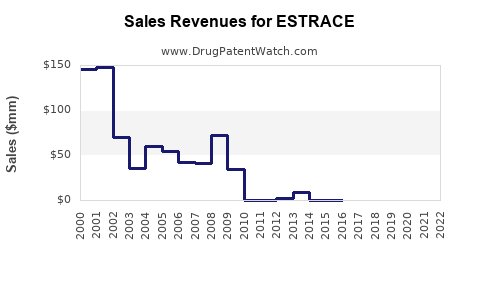
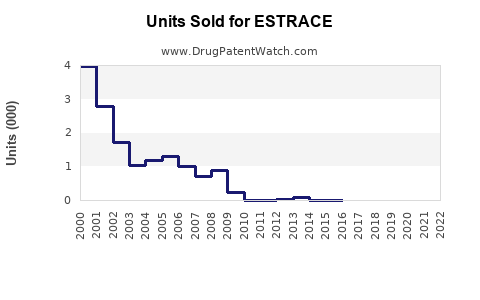
Annual Sales Revenues and Units Sold for ESTRACE
| Drug Name | Revenues (USD) | Units | Year |
|---|---|---|---|
| ESTRACE | ⤷ Start Trial | ⤷ Start Trial | 2022 |
| ESTRACE | ⤷ Start Trial | ⤷ Start Trial | 2021 |
| ESTRACE | ⤷ Start Trial | ⤷ Start Trial | 2020 |
| ESTRACE | ⤷ Start Trial | ⤷ Start Trial | 2019 |
| ESTRACE | ⤷ Start Trial | ⤷ Start Trial | 2018 |
| ESTRACE | ⤷ Start Trial | ⤷ Start Trial | 2017 |
| ESTRACE | ⤷ Start Trial | ⤷ Start Trial | 2016 |
| >Drug Name | >Revenues (USD) | >Units | >Year |
Estrace Market Analysis and Sales Projections: Vaginal Estradiol Cream, Competition, Patents, and Generic Risk
Estrace is the branded vaginal estradiol cream containing 0.01% estradiol. Its U.S. commercial market is mature, genericized, and primarily driven by prescription volume rather than brand pricing. The principal commercial risks are generic substitution, low-cost estradiol alternatives, payer preference for tablets or inserts, and the absence of a durable patent barrier around the core product.
The market remains sizeable because genitourinary syndrome of menopause is prevalent, treatment is chronic or recurrent, and vaginal estrogen has a distinct clinical position for local symptoms. Brand Estrace has limited ability to sustain premium pricing unless it retains strong formulary access, physician familiarity, or a differentiated distribution strategy.
What is Estrace and which product is being analyzed?
Estrace is a brand associated with estradiol products, but the commercial and patent analysis differs by dosage form.
| Product | Active ingredient | U.S. dosage form | Primary use | Commercial status |
|---|---|---|---|---|
| Estrace Vaginal Cream | Estradiol 0.01% | Vaginal cream | Vulvar and vaginal atrophy associated with menopause | Brand with generic competition |
| Estrace tablets | Estradiol | Oral tablets | Menopausal hormone therapy | Generic market; brand availability has been limited or discontinued in many channels |
| Generic estradiol cream | Estradiol 0.01% | Vaginal cream | Same core indications | Multiple generic suppliers |
This analysis focuses on Estrace Vaginal Cream because it is the commercially relevant branded product in the current U.S. market. Estrace Vaginal Cream is supplied in a tube with an applicator and is used intravaginally for menopausal atrophic symptoms. FDA labeling identifies estradiol as the active estrogen and describes use for moderate-to-severe symptoms of vulvar and vaginal atrophy caused by menopause.[1]
How large is the U.S. vaginal estrogen market?
The U.S. vaginal estrogen market is a mature specialty segment within menopausal hormone therapy. Public companies generally do not disclose standalone Estrace sales, and syndicated prescription data are required to establish audited unit and revenue figures. A practical market model therefore uses prescription volume, net price, and generic substitution assumptions.
The relevant competitive set includes:
- Estrace Vaginal Cream and generic estradiol cream
- Vagifem and generic estradiol vaginal tablets
- Yuvafem and generic equivalents
- Imvexxy vaginal inserts
- Estring vaginal ring
- Premarin vaginal cream
- Osphena, an oral selective estrogen receptor modulator
- Intrarosa, a vaginal prasterone product
The market is segmented by delivery system. Cream is generally the lowest-cost local estrogen option, while tablets, inserts, and rings offer cleaner administration and more consistent unit dosing.
Estimated U.S. market framework
The following is an analytical projection rather than reported company guidance.
| Metric | 2024 estimated range | 2025 estimated range |
|---|---|---|
| U.S. vaginal estrogen and related local therapies, retail and specialty sales | $900 million-$1.3 billion | $950 million-$1.4 billion |
| Estradiol cream share of local estrogen prescriptions | 20%-30% | 20%-30% |
| Estrace brand share of estradiol cream prescriptions | 5%-15% | 4%-12% |
| Estimated Estrace brand gross sales | $20 million-$70 million | $18 million-$65 million |
| Estimated generic estradiol cream sales | $150 million-$300 million | $170 million-$330 million |
The range is wide because public sources do not disclose the product-level variables needed to calculate audited sales. Brand revenue is likely much lower than the total sales generated by all estradiol cream prescriptions because generic substitution is extensive.
What are the main growth drivers for Estrace?
The strongest growth factor is the expanding recognition and treatment of genitourinary syndrome of menopause. Symptoms can include vaginal dryness, dyspareunia, irritation, urinary urgency, and recurrent urinary discomfort. Local estrogen remains a widely used treatment option when nonhormonal products do not provide adequate relief.
Demand is supported by several factors:
- A large postmenopausal population.
- Chronic or recurrent treatment requirements.
- Physician familiarity with estradiol cream.
- Broad generic availability that improves affordability.
- Increased menopause-focused healthcare utilization.
- Limited systemic exposure relative to systemic estrogen therapy, although labeling retains estrogen-class warnings and contraindications.
Estrace cream also benefits from flexible dosing. Clinicians can adjust the amount and frequency, which can be useful for patients with differing symptom severity. That flexibility is a commercial advantage over fixed-dose inserts, but it creates administration complexity and may reduce adherence.
What factors limit Estrace sales growth?
Estrace faces structural constraints that reduce brand growth.
Generic substitution
Generic estradiol cream is the primary threat. The active ingredient, concentration, route, and core therapeutic use are readily understood by prescribers and pharmacists. Once a therapeutically equivalent generic is available, payers typically place the generic on preferred tiers and impose higher copayments or prior authorization requirements on the brand.
Formulation preference
Some patients and clinicians prefer vaginal tablets, inserts, or rings because these products provide less mess and more standardized administration. Estradiol inserts and rings can capture patients who do not want to measure cream.
Pricing pressure
The product has limited ability to sustain high annual price increases in a market with generic alternatives. Net prices depend heavily on payer contracting, rebates, pharmacy benefit design, and dispensing channel.
Safety perceptions
Estrogen products remain subject to class labeling concerning endometrial cancer, cardiovascular events, breast cancer, and thromboembolic risk. Vaginal estrogen products are used at lower systemic exposure than systemic estrogen products, but safety labeling can still affect prescribing and patient acceptance.[1,2]
What patents protect Estrace Vaginal Cream?
The commercial protection for Estrace Vaginal Cream is weak relative to products supported by active composition-of-matter or formulation patents.
Core patent position
Estradiol is an established active pharmaceutical ingredient. Its basic chemical composition is long out of patent protection. The principal product is an old drug, and generic estradiol cream products have been approved through the abbreviated new drug application pathway.
The FDA Orange Book should be used to verify current patents and exclusivity listings for the specific Estrace NDA. Orange Book listings can change as FDA records are updated, and the relevant review must distinguish:
- Active patent listings
- Expired patents
- Method-of-use patents
- Drug substance or drug product patents
- Regulatory exclusivity
- Discontinued or unapproved product presentations
No durable composition-of-matter barrier should be assumed for Estrace Vaginal Cream. The commercial position depends more on brand recognition, distribution, payer access, and prescribing habits than on enforceable exclusivity.
Formulation patents
Potential formulation claims can cover:
- The cream vehicle
- Emulsion characteristics
- Preservative systems
- Applicator design
- Dosing methods
- Stability or manufacturing processes
Such claims generally provide narrower protection than a composition-of-matter patent. They may create litigation leverage if listed and enforceable, but they do not necessarily prevent approval of a generic with a different formulation or manufacturing process.
When does Estrace lose exclusivity?
Estrace Vaginal Cream has already lost practical market exclusivity. Generic estradiol cream products are available, and the commercial market is no longer protected by a period of first-launch exclusivity.
The relevant dates are product-specific. FDA approval dates and current Orange Book listings should be reviewed by NDA and ANDA number. The brand's present competitive exposure is therefore based on substitution economics rather than a future patent cliff.
| Exclusivity category | Estrace Vaginal Cream position |
|---|---|
| New chemical entity exclusivity | Not applicable to established estradiol |
| New clinical investigation exclusivity | No meaningful current barrier identified |
| Pediatric exclusivity | No current commercial significance identified |
| Composition-of-matter patent | Expired for estradiol |
| Generic competition | Present |
| Brand substitution risk | High |
| Future loss-of-exclusivity event | Not the primary commercial issue |
What is the Orange Book status of Estrace?
Estrace Vaginal Cream is an FDA-approved prescription product. Its regulatory status should be evaluated through the FDA Drugs@FDA database and the Orange Book under the relevant NDA record.[3,4]
The key diligence points are:
- Whether the branded NDA remains active.
- Whether the specific cream strength and package size are listed as currently marketed.
- Which patents, if any, remain listed.
- Whether listed patents are formulation, method-of-use, or drug-product patents.
- Which ANDA products are therapeutically equivalent.
- Whether any generic has a “B” rating or other substitution limitation.
For commercial forecasting, an approved and substitutable generic market is more important than the existence of expired or narrow Orange Book patents.
Which companies compete with Estrace?
Competition comes from both generic manufacturers and branded local estrogen products.
Generic manufacturers
The generic market commonly includes large U.S. and international suppliers such as:
- Teva Pharmaceuticals
- Viatris
- Prasco Laboratories
- Rising Pharmaceuticals
- Padagis
- Amneal Pharmaceuticals
- Perrigo, depending on product and channel
- Other ANDA holders and authorized distributors
Supplier participation can change because of manufacturing economics, shortages, contract arrangements, and product discontinuations.
Branded competitors
| Product | Manufacturer or sponsor | Delivery system | Competitive position |
|---|---|---|---|
| Premarin Vaginal Cream | Pfizer | Cream | Established branded estrogen; different active ingredient |
| Vagifem | Novo Nordisk | Vaginal tablet | Fixed-dose alternative |
| Yuvafem | Generic/branded generic suppliers | Vaginal tablet | Lower-cost tablet alternative |
| Imvexxy | TherapeuticsMD, now subject to commercial ownership changes | Vaginal insert | Low-dose insert positioning |
| Estring | Pfizer | Vaginal ring | Long-duration administration |
| Intrarosa | Endoceutics/Mayne Pharma-related commercial structure | Vaginal insert | Prasterone alternative |
| Osphena | Duchesnay | Oral tablet | Non-estrogen systemic alternative |
The most direct competitor is generic estradiol cream, followed by generic vaginal tablets. Premarin competes within the same cream category but contains conjugated estrogens rather than estradiol.
Are there Paragraph IV challenges or Estrace patent litigation?
A Paragraph IV certification is relevant only when a generic applicant challenges a listed patent as invalid, unenforceable, or not infringed. Because Estrace Vaginal Cream is already exposed to generic competition, any current Paragraph IV event would likely involve a narrow patent, an updated listing, or a specific formulation or method-of-use claim.
No current litigation should be assumed without checking:
- FDA Paragraph IV notices
- PACER
- CourtListener
- USPTO Patent Center
- Orange Book patent listings
- Company regulatory filings
The absence of a prominent, ongoing patent dispute would be consistent with a mature generic market. Litigation risk is more likely to involve supply, labeling, manufacturing, or market-entry issues than a broad challenge to estradiol itself.
What generic launch scenarios exist for Estrace?
Base case
Generic estradiol cream remains widely available. Brand volume declines gradually as formularies continue to prefer generic products. Estrace retains a small branded segment supported by physicians, patients with brand preference, and plans that do not impose aggressive substitution.
Downside case
Additional generic suppliers enter, wholesale acquisition cost declines, and payer coverage moves the brand to nonpreferred tiers. Brand prescriptions fall 10%-20% annually, with revenue declining faster because of rebates and lower net pricing.
Upside case
The brand preserves selected payer contracts, maintains reliable supply, and benefits from patients who prefer its applicator or consistency. Volume stabilizes, but a major return to premium brand share is unlikely without a new delivery system or clinically differentiated formulation.
What are the five-year sales projections for Estrace?
The projections below estimate U.S. branded Estrace Vaginal Cream sales, not total estradiol cream market revenue.
| Year | Downside case | Base case | Upside case |
|---|---|---|---|
| 2024 | $25 million | $45 million | $70 million |
| 2025 | $20 million | $42 million | $68 million |
| 2026 | $16 million | $39 million | $66 million |
| 2027 | $13 million | $36 million | $64 million |
| 2028 | $10 million | $33 million | $62 million |
| 2029 | $8 million | $30 million | $60 million |
The base case implies a compound annual decline of approximately 8% from 2024 through 2029. The decline reflects continued generic substitution, not a collapse in demand for vaginal estrogen therapy.
A separate total-market forecast is more favorable:
| Year | Estimated U.S. local vaginal estrogen market |
|---|---|
| 2024 | $900 million-$1.3 billion |
| 2025 | $950 million-$1.4 billion |
| 2026 | $1.0 billion-$1.5 billion |
| 2027 | $1.05 billion-$1.6 billion |
| 2028 | $1.1 billion-$1.7 billion |
| 2029 | $1.15 billion-$1.8 billion |
This market can grow while Estrace brand sales decline because generic and competing branded products capture the increase.
How strong is the Estrace patent estate?
The patent estate is weak as a basis for long-term value. Its principal strengths are:
- Established brand recognition
- FDA approval and prescribing history
- Broad physician familiarity
- A known cream delivery system
- Potential manufacturing know-how
- Distribution relationships
Its principal weaknesses are:
- Expired active-ingredient protection
- Existing generic competition
- Low switching costs
- Limited differentiation in the active ingredient
- Payer preference for generic estradiol
- Substitution by tablets, inserts, and rings
The asset is more defensible as a cash-flow brand than as a patent-protected innovation.
What licensing and business-development opportunities exist?
Licensing value is most likely in product extensions rather than the existing cream alone. Potential opportunities include:
- New applicator technology
- Metered-dose delivery
- Lower-mess formulations
- Preservative-free cream
- Extended-duration vaginal delivery
- Co-packaged nonhormonal moisturizers
- Digital adherence support
- Geographic licensing in markets with limited generic competition
A licensing transaction centered only on the existing U.S. Estrace cream would face substantial valuation pressure. A transaction that includes differentiated delivery technology, international rights, or a broader menopause portfolio would have stronger commercial rationale.
What regulatory and manufacturing barriers affect Estrace?
The primary regulatory route for generic estradiol cream is an ANDA demonstrating pharmaceutical equivalence and bioequivalence under FDA requirements. Creams can be more complex than immediate-release tablets because equivalence may involve formulation characteristics, rheology, particle size, device performance, and local drug delivery.
Manufacturing barriers include:
- Consistent emulsion production
- Uniform estradiol content
- Microbial control
- Preservative performance
- Tube and applicator compatibility
- Stability through the labeled shelf life
- Reliable supply of pharmaceutical-grade estradiol
These barriers can limit the number of durable suppliers, but they are not equivalent to a strong patent barrier. Manufacturing complexity can support supply reliability and temporary pricing power without preventing eventual generic competition.
Key Takeaways
- Estrace Vaginal Cream is a mature branded estradiol product with substantial generic competition.
- The U.S. branded product likely generates tens of millions of dollars annually, not hundreds of millions.
- Base-case U.S. brand sales are projected to decline from approximately $45 million in 2024 to $30 million by 2029.
- The total local vaginal estrogen market can grow while Estrace brand revenue falls.
- Generic estradiol cream is the most direct competitive threat.
- Estradiol's core composition-of-matter protection has expired.
- Current commercial value depends on brand recognition, payer access, supply reliability, and prescribing habits.
- Formulation and applicator patents, if active, are narrower than composition-of-matter protection.
- Paragraph IV and litigation risk should be assessed against current Orange Book listings and court records, not assumed from historical Estrace patent activity.
- The strongest business-development opportunity is a differentiated delivery system or broader menopause product portfolio.
FAQs
Is Estrace Vaginal Cream still profitable after generic entry?
Yes, but its profitability depends on net pricing, formulary position, manufacturing cost, and retained brand volume. Generic entry sharply limits premium pricing.
Does generic estradiol cream have the same active ingredient as Estrace?
Yes. Generic estradiol cream contains estradiol, generally at the same 0.01% strength. Excipients, manufacturing processes, packaging, and applicator characteristics may differ.
Is Estrace more commercially valuable than Premarin Vaginal Cream?
Estrace benefits from the lower-cost estradiol category, while Premarin retains a distinct conjugated-estrogen brand position. Relative value depends on payer coverage, brand retention, and net price.
Can a new vaginal estrogen formulation obtain patent protection?
Yes. A new formulation, applicator, dosing method, delivery system, or manufacturing process may qualify for patent protection if it satisfies patentability requirements. Protection would not automatically cover existing Estrace products.
What would increase Estrace sales despite generic competition?
A metered-dose applicator, lower-mess formulation, improved adherence, favorable payer contracting, or a clinically differentiated delivery system could support sales. Price increases alone are unlikely to produce durable growth.
References
- U.S. Food and Drug Administration. (2023). Estrace (estradiol vaginal cream) prescribing information. FDA.
- North American Menopause Society. (2022). The 2022 hormone therapy position statement of The North American Menopause Society. Menopause, 29(7), 767-794.
- U.S. Food and Drug Administration. (n.d.). Drugs@FDA: FDA-approved drugs database. FDA.
- U.S. Food and Drug Administration. (n.d.). Approved drug products with therapeutic equivalence evaluations, Orange Book. FDA.
- U.S. Food and Drug Administration. (2019). Abbreviated new drug application submissions: Stability testing of drug substances and products. FDA.
More… ↓
