Share This Page
Drug Sales Trends for DIGOXIN
✉ Email this page to a colleague
Payment Methods and Pharmacy Types for DIGOXIN (2013)
Revenues by Pharmacy Type
Units Sold by Pharmacy Type
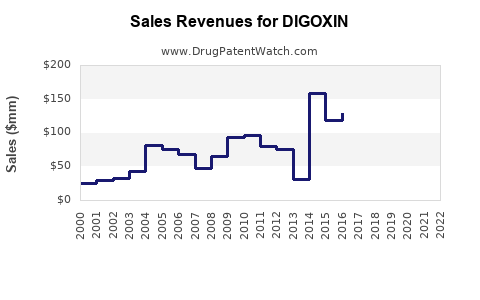
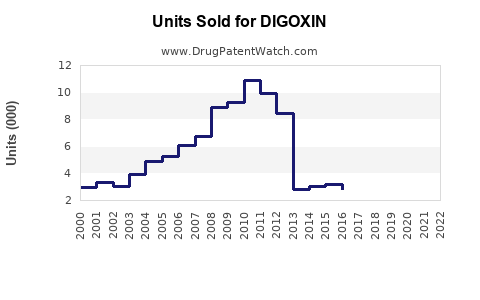
Annual Sales Revenues and Units Sold for DIGOXIN
| Drug Name | Revenues (USD) | Units | Year |
|---|---|---|---|
| DIGOXIN | ⤷ Start Trial | ⤷ Start Trial | 2022 |
| DIGOXIN | ⤷ Start Trial | ⤷ Start Trial | 2021 |
| DIGOXIN | ⤷ Start Trial | ⤷ Start Trial | 2020 |
| DIGOXIN | ⤷ Start Trial | ⤷ Start Trial | 2019 |
| DIGOXIN | ⤷ Start Trial | ⤷ Start Trial | 2018 |
| >Drug Name | >Revenues (USD) | >Units | >Year |
Digoxin Market Analysis, Patent Status, Competitive Landscape, and Sales Projections
Digoxin is a mature, low-cost generic cardiovascular drug with declining clinical use, limited pricing power, and no meaningful remaining patent exclusivity in the United States. Commercial demand is concentrated in chronic heart-failure and atrial-fibrillation treatment, with continued use among selected patients who require rate control or have symptomatic heart failure. The market is fragmented across generic tablet, oral-solution, and injectable products.
The U.S. digoxin market is likely a low-double-digit-million-dollar annual market at manufacturer revenue, with retail spending materially higher because of pharmacy and payer markups. A base-case model indicates global manufacturer sales of approximately $100 million to $130 million in 2024, declining to $75 million to $100 million by 2029. The principal risks are volume erosion, substitution by beta blockers and calcium-channel blockers, reduced heart-failure use, and generic price competition.
What is the current market position of digoxin?
Digoxin is a cardiac glycoside marketed primarily as an oral tablet, oral solution, and intravenous injection. In the United States, the drug is available through generic manufacturers and historically under the Lanoxin brand associated with GlaxoSmithKline and earlier Glaxo Wellcome commercialization.
The main clinical uses are:
- Ventricular-rate control in selected patients with atrial fibrillation or atrial flutter.
- Treatment of mild to moderate heart failure with reduced ejection fraction as an adjunct to guideline-directed therapy.
- Intravenous treatment when oral administration is not practical or when more rapid digitalization is required.
Digoxin is no longer a first-line therapy for most patients with atrial fibrillation or heart failure. Beta blockers, nondihydropyridine calcium-channel blockers, mineralocorticoid receptor antagonists, angiotensin receptor-neprilysin inhibitors, sodium-glucose cotransporter-2 inhibitors, and other therapies have displaced much of its historical use.
The FDA label emphasizes narrow therapeutic exposure and the need to individualize dosing based on age, renal function, lean body weight, electrolyte status, and concomitant medicines (U.S. Food and Drug Administration [FDA], 2022).
How large is the digoxin market?
Published market-research estimates for digoxin vary substantially because some reports include only active pharmaceutical ingredient sales, while others include hospital products, retail prescriptions, and branded or generic finished-dose revenue. A bottom-up commercial model produces the following range:
| Market segment | Estimated 2024 manufacturer sales | 2029 base-case estimate | 2024-2029 trend |
|---|---|---|---|
| U.S. oral tablets and solution | $15 million-$25 million | $10 million-$17 million | Declining |
| U.S. injectable products | $3 million-$7 million | $3 million-$6 million | Stable to declining |
| Europe | $20 million-$30 million | $15 million-$24 million | Declining |
| Asia-Pacific | $35 million-$50 million | $32 million-$45 million | Stable to modest decline |
| Latin America, Middle East, and Africa | $25 million-$35 million | $20 million-$30 million | Declining |
| Global total | $98 million-$147 million | $80 million-$122 million | Low-single-digit annual decline |
These are modeled manufacturer-revenue ranges rather than reported audited sales. The model assumes continued use in older patients, steady hospital demand for injectable digoxin, and annual unit declines partly offset by low generic pricing increases in selected markets.
U.S. retail expenditure is higher than manufacturer revenue. Generic dispensing prices vary by strength, package size, payer, pharmacy channel, and shortage conditions. Digoxin’s low acquisition cost limits the revenue opportunity even when prescription volume remains clinically meaningful.
What are the digoxin sales projections through 2029?
The base case projects global manufacturer sales declining from approximately $110 million in 2024 to $88 million in 2029.
| Year | Global manufacturer-sales estimate | Annual change | Main driver |
|---|---|---|---|
| 2024 | $100 million-$130 million | -2% to -5% | Stable generic demand |
| 2025 | $96 million-$125 million | -2% to -4% | Continued substitution |
| 2026 | $93 million-$120 million | -2% to -4% | Lower chronic use |
| 2027 | $89 million-$114 million | -2% to -4% | Mature generic erosion |
| 2028 | $85 million-$108 million | -2% to -4% | Reduced prescribing |
| 2029 | $80 million-$102 million | -2% to -4% | Volume decline and price pressure |
Bull-case projection
A bull case produces 2029 global sales of approximately $115 million to $135 million. This outcome would require stable atrial-fibrillation use, persistent demand in markets where inexpensive medicines remain preferred, and limited additional generic price erosion.
Bear-case projection
A bear case produces 2029 sales of approximately $55 million to $75 million. This scenario assumes faster replacement by contemporary rate-control and heart-failure therapies, further reductions in digoxin prescribing among older patients, and aggressive competition among injectable and tablet suppliers.
The most probable outcome is a gradual decline rather than a rapid market collapse. Digoxin has a low cost base, a long prescribing history, and established hospital supply chains. Those factors support continued availability even as clinical use contracts.
What companies manufacture and sell digoxin?
The competitive landscape is predominantly generic. U.S. suppliers have included manufacturers and marketers such as:
- Hikma Pharmaceuticals, particularly in injectable hospital products.
- Rising Pharmaceuticals and related generic marketers.
- West-Ward Pharmaceuticals, now associated with Hikma’s U.S. operations.
- Amneal Pharmaceuticals and other generic suppliers, depending on product strength and dosage form.
- Contract manufacturers and regional suppliers serving non-U.S. markets.
- GlaxoSmithKline historically marketed Lanoxin, although the commercial importance of the branded product has diminished substantially.
Supplier participation changes by dosage form, strength, market, and product availability. The tablet market is more exposed to price competition because several suppliers can compete for standard strengths. Injectable digoxin has a narrower supplier base and may have greater commercial value during manufacturing disruptions or hospital shortages.
What formulations are protected by digoxin patents?
No commercially significant, enforceable U.S. patent estate is known to protect the standard digoxin tablets, oral solution, or conventional intravenous injection. The principal formulations are:
| Formulation | Typical strength or concentration | Commercial position | Patent outlook |
|---|---|---|---|
| Immediate-release tablets | 62.5 mcg, 125 mcg, 250 mcg | Largest outpatient segment | No meaningful current patent barrier |
| Oral solution | Commonly 0.05 mg/mL | Niche outpatient and pediatric use | No meaningful current patent barrier |
| Intravenous injection | Commonly 0.25 mg/mL | Hospital and acute-care use | No meaningful current patent barrier |
| Historical branded Lanoxin products | Multiple dosage forms | Largely displaced by generics | Historical exclusivity expired |
Any residual commercial protection is operational rather than patent-based. Examples include manufacturing know-how, validated supply chains, regulatory file ownership, reliable sterile production, and hospital contracting. These factors may delay entry by a specific supplier but do not prevent generic competition.
When does digoxin lose exclusivity?
Digoxin lost meaningful U.S. market exclusivity decades ago. The active ingredient is an old small-molecule drug, and conventional digoxin products are available through abbreviated new drug application pathways rather than a modern branded exclusivity model.
The relevant exclusivity position is:
| Exclusivity category | Current status |
|---|---|
| New chemical entity exclusivity | Expired |
| Standard branded approval exclusivity | Expired |
| Orphan-drug exclusivity | Not a current basis for market protection |
| Pediatric exclusivity | No material current protection identified |
| Generic first-filer exclusivity | Historical or product-specific, not a durable market barrier |
| Patent exclusivity | No material current patent barrier identified |
The Orange Book lists approved drug products and patent information for applicable FDA products. For conventional digoxin, generic competition and abbreviated approvals are the relevant regulatory framework rather than an active branded patent estate (FDA, 2024a).
What is the Orange Book status of digoxin?
Digoxin products appear in FDA-approved drug-product records by dosage form and strength. Orange Book status is product-specific because the FDA records individual approved products under different application and marketing arrangements.
The commercial implications are straightforward:
- Generic digoxin products can compete through ANDA approvals.
- Standard tablets, oral solutions, and injections do not depend on a current composition-of-matter patent.
- Any listed patent information should be reviewed at the individual product level because listing status may differ among products and dosage forms.
- A company entering the market would face regulatory, manufacturing, and contracting barriers rather than a broad patent injunction risk.
FDA labeling and product information are also available through DailyMed, which provides current labeling for marketed prescription products (National Library of Medicine, 2024).
Are there Paragraph IV challenges involving digoxin?
Paragraph IV litigation is not a major current feature of the digoxin market. The principal reason is that the drug’s major patent terms expired long ago, leaving little incentive for a high-value patent challenge against a branded product.
Generic applicants may still encounter:
- Product-specific patent certifications.
- Regulatory disputes involving labeling or dosage-form equivalence.
- Manufacturing and quality issues.
- ANDA deficiencies or inspections.
- Supply and approval delays unrelated to patent validity.
The expected legal risk for a new digoxin entrant is therefore lower than for a recently approved cardiovascular drug with active composition, formulation, or method-of-use patents.
What patent litigation affects digoxin?
No material current U.S. patent litigation is identified as a central barrier to ordinary digoxin tablets, oral solution, or injectable products. Historical disputes, if any, have limited relevance to current market access because generic products are already established.
Potential litigation exposure is more likely to involve:
- Product liability claims related to dosing errors or toxicity.
- Manufacturing-quality allegations.
- Contract disputes between suppliers and distributors.
- Regulatory enforcement involving labeling, sterility, or current good manufacturing practices.
Digoxin toxicity creates greater liability exposure than patent exposure. The drug has a narrow therapeutic index, and toxic effects can include nausea, vomiting, visual disturbances, bradyarrhythmias, atrioventricular block, and ventricular arrhythmias. Renal impairment and drug interactions can increase exposure (FDA, 2022).
What generic entry risks exist for digoxin?
Generic entry risk is already realized across the market. A new entrant would not be challenging a protected premium brand; it would be entering a mature generic market.
The key risks are:
| Risk | Commercial impact |
|---|---|
| Low selling price | Limits return on regulatory and manufacturing investment |
| Small addressable market | Makes scale difficult |
| Multiple established suppliers | Increases price competition |
| Narrow therapeutic index | Raises bioequivalence and quality-control sensitivity |
| Sterile injectable requirements | Increases capital and compliance costs |
| Hospital purchasing concentration | Creates contract and tender pressure |
| Declining clinical use | Reduces long-term volume |
| Product discontinuations | Can create temporary shortages but not durable demand |
The most attractive entry niche is injectable digoxin, where manufacturing capability and supply reliability can be more valuable than brand recognition. Tablets have lower technical complexity but greater price pressure.
How strong is the digoxin patent estate?
The patent estate is weak from an exclusivity perspective and modest from an operational perspective.
| Factor | Assessment |
|---|---|
| Composition-of-matter protection | None of current commercial significance |
| Formulation patents | Limited or expired for conventional products |
| Method-of-use patents | No broad current barrier to standard indications |
| Manufacturing patents | Potentially relevant to individual suppliers, but not market-wide |
| Regulatory exclusivity | Expired for established products |
| Litigation leverage | Low |
| Generic vulnerability | High |
| Supply-chain defensibility | Moderate for sterile injection |
Digoxin is therefore unsuitable for a conventional patent-driven specialty-pharmaceutical strategy. Its value lies in dependable production, geographic reach, hospital contracts, and low-cost portfolio economics.
Does digoxin have biosimilar risk?
Digoxin has no biosimilar risk because it is a chemically synthesized small molecule, not a biologic. Competition occurs through generic-drug pathways, including ANDAs in the United States and comparable generic procedures in other jurisdictions.
The relevant substitution risks are therapeutic rather than biosimilar:
- Beta blockers for ventricular-rate control.
- Diltiazem or verapamil in appropriate atrial-fibrillation patients.
- Amiodarone in selected rhythm-control or rate-control settings.
- Contemporary guideline-directed heart-failure medicines.
- Catheter ablation and other procedural treatment.
What FDA regulatory issues affect digoxin sales?
FDA regulation focuses on quality, bioequivalence, labeling, and narrow-therapeutic-index control.
Important regulatory considerations include:
- Strength-specific bioequivalence.
- Accurate digoxin assay and content uniformity.
- Control of tablet dissolution.
- Stability and impurity testing.
- Sterility assurance for intravenous products.
- Dosing instructions based on renal function and body size.
- Labeling for drug interactions and toxicity.
- Appropriate conversion between oral and intravenous products.
The FDA label recommends serum-concentration monitoring when clinically indicated, while also recognizing that clinical response and toxicity are not determined by concentration alone (FDA, 2022). This labeling complexity increases pharmacovigilance obligations but does not create commercial exclusivity.
Which licensing deals affect the digoxin market?
No major current licensing transaction is central to the global digoxin market. The product is generally supplied through generic manufacturing, distribution, and marketing agreements rather than high-value originator licensing.
Commercial arrangements may include:
- Contract manufacturing for tablets or sterile injection.
- Regional distribution rights.
- Hospital tender agreements.
- Authorized generic supply.
- Portfolio acquisitions involving mature cardiovascular products.
These agreements can change the identity of the marketer without changing the underlying competitive structure. A licensing transaction would likely have limited strategic value unless it added scarce injectable capacity or access to a protected regional market.
What is the competitive outlook for digoxin?
Digoxin remains commercially viable as a low-revenue, low-growth generic. The market has three distinct characteristics:
- Chronic outpatient tablets generate the largest unit base.
- Injectable products have greater supply-chain value and may produce better margins.
- Clinical substitution limits long-term growth across all dosage forms.
The market is more resilient in countries where digoxin remains familiar to physicians, affordable to patients, and available through public-sector procurement. It is weaker in markets with broad access to newer heart-failure and atrial-fibrillation therapies.
What is the revenue exposure for manufacturers?
For a diversified generic manufacturer, digoxin is unlikely to represent material revenue exposure unless the company has a concentrated cardiovascular portfolio or supplies a significant share of the injectable market.
| Manufacturer profile | Expected digoxin exposure |
|---|---|
| Large diversified generic company | Immaterial to low |
| Hospital-injection specialist | Low but potentially strategic |
| Regional cardiovascular supplier | Moderate |
| Single-product or small-portfolio company | Potentially material |
| API manufacturer | Low-value, volume-dependent |
| Branded specialty company | Not strategically attractive |
A supply disruption can produce short-term price increases, especially for injection, but the market lacks the sustained pricing power associated with patented drugs or concentrated specialty products.
Key Takeaways
- Digoxin is a mature generic cardiovascular drug with no meaningful current U.S. patent exclusivity.
- Global manufacturer sales are estimated at approximately $100 million to $130 million in 2024.
- Base-case sales decline to roughly $80 million to $102 million by 2029.
- Tablets account for most chronic use but face the strongest price competition.
- Injectable digoxin has a smaller market and greater manufacturing barriers.
- Paragraph IV litigation and patent-based generic-entry risk are limited.
- Digoxin is not subject to biosimilar competition.
- The main commercial threats are clinical substitution, declining prescribing, and generic price erosion.
- The strongest business case is operational: reliable sterile manufacturing, hospital access, and regional distribution.
- The drug is not an attractive platform for patent-led investment or premium pricing.
FAQs About Digoxin Market Size, Patents, and Sales
Is digoxin still profitable for generic manufacturers?
It can be profitable for established manufacturers with existing facilities and distribution contracts. Stand-alone development is less attractive because prices are low and the market is declining.
Which digoxin dosage form has the strongest commercial outlook?
Injectable digoxin has the strongest relative outlook because fewer suppliers manufacture sterile products. Tablets have greater volume but more severe price competition.
Can a company launch a new digoxin product without a patent license?
Generally, yes, provided the product satisfies applicable FDA or foreign regulatory requirements and does not infringe a product-specific enforceable patent. Conventional digoxin products have no broad current patent barrier.
Is Lanoxin still a major competitor to generic digoxin?
No. Lanoxin has historical brand recognition, but generic products dominate the commercial market. The main competitive factors are price, availability, labeling, and supply reliability.
Will digoxin sales increase because of population aging?
Population aging supports a residual patient base, but it is unlikely to offset therapeutic substitution and declining use in guideline-directed cardiovascular care. Aging is a stabilizing factor, not a strong growth driver.
References
-
National Library of Medicine. (2024). DailyMed: Digoxin drug labels. U.S. National Library of Medicine. https://dailymed.nlm.nih.gov/
-
U.S. Food and Drug Administration. (2022). Digoxin prescribing information. FDA. https://www.accessdata.fda.gov/
-
U.S. Food and Drug Administration. (2024a). Approved drug products with therapeutic equivalence evaluations: Orange Book. FDA. https://www.accessdata.fda.gov/scripts/cder/ob/
-
U.S. Food and Drug Administration. (2024b). Drugs@FDA: FDA-approved drugs. FDA. https://www.accessdata.fda.gov/scripts/cder/daf/
-
U.S. Food and Drug Administration. (2024c). ANDA approvals and abbreviated new drug applications. FDA. https://www.fda.gov/drugs/abbreviated-new-drug-application-anda/abbreviated-new-drug-application-anda
More… ↓
