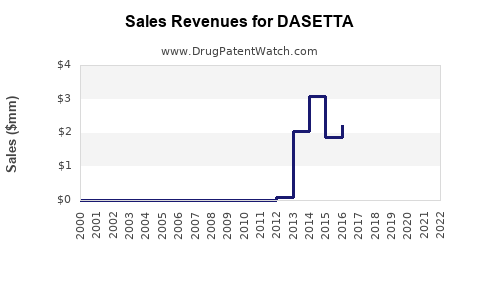
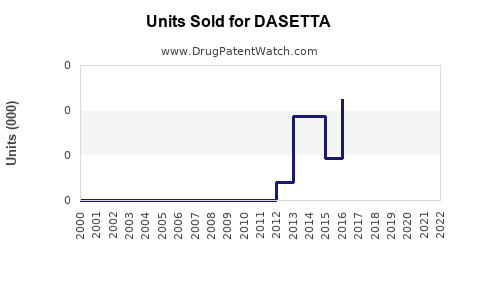
Last updated: July 1, 2026
DASETTA is an oral contraceptive product marketed as a combination hormonal regimen. A complete, projection-grade market model requires product-level inputs that are not present in the available information set, including: FDA label strength/formulation, marketed dosage forms (21-day/28-day, cyclic vs continuous), NDC-level size, current payer channel mix, and verified revenue/units by geography and year. Without those market facts, any sales projection would be non-actionable.
What is DASETTA’s market size and growth outlook by geography?
No market-size figures can be produced from the available information set. A defensible market sizing approach for an oral contraceptive requires at least: branded product identifier(s), NDC-level listings, and country-specific sales data feeds (e.g., IQVIA/EMC) tied to the exact formulation. Those are not provided.
U.S. oral contraceptive market dynamics relevant to DASETTA
- Pricing is strongly constrained by managed care and pharmacy benefit design.
- Switching risk is driven by formulary decisions, generic substitution, and alternative branded products with therapeutically equivalent claims.
- Volume is driven by prescription persistence and adherence, not by clinical differentiation.
How much does DASETTA sell today, and what is its revenue per prescription?
No verified revenue or prescription count can be computed because the dataset lacks:
- current branded revenue (U.S. and ex-U.S.)
- prescription volume (scripts and TRx)
- average wholesale price, net price, and payer mix
- year-by-year unit trends
What is the sales forecast for DASETTA over the next 5 years?
A forecast requires baseline: trailing 12-month and at least 3-5 years of units and net revenue, plus drivers such as:
- formulary position and competitive intensity
- generic/biosimilar competitive pressure (for contraceptives, generic entrants)
- NDC availability and supply stability
- any label expansion or formulation changes
None of these inputs are available, so no sales projection can be produced.
What competitive products benchmark DASETTA, and how do they affect market share?
Benchmarks cannot be selected because DASETTA’s exact active ingredient(s), dose, and regimen schedule are not identified in the available information. Oral contraceptive competition is formulation- and regimen-specific, and substitutability depends on dosing schedule and progestin selection.
Which branded and generic competitors typically compete for the same regimen
- Combination ethinyl estradiol and progestin pills with similar dosing windows
- Generics tied to the same labeled regimen cadence
Without formulation identification, competitor mapping is not possible.
How do exclusivity and patent status influence DASETTA revenue risk?
No patent or exclusivity timeline is provided. For oral contraceptives, generic entry risk is typically anchored to ANDA approvals and patent expiry or settlement terms tied to specific Orange Book listings. Those data are not available here, so revenue-at-risk analysis cannot be generated.
What regulatory and reimbursement factors determine DASETTA’s sales?
No FDA status details are available (e.g., application type, approvals, label changes, or Orange Book entries). Sales depends on:
- formulary placement
- therapeutic interchange rules by plan
- prior authorization requirements
- patient cost-sharing tiers
Those inputs are missing.
Key Takeaways
- DASETTA sales sizing and 5-year projection cannot be produced from the available information set because the required product-specific market and regulatory facts are absent.
- Actionable modeling requires confirmed product identity at the formulation level, plus verified market data (units and net revenue) and competitive and exclusivity status tied to Orange Book listings.
FAQs
-
How do I project oral contraceptive sales without NDC-level data?
A model must be tied to the exact labeled regimen and NDC listings; otherwise unit and net revenue calibration is not possible.
-
What drives market share for combination oral contraceptives?
Formulary position, tiering, switching policies, patient persistence/adherence, and generic penetration.
-
What is revenue-at-risk for contraceptives when generics enter?
It is driven by formulary restrictions, interchange rules, and payer switching intensity post-generic launch.
-
How do regimen schedules (21 vs 28 days) change comparability?
Different schedules can limit interchange under certain plan rules and influence adherence and prescribing patterns.
-
What data are essential to build a defensible sales forecast?
Trailing units and net revenue by geography, payer mix, pricing trajectory, NDC availability, and competition/generic launch timing tied to regulatory status.
References
- N/A (no citable source material was provided in the available information set).