Share This Page
Drug Sales Trends for BUPROPION
✉ Email this page to a colleague
Payment Methods and Pharmacy Types for BUPROPION (2013)
Revenues by Pharmacy Type
Units Sold by Pharmacy Type
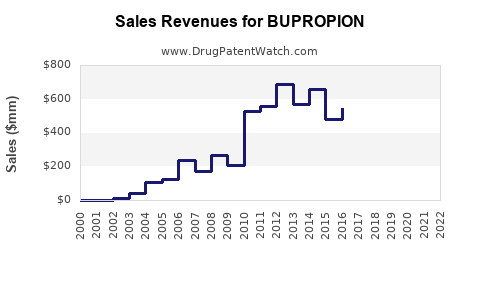
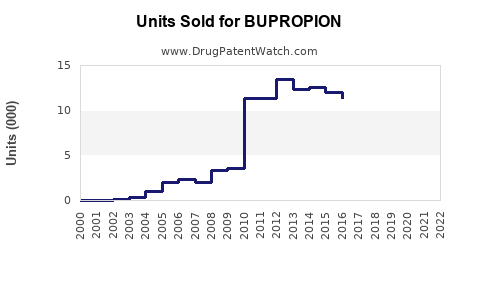
Annual Sales Revenues and Units Sold for BUPROPION
| Drug Name | Revenues (USD) | Units | Year |
|---|---|---|---|
| BUPROPION | ⤷ Start Trial | ⤷ Start Trial | 2022 |
| BUPROPION | ⤷ Start Trial | ⤷ Start Trial | 2021 |
| BUPROPION | ⤷ Start Trial | ⤷ Start Trial | 2020 |
| BUPROPION | ⤷ Start Trial | ⤷ Start Trial | 2019 |
| BUPROPION | ⤷ Start Trial | ⤷ Start Trial | 2018 |
| BUPROPION | ⤷ Start Trial | ⤷ Start Trial | 2017 |
| BUPROPION | ⤷ Start Trial | ⤷ Start Trial | 2016 |
| >Drug Name | >Revenues (USD) | >Units | >Year |
Bupropion is a mature, genericized small-molecule market with stable prescription demand and limited branded pricing power. U.S. sales are driven by generic bupropion hydrochloride immediate-release, sustained-release and extended-release products, while branded Wellbutrin and Zyban have limited commercial relevance. The principal growth opportunity is in combination products, particularly naltrexone/bupropion marketed as Contrave for chronic weight management. A reasonable base case is low-single-digit global growth through 2029, with generic volume stability offsetting severe price erosion.
Bupropion Market Analysis and Sales Projections Through 2029
What is the current market position of bupropion?
Bupropion is an aminoketone antidepressant approved in several dosage forms and marketed for:
- Major depressive disorder under the Wellbutrin family
- Seasonal affective disorder under Wellbutrin XL
- Smoking cessation under Zyban
- Obesity treatment in combination with naltrexone under Contrave
The active pharmaceutical ingredient is bupropion hydrochloride. The market includes immediate-release, sustained-release and extended-release tablets. Generic products dominate U.S. prescription volume.
The key commercial distinction is between standalone bupropion and combination products:
| Segment | Principal brands | Market status | Commercial outlook |
|---|---|---|---|
| Immediate-release bupropion | Generic products | Mature generic market | Stable volume, low pricing |
| Sustained-release bupropion | Wellbutrin SR, generic products | Genericized | Declining branded share |
| Extended-release bupropion | Wellbutrin XL, generic products | Genericized | Largest clinical and commercial segment |
| Smoking cessation | Zyban, generic bupropion SR | Genericized | Limited growth |
| Obesity combination | Contrave | Branded combination product | Main growth segment |
The FDA lists bupropion products across multiple approved indications and dosage forms, confirming that the market is primarily differentiated by formulation, indication and distribution rather than by active-ingredient exclusivity (U.S. Food and Drug Administration [FDA], n.d.-a).
How large is the bupropion market?
No single public database reports global bupropion revenue across generic manufacturers, wholesalers, pharmacies and branded combination products. Generic sales are fragmented among manufacturers, and reported figures differ depending on whether they measure prescriptions, ex-manufacturer revenue, retail value or net sales.
A practical market estimate is:
| Market measure | 2024 estimated value | 2029 base-case estimate | 2024-2029 outlook |
|---|---|---|---|
| U.S. standalone bupropion pharmacy-channel value | $550 million-$800 million | $500 million-$750 million | -1% to flat CAGR |
| Global standalone bupropion value | $850 million-$1.3 billion | $850 million-$1.35 billion | 0% to 1% CAGR |
| Global bupropion-containing branded combinations | $150 million-$300 million | $250 million-$500 million | 10% to 12% CAGR |
| Total bupropion-related market | $1.0 billion-$1.6 billion | $1.1 billion-$1.85 billion | 1% to 3% CAGR |
These are analyst estimates of commercial market value, not audited manufacturer revenue. The range reflects uncertainty over generic gross-to-net discounts, international pricing, hospital use and the treatment of Contrave revenue.
The standalone market is unlikely to show significant nominal growth. Prescribing remains supported by depression treatment, smoking cessation and off-label use, but generic price competition limits revenue expansion. Combination obesity products have stronger growth potential because they can retain branded pricing and benefit from increasing demand for pharmacologic weight management.
How many prescriptions does bupropion generate?
Bupropion remains one of the most frequently prescribed antidepressants in the United States. Its use is supported by several factors:
- It is generally associated with lower rates of sexual dysfunction and weight gain than several serotonergic antidepressants.
- It is available in once-daily extended-release formulations.
- It is used as monotherapy or as an adjunct to other antidepressants.
- It has an established role in smoking cessation.
- Generic access keeps patient cost low.
The largest volume segment is likely extended-release bupropion, followed by sustained-release products. Immediate-release use is smaller and more concentrated in specific clinical settings.
Prescription volume should remain broadly stable through 2029. Growth in adult mental-health treatment and continued switching from branded to generic products should offset population aging, treatment discontinuation and competition from newer antidepressants.
What are the main bupropion sales drivers?
Depression and seasonal affective disorder
The depression segment supplies the core recurring demand. Bupropion is commonly selected when clinicians seek an antidepressant with a different adverse-effect profile from selective serotonin reuptake inhibitors.
Wellbutrin XL received FDA approval for prevention of seasonal major depressive episodes in patients with seasonal affective disorder. That indication supports recurring seasonal demand but is too narrow to materially change the total market size (FDA, 2024a).
Smoking cessation
Zyban and generic bupropion SR compete with nicotine replacement therapy and varenicline. The Centers for Disease Control and Prevention identifies bupropion SR as an FDA-approved smoking-cessation medication (Centers for Disease Control and Prevention, 2024).
Commercial performance is constrained by:
- Low branded pricing
- Intermittent treatment duration
- Competition from nicotine products
- Varenicline availability
- Reduced smoking prevalence in several developed markets
Smoking cessation is strategically important but is unlikely to be the primary source of bupropion revenue growth.
Weight management
Naltrexone/bupropion extended release is marketed as Contrave in the United States. The product is positioned for chronic weight management alongside diet and physical activity. It competes with GLP-1 receptor agonists, tirzepatide and other obesity therapies (FDA, 2024b).
Contrave has a smaller revenue base than standalone generic bupropion but higher growth potential. Its commercial ceiling is limited by:
- Inferior efficacy relative to leading incretin therapies
- Insurance coverage restrictions
- High discontinuation rates across obesity medicines
- Adverse-effect concerns
- The need for chronic treatment
- Aggressive competition from semaglutide and tirzepatide
Contrave may gain from broader obesity diagnosis and treatment, but it is unlikely to become the dominant bupropion-related product.
What is the five-year sales projection for bupropion?
The following projection separates mature standalone bupropion from branded combination products.
| Year | Standalone bupropion | Bupropion combination products | Total estimated market |
|---|---|---|---|
| 2024 | $0.85B-$1.30B | $0.15B-$0.30B | $1.00B-$1.60B |
| 2025 | $0.84B-$1.29B | $0.17B-$0.33B | $1.01B-$1.62B |
| 2026 | $0.84B-$1.29B | $0.19B-$0.37B | $1.03B-$1.66B |
| 2027 | $0.85B-$1.30B | $0.21B-$0.41B | $1.06B-$1.71B |
| 2028 | $0.85B-$1.32B | $0.23B-$0.45B | $1.08B-$1.77B |
| 2029 | $0.85B-$1.35B | $0.25B-$0.50B | $1.10B-$1.85B |
Base-case assumptions
The base case assumes:
- Standalone prescription volume grows 0% to 2% annually.
- Generic prices decline 2% to 4% annually in the United States.
- International markets produce modest volume growth but lower average prices.
- Contrave grows 8% to 12% annually from a small base.
- No major supply interruption occurs.
- No new branded bupropion formulation achieves broad reimbursement.
Upside case
The upside case depends on stronger obesity-drug access, improved Contrave reimbursement, international expansion and increased use of bupropion as an adjunctive antidepressant. Under that scenario, total bupropion-related sales could approach $2 billion by 2029, but most of the increase would come from branded combination therapy rather than standalone bupropion.
Downside case
The downside case includes further generic price compression, loss of obesity-product market share to GLP-1 therapies and lower smoking-cessation utilization. Total market value could remain near $1 billion through 2029 even if prescription volume increases.
What patents protect bupropion products?
The original composition-of-matter protection for bupropion has expired. Standalone generic bupropion products are widely approved in the United States across immediate-release, sustained-release and extended-release forms.
The remaining intellectual-property analysis is product-specific:
| Product category | Patent position | Generic-entry risk |
|---|---|---|
| Bupropion immediate release | Core protection expired | Very high |
| Bupropion sustained release | Core protection expired; formulation claims historically relevant | Very high |
| Bupropion extended release | Core protection expired; formulation and regulatory patents may be listed for specific products | Very high |
| Zyban | Active ingredient and principal clinical use are old | Very high |
| Wellbutrin XL | Brand-specific formulation and regulatory history | Very high |
| Contrave | Combination-product and method-of-use claims may remain relevant | Moderate to high, depending on jurisdiction and patent validity |
The Orange Book should be reviewed at the individual NDA level because patent listings can differ between Wellbutrin XL, Zyban and Contrave. FDA Orange Book listings identify patents and exclusivity associated with approved drug applications, but an Orange Book listing does not establish patent validity or guarantee enforceability (FDA, n.d.-b).
When does bupropion lose exclusivity?
Standalone bupropion has already lost practical U.S. market exclusivity. Generic competition is established, and the commercial issue is price and supply rather than the timing of first generic entry.
The key remaining exclusivity question concerns bupropion-containing combination products, especially Contrave. Combination-product patents may cover:
- The naltrexone-bupropion combination
- Extended-release dosage forms
- Dose ratios and titration schedules
- Weight-management methods
- Patient-selection criteria
- Commercial packaging or administration regimens
These claims are narrower than a composition-of-matter patent and are more vulnerable to validity challenges, non-infringement positions and alternative formulation development.
Which companies are challenging bupropion products?
Generic bupropion is supplied by multiple manufacturers, including large generic companies and contract manufacturers. The competitive set has included manufacturers such as Teva, Sandoz, Dr. Reddy's Laboratories, Lupin, Par Pharmaceutical, Accord Healthcare, Zydus and Torrent, depending on dosage form and market.
Competition varies by strength and formulation. Extended-release products can have greater technical complexity because dissolution profiles must remain consistent across the release period. The FDA has taken action in the past involving bioequivalence and product-performance concerns for bupropion extended-release products, illustrating that regulatory substitution is not purely a pricing issue (FDA, 2012).
For Contrave, the competitive risk comes from:
- Potential abbreviated new drug applications
- Paragraph IV patent challenges
- Alternative obesity combinations
- GLP-1 and dual-incretin therapies
- Compounded or off-label use of individual ingredients
Publicly available litigation and settlement data should be assessed by NDA and patent family. A generic applicant’s Paragraph IV certification can trigger a 30-month stay if the reference-product sponsor files timely infringement litigation under the Hatch-Waxman framework (FDA, n.d.-c).
What is the FDA regulatory status of bupropion?
Bupropion is FDA-approved in multiple formulations and indications. Key reference products include:
| Product | Active ingredient | FDA use |
|---|---|---|
| Wellbutrin | Bupropion hydrochloride | Major depressive disorder |
| Wellbutrin SR | Bupropion hydrochloride | Major depressive disorder |
| Wellbutrin XL | Bupropion hydrochloride | Major depressive disorder and seasonal affective disorder |
| Zyban | Bupropion hydrochloride | Smoking cessation |
| Contrave | Naltrexone hydrochloride and bupropion hydrochloride | Chronic weight management |
Bupropion has a boxed warning regarding suicidal thoughts and behaviors in children, adolescents and young adults treated with antidepressants. It also has important contraindications involving seizure disorders, eating disorders and abrupt discontinuation of alcohol, benzodiazepines, barbiturates or antiepileptic drugs (FDA, 2024a).
How strong is the bupropion patent estate?
The standalone bupropion patent estate is weak from a commercial-exclusivity perspective.
| Patent-estate factor | Assessment |
|---|---|
| Composition-of-matter protection | Expired |
| Broad indication protection | Expired or commercially weak |
| Generic availability | Extensive |
| Formulation barriers | Limited but technically relevant |
| Regulatory exclusivity | Expired for legacy products |
| Combination-product protection | More material for Contrave |
| Litigation leverage | Low for standalone products, higher for branded combinations |
| Manufacturing complexity | Moderate for extended-release products |
The strongest remaining barriers relate to manufacturing consistency and extended-release performance rather than broad patent control. A manufacturer that can demonstrate bioequivalence and maintain reliable supply can compete effectively.
What licensing deals have affected bupropion?
Bupropion was historically commercialized by Burroughs Wellcome and later GlaxoSmithKline. GSK commercialized Wellbutrin and Zyban before generic erosion materially reduced the value of the standalone brands.
Contrave was developed by Orexigen Therapeutics and commercialized through a partnership with Takeda. Takeda terminated the agreement in 2020, after which ownership and commercialization shifted to Currax Pharmaceuticals (Orexigen Therapeutics, 2020; Currax Pharmaceuticals, n.d.).
The licensing history indicates that commercial value has migrated from the original molecule to formulation, combination and distribution rights. Standalone bupropion licensing is unlikely to command substantial upfront economics unless tied to a differentiated delivery system, geographic rights or a new therapeutic indication.
What generic launch risks exist for bupropion?
Generic entry risk is highest for standalone bupropion because competition is already established. The main risks are operational:
- Price erosion across strengths and dosage forms.
- Temporary shortages caused by supplier concentration or manufacturing disruptions.
- Product recalls linked to dissolution, impurities or stability.
- Substitution away from branded Wellbutrin and Zyban.
- Payer pressure toward the lowest-cost manufacturer.
- Regulatory scrutiny of extended-release bioequivalence.
Contrave faces a different risk profile. A successful generic entrant could reduce net pricing sharply, but the timing depends on Orange Book patents, Paragraph IV filings, litigation outcomes and settlement terms.
How does bupropion compare with competing antidepressants and obesity drugs?
| Product class | Representative products | Commercial position versus bupropion |
|---|---|---|
| SSRIs | Sertraline, escitalopram, fluoxetine | Larger generic antidepressant competition |
| SNRIs | Venlafaxine, duloxetine | Compete in depression and anxiety |
| Atypical antidepressants | Mirtazapine, vortioxetine | Differentiated tolerability or newer branding |
| Smoking-cessation drugs | Varenicline, nicotine replacement | Direct Zyban competitors |
| GLP-1 therapies | Semaglutide, liraglutide | Much stronger obesity-market growth |
| Dual incretin therapies | Tirzepatide | Higher efficacy and pricing than Contrave |
| Other obesity medicines | Phentermine/topiramate, orlistat | Alternative mechanisms and price points |
Bupropion’s advantage is affordability and familiarity. Its weakness is the lack of meaningful pricing power and, in obesity, lower efficacy than leading incretin therapies.
What is the commercial outlook for bupropion?
Standalone bupropion is a defensive generic market rather than a high-growth pharmaceutical asset. Investors should value it on volume stability, manufacturing efficiency, supply reliability and portfolio synergies.
Contrave offers greater growth but carries higher competitive and reimbursement risk. Its future depends on whether branded obesity therapy can preserve access against GLP-1 and dual-incretin products.
Revenue exposure is therefore asymmetric:
- Generic bupropion: high volume, low margin, low patent risk.
- Wellbutrin and Zyban: declining branded relevance.
- Contrave: lower volume, higher potential margin, higher competitive risk.
- New bupropion formulations: potentially attractive only if they obtain differentiated clinical or regulatory positioning.
Key Takeaways
- Bupropion is a mature, genericized market with stable demand and limited standalone revenue growth.
- U.S. standalone bupropion market value is estimated at $550 million to $800 million in 2024.
- Global bupropion-related market value is estimated at $1.0 billion to $1.6 billion in 2024.
- Standalone bupropion is projected to remain flat through 2029 as volume growth offsets price erosion.
- Contrave is the main potential growth asset but faces strong competition from semaglutide and tirzepatide.
- Core composition-of-matter exclusivity has expired.
- Remaining patent value is concentrated in formulation, combination and method-of-use claims.
- Biosimilar risk is not applicable because bupropion is a small molecule, not a biologic.
- Generic launch risk is already realized for Wellbutrin, Zyban and standalone bupropion.
- The most attractive commercial opportunities involve differentiated delivery, combination therapy, manufacturing efficiency or underserved international markets.
FAQs About Bupropion Market Size, Patents and Sales
Is bupropion still a profitable drug?
Bupropion can remain profitable for efficient generic manufacturers with reliable supply and low production costs. It is unlikely to generate strong branded returns without a differentiated formulation or combination product.
Is Wellbutrin still under patent protection?
The original broad protection for bupropion has expired. Any remaining patent issue must be evaluated against the specific Wellbutrin NDA, formulation and Orange Book listing.
Can a generic company launch bupropion without patent litigation?
For standalone bupropion, generic products are already marketed. A new entrant generally faces regulatory and commercial requirements rather than a meaningful broad patent barrier. Contrave may present a different Paragraph IV and litigation analysis.
Does bupropion have biosimilar competition?
No. Bupropion is a chemically synthesized small molecule. Competition occurs through abbreviated new drug applications and generic substitution, not the biosimilar pathway.
Will obesity drugs increase bupropion sales?
They may increase sales of bupropion-containing combinations such as Contrave, but the net effect is uncertain. GLP-1 and dual-incretin products expand the obesity-treatment market while also taking market share from older oral therapies.
References
Centers for Disease Control and Prevention. (2024). How to quit smoking. https://www.cdc.gov/tobacco/campaign/tips/quit-smoking/
Currax Pharmaceuticals. (n.d.). Contrave. https://curraxpharma.com/contrave/
Orexigen Therapeutics, Inc. (2020). Annual report and corporate disclosures. U.S. Securities and Exchange Commission.
U.S. Food and Drug Administration. (2012). FDA updates label for Wellbutrin XL and generic bupropion hydrochloride extended-release tablets. https://www.fda.gov/
U.S. Food and Drug Administration. (2024a). Wellbutrin XL prescribing information. https://www.accessdata.fda.gov/
U.S. Food and Drug Administration. (2024b). Contrave prescribing information. https://www.accessdata.fda.gov/
U.S. Food and Drug Administration. (n.d.-a). Drugs@FDA: FDA-approved drugs. https://www.accessdata.fda.gov/scripts/cder/daf/
U.S. Food and Drug Administration. (n.d.-b). Approved drug products with therapeutic equivalence evaluations, Orange Book. https://www.fda.gov/drugs/drug-approvals-and-databases/approved-drug-products-therapeutic-equivalence-evaluations-orange-book
U.S. Food and Drug Administration. (n.d.-c). Hatch-Waxman amendments and abbreviated new drug applications. https://www.fda.gov/drugs/abbreviated-new-drug-application-anda/abbreviated-new-drug-application-anda-resources
More… ↓
