Share This Page
Drug Sales Trends for AMIODARONE
✉ Email this page to a colleague
Payment Methods and Pharmacy Types for AMIODARONE (2013)
Revenues by Pharmacy Type
Units Sold by Pharmacy Type
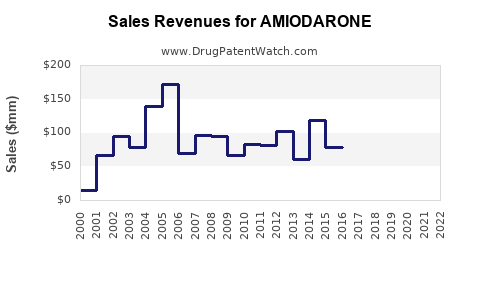
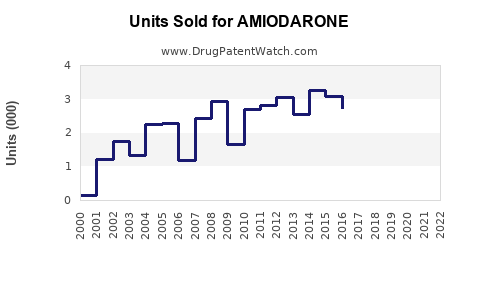
Annual Sales Revenues and Units Sold for AMIODARONE
| Drug Name | Revenues (USD) | Units | Year |
|---|---|---|---|
| AMIODARONE | ⤷ Start Trial | ⤷ Start Trial | 2022 |
| AMIODARONE | ⤷ Start Trial | ⤷ Start Trial | 2021 |
| AMIODARONE | ⤷ Start Trial | ⤷ Start Trial | 2020 |
| AMIODARONE | ⤷ Start Trial | ⤷ Start Trial | 2019 |
| AMIODARONE | ⤷ Start Trial | ⤷ Start Trial | 2018 |
| >Drug Name | >Revenues (USD) | >Units | >Year |
Amiodarone Market Analysis, Patent Status, Competitive Landscape, and Sales Projections
Amiodarone is a mature, low-cost antiarrhythmic used mainly for ventricular tachycardia, ventricular fibrillation, and selected atrial arrhythmias. The market is predominantly generic, with limited pricing power and no meaningful remaining composition-of-matter exclusivity. Commercial opportunity is concentrated in hospital injectable products, differentiated premixes, contract manufacturing, and supply reliability rather than in conventional oral tablets.
A reasonable base-case model places global amiodarone product sales in the approximate range of $600 million to $900 million annually, with low- to mid-single-digit unit growth and flat-to-declining pricing. The U.S. market is likely in the range of $100 million to $180 million in annual manufacturer and distributor revenue, depending on inclusion of hospital premixes, retail prescriptions, and contract-manufactured products. These are modeled market estimates, not reported consolidated sales from a single company.
What is amiodarone used for and how large is the market?
Amiodarone hydrochloride is a Class III antiarrhythmic with sodium-channel, potassium-channel, calcium-channel, and beta-adrenergic blocking activity. The FDA-approved oral product is used for recurrent ventricular fibrillation and recurrent hemodynamically unstable ventricular tachycardia when other therapies are ineffective or not tolerated. Intravenous amiodarone is used for ventricular arrhythmias and selected acute rhythm-control settings (FDA, 2023a; FDA, 2023b).
Principal dosage forms and customers
| Segment | Main customers | Commercial characteristics |
|---|---|---|
| Oral tablets, 100 mg, 200 mg, 400 mg | Retail pharmacies, cardiology practices, hospitals | Highly commoditized; low unit pricing |
| Intravenous solution | Hospitals, emergency departments, intensive-care units | Higher value per treatment; procurement and shortages matter |
| Ready-to-use premixes | Hospitals and integrated delivery networks | Differentiated by preparation time, container, stability, and safety |
| Compounded or institutional supply | Hospitals and specialty distributors | Sensitive to manufacturing capacity and quality compliance |
The clinical market is supported by an aging population, higher prevalence of atrial fibrillation and heart failure, and continued use in severe ventricular arrhythmias. Demand is constrained by amiodarone’s toxicity profile and the availability of alternatives such as sotalol, dofetilide, dronedarone, catheter ablation, and implantable cardioverter-defibrillators.
What are the current amiodarone sales drivers?
The largest commercial driver is hospital use of injectable amiodarone. Oral tablets have low prices and many suppliers, while injectable products can command higher contract prices because hospitals value supply continuity, ready-to-use packaging, and reduced preparation requirements.
Key demand drivers
- Growth in atrial fibrillation and ventricular arrhythmia diagnoses.
- Continued use in emergency and critical-care protocols.
- Demand for premixed intravenous products.
- Generic supply disruptions that shift share among manufacturers.
- Low treatment cost relative to branded alternatives and procedures.
Key market constraints
Amiodarone carries boxed warnings for pulmonary toxicity, hepatic injury, and worsening arrhythmia. The FDA label also requires monitoring of pulmonary, hepatic, thyroid, ophthalmic, and cardiac effects (FDA, 2023a). These safety requirements limit first-line use and reduce the probability of durable premium pricing.
Dronedarone and catheter ablation can displace amiodarone in selected atrial-fibrillation patients, although amiodarone remains more broadly used in complex or refractory cases. Dofetilide and sotalol compete in rhythm control but have their own monitoring and proarrhythmic limitations.
What are the amiodarone sales projections through 2029?
The following projection uses a scenario model rather than a reported company forecast. It assumes a mature generic market, low annual prescription growth, stable hospital demand, and modest price erosion.
| Year | Low case | Base case | High case | Base-case growth |
|---|---|---|---|---|
| 2025 | $560 million | $720 million | $900 million | - |
| 2026 | $550 million | $730 million | $925 million | 1.4% |
| 2027 | $540 million | $740 million | $950 million | 1.4% |
| 2028 | $525 million | $750 million | $975 million | 1.4% |
| 2029 | $510 million | $760 million | $1.00 billion | 1.3% |
The base case implies a compound annual growth rate of approximately 1.1% from 2025 through 2029. The low case assumes continued oral price erosion, limited hospital volume growth, and greater substitution by ablation and competing antiarrhythmics. The high case assumes persistent injectable shortages, greater use of ready-to-administer products, and stronger expansion in emerging markets.
U.S. revenue projection
| Year | U.S. low case | U.S. base case | U.S. high case |
|---|---|---|---|
| 2025 | $90 million | $135 million | $180 million |
| 2026 | $88 million | $137 million | $185 million |
| 2027 | $86 million | $139 million | $190 million |
| 2028 | $83 million | $141 million | $195 million |
| 2029 | $80 million | $143 million | $200 million |
The U.S. base case assumes that injectable products account for approximately 55% to 65% of manufacturer revenue despite representing a smaller share of total treated patients. Oral tablets remain important for volume but contribute less revenue because generic reimbursement is low.
Which companies sell amiodarone products?
Amiodarone is supplied by multiple generic and hospital-product manufacturers. The supplier group changes by dosage form, market, and procurement contract.
Major commercial categories
- Generic oral-tablet manufacturers, including large U.S. and international generics companies.
- Hospital injectable suppliers, including manufacturers of conventional vials and bags.
- Baxter’s Nexterone product line, which has been marketed as a premixed intravenous amiodarone formulation.
- Contract manufacturers and regional suppliers serving government, hospital, and tender markets.
- Compounding pharmacies and outsourcing facilities in markets with intermittent commercial shortages.
The relevant competitive advantage is usually operational. Manufacturing scale, sterile-fill capacity, validated container systems, regulatory compliance, and the ability to maintain supply during shortages are more important than branding.
What patents protect amiodarone?
The original amiodarone active-ingredient patent estate is effectively expired in the United States and major pharmaceutical markets. Amiodarone was commercialized decades ago, and the active ingredient is available from multiple generic suppliers.
| IP category | Current commercial relevance |
|---|---|
| Original compound patent | Expired |
| Original oral formulation patents | Expired or no longer commercially blocking |
| Generic tablet patents | Generally absent as meaningful market barriers |
| Injectable formulation patents | Potentially relevant for specific premixes, containers, or concentrations |
| Manufacturing-process patents | May protect individual processes but rarely block the entire market |
| Method-of-use patents | Limited practical blocking value for conventional uses |
| Regulatory exclusivity | No meaningful current exclusivity expected for standard products |
A specific premixed intravenous product may have had patents directed to formulation stability, container design, concentration, or ready-to-use administration. Those rights do not recreate exclusivity for amiodarone as an active ingredient. Patent scope must be assessed at the product level rather than at the molecule level.
What is the Orange Book status of amiodarone?
The FDA Orange Book identifies approved drug products and any patents or regulatory exclusivities listed by the relevant NDA holder. Standard generic amiodarone tablets do not have a meaningful active patent barrier comparable with a current branded small-molecule product. The regulatory pathway for new generic tablets is generally an abbreviated new drug application supported by bioequivalence rather than clinical efficacy trials (FDA, 2024).
The main Orange Book-related risks are product-specific:
- A listed patent for a particular injectable presentation.
- A patent associated with a premixed or ready-to-use formulation.
- A dispute over whether a generic applicant must certify against a listed patent.
- Labeling differences involving a protected method of use.
For standard 100 mg, 200 mg, and 400 mg tablets, the commercial risk from Paragraph IV litigation is low because the market is already populated by generic suppliers and the underlying product is old.
Are there Paragraph IV challenges to amiodarone?
Paragraph IV challenges are unlikely to create a material market event for conventional amiodarone tablets. The relevant patents for the original drug have expired, and generic competition is established.
A Paragraph IV filing could still arise for a later injectable presentation, premixed bag, novel container, or differentiated administration system. The business impact would depend on:
- The exact Orange Book-listed patent.
- Whether the product has meaningful hospital share.
- Whether the challenger obtains approval before patent expiration.
- Whether the parties settle and on what launch date.
- Whether the branded product has a practical substitute among other injectable suppliers.
Any litigation involving a specific amiodarone product should be evaluated separately from the broader molecule market.
What formulation patents protect intravenous amiodarone?
The most commercially relevant formulation claims may address solubility, concentration, excipient selection, stability, container compatibility, particulate control, and ready-to-use administration.
Conventional intravenous amiodarone contains solubilizing excipients because the active ingredient has limited water solubility. Product developers may seek differentiation through premixed systems that eliminate bedside dilution or reduce handling requirements. Hospital value can arise from lower preparation risk and faster administration even when the active ingredient itself is unprotected.
Formulation patents are more likely to create a product-specific competitive window than a market-wide barrier. A competing supplier may avoid infringement by changing the container, concentration, excipient ratio, manufacturing process, or administration configuration.
When does amiodarone lose exclusivity?
Amiodarone lost meaningful U.S. market exclusivity many years ago. The original oral and injectable products are now genericized. There is no expected future loss-of-exclusivity event comparable to the expiration of a modern branded medicine.
| Exclusivity type | Status |
|---|---|
| Composition of matter | Expired |
| Original product patent | Expired |
| Standard oral-generic exclusivity | Expired |
| Current pediatric exclusivity | None expected |
| Orphan-drug exclusivity | Not a current market barrier |
| Biosimilar exclusivity | Not applicable |
FDA approval of the original Cordarone product preceded the modern generic market, and the relevant product economics are now determined by generic competition and hospital procurement rather than patent expiry.
What patent litigation affects amiodarone?
The principal litigation risk is formulation-specific rather than molecule-specific. Potential disputes may involve:
- Premixed intravenous amiodarone.
- Ready-to-use bags or containers.
- Stability and storage claims.
- Methods for reducing preparation or administration steps.
- Manufacturing processes for sterile injectable products.
The litigation exposure of a conventional tablet supplier is low. The exposure of a supplier launching a differentiated injectable product can be higher, particularly if the product competes directly with a branded premix and has a material hospital contract pipeline.
No broad biosimilar litigation applies because amiodarone is a chemically synthesized small molecule, not a biologic.
How strong is the amiodarone patent estate?
The overall patent estate is weak from a market-blocking perspective but can be moderate for narrowly defined injectable products.
| Evaluation factor | Assessment |
|---|---|
| Core molecule protection | None remaining |
| Oral-tablet protection | Very weak |
| Injectable formulation protection | Product-specific and potentially moderate |
| Manufacturing barriers | Moderate for sterile injectable products |
| Regulatory barriers | Higher for injectables than tablets |
| Substitution risk | Moderate |
| Generic entry risk | High for conventional tablets |
| Hospital supply advantage | Potentially meaningful |
The strongest commercial moat is manufacturing execution. Sterile injectable facilities require validated aseptic processing, quality systems, container compatibility testing, and reliable supply-chain management. These barriers can support market share without supporting high margins.
What generic launch scenarios exist for amiodarone?
Conventional oral-tablet launch
A new tablet entrant would face established suppliers, low reimbursement, and limited differentiation. Expected pricing would be aggressive, and share gains would depend on wholesaler access, pharmacy contracts, and reliable supply.
Injectable vial launch
A vial product can achieve better economics than tablets but must compete for hospital formulary and group-purchasing contracts. Regulatory and manufacturing execution are more important than patent clearance.
Premixed intravenous launch
A ready-to-use product has the strongest commercial differentiation. It can reduce pharmacy preparation work and support hospital safety objectives. Patent risk, manufacturing cost, and purchasing-contract concentration are higher than for standard vials.
Shortage-driven launch
Temporary supply disruptions can create rapid demand for an approved alternative. The resulting revenue may be volatile and may decline when incumbent suppliers restore inventory.
How does amiodarone compare with competing antiarrhythmics?
| Drug | Main competitive position | Commercial constraint |
|---|---|---|
| Amiodarone | Broad efficacy in difficult ventricular and atrial arrhythmias | Organ toxicity and monitoring burden |
| Sotalol | Oral rhythm control with established generic supply | QT prolongation and renal dosing |
| Dofetilide | Atrial-fibrillation rhythm control | Initiation requires intensive monitoring |
| Dronedarone | Alternative for selected atrial-fibrillation patients | Lower efficacy in some populations; safety restrictions |
| Catheter ablation | Non-drug rhythm-control option | Procedure cost, access, and patient selection |
| Implantable defibrillator therapy | Prevention of sudden cardiac death | Device and procedure economics |
Amiodarone remains difficult to displace in severe ventricular arrhythmias and in patients who cannot tolerate or do not respond to alternatives. It is more vulnerable in chronic atrial-fibrillation treatment, where clinicians can use ablation, other antiarrhythmics, or rate-control strategies.
What is the investment and licensing outlook for amiodarone?
Licensing opportunities are limited for the active ingredient. More credible transactions would involve:
- A differentiated premixed intravenous product.
- A novel container or administration system.
- Regional distribution rights.
- Contract manufacturing of sterile injectable products.
- Supply agreements tied to hospital tenders.
- Acquisition of a facility with validated amiodarone injectable capacity.
A license based only on standard oral amiodarone tablets would have weak pricing leverage. A transaction involving an approved ready-to-use injectable product could have value if it includes hospital contracts, shortage resilience, and defensible formulation or manufacturing know-how.
What is the FDA regulatory status of amiodarone?
Amiodarone is FDA-approved in oral and intravenous forms. The oral label includes serious safety warnings and limits use to patients with life-threatening or highly symptomatic arrhythmias where other treatments are ineffective or not tolerated (FDA, 2023a). The intravenous product is approved for specified ventricular arrhythmias and is administered under hospital or monitored-care conditions (FDA, 2023b).
The principal regulatory risks for manufacturers are:
- Sterile manufacturing failures.
- Particulate or container-compatibility problems.
- Labeling deviations.
- Stability failures.
- Supply interruptions.
- Postmarketing safety and pharmacovigilance obligations.
Key Takeaways
- Amiodarone is a mature generic market with no meaningful remaining composition-of-matter exclusivity.
- Global annual product sales are modeled at approximately $600 million to $900 million, with a base case of $720 million in 2025 and $760 million in 2029.
- U.S. annual revenue is modeled at approximately $100 million to $180 million.
- Injectable and premixed products provide the strongest commercial opportunity.
- Standard oral tablets face high generic-entry risk and weak pricing power.
- Patent risk is concentrated in product-specific injectable formulations, containers, and manufacturing methods.
- Biosimilar risk does not apply.
- Hospital supply reliability, sterile manufacturing capacity, and procurement access are more important than molecule-level IP.
- Licensing value is likely to be higher for differentiated intravenous products than for conventional tablets.
- Long-term growth is likely to remain low, with demand supported by severe arrhythmia treatment and constrained by toxicity, competing drugs, and catheter ablation.
FAQs
Is amiodarone still profitable for generic drug manufacturers?
Yes, but profitability is more likely in injectable, premixed, or shortage-sensitive products than in standard oral tablets. Tablet margins are constrained by numerous suppliers and low reimbursement.
Does amiodarone have biosimilar competition?
No. Amiodarone is a chemically synthesized small molecule. Competition comes from generic versions and alternative antiarrhythmic therapies, not biosimilars.
Can a company still obtain a patent on an amiodarone product?
Yes. A company may obtain patents on a new formulation, container, dosing system, manufacturing process, or delivery configuration. Such patents would not restore exclusivity for the active ingredient itself.
Is intravenous amiodarone a larger opportunity than oral amiodarone?
Usually, yes, on a revenue-per-unit basis. Intravenous products have higher manufacturing and regulatory barriers and can command greater value in hospital procurement, particularly when supplied in ready-to-use formats.
What is the largest risk to an amiodarone sales forecast?
The largest risks are price erosion in oral generics, hospital contract losses, injectable manufacturing interruptions, restoration of competitor supply after a shortage, and substitution by catheter ablation or alternative antiarrhythmics.
References
-
U.S. Food and Drug Administration. (2023a). Amiodarone hydrochloride tablets: Prescribing information. FDA.
-
U.S. Food and Drug Administration. (2023b). Amiodarone hydrochloride injection: Prescribing information. FDA.
-
U.S. Food and Drug Administration. (2024). Approved drug products with therapeutic equivalence evaluations: Orange Book. FDA.
-
National Heart, Lung, and Blood Institute. (2022). Atrial fibrillation and arrhythmia treatment information. National Institutes of Health.
-
U.S. Food and Drug Administration. (2024). Drug shortages database. FDA.
More… ↓
