Last updated: April 4, 2026
What is the Current Market Size for Oxymetazoline?
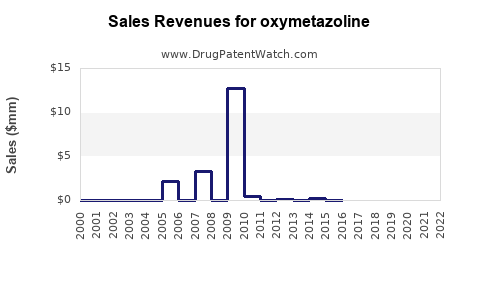
Oxymetazoline is a topical nasal decongestant used primarily for relief of nasal congestion caused by colds, allergies, sinusitis, and other respiratory conditions. The global nasal decongestant market, driven primarily by oxymetazoline, was valued at approximately USD 1.8 billion in 2022, with an estimated compound annual growth rate (CAGR) of 4.2% forecast through 2030. The market segments include retail OTC products and prescription formulations.
Key Regions:
| Region |
Market Share (2022) |
Projected CAGR (2023-2030) |
| North America |
42% |
3.8% |
| Europe |
30% |
4.5% |
| Asia-Pacific |
15% |
5.0% |
| Rest of World |
13% |
4.1% |
What Are the Key Drivers of Market Growth?
- Increase in Respiratory Conditions: Rising prevalence of allergies (e.g., allergic rhinitis) and upper respiratory infections globally, especially in urban areas.
- Over-the-Counter Accessibility: Availability of oxymetazoline nasal sprays OTC in many countries, boosting consumer use.
- Consumer Preference for Fast-Acting Relief: Consumers seek immediate relief, favoring products like oxymetazoline with rapid onset.
- Product Innovation: New formulations with longer duration, reduced rebound congestion, and improved safety profiles.
What Are the Market Challenges and Limitations?
- Rebound Congestion: Prolonged use of oxymetazoline can cause rhinitis medicamentosa, leading to usage restrictions and consumer warnings.
- Regulatory Restrictions: Stricter marketing and safety regulations may limit OTC sales in certain jurisdictions.
- Competition: Presence of multiple nasal decongestants like xylometazoline, phenylephrine, and pseudoephedrine.
What Are the Sales Projections for the Next Decade?
Based on current growth trends, the global oxymetazoline market is expected to reach approximately USD 2.8 billion by 2030, with a CAGR of 4.2%.
Projection Summary:
| Year |
Estimated Market Size (USD billion) |
| 2023 |
1.92 |
| 2025 |
2.2 |
| 2027 |
2.5 |
| 2030 |
2.8 |
Sales by Segment:
- OTC Market: Maintains dominant share (>80%), driven by OTC formulations.
- Prescription Market: Accounts for ~15-20% of sales, mainly for severe cases or special formulations.
- Emerging Markets: Expected to grow faster, with CAGR reaching 5% due to expanding healthcare access.
What Are the Key Players and Their Market Shares?
| Company |
Market Share (%) |
Notable Products |
| Johnson & Johnson |
25% |
Afrin nasal spray |
| GlaxoSmithKline |
20% |
Otrivin |
| Perrigo |
10% |
Multiple OTC formulations |
| Others |
45% |
Regional and generic brands |
What Regulatory Trends Influence Sales?
- FDA (U.S.): No restrictions on OTC sales but warns against prolonged use.
- EMA (Europe): Similar guidelines; some countries restrict OTC sales or require medical advice.
- Asia-Pacific: Varies; often less restrictive, leading to faster market penetration.
What Are the Opportunities for Growth?
- Developing formulations with reduced rebound congestion risks.
- Expanding into emerging markets with increasing healthcare spending.
- Combining oxymetazoline with other agents for multisymptom relief.
- Innovating dosage forms, including nasal strips or drops.
What Is the Impact of Patent Expiry and Generic Competition?
Most oxymetazoline formulations rely on off-patent active ingredients, leading to a high prevalence of generics. This intensifies price competition but limits premium pricing strategies.
Key Takeaways
- The global oxymetazoline market is robust, with growth driven by rising respiratory conditions and OTC availability.
- Market size is projected to reach USD 2.8 billion by 2030, with a CAGR of 4.2%.
- Competition is high, dominated by generics from well-established pharmaceutical firms.
- Challenges include rebound congestion risks and regulatory restrictions.
- Opportunities exist in product innovation, emerging markets, and combination therapies.
FAQs
1. How does oxymetazoline compare to other nasal decongestants?
Oxymetazoline offers longer-lasting relief (up to 12 hours) compared to phenylephrine (4-6 hours) but carries a risk of rebound congestion if used beyond three days.
2. What are the primary regulatory concerns for oxymetazoline?
Regulators emphasize the risk of rhinitis medicamentosa and recommend limiting use duration. Packaging warnings and usage instructions are standard.
3. Are there upcoming patent protections or exclusivities for oxymetazoline?
Most formulations are off-patent; patent protections are limited mainly to specific delivery devices or formulations.
4. What are the market opportunities in emerging economies?
Growing healthcare infrastructure, rising awareness, and increased access to OTC products provide expansion opportunities.
5. How is the product landscape evolving?
Innovations focus on reducing rebound congestion, extending duration, and combining with antihistamines or corticosteroids.
References
[1] Markets and Markets. (2023). Nasal decongestant market size and forecasts.
[2] Grand View Research. (2022). Over-the-counter nasal spray market analysis.
[3] U.S. Food and Drug Administration. (2023). Guidance on nasal decongestant use.
[4] European Medicines Agency. (2023). Regulatory considerations for nasal decongestants.
[5] IQVIA. (2022). Global pharmaceutical sales data.