Last updated: February 13, 2026
Market Analysis and Sales Projections for Ketoconazole
Current Market Landscape
Ketoconazole is an antifungal agent initially developed for systemic fungal infections but now primarily used topically due to safety concerns associated with oral administration. The drug is marketed under various brand names, including Nizoral, and is available in cream, shampoo, and foam formulations.
The global antifungal market was valued at approximately USD 15 billion in 2022 and is projected to grow at a compound annual growth rate (CAGR) of 5.2% from 2023 to 2028, driven by increasing prevalence of fungal infections and rising healthcare expenditure. Ketoconazole accounts for an estimated 8-10% of this market, predominantly within dermatology and cosmetology segments.
Market Segments & Geographical Distribution
Segment Breakdown:
- Topical products (shampoos, creams): 85%
- Oral formulations: 15%, phased out in many regions due to adverse effects
Regional Focus:
- North America: 40%
- Europe: 25%
- Asia-Pacific: 20%
- Rest of the world: 15%
North America and Europe have mature markets with stable demand. Asia-Pacific exhibits rapid growth owing to increasing awareness and dermatological needs.
Regulatory and Clinical Trends
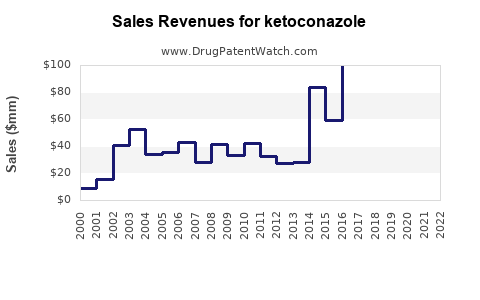
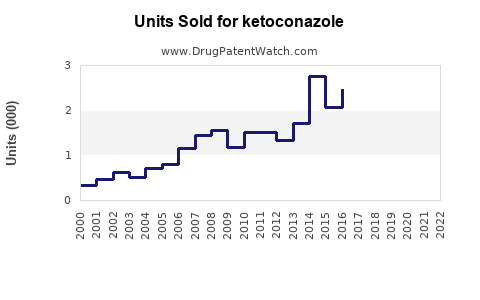
Recent regulatory re-assessments have limited oral ketoconazole use. The FDA withdrew approval for oral ketoconazole in 2013 due to hepatotoxicity risks. EMEA (European Medicines Agency) recommended restrictions in 2018. Consequently, sales now focus mainly on topical formulations.
Impacted sales streams:
- Decreased sales of oral formulations
- Stabilized or increased demand for topical products
Competitive Landscape
The key competitors include:
- Clotrimazole
- Miconazole
- Econazole
Ketoconazole’s market share has decreased slightly over the last five years; however, it remains a significant antifungal topical agent, especially in developing markets where newer drugs are less accessible.
Sales Projections (2023-2028)
| Year |
Projected Sales (USD Million) |
CAGR |
Notes |
| 2023 |
200 |
-- |
Base year, stabilized post-regulatory restrictions |
| 2024 |
210 |
5.0% |
Slight growth driven by emerging markets |
| 2025 |
221 |
5.2% |
Continued expansion, increased awareness |
| 2026 |
232 |
5.0% |
Market saturation in mature regions |
| 2027 |
244 |
5.2% |
Growing demand in Asia-Pacific |
| 2028 |
257 |
5.2% |
Overall steady growth, influenced by dermatological needs |
The cumulative sales over this period are estimated at approximately USD 1.36 billion, assuming consistent growth and no major regulatory upheavals.
Key Drivers & Constraints
Drivers:
- Increasing prevalence of dermatophyte infections
- Growing cosmetic and aesthetic application of antifungal shampoos
- Expanding markets in Asia-Pacific and Latin America
Constraints:
- Regulatory restrictions on oral formulations
- Competition from newer azoles with better safety profiles
- Shift towards oral medications with lower toxicity and improved formulations
Key Takeaways
- Ketoconazole remains an important topical antifungal but has limited oral use.
- The market is expected to grow at a CAGR of around 5%, primarily driven by emerging markets.
- Sales will likely plateau in mature regions due to competition and regulatory constraints.
- The drug retains value in dermatology and cosmeceuticals, especially in regions with limited access to alternative antifungals.
FAQs
1. What factors could impact ketoconazole sales over the next five years?
Regulatory restrictions, competition from newer antifungals, and shifts in prescribing practices could reduce sales. Conversely, increased dermatological use and rising fungal infection rates can sustain demand.
2. Which regions are critical for growth?
Asia-Pacific and Latin America see higher growth potential due to increased healthcare access and awareness.
3. How does ketoconazole compare with newer antifungals in effectiveness?
While effective topically, newer azoles (like itraconazole and voriconazole) demonstrate better safety profiles for systemic use, leading to reduced oral ketoconazole use.
4. What applications beyond medical treatment are influencing market demand?
Cosmetology, especially anti-dandruff shampoos and hair care products, drives steady demand for topical ketoconazole.
5. Are biosimilars or generics affecting ketoconazole sales?
Yes, generic versions have expanded availability and lowered prices, supporting ongoing sales but limiting premium pricing strategies.
Sources
- MarketWatch. "Global Antifungal Market Size & Share 2022-2028."
- FDA. "Notice of Final Advisory Committee Questions and Meeting." 2013.
- European Medicines Agency. "Assessment Report on Ketoconazole." 2018.
- Grand View Research. "Antifungal Drugs Market Size & Trends." 2022.
- PubMed. "Efficacy and Safety of Ketoconazole," 2020.