Share This Page
Drug Sales Trends for XALATAN
✉ Email this page to a colleague
Payment Methods and Pharmacy Types for XALATAN (2012)
Revenues by Pharmacy Type
Units Sold by Pharmacy Type
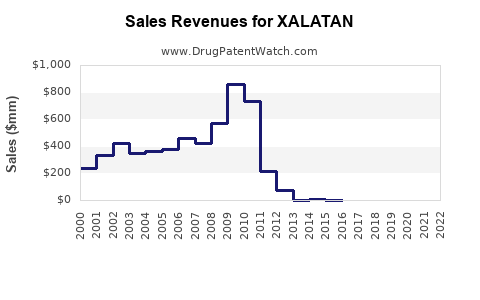
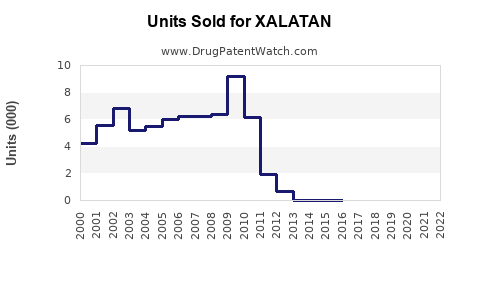
Annual Sales Revenues and Units Sold for XALATAN
| Drug Name | Revenues (USD) | Units | Year |
|---|---|---|---|
| XALATAN | ⤷ Start Trial | ⤷ Start Trial | 2022 |
| XALATAN | ⤷ Start Trial | ⤷ Start Trial | 2021 |
| XALATAN | ⤷ Start Trial | ⤷ Start Trial | 2020 |
| XALATAN | ⤷ Start Trial | ⤷ Start Trial | 2019 |
| XALATAN | ⤷ Start Trial | ⤷ Start Trial | 2018 |
| XALATAN | ⤷ Start Trial | ⤷ Start Trial | 2017 |
| XALATAN | ⤷ Start Trial | ⤷ Start Trial | 2016 |
| >Drug Name | >Revenues (USD) | >Units | >Year |
Xalatan is a mature, off-patent ophthalmic product with limited branded growth potential. Market value is concentrated in generic latanoprost, while branded Xalatan revenue depends on residual physician preference, payer coverage, preservative-free positioning, and demand in markets with slower generic substitution. A normalized forecast indicates continued low-single-digit annual erosion for branded sales through 2030, with generic latanoprost retaining the larger commercial opportunity.
Xalatan Market Analysis and Sales Projections Through 2030
What is Xalatan and how is it used?
Xalatan is the branded ophthalmic solution containing latanoprost, a prostaglandin F2α analog used to reduce elevated intraocular pressure in patients with open-angle glaucoma or ocular hypertension. It is administered as one drop in the affected eye once daily, typically in the evening. The product is marketed in a 0.005% ophthalmic solution formulation. [1]
Latanoprost lowers intraocular pressure by increasing uveoscleral outflow. Prostaglandin analogs remain a major first-line treatment category for glaucoma because of their once-daily dosing and strong pressure-lowering effect.
The commercial product has several limitations:
- The active ingredient is off patent in major markets.
- Generic latanoprost is widely available.
- The product is a mature therapy with limited ability to expand its labeled population.
- Branded sales are exposed to payer substitution and low-cost generic competition.
- Preservative-free and combination-product alternatives compete for the same patients.
How large is the Xalatan and latanoprost market?
Public companies generally do not disclose current standalone Xalatan revenue. Pfizer historically reported Xalatan as a major ophthalmology product, with annual sales near or above $1 billion before broad generic erosion. The product lost substantial value after generic latanoprost entered the U.S. market in 2011. [2]
The relevant market now has three segments:
| Segment | Commercial position | Growth outlook |
|---|---|---|
| Branded Xalatan | Residual brand demand, selected international markets | Declining |
| Generic latanoprost | Dominant volume supplier | Stable to modest growth |
| Competing glaucoma products | Travoprost, bimatoprost, timolol combinations, newer agents | Mixed |
The commercial value of the total latanoprost market is materially larger than current Xalatan brand sales. Generic manufacturers compete primarily on price, supply reliability, preservative options, bottle design, and formulary access.
Glaucoma prevalence supports durable unit demand. The National Eye Institute estimates that millions of U.S. adults have glaucoma, with many cases remaining undiagnosed. Aging populations in North America, Europe, Japan, China, and other markets support long-term prescription volume even as per-unit pricing declines. [3]
What are the Xalatan sales projections from 2025 to 2030?
The following forecast normalizes 2024 branded Xalatan net sales to an index of 100 because audited current product-level revenue is not publicly reported. The model assumes no major label expansion, no meaningful patent recovery, continued generic substitution, and stable glaucoma prevalence.
| Year | Base case index | Downside index | Upside index |
|---|---|---|---|
| 2024 | 100 | 100 | 100 |
| 2025 | 95 | 88 | 100 |
| 2026 | 90 | 77 | 98 |
| 2027 | 85 | 68 | 96 |
| 2028 | 81 | 60 | 94 |
| 2029 | 77 | 53 | 92 |
| 2030 | 73 | 47 | 90 |
The base case implies a compound annual decline of approximately 5% from 2024 through 2030. The downside case reflects accelerated payer exclusion, further international generic penetration, or product discontinuation in selected markets. The upside case assumes stronger branded retention in emerging markets and slower substitution in markets where physician dispensing or branded prescribing remains common.
For an investor or licensing model, the dollar conversion is straightforward:
| 2024 Xalatan net sales assumption | 2030 base-case sales | 2030 downside sales | 2030 upside sales |
|---|---|---|---|
| $50 million | $36.5 million | $23.5 million | $45.0 million |
| $100 million | $73.0 million | $47.0 million | $90.0 million |
| $200 million | $146.0 million | $94.0 million | $180.0 million |
These projections apply to branded Xalatan sales, not the total market for generic and branded latanoprost.
When did Xalatan lose exclusivity?
Xalatan’s principal U.S. market protection ended in the early 2010s. The FDA approved generic latanoprost products in 2011, allowing meaningful substitution after the core protection period ended. [4]
| Milestone | Approximate timing | Commercial effect |
|---|---|---|
| FDA approval of Xalatan | 1996 | U.S. launch |
| Core U.S. patent protection | Expired around 2010-2011 | Generic entry became possible |
| First significant U.S. generic approvals | 2011 | Rapid price and share erosion |
| Current status | Off patent | Brand has no durable U.S. exclusivity |
The Orange Book remains the relevant source for historical patent and exclusivity information associated with NDA 020597. Current commercial risk is not driven by an active Xalatan patent barrier. [5]
What patents protect Xalatan today?
No active U.S. patent estate is expected to provide meaningful exclusivity for the original Xalatan product. The relevant historical protection covered latanoprost and its ophthalmic use. Those rights expired before the current generic market structure developed.
Formulation patents
Xalatan’s original formulation contains latanoprost in an ophthalmic vehicle with benzalkonium chloride as a preservative. Generic manufacturers have been able to commercialize substantially equivalent formulations through the abbreviated new drug application pathway.
Potentially differentiating formulation areas include:
- Preservative-free latanoprost;
- Multidose preservative-free containers;
- Improved bottle-drop accuracy;
- Extended room-temperature stability;
- Combination products;
- Reduced ocular-surface irritation.
These technologies may have separate patent protection, but they do not restore exclusivity to the original Xalatan product.
Method-of-use patents
The original glaucoma and ocular-hypertension use claims are mature. New method-of-use patents could cover treatment sequencing, adherence improvement, selected patient subgroups, or combination therapy, but they would have limited ability to block generic latanoprost for the original approved indication.
What is the FDA and Orange Book status of Xalatan?
Xalatan is an FDA-approved prescription ophthalmic product. Its U.S. regulatory reference is NDA 020597. Generic latanoprost products have been approved through ANDAs referencing the branded product. [1, 5]
The key regulatory distinction is between:
- The original Xalatan NDA;
- Generic latanoprost ANDAs;
- Brand or generic combination products;
- Preservative-free latanoprost formulations;
- Other prostaglandin analogs with separate NDAs.
Because the product is small-molecule and off patent, biosimilar risk does not apply. The relevant competitive risk is generic substitution, not biosimilar entry.
Which companies compete with Xalatan and generic latanoprost?
Competition is divided between generic suppliers and branded glaucoma products.
Generic latanoprost competitors
Major generic ophthalmology companies that have participated in the U.S. market include:
- Viatris;
- Teva Pharmaceutical Industries;
- Sandoz;
- Apotex;
- Mylan, now part of Viatris;
- Bausch + Lomb;
- Hikma;
- Amneal;
- Dr. Reddy’s Laboratories;
- Zydus Lifesciences.
Supplier participation varies by country and time. Generic pricing is sensitive to manufacturing capacity, FDA inspection status, shortages, contract pharmacy purchasing, and wholesaler concentration.
Branded therapeutic competitors
Relevant branded and specialty competitors include:
- Lumigan, containing bimatoprost;
- Travatan Z, containing travoprost;
- Rocklatan, containing netarsudil and latanoprost;
- Vyzulta, containing latanoprostene bunod;
- Cosopt and related fixed combinations;
- Rhopressa, containing netarsudil.
Xalatan’s main competitive advantage is familiarity and once-daily dosing. Its main disadvantages are generic availability and limited differentiation from low-cost latanoprost products.
How strong is the Xalatan patent estate?
The current patent strength is low. The original composition, use, and formulation protections have expired or no longer provide meaningful commercial exclusion in the United States.
| Patent factor | Assessment |
|---|---|
| Core active ingredient protection | Expired |
| Original ophthalmic-use protection | Expired or commercially non-blocking |
| Original formulation protection | Expired or non-exclusive |
| Current U.S. Orange Book leverage | Low |
| Generic Paragraph IV exposure | Historical rather than current |
| Manufacturing complexity | Moderate |
| Ability to block generic substitution | Minimal |
The remaining business risk is operational rather than patent-driven. Sterile ophthalmic manufacturing requires validated aseptic processes, container-closure controls, stability data, and regulatory compliance. Those requirements can limit the number of reliable suppliers, but they do not create durable exclusivity for Xalatan.
What patent litigation and Paragraph IV challenges affected Xalatan?
The major legal event was the wave of ANDA activity associated with generic latanoprost entry around the end of the original patent term. Paragraph IV certifications are relevant when a generic applicant claims that a listed patent is invalid, unenforceable, or not infringed. [5]
For Xalatan, that litigation cycle is commercially historical. There is no current litigation pathway that would materially restore brand exclusivity for the original product. Any new dispute would more likely concern:
- A new preservative-free formulation;
- A delivery device;
- A combination product;
- Manufacturing or supplier rights;
- A separate latanoprost-based product.
No widely reported settlement agreement currently provides Xalatan with a material market-protection advantage.
What generic entry risks exist for Xalatan?
Generic entry risk is already realized rather than prospective. The principal risks to the remaining brand business are:
- Formulary exclusion or higher patient copay for branded Xalatan.
- Low-cost substitution at the pharmacy.
- Additional generic suppliers entering markets with limited current competition.
- Hospital and government procurement shifting to tender-based purchasing.
- Physician movement toward preservative-free or combination therapies.
- Supply interruptions by a branded or generic manufacturer.
Generic supply concentration can create temporary pricing opportunities, but these are unlikely to change the long-term direction of branded sales.
How does Xalatan compare with competing glaucoma drugs?
| Product | Active ingredient | Dosing | Patent position | Commercial profile |
|---|---|---|---|---|
| Xalatan | Latanoprost | Once daily | Off patent | Mature brand |
| Generic latanoprost | Latanoprost | Once daily | Off patent | Volume leader |
| Lumigan | Bimatoprost | Once daily | Brand and formulation rights vary | Premium prostaglandin |
| Travatan Z | Travoprost | Once daily | Mature branded product | Alternative prostaglandin |
| Vyzulta | Latanoprostene bunod | Once daily | Active product-specific rights may apply | Differentiated nitric-oxide pathway |
| Rocklatan | Netarsudil/latanoprost | Once daily | Product-specific patents | Combination therapy |
Xalatan is strongest where low acquisition cost and physician familiarity matter. It is weakest in markets with aggressive generic substitution or where ocular-surface tolerability and preservative-free delivery influence prescribing.
What licensing and commercial opportunities exist for Xalatan?
Licensing upside is limited for the original brand. More attractive opportunities involve latanoprost-related technologies rather than Xalatan itself:
- Regional commercialization rights in markets with limited generic penetration;
- Preservative-free ophthalmic delivery;
- Combination products;
- Multidose container systems;
- Contract manufacturing and supply agreements;
- Emerging-market distribution partnerships.
A licensing valuation should rely on net sales after generic discounts, not historical peak Xalatan revenue. Royalty assumptions should also reflect the absence of patent exclusivity and the possibility of direct generic competition.
What is the geographic outlook for Xalatan sales?
The United States and Western Europe offer limited branded growth. Generic penetration is high, payer leverage is strong, and pharmacy substitution is routine.
Higher residual brand opportunity may exist in:
- Latin America;
- Southeast Asia;
- Middle Eastern markets;
- Selected African markets;
- Countries where branded prescribing remains common;
- Markets where generic regulatory approval or distribution is fragmented.
China and India provide large patient populations but remain highly price-sensitive. Local manufacturing and registration requirements can reduce the value of imported branded supply.
Key Takeaways
- Xalatan is a mature, off-patent latanoprost product.
- Generic latanoprost, rather than branded Xalatan, captures most current market volume.
- Branded Xalatan sales are likely to decline at roughly 5% annually in the base case through 2030.
- The U.S. patent and Orange Book position does not provide meaningful current exclusivity.
- Biosimilar risk is irrelevant because Xalatan is a small-molecule drug.
- The main barriers are sterile manufacturing, supply reliability, distribution, and regulatory compliance.
- Commercial upside is greater in preservative-free delivery, combination products, and selected international markets than in the original branded formulation.
- Licensing valuations should use current residual brand economics rather than historical peak sales.
FAQs About Xalatan Market Size, Patents, and Sales
Is Xalatan still sold in the United States?
Xalatan remains an FDA-approved reference product, but generic latanoprost is widely available and usually receives stronger payer preference.
What is the largest revenue opportunity related to Xalatan?
The largest opportunity is the broader generic latanoprost market, not the branded Xalatan product. Brand revenue is concentrated in residual prescribing and selected international markets.
Does Xalatan have a patent extending beyond 2030?
No active original Xalatan patent is expected to provide U.S. exclusivity through 2030. Any later patent opportunity would need to cover a new formulation, device, combination, or method of use.
Can a company launch a generic version of Xalatan?
Yes. Generic latanoprost products have been approved through the ANDA pathway, subject to FDA requirements for pharmaceutical equivalence, bioequivalence, manufacturing quality, and sterile ophthalmic production.
Is preservative-free latanoprost a major threat to Xalatan?
It is a potential premium threat, particularly for patients with ocular-surface disease or intolerance to benzalkonium chloride. Its commercial impact depends on price, reimbursement, bottle technology, and clinical differentiation.
References
- U.S. Food and Drug Administration. (2019). Xalatan prescribing information. FDA Drugs@FDA database.
- Pfizer Inc. (2011). Annual report 2011. Pfizer Investor Relations.
- National Eye Institute. (2023). Glaucoma data and statistics. National Institutes of Health.
- U.S. Food and Drug Administration. (2011). FDA approves first generic latanoprost ophthalmic solution. FDA.
- U.S. Food and Drug Administration. (2024). Approved drug products with therapeutic equivalence evaluations: Orange Book. FDA.
More… ↓
