Drug Sales Trends for SYNTHROID
Payment Methods and Pharmacy Types for SYNTHROID (2012)
Revenues by Pharmacy Type
Units Sold by Pharmacy Type
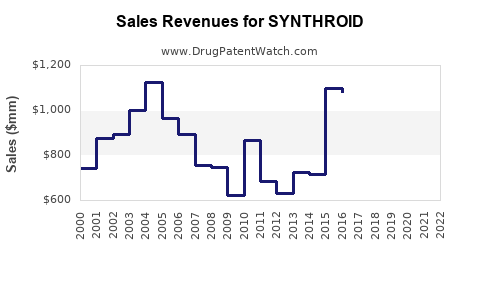
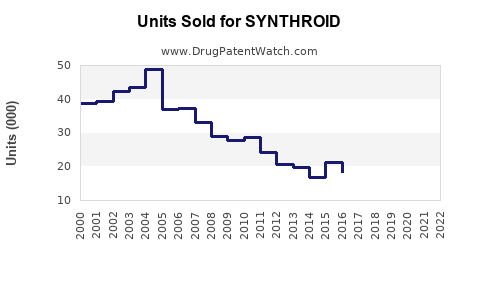
Annual Sales Revenues and Units Sold for SYNTHROID
| Drug Name | Revenues (USD) | Units | Year |
|---|---|---|---|
| SYNTHROID | ⤷ Start Trial | ⤷ Start Trial | 2022 |
| SYNTHROID | ⤷ Start Trial | ⤷ Start Trial | 2021 |
| SYNTHROID | ⤷ Start Trial | ⤷ Start Trial | 2020 |
| SYNTHROID | ⤷ Start Trial | ⤷ Start Trial | 2019 |
| >Drug Name | >Revenues (USD) | >Units | >Year |
Synthroid Market Analysis, Sales Forecast, Patent Position, and Generic Competition
Synthroid remains one of the largest branded levothyroxine products, but its commercial position depends on brand loyalty, physician preference, supply consistency, and the therapeutic sensitivity of thyroid replacement therapy rather than meaningful patent protection. AbbVie does not disclose standalone Synthroid revenue in its public filings, so the sales figures below are modeled estimates. U.S. branded net sales are estimated at approximately $0.8 billion to $1.1 billion in 2024, with a base-case decline toward $0.7 billion by 2030 as generic substitution and lower-cost levothyroxine products expand.
What is Synthroid and who owns the drug?
Synthroid is the branded version of levothyroxine sodium, a synthetic form of thyroxine, or T4. It is used primarily to treat hypothyroidism and to suppress thyroid-stimulating hormone in selected thyroid cancer patients.
AbbVie owns the Synthroid brand following its acquisition of Allergan in 2020. Allergan had acquired the product through its purchase of Forest Laboratories in 2014. Synthroid is distributed as oral tablets in multiple strengths, generally ranging from 25 mcg to 300 mcg.
The product competes with:
- Generic levothyroxine sodium tablets
- Levoxyl, marketed by Pfizer
- Unithroid, marketed by Amneal Pharmaceuticals
- Tirosint and Tirosint-SOL, marketed by IBSA Pharma
- Euthyrox, marketed by Merck in selected markets
- Regional levothyroxine brands and hospital-channel products
The U.S. Food and Drug Administration classifies levothyroxine as a narrow therapeutic index drug. Small differences in exposure can have clinical consequences for some patients, which supports continued brand retention even after generic approval. FDA has required manufacturers to demonstrate tighter dose uniformity and bioequivalence standards for levothyroxine products than applied historically to many conventional generics. [1][2]
How large is the Synthroid market?
The overall levothyroxine market is materially larger than the Synthroid segment because generic levothyroxine accounts for most prescriptions. The market has stable demand because hypothyroidism is a chronic condition requiring long-term treatment.
Estimated market structure
| Segment | Estimated 2024 U.S. annual value | Market position |
|---|---|---|
| Generic levothyroxine tablets | $1.3 billion-$1.8 billion | Dominant volume supplier |
| Synthroid | $0.8 billion-$1.1 billion | Leading branded product |
| Tirosint and Tirosint-SOL | $0.2 billion-$0.4 billion | Premium soft-gel and liquid segment |
| Levoxyl, Unithroid and other brands | $0.1 billion-$0.3 billion | Smaller branded competitors |
| Total U.S. levothyroxine market | $2.4 billion-$3.6 billion | Mature, recurring market |
These figures are analyst estimates rather than company-reported market totals. Public filings from AbbVie do not separately report Synthroid revenue, and prescription data providers differ in their treatment of retail, mail-order, specialty, and government channels. [3]
The global market is larger, but Synthroid has a stronger position in the United States than in many international markets. Local brands, generic substitution policies, national reimbursement systems, and different prescribing practices reduce Synthroid's international pricing power.
What are the Synthroid sales projections through 2030?
The most likely outlook is low-single-digit annual revenue erosion in the United States. Prescription demand should remain stable or grow modestly, but revenue will be pressured by generic substitution, payer controls, and negotiated discounts.
Synthroid modeled net-sales forecast
| Year | Downside case | Base case | Upside case |
|---|---|---|---|
| 2024E | $0.85B | $0.95B | $1.10B |
| 2025E | $0.79B | $0.91B | $1.07B |
| 2026E | $0.73B | $0.87B | $1.04B |
| 2027E | $0.68B | $0.83B | $1.01B |
| 2028E | $0.63B | $0.80B | $0.98B |
| 2029E | $0.59B | $0.77B | $0.95B |
| 2030E | $0.55B | $0.74B | $0.92B |
The base case assumes:
- Stable U.S. treated-patient volume
- Annual prescription growth of approximately 1% to 2%
- Net price erosion of 3% to 5% annually
- Continued brand retention among a portion of patients stabilized on Synthroid
- No major supply disruption
- No material new formulation with superior reimbursement
Under these assumptions, Synthroid revenue declines at approximately 3% to 4% annually. The upside scenario assumes that physicians and patients continue to avoid switching among levothyroxine products because of dose-adjustment concerns. The downside scenario assumes more aggressive formulary exclusion, pharmacy-level generic substitution, and lower patient willingness to pay.
What drives Synthroid revenue?
The main commercial drivers are:
- The number of patients receiving long-term thyroid replacement.
- The share of prescriptions filled as branded Synthroid.
- Refill persistence and adherence.
- Managed-care coverage and copay differentials.
- Generic supply reliability.
- Physician concern about switching products.
- Premium demand for consistent formulation and dose response.
The patient base is relatively defensive. A patient who is well controlled on a particular levothyroxine product may remain on that product for years. That supports recurring revenue and reduces the speed of brand erosion. It does not eliminate price pressure.
When does Synthroid lose exclusivity?
Synthroid has already lost practical market exclusivity. Levothyroxine sodium is an established small-molecule active ingredient, and FDA-approved generic products have been available for many years.
There is no current composition-of-matter patent protecting levothyroxine sodium. The main commercial protection is the Synthroid trademark, product history, manufacturing consistency, physician familiarity, and patient retention.
Exclusivity assessment
| Protection type | Current position |
|---|---|
| Active ingredient patent | Expired or commercially irrelevant |
| Core tablet patent | No meaningful current barrier identified |
| FDA new-drug exclusivity | Expired |
| Orphan-drug exclusivity | Not applicable |
| Pediatric exclusivity | Not a current commercial barrier |
| Trademark | Active brand protection |
| Manufacturing know-how | Potential operational advantage |
| Patient and physician loyalty | Significant but non-statutory protection |
Patent expiration is therefore not the principal trigger for future Synthroid erosion. The relevant competitive events are formulary decisions, generic contracting, supply availability, and potential litigation over product quality or labeling.
What is the Orange Book status of Synthroid?
The Orange Book is relevant to identifying listed patents, therapeutic equivalence ratings, and approved generic competition. For Synthroid, the commercial record is dominated by generic levothyroxine approvals rather than a live patent estate that blocks substitution.
FDA-listed levothyroxine products have historically included multiple tablet strengths and several manufacturers. Generic approval does not guarantee identical inactive ingredients, tablet appearance, supply continuity, or patient experience. FDA has rated approved generic levothyroxine products therapeutically equivalent under applicable standards, although professional groups and regulators have emphasized consistent use of a single product for selected patients. [1][2]
The Orange Book should be reviewed for current product-specific listings because patents, delistings, and approved strengths can change. No current patent barrier is expected to prevent generic levothyroxine substitution for the principal Synthroid tablet business.
Are there Paragraph IV challenges to Synthroid?
Paragraph IV litigation is unlikely to be the central risk for Synthroid because generic levothyroxine products entered the market long ago. The principal generic-entry event has already occurred.
A Paragraph IV certification is most relevant when a generic applicant seeks approval before listed patents expire. For a mature levothyroxine product with established generic competition, future Paragraph IV activity would more likely concern:
- A new Synthroid formulation
- A newly listed manufacturing patent
- A liquid or soft-gel delivery system
- A new combination product
- A reformulated product with a distinct regulatory pathway
The standard Synthroid tablet business does not depend on pending patent litigation to preserve revenue.
What formulations are protected in the levothyroxine market?
The strongest formulation differentiation is outside the conventional Synthroid tablet.
Tablets
Synthroid competes directly with generic levothyroxine tablets. Tablet products are difficult to protect through patents when the active ingredient and basic dosage form are long established. Commercial differentiation depends on dose precision, supply reliability, excipient consistency, and physician familiarity.
Soft-gel capsules
Tirosint uses a soft-gel formulation designed to reduce the impact of certain excipients and improve absorption consistency for some patients. The product is positioned for patients with absorption issues, excipient intolerance, or difficulty maintaining stable thyroid levels.
Oral solution
Tirosint-SOL is a liquid levothyroxine product. Its formulation and delivery system support premium pricing and create a more defensible niche than standard tablets, although reimbursement and patient selection constrain its market size.
Manufacturing barriers
Levothyroxine manufacturing requires tight control of:
- Potency and content uniformity
- Degradation products
- Tablet strength differentiation
- Stability over shelf life
- Bioequivalence between batches
- Cross-contamination and dose-control procedures
These requirements create quality-control barriers, but they are not equivalent to patent exclusivity. A capable generic manufacturer can overcome them through validated manufacturing and FDA approval.
How strong is the Synthroid patent estate?
Synthroid has a weak patent estate and a stronger commercial franchise.
Patent strength
The patent position is weak because:
- Levothyroxine sodium is an old active ingredient.
- Generic tablet products are established.
- No current composition patent blocks competition.
- Standard tablet technology is readily reproducible.
- Brand revenue is not dependent on patent litigation.
Commercial strength
The commercial position remains stronger because:
- Hypothyroidism requires chronic therapy.
- Patients often refill the same product repeatedly.
- Physicians may avoid unnecessary switching.
- FDA considers levothyroxine a narrow therapeutic index drug.
- Synthroid has extensive brand recognition.
- AbbVie has scale in contracting, distribution, and promotion.
This distinction is important for valuation. Synthroid should be modeled as a mature branded chronic-care asset, not as a patent-protected growth product.
Which companies are challenging Synthroid?
Generic and branded competitors include:
| Company | Product or position | Competitive threat |
|---|---|---|
| Teva | Generic levothyroxine | High-volume price competition |
| Mylan/Viatris | Generic levothyroxine | Retail and payer substitution |
| Sandoz | Generic levothyroxine in selected markets | Regional competition |
| Lannett and other manufacturers | Generic levothyroxine | Supply and contract competition |
| Pfizer | Levoxyl | Branded alternative |
| Amneal | Unithroid | Branded alternative |
| IBSA Pharma | Tirosint and Tirosint-SOL | Premium formulation competition |
| Merck | Euthyrox in selected countries | International branded competition |
Generic suppliers are the primary threat to Synthroid's volume and net price. Tirosint is the most relevant premium-formulation competitor because it competes for patients who value absorption consistency or have concerns about tablet excipients.
What generic launch scenarios exist for Synthroid?
Because generic launch has already occurred, the relevant scenarios concern further share migration rather than first entry.
Base case
Generic products capture additional share gradually. Synthroid retains a meaningful group of stable patients, while new patients are more likely to start on a generic. Revenue declines 3% to 4% annually.
Downside case
Large pharmacy chains and payers make generic levothyroxine the default product. Brand copays rise, and patients switch despite physician preference. Revenue declines 6% to 8% annually.
Upside case
Supply disruptions, inconsistent generic availability, or physician concerns about switching support brand retention. Synthroid revenue declines less than 2% annually and may remain near $900 million through 2030.
A full generic conversion is unlikely in the near term because patients and prescribers do not treat every levothyroxine product as interchangeable in practice, even where FDA therapeutic-equivalence ratings permit substitution.
What is the FDA regulatory status of Synthroid?
Synthroid is an FDA-approved levothyroxine sodium product for hypothyroidism and related indications. The regulatory risk is low for the established tablet product. The principal FDA issues are product quality, labeling, bioequivalence, manufacturing consistency, and postmarketing compliance.
There is no biosimilar risk because Synthroid is a small-molecule drug, not a biologic. The relevant competitive pathway is the abbreviated new drug application, or ANDA, rather than the biosimilar pathway under the Public Health Service Act.
What licensing deals affect Synthroid?
Synthroid's commercial ownership history is more relevant than a current external licensing arrangement:
- Forest Laboratories acquired the Synthroid business before Allergan acquired Forest.
- AbbVie acquired Allergan in 2020.
- AbbVie now controls the brand and related commercial operations.
No publicly disclosed licensing transaction is required to explain the current Synthroid revenue outlook. The product's performance is primarily an internal portfolio and contracting issue for AbbVie.
What patent litigation affects Synthroid?
No active patent litigation is expected to determine the near-term economics of the standard Synthroid tablet business. Litigation risk is more likely to arise from:
- Product liability or manufacturing-quality claims
- Trademark disputes
- Generic labeling or substitution disputes
- Reformulated levothyroxine products
- Supply and distribution agreements
- Alleged anticompetitive contracting practices
The absence of a major patent dispute reduces legal uncertainty but also confirms that Synthroid's revenue is exposed to ordinary generic competition.
How does Synthroid compare with Tirosint and generic levothyroxine?
| Factor | Synthroid | Generic levothyroxine | Tirosint |
|---|---|---|---|
| Active ingredient | Levothyroxine sodium | Levothyroxine sodium | Levothyroxine |
| Main dosage form | Tablet | Tablet | Soft-gel and oral solution |
| Price | Premium | Lowest | Premium to very high |
| Patent protection | Weak or expired | Not applicable | Stronger formulation position |
| Main customer | Stable branded users | Price-sensitive and new starts | Selected patients needing formulation differentiation |
| Main risk | Generic substitution | Margin compression | Reimbursement and narrow patient segment |
| Growth outlook | Low or negative | Volume growth with price pressure | Higher growth from a smaller base |
Synthroid has greater absolute revenue than premium alternatives, but Tirosint has a potentially more defensible formulation position. Generic levothyroxine has the strongest volume position but the weakest pricing power.
Key Takeaways
- Synthroid is a mature branded levothyroxine product owned by AbbVie.
- Estimated 2024 U.S. branded net sales are approximately $0.8 billion to $1.1 billion, although AbbVie does not report standalone revenue.
- Base-case revenue is projected to decline from about $0.95 billion in 2024 to $0.74 billion in 2030.
- Generic levothyroxine is the primary competitive threat.
- Synthroid has no meaningful current composition-of-matter patent barrier.
- Its commercial durability comes from chronic use, brand familiarity, dose consistency, and physician reluctance to switch stable patients.
- Paragraph IV litigation and biosimilar risk are not central to the standard tablet business.
- Tirosint and Tirosint-SOL provide the strongest premium-formulation competition.
- The main valuation risk is gradual net-price erosion, not an abrupt patent cliff.
FAQs
Is Synthroid still a profitable drug for AbbVie?
Yes. Its chronic-use profile, established brand, and recurring refills support substantial cash flow, although revenue and margin are exposed to generic substitution and payer pressure.
Can pharmacies automatically substitute generic levothyroxine for Synthroid?
Substitution depends on state law, payer policy, prescriber instructions, and the product's FDA therapeutic-equivalence status. Physicians may request that a patient remain on a consistent product.
Does Synthroid have a biosimilar competitor?
No. Levothyroxine is a small-molecule drug. Competitors receive approval through the generic-drug pathway, not the biosimilar pathway.
Is Tirosint a direct substitute for Synthroid?
Tirosint contains levothyroxine but uses a soft-gel or liquid formulation. It may be selected for patients with absorption, excipient, adherence, or tolerability concerns. It is not generally positioned as a low-cost replacement for Synthroid.
What is the largest long-term risk to Synthroid sales?
The largest risk is continued generic share migration combined with higher brand copays and payer restrictions. The risk is gradual revenue erosion rather than loss of sales through a single patent expiration event.
References
- U.S. Food and Drug Administration. (2014). Levothyroxine sodium products: Guidance for industry. https://www.fda.gov
- U.S. Food and Drug Administration. (2020). Approved drug products with therapeutic equivalence evaluations. https://www.fda.gov
- AbbVie Inc. (2024). Annual report pursuant to Section 13 or 15(d) of the Securities Exchange Act of 1934. https://investors.abbvie.com
- U.S. Food and Drug Administration. (2024). Orange Book: Approved drug products with therapeutic equivalence evaluations. https://www.accessdata.fda.gov/scripts/cder/ob/
- American Thyroid Association. (2014). Guidelines for the treatment of hypothyroidism. Thyroid, 24(12), 1670-1751. https://www.liebertpub.com/doi/10.1089/thy.2014.0028
More… ↓
