Drug Sales Trends for SILENOR
Payment Methods and Pharmacy Types for SILENOR (2012)
Revenues by Pharmacy Type
Units Sold by Pharmacy Type
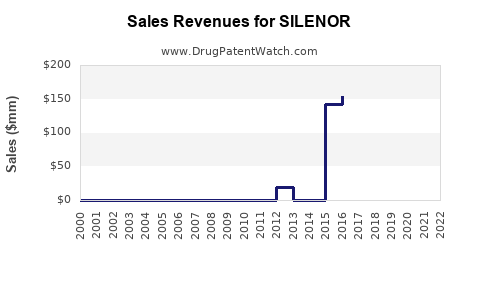
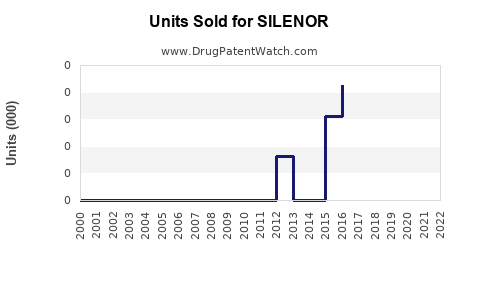
Annual Sales Revenues and Units Sold for SILENOR
| Drug Name | Revenues (USD) | Units | Year |
|---|---|---|---|
| SILENOR | ⤷ Start Trial | ⤷ Start Trial | 2022 |
| SILENOR | ⤷ Start Trial | ⤷ Start Trial | 2021 |
| SILENOR | ⤷ Start Trial | ⤷ Start Trial | 2020 |
| SILENOR | ⤷ Start Trial | ⤷ Start Trial | 2019 |
| >Drug Name | >Revenues (USD) | >Units | >Year |
Silenor Market Analysis and Sales Projections: Doxepin Insomnia Drug
Silenor is a low-dose doxepin tablet approved for sleep-maintenance insomnia. Its commercial position is limited by competition from generic doxepin capsules, low-cost off-label therapies, and newer branded orexin antagonists. Its main advantages are the absence of a controlled-substance classification, established safety data, and a differentiated 3 mg and 6 mg tablet formulation. Public company disclosures do not provide a current standalone Silenor revenue figure, so the projections below are analyst estimates based on product positioning, prescription economics, and market access conditions.
What is Silenor and how does it work?
Silenor contains doxepin hydrochloride in 3 mg and 6 mg tablets. The FDA approved it in March 2010 for the treatment of insomnia characterized by difficulty with sleep maintenance in adults. The recommended starting dose is 6 mg, with a 3 mg dose available for patients requiring lower exposure.[1]
At the low doses used in Silenor, doxepin primarily acts as a histamine H1 receptor antagonist. This differs from the higher-dose tricyclic antidepressant use of doxepin.
| Product attribute | Silenor |
|---|---|
| Active ingredient | Doxepin hydrochloride |
| Dosage form | Immediate-release tablets |
| Strengths | 3 mg and 6 mg |
| FDA indication | Sleep-maintenance insomnia |
| Initial FDA approval | March 17, 2010 |
| Controlled substance | No |
| Primary commercial market | U.S. prescription insomnia treatment |
| Current product owner/marketer | Currax Pharmaceuticals |
| Main clinical differentiator | Low-dose doxepin with no Schedule IV classification |
Silenor is not interchangeable with higher-strength generic doxepin capsules solely because the active ingredient is the same. The products differ in strength, formulation, labeling and approved use.
What is the size of the insomnia drug market?
The addressable market is large, but the branded prescription segment is highly fragmented. Insomnia treatment includes FDA-approved drugs, generic sedative-hypnotics, antidepressants used off label and nonprescription products.
Key FDA-approved prescription competitors include:
- Zolpidem, including Ambien and generic formulations
- Eszopiclone, including Lunesta and generic formulations
- Zaleplon and generic formulations
- Ramelteon, including Rozerem and generic formulations
- Suvorexant, marketed as Belsomra
- Lemborexant, marketed as Dayvigo
- Daridorexant, marketed as Quviviq
- Low-dose doxepin, including Silenor
The commercial market has two distinct segments. Generic hypnotics and off-label trazodone dominate prescription volume through low prices. Newer orexin receptor antagonists compete for branded spending because they offer differentiated mechanisms and substantial promotional support.
Silenor occupies a smaller niche between these groups. It has branded pricing and prescription positioning but lacks the commercial scale, promotional intensity and perceived novelty of the orexin class.
How does Silenor compare with competing insomnia drugs?
| Product or class | Main advantage | Main limitation relative to Silenor |
|---|---|---|
| Generic zolpidem | Low cost and high physician familiarity | Controlled substance and abuse, dependence and complex sleep-behavior concerns |
| Generic eszopiclone | Established efficacy and low cost | Controlled substance; metallic taste and next-day effects |
| Ramelteon | Noncontrolled melatonin-receptor mechanism | Lower perceived efficacy for some patients |
| Belsomra | Orexin mechanism and branded differentiation | Controlled substance; higher cost |
| Dayvigo | Orexin mechanism and sleep-maintenance positioning | Controlled substance; higher cost |
| Quviviq | Orexin mechanism and branded commercial strategy | Controlled substance; access and pricing pressure |
| Generic doxepin capsules | Low acquisition cost | Not a direct substitute for Silenor’s low-dose tablet presentation |
| Trazodone | Very low cost and widespread off-label use | Not FDA-approved for insomnia; tolerability and evidence limitations |
| Silenor | Noncontrolled, low-dose, sleep-maintenance indication | Limited brand awareness and weaker commercial scale |
Silenor’s strongest positioning is for adults who need sleep-maintenance treatment and for prescribers seeking a noncontrolled alternative. Its weaker position is first-line treatment in price-sensitive formularies.
What is Silenor’s FDA regulatory status?
Silenor is an FDA-approved drug under New Drug Application 022036. Its approved indication is narrow: insomnia characterized by difficulty with sleep maintenance.[1]
The FDA label identifies several clinically relevant warnings and precautions, including complex sleep behaviors, worsening depression or suicidal thinking, abnormal thinking and behavior, and potential next-day impairment. Silenor is contraindicated in patients with untreated narrow-angle glaucoma or severe urinary retention.[1]
The regulatory profile supports continued marketing but does not create a major barrier to generic competition. Doxepin is an old active ingredient, and the original active-ingredient exclusivity period has long expired.
Is Silenor a controlled substance?
No. Silenor is not scheduled under the federal Controlled Substances Act. This is commercially relevant because physicians and patients may prefer a noncontrolled sleep medication, particularly for long-term treatment, older adults or patients with substance-use risk.
The absence of scheduling does not eliminate safety concerns. The product label still warns about next-day impairment, abnormal sleep behaviors and psychiatric effects.[1]
What patents protect Silenor?
Silenor’s commercial protection has historically depended on patents covering low-dose doxepin formulations and the treatment of insomnia, rather than on new chemical-entity protection for doxepin.
The key legal distinction is between:
- The active ingredient doxepin, which has been used for decades.
- Low-dose tablet formulations developed for insomnia.
- Method-of-use claims directed to sleep-maintenance insomnia.
- Regulatory exclusivity associated with the original Silenor approval.
The FDA Orange Book is the controlling public source for patents and regulatory exclusivity associated with an approved product.[2] Patent protection for Silenor should be evaluated by claim scope, expiration, terminal disclaimers, pediatric extensions and any listed patent litigation. A patent covering a formulation does not necessarily prevent all generic doxepin products from entering the market.
When does Silenor lose exclusivity?
Silenor’s original FDA exclusivity has expired. The relevant commercial issue is patent-based protection for the low-dose product, not new chemical entity exclusivity.
Generic doxepin capsules have been available for years, but they are not automatically substitutable for Silenor tablets. A generic applicant seeking approval of a therapeutically equivalent low-dose doxepin tablet would face formulation, labeling and patent considerations distinct from those applicable to older doxepin capsules.
Are there biosimilar risks for Silenor?
No. Silenor is a small-molecule drug, not a biologic. Biosimilar competition is therefore not relevant. The relevant risks are generic substitution, authorized-generic competition, formulary exclusion and off-label use of low-cost doxepin capsules or trazodone.
Have generic companies filed Paragraph IV challenges to Silenor?
Publicly available information does not establish a current, commercially material Paragraph IV challenge that has produced a major market event for Silenor. Paragraph IV risk remains possible if a generic manufacturer targets the low-dose tablet formulation or an Orange Book-listed method-of-use patent.
A generic challenge would likely focus on one or more of the following:
- Invalidity of formulation claims
- Obviousness based on prior doxepin and insomnia literature
- Noninfringement through a different tablet composition
- Carve-out of patented method-of-use language
- Failure of the branded product to support broad patent protection
The commercial impact would depend on whether the challenger receives 180-day first-filer exclusivity, whether the product is therapeutically substitutable at the pharmacy level and whether the patent holder reaches a settlement.
What is the competitive landscape for Silenor?
Silenor competes in a market where clinical differentiation does not consistently translate into sales. Physicians can prescribe inexpensive generic agents, while managed-care plans often prefer low-cost alternatives before approving branded drugs.
The strongest branded competitors are the orexin antagonists:
| Drug | Company | Mechanism | Commercial threat to Silenor |
|---|---|---|---|
| Belsomra | Merck | Orexin receptor antagonist | High |
| Dayvigo | Eisai | Orexin receptor antagonist | High |
| Quviviq | Idorsia | Orexin receptor antagonist | High |
| Silenor | Currax | Low-dose H1 antagonism | Niche |
Orexin drugs are positioned around sleep initiation and maintenance without the same pharmacology as traditional sedative-hypnotics. Their higher prices support greater promotional activity, but payer restrictions can limit access.
Silenor’s most defensible segment is patients who need sleep-maintenance treatment and want to avoid controlled substances. Its least defensible segment is broad insomnia treatment where low-cost generics are acceptable.
What are Silenor’s sales and revenue projections?
Public filings from private product owner Currax do not provide a consistently reported standalone Silenor revenue series. The following forecast is a market model rather than reported company guidance.
Base-case Silenor net sales projection
| Year | Estimated U.S. net sales | Annual growth | Main assumption |
|---|---|---|---|
| 2024 | $18 million | - | Stable niche demand and limited promotion |
| 2025 | $19 million | 6% | Modest prescription recovery |
| 2026 | $20 million | 5% | Stable noncontrolled positioning |
| 2027 | $20 million | 2% | Increased orexin competition |
| 2028 | $19 million | -5% | Generic low-dose pressure or weaker reimbursement |
| 2029 | $18 million | -5% | Mature branded product decline |
Scenario analysis
| Scenario | 2029 annual sales | Conditions |
|---|---|---|
| Downside | $8 million-$12 million | Low-dose generic entry, payer restrictions and reduced promotion |
| Base case | $16 million-$20 million | Continued niche demand with stable pricing |
| Upside | $30 million-$40 million | Expanded payer coverage, stronger physician promotion and growth in noncontrolled insomnia prescribing |
The base case implies a largely flat market through 2027 followed by a gradual decline. Silenor is unlikely to become a major insomnia product without a material change in reimbursement, promotion, labeling or distribution.
What is the revenue exposure to generic entry?
Generic entry is the primary downside risk. A therapeutically substitutable low-dose doxepin tablet could reduce branded unit volume and force price concessions. The impact would be greater than competition from generic capsules because tablet-level substitution could occur directly at the pharmacy.
Estimated revenue impact under a direct generic tablet launch:
| Period after generic entry | Estimated Silenor net-sales impact |
|---|---|
| First 12 months | 30%-50% decline |
| Year two | 50%-70% decline |
| Year three | 65%-85% decline |
The decline could be slower if generic applicants receive narrow labels, if patent litigation delays launch or if payers maintain brand coverage for patients stabilized on Silenor.
What licensing deals and commercial partnerships affect Silenor?
Silenor was originally developed and commercialized by Somaxon Pharmaceuticals. Pernix Pharmaceuticals acquired Somaxon in 2013, adding Silenor to its commercial portfolio. Currax Pharmaceuticals later acquired assets from Pernix and became associated with the current commercial portfolio, including Silenor.[3][4]
The commercial history indicates that Silenor has changed hands through portfolio transactions rather than through a major strategic licensing transaction with a global pharmaceutical company. That structure limits evidence of substantial external investment in broad international expansion.
Silenor is primarily a U.S. commercial opportunity. Its value is tied to domestic prescription sales, payer access and lifecycle management rather than global launch potential.
How strong is the Silenor patent estate?
The patent estate is commercially moderate but not structurally strong.
Its strengths are:
- Low-dose tablet differentiation from older doxepin capsules
- A defined sleep-maintenance indication
- Noncontrolled-substance positioning
- Potential formulation and method-of-use barriers
Its weaknesses are:
- Long prior-art history for doxepin
- Expired active-ingredient exclusivity
- Availability of generic doxepin
- Extensive off-label competition from trazodone
- Limited economic incentive for broad international expansion
- Potential for generic design-around strategies
Silenor’s strongest protection is likely product differentiation and market positioning, not long-duration exclusivity comparable to a new chemical entity.
What generic launch scenarios exist for Silenor?
Three launch scenarios are commercially relevant:
- No direct generic tablet launch. Silenor retains a small branded niche while generic capsules and trazodone limit growth.
- Delayed generic tablet launch. Patent litigation or regulatory strategy delays entry, allowing the brand to preserve sales for several years.
- First-filer or multi-generic launch. Direct substitution produces rapid price erosion and a sharp decline in brand revenue.
The third scenario presents the largest valuation risk. A branded insomnia product with limited differentiation can lose most of its commercial value after direct generic substitution, even if the product retains clinical utility.
Key Takeaways
- Silenor is a 3 mg and 6 mg low-dose doxepin tablet approved for sleep-maintenance insomnia.
- Its principal commercial advantage is noncontrolled-substance status.
- Its principal weaknesses are generic competition, off-label trazodone use and newer orexin antagonists.
- Original FDA exclusivity has expired; formulation and method-of-use patents are the relevant legal protections.
- No biosimilar risk applies because Silenor is a small-molecule drug.
- Estimated 2024 U.S. net sales are approximately $18 million, with a base-case decline to $16 million-$20 million by 2029.
- Direct generic low-dose tablet entry could reduce branded sales by 65%-85% within three years.
- Silenor is a niche cash-flow asset rather than a high-growth insomnia franchise.
FAQs
Is Silenor stronger than generic doxepin?
Silenor is not necessarily pharmacologically stronger. It is a low-dose tablet specifically studied and labeled for insomnia, while generic doxepin is commonly sold in higher-strength capsules for other indications. The products are not automatically interchangeable.
Can Silenor be used for sleep initiation?
Silenor is approved for insomnia characterized by difficulty with sleep maintenance. It may affect overall sleep quality, but its FDA indication is not specifically centered on sleep initiation.
Is Silenor safer than Ambien?
The drugs have different risk profiles. Silenor is not a controlled substance, while Ambien is a Schedule IV drug. Silenor still carries warnings for next-day impairment, abnormal sleep behaviors and psychiatric effects. Comparative safety depends on patient characteristics and treatment duration.
Does insurance usually cover Silenor?
Coverage varies by plan. Insurers may require trial of generic doxepin, zolpidem, trazodone or other lower-cost treatments before covering Silenor. Tier placement and prior authorization can materially affect prescriptions and net sales.
What would increase Silenor’s valuation?
The most significant value drivers would be stronger payer coverage, evidence supporting use in older adults, broader physician adoption as a noncontrolled sleep-maintenance treatment, and continued protection against directly substitutable low-dose generic tablets.
References
-
U.S. Food and Drug Administration. (2010). Silenor (doxepin hydrochloride) tablets prescribing information. FDA.
-
U.S. Food and Drug Administration. (n.d.). Orange Book: Approved drug products with therapeutic equivalence evaluations. FDA. https://www.accessdata.fda.gov/scripts/cder/ob/
-
Pernix Pharmaceuticals. (2013). Pernix Pharmaceuticals completes acquisition of Somaxon Pharmaceuticals. Company announcement.
-
Currax Pharmaceuticals. (n.d.). Silenor product information. Currax Pharmaceuticals. https://curraxpharma.com/<>
More… ↓
