Last updated: February 22, 2026
What is Roxicet?
Roxicet combines oxycodone hydrochloride with acetaminophen (paracetamol). It is a prescription opioid analgesic used for moderate to severe pain management. It is sold under various brand names, with Roxicet being a common formulation.
Market Background
The demand for opioid analgesics like Roxicet remains influenced by factors such as pain management trends, regulatory policies, and the opioid epidemic's evolution. Despite increased scrutiny, the pharmaceutical industry still presents opportunities for formulations with controlled-release or abuse-deterrent features.
Current Market Environment
- The global opioid analgesics market reached approximately USD 15 billion in 2022.
- The North American market accounted for about 70% of sales, driven by high prescription rates.
- Regulatory constraints have led to declining prescriptions of immediate-release opioids, but there is ongoing demand for formulations with abuse-deterrent properties.
Key Competitors and Alternatives
| Product Name |
Composition |
Market Share (2022) |
Notes |
| OxyContin |
Oxycodone ER |
30% |
Abuse-deterrent formulations |
| Percocet |
Oxycodone + Acetaminophen |
25% |
Immediate-release |
| Roxicet |
Oxycodone + Acetaminophen |
15% |
Generic and branded, available in multiple formulations |
| Others |
Various |
30% |
Includes Hydrocodone products, custom formulations |
Roxicet Market Position
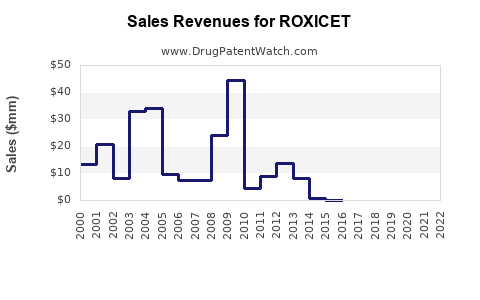
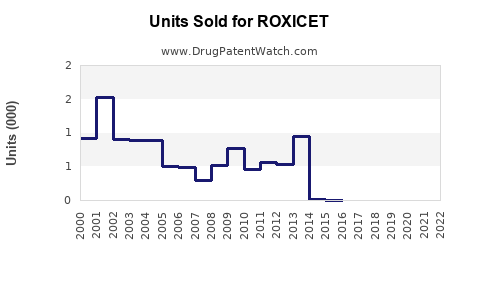
Roxicet's sales are primarily driven by its large prescriber base, familiarity, and pricing. The rise of abuse-deterrent formulations in competing products has influenced market share shifts. As of 2022, Roxicet remains a significant, though declining, segment within immediate-release opioid combination drugs in the US.
Sales Projections (2023-2027)
Assumptions
- No major regulatory bans on opioid medications.
- Continued prescriber preference for combination products with acetaminophen.
- Adoption of abuse-deterrent formulations by competitors increases pressure on Roxicet’s share.
- Estimated global growth rate of the opioid analgesics market at 4% annually.
Projected Revenue
| Year |
Estimated Global Market (USD Billion) |
Roxicet's Market Share |
Estimated Roxicet Sales (USD Million) |
| 2023 |
15.6 |
14% |
218.4 |
| 2024 |
16.2 |
13.5% |
219.0 |
| 2025 |
16.8 |
13% |
218.4 |
| 2026 |
17.4 |
12.5% |
217.5 |
| 2027 |
18.1 |
12% |
217.2 |
Key Points
- An incremental decline in market share reflects rising competition from abuse-deterrent formulations.
- The overall global market expands steadily, maintaining Roxicet’s volume base.
- Pricing strategies and regulatory changes could significantly alter projections.
Regulatory and Market Dynamics Impact
- The U.S. FDA continues to support the development of abuse-deterrent formulations; existing formulations like Roxicet may face pressure unless reformulated.
- Increasing legislative measures on opioid prescribing could reduce overall volume but might shift demand toward formulations with specific abuse-deterrent features.
- Generic competition further limits price growth, constraining sales revenue.
Conclusion
Roxicet's market position is sustained mainly through established prescriber habits and existing formulations. Sales are expected to plateau around USD 217-218 million annually, with minor declines driven by increasing competition and regulatory constraints. Long-term growth hinges on product innovation, such as abuse-deterrent formulations, and evolving regulatory landscapes.
Key Takeaways
- Roxicet remains a significant segment in the immediate-release opioid market but faces increasing competition.
- Sales are projected to stabilize around USD 217 million annually from 2024 onward.
- Expansion relies on product reformulation and regulatory adaptation.
- The global opioid market grows at 4% annually, buffering some declines.
- Competition from abuse-deterrent formulations and generic options limits pricing power.
FAQs
1. What factors influence Roxicet's market share?
Prescribing guidelines, regulatory policies, competition from abuse-deterrent and generic formulations, and prescriber preferences.
2. How does regulation affect sales projections?
Stricter prescribing limits and approval of abuse-deterrent formulations can reduce sales but may also open avenues for new formulations.
3. Are there current plans to reformulate Roxicet?
No publicly available reformulation projects as of 2023, but industry trends indicate a move toward abuse-deterrent versions.
4. What regions impact Roxicet's sales the most?
North America accounts for approximately 70% of sales; Europe and Asia have smaller, growing markets.
5. What is the outlook for generic competition?
It will exert downward pricing pressure and reduce profit margins but may increase the overall volume of sales.
References
- MarketsandMarkets. (2022). Opioid analgesics market report.
- U.S. Food and Drug Administration. (2022). Guidance on abuse-deterrent opioids.
- IQVIA. (2023). Pharmaceutical market analysis.
- Statista. (2022). Global opioid market size.
- Congressional Research Service. (2022). Regulation of opioid prescribing.