Share This Page
Drug Sales Trends for PRILOSEC
✉ Email this page to a colleague
Payment Methods and Pharmacy Types for PRILOSEC (2012)
Revenues by Pharmacy Type
Units Sold by Pharmacy Type
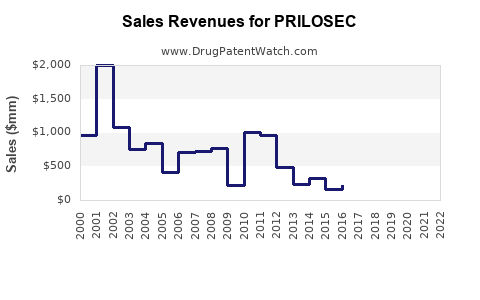
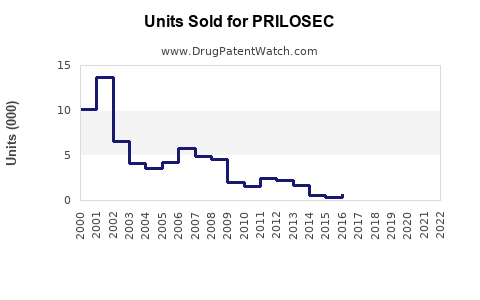
Annual Sales Revenues and Units Sold for PRILOSEC
| Drug Name | Revenues (USD) | Units | Year |
|---|---|---|---|
| PRILOSEC | ⤷ Start Trial | ⤷ Start Trial | 2022 |
| PRILOSEC | ⤷ Start Trial | ⤷ Start Trial | 2021 |
| PRILOSEC | ⤷ Start Trial | ⤷ Start Trial | 2020 |
| >Drug Name | >Revenues (USD) | >Units | >Year |
Prilosec Market Analysis, Sales History, Patent Status, and 2025-2029 Projections
Prilosec, the original omeprazole brand, is a mature proton-pump inhibitor with limited prescription value and continuing over-the-counter demand. Its core patents expired years ago, generic omeprazole dominates U.S. prescriptions, and no meaningful regulatory exclusivity protects the product. Commercial value now depends on consumer brand recognition, retail distribution, price, packaging, and category marketing rather than pharmaceutical exclusivity.
Prilosec’s historical peak was several billion dollars in annual global sales before U.S. generic entry. Current brand sales are not separately disclosed by AstraZeneca or the companies marketing Prilosec OTC. A reasonable base-case scenario is low-single-digit annual decline in branded retail revenue through 2029, with downside risk from private-label omeprazole and upside limited by the mature PPI category.
What is Prilosec and how large is its market?
Prilosec is the brand name for omeprazole, a proton-pump inhibitor approved for acid-related gastrointestinal disorders. Prescription indications include gastroesophageal reflux disease, erosive esophagitis, gastric and duodenal ulcers, and hypersecretory conditions. Prilosec OTC is marketed for frequent heartburn in adults.
The product has two economically distinct markets:
| Market | Product | Main revenue driver | Competitive condition |
|---|---|---|---|
| Prescription | Generic and branded omeprazole | Pharmacy volume and reimbursement | Generic-dominated |
| Consumer health | Prilosec OTC and store-brand omeprazole | Retail sales, brand recognition, packaging | Brand and private-label competition |
The prescription market is large in volume but unattractive for the original brand. Generic omeprazole, pantoprazole, lansoprazole, and esomeprazole compete mainly on price and formulary position. Prilosec OTC retains consumer value because the brand has been established for decades and is sold through mass retailers, pharmacies, grocery stores, and online channels.
Public companies generally do not report Prilosec revenue as a separate line item. Retail sales, manufacturer net sales, distributor revenue, and pharmacy reimbursement are different measures. Direct comparisons should therefore use a consistent revenue definition.
How much did Prilosec sell at its peak?
Prilosec was one of the world’s largest pharmaceutical products before generic erosion. AstraZeneca reported omeprazole sales at a level exceeding $6 billion annually around the product’s peak, when the company marketed the product internationally under the Losec and Prilosec names (AstraZeneca, 2001).
The product’s commercial trajectory followed the standard blockbuster lifecycle:
| Period | Commercial event | Market effect |
|---|---|---|
| 1989 | U.S. prescription approval | Launch of the original U.S. brand |
| 1990s | Rapid adoption for reflux and ulcer treatment | Expansion into a multibillion-dollar product |
| 2001 | U.S. prescription patent expiry and generic entry | Sharp erosion of branded prescription sales |
| 2003 | Prilosec OTC launch | Creation of a consumer-health revenue stream |
| 2010s | Broad generic substitution | Prescription brand became commercially marginal |
| 2020s | Mature OTC market | Revenue driven by retail execution and brand equity |
Prilosec’s historical sales should not be used as a forecast for current brand revenue. The original prescription franchise benefited from patent protection, high reimbursement, and limited direct competition. Those conditions no longer exist.
What are Prilosec’s 2025-2029 sales projections?
A precise public forecast for Prilosec is unavailable because current sales are not separately disclosed. The following is an analyst scenario for branded Prilosec consumer-health revenue, not reported company guidance.
| Scenario | 2025 estimated retail sales | Annual change through 2029 | 2029 estimated retail sales | Main assumptions |
|---|---|---|---|---|
| Downside | $250 million-$400 million | -6% to -9% | $180 million-$280 million | Private-label substitution, lower promotional support, price competition |
| Base case | $400 million-$650 million | -2% to -4% | $340 million-$550 million | Stable brand awareness, modest category growth, continued retail availability |
| Upside | $650 million-$900 million | 0% to +2% | $650 million-$975 million | Strong digital marketing, premium pricing, favorable heartburn incidence and retail execution |
These ranges refer to estimated retail sales, not manufacturer net revenue. Manufacturer revenue would normally be lower after retailer, wholesaler, promotional, and rebate deductions.
The base case implies a mature-brand profile:
- No meaningful contribution from prescription Prilosec.
- Low-single-digit annual erosion in the OTC brand.
- Continued pressure from store-brand omeprazole.
- Limited ability to increase price without accelerating substitution.
- Greater importance of shelf placement, search visibility, pack size, and promotional activity.
A volume-based forecast is more defensible than a prescription-price forecast. Generic omeprazole prices are compressed, while OTC Prilosec can preserve a price premium if consumers continue to associate the brand with reliable heartburn treatment.
How does Prilosec compare with competing proton-pump inhibitors?
Prilosec competes in a crowded class with little clinical differentiation for common heartburn treatment. Competitors include generic omeprazole, Nexium, Prevacid, Protonix, AcipHex, and newer potassium-competitive acid blockers such as Voquezna.
| Product | Active ingredient | Current commercial position | Competitive threat to Prilosec |
|---|---|---|---|
| Prilosec | Omeprazole | Legacy prescription and OTC brand | Direct brand and generic competition |
| Nexium | Esomeprazole | OTC and prescription brand | Strong consumer-brand competitor |
| Prevacid | Lansoprazole | OTC and generic product | Direct OTC substitution |
| Protonix | Pantoprazole | Primarily prescription and generic | Prescription volume competitor |
| AcipHex | Rabeprazole | Smaller prescription franchise | Limited consumer threat |
| Voquezna | Vonoprazan | Newer acid-suppression product | Potential clinical and premium-price threat |
| Store brands | Omeprazole or other PPIs | Low-price retail alternatives | Largest margin and volume threat |
Generic omeprazole is the most direct competitor because it offers the same active ingredient. Nexium has greater brand strength in some consumer channels, while vonoprazan may compete for patients and physicians seeking rapid or durable acid control. The newer product has a different mechanism and is not a direct generic substitute, but it can reduce long-term dependence on conventional PPIs in selected indications.
When did Prilosec lose exclusivity?
Prilosec lost U.S. prescription exclusivity after expiration of its foundational patent estate and subsequent generic approvals. The principal market event occurred in 2001, when generic omeprazole entered the U.S. prescription market.
The original patent strategy covered the omeprazole compound and related pharmaceutical compositions. Those rights are now expired. The core product is therefore open to generic manufacture, subject to applicable regulatory requirements.
| Exclusivity category | Current status |
|---|---|
| New chemical entity exclusivity | Expired |
| Original compound patents | Expired |
| Prescription market exclusivity | Expired |
| Pediatric exclusivity | Expired |
| OTC regulatory exclusivity | No material current exclusivity blocking generic omeprazole |
| Core formulation protection | Expired or commercially ineffective against standard generic products |
Prilosec OTC is regulated under an approved OTC new drug application and labeling requirements. OTC approval does not recreate the patent monopoly that supported the original prescription product. Generic and store-brand products can compete if they satisfy FDA approval and labeling requirements.
What is the Orange Book status of Prilosec?
The Orange Book remains relevant for prescription omeprazole products, but it does not provide meaningful exclusivity protection for the original Prilosec franchise. The FDA Orange Book identifies approved drug products and relevant patent and exclusivity information, while OTC products can involve separate regulatory listings and monograph frameworks (U.S. Food and Drug Administration, 2024a).
The commercial implications are clear:
- Generic omeprazole is approved and widely available.
- No unexpired core patent prevents standard generic entry.
- A Paragraph IV challenge is no longer the principal risk to the original brand.
- Any dispute would more likely concern a specific formulation, labeling, manufacturing process, or later product presentation.
Which companies are challenging Prilosec exclusivity?
No major current Paragraph IV campaign is required to challenge the original Prilosec brand because generic omeprazole already entered the market after expiration of the relevant prescription patent protection.
The competitive field includes:
- Generic-drug manufacturers selling omeprazole capsules and delayed-release products.
- Consumer-health companies selling OTC omeprazole.
- Retailers offering private-label versions.
- Manufacturers of alternative PPIs.
- Companies developing non-PPI acid-suppression products.
A Paragraph IV filing is commercially relevant when an innovator still has an unexpired listed patent. That framework no longer determines market access for ordinary generic omeprazole. Any remaining patent dispute would be product-specific rather than a challenge to the foundational Prilosec franchise.
What formulation patents protect Prilosec?
Prilosec requires protection of omeprazole from degradation in acidic conditions. Commercial products therefore use delayed-release capsules, tablets, granules, or related enteric-delivery systems. The technical barrier is pharmaceutical formulation and manufacturing quality, not ownership of the omeprazole molecule.
Relevant product attributes include:
- Enteric protection.
- Delayed release in the intestine.
- Chemical stability during storage.
- Consistent dissolution performance.
- Capsule, tablet, or orally disintegrating delivery.
- Compatibility with OTC labeling and dosing instructions.
The original formulation and manufacturing rights have largely expired. Current generic manufacturers must still demonstrate bioequivalence, manufacturing control, and compliance with FDA requirements. These requirements can create operational barriers, but they do not preserve Prilosec pricing power.
What manufacturing and intellectual-property barriers remain?
The remaining barriers are practical rather than exclusivity-based.
Manufacturers must control:
- Omeprazole degradation during production and storage.
- Enteric coating performance.
- Particle-size and granulation consistency.
- Dissolution and bioequivalence.
- Stability across the labeled shelf life.
- Packaging that protects the product from moisture and light.
- FDA current good manufacturing practice requirements.
These issues can delay an individual generic manufacturer, but they do not prevent broad competition. Multiple suppliers and contract manufacturers can produce omeprazole products, reducing supply-side concentration.
For the OTC brand, the more important assets are trademarks, retailer relationships, packaging, advertising, consumer trust, and distribution. Trademark protection can preserve the Prilosec name, but it cannot prevent competitors from selling omeprazole under different names.
What FDA regulatory status does Prilosec have?
Prilosec has an established FDA regulatory history as a prescription and OTC product. The prescription product is approved for acid-related gastrointestinal diseases, while Prilosec OTC is labeled for frequent heartburn and self-care use within the labeled duration and dosing limits (U.S. Food and Drug Administration, 2024b).
Regulatory considerations include:
- Prescription omeprazole remains widely approved in delayed-release dosage forms.
- OTC labeling limits the product’s self-care indication.
- Consumers with alarm symptoms or persistent symptoms are directed to seek medical evaluation.
- Long-term use raises labeling and medical-supervision considerations.
- Newer acid-suppression products may compete for patients who require stronger or faster control.
FDA approval supports continued commercialization, but it does not confer current market exclusivity on the legacy brand.
What is the generic launch risk for Prilosec?
Generic launch risk is already realized rather than prospective. The U.S. prescription market has been generic for more than two decades. The current risk is continued erosion of OTC brand share.
| Risk | Probability | Financial effect |
|---|---|---|
| Generic prescription substitution | High and established | Minimal incremental effect because brand share is already low |
| Store-brand OTC substitution | High | Reduces volume and gross margin |
| Retailer delisting | Medium | Can cause abrupt channel revenue loss |
| Consumer switching to Nexium or Prevacid | Medium | Reduces brand share within OTC PPIs |
| Shift to vonoprazan | Low to medium over five years | More relevant in physician-directed treatment |
| Manufacturing interruption | Low to medium | Could affect shelf availability and retailer confidence |
The base-case risk is gradual erosion. The downside case is a faster decline if private-label products gain shelf space and the brand reduces advertising or promotional support.
How strong is the Prilosec patent estate?
The patent estate is commercially weak for the original product because the core compound, prescription market, and historical formulation protections have expired. The remaining defensibility is primarily non-patent based.
| Asset | Strength | Commercial relevance |
|---|---|---|
| Omeprazole compound patents | None against current generic entry | Historical only |
| Original delayed-release technology | Low | Broadly available to competitors |
| OTC brand trademark | Moderate | Supports consumer recognition |
| Packaging and trade dress | Moderate | Protects presentation, not active ingredient |
| Manufacturing know-how | Low to moderate | Can improve cost and quality but is not exclusive |
| Retail distribution | Moderate | Can support shelf presence and sell-through |
| Consumer loyalty | Moderate | Main source of remaining brand premium |
There is no credible basis for valuing Prilosec as a patent-protected pharmaceutical franchise. It is better analyzed as a mature consumer-health brand with an established active ingredient.
What licensing deals affect Prilosec?
The major historical commercial structure involved AstraZeneca’s rights to omeprazole and later arrangements supporting the OTC launch and commercialization. Prilosec OTC was launched in the United States through a consumer-health partnership involving AstraZeneca and Procter & Gamble in 2003. The product has since operated within the consumer-health ownership and licensing structures applicable to the brand and market.
Current commercial analysis should distinguish:
- Ownership of the Prilosec trademark.
- Rights to sell prescription omeprazole.
- Rights to sell Prilosec OTC.
- Retail distribution agreements.
- Contract manufacturing arrangements.
- Regional rights outside the United States.
Public disclosures do not provide a complete, current global schedule of Prilosec licensing economics. Licensing is not the central value driver for standard generic omeprazole.
What revenue exposure does Prilosec create for manufacturers?
For a diversified consumer-health company, Prilosec is unlikely to be a material growth engine. Its value is defensive and cash-generative if the brand retains distribution and pricing discipline.
Revenue exposure is concentrated in:
- U.S. OTC sales.
- Retail and e-commerce channels.
- Seasonal and episodic heartburn demand.
- Consumer willingness to pay for a recognized brand.
- Promotional effectiveness.
- Retailer inventory and shelf allocation.
Prescription exposure is low because insurers, pharmacies, and physicians favor generic omeprazole and alternative PPIs. The principal financial sensitivity is gross margin, not therapeutic demand. A 5% to 10% volume decline could produce a larger profit decline if the company responds with discounts or promotional spending.
What is the likely commercial outlook for Prilosec?
Prilosec is likely to remain available through 2029, but its market position will be mature and defensive. The brand can preserve meaningful consumer-health sales if it maintains distribution, supports awareness, and avoids excessive price premiums over store brands.
The most probable outcome is:
- Stable presence in the OTC heartburn category.
- Continued decline in prescription-brand relevance.
- Low-single-digit annual revenue erosion.
- No meaningful patent-driven pricing power.
- Increasing competition from private-label omeprazole.
- Limited impact from biologic or biosimilar competition because Prilosec is a small-molecule drug, not a biologic.
- Selective pressure from vonoprazan and other newer acid-suppression therapies.
Key Takeaways
- Prilosec is the original omeprazole brand and a mature OTC consumer-health product.
- Historical peak sales exceeded $6 billion annually before U.S. generic entry.
- The original prescription patent estate and exclusivity periods have expired.
- Generic omeprazole dominates the prescription market.
- Current brand revenue is not separately disclosed by public companies.
- A reasonable 2025 base-case estimate for Prilosec-branded retail sales is $400 million to $650 million, with low-single-digit annual erosion through 2029.
- Store brands are the largest direct commercial threat.
- The remaining moat is based on trademark, distribution, packaging, and consumer recognition.
- Prilosec has no meaningful biosimilar risk because omeprazole is a small-molecule drug.
- The product should be valued as a mature consumer brand, not as a patent-protected pharmaceutical asset.
FAQs
Is Prilosec still profitable after generic omeprazole entry?
Yes, the OTC brand can remain profitable because consumers may pay a premium for brand recognition. Profitability depends on retail pricing, marketing costs, retailer terms, and manufacturing efficiency.
Does Prilosec still have patent protection?
The original compound and core prescription protections have expired. Any current protection would relate to specific trademarks, packaging, or product-specific rights rather than the omeprazole molecule.
Is Prilosec OTC the same as prescription omeprazole?
Both contain omeprazole, but approved indications, strengths, dosing instructions, labeling, and regulatory status differ. Prescription products are used under physician direction for broader conditions.
Can a generic company launch a product called Prilosec?
No. The Prilosec name is a trademark. Generic companies can sell omeprazole using their own proprietary or generic names if their products satisfy FDA requirements.
Will vonoprazan replace Prilosec?
Vonoprazan may win selected patients and physician-directed treatment, but it is unlikely to eliminate OTC omeprazole demand. Price, access, indication, and consumer self-care behavior will limit substitution.
References
AstraZeneca. (2001). Annual report and Form 20-F 2001. AstraZeneca PLC.
Procter & Gamble Company. (2003). Annual report 2003. The Procter & Gamble Company.
U.S. Food and Drug Administration. (2024a). Approved drug products with therapeutic equivalence evaluations: Orange Book. https://www.fda.gov
U.S. Food and Drug Administration. (2024b). Prilosec OTC drug facts and labeling. https://www.fda.gov
U.S. Food and Drug Administration. (2024c). Drugs@FDA: FDA-approved drugs. https://www.accessdata.fda.gov/scripts/cder/daf/
More… ↓
