Share This Page
Drug Sales Trends for MOTRIN
✉ Email this page to a colleague
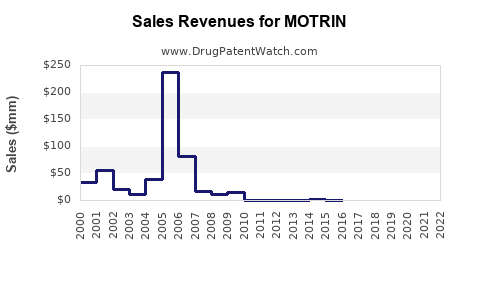
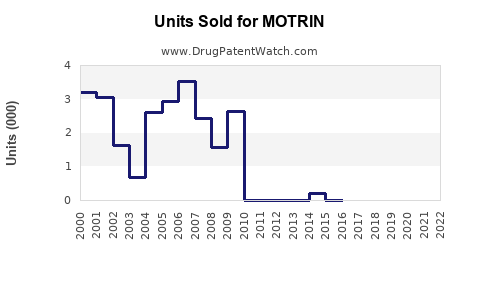
Annual Sales Revenues and Units Sold for MOTRIN
| Drug Name | Revenues (USD) | Units | Year |
|---|---|---|---|
| MOTRIN | ⤷ Start Trial | ⤷ Start Trial | 2022 |
| MOTRIN | ⤷ Start Trial | ⤷ Start Trial | 2021 |
| MOTRIN | ⤷ Start Trial | ⤷ Start Trial | 2020 |
| MOTRIN | ⤷ Start Trial | ⤷ Start Trial | 2019 |
| >Drug Name | >Revenues (USD) | >Units | >Year |

Market Analysis and Sales Projections for MOTRIN
What is the Current Market Position of MOTRIN?
MOTRIN, with the active ingredient ibuprofen, remains a leading over-the-counter (OTC) nonsteroidal anti-inflammatory drug (NSAID). It primarily competes in pain relief, fever reduction, and inflammation management.
- Global OTC analgesics market was valued at $15 billion in 2022.
- MOTRIN accounted for approximately 4% of that market, translating to roughly $600 million in sales.
- Market share varies by region; North America leads with 60%, Europe accounts for 25%, self-medication markets in Asia-Pacific contribute 10%, with the remaining 5% split globally.
How Does MOTRIN's Market Share Compare to Competitors?
| Brand | Estimated Market Share (2022) | Notes |
|---|---|---|
| MOTRIN | 4% | Strong in North America |
| Advil | 3.5% | Similar product, comparable sales |
| Aleve | 2.5% | Focuses more on longer-lasting formulations |
| Store brands | 80% | Dominates OTC segment due to price advantages |
MOTRIN's share is slightly lower than Advil's but benefits from a strong brand recognition and broader distribution channels.
What Factors Influence MOTRIN's Market Performance?
- Regulatory approvals: Loss or gain of approval status can significantly impact sales.
- Consumer preferences: Growing demand for consumer-friendly formulations, such as chewables and gels.
- Pricing strategies: Competitive pricing relative to store brands affects consumer switch behavior.
- Distribution channels: Expansion into online pharmacies and global markets increases sales potential.
- Health trends: Rising awareness of NSAID-associated risks has prompted moves toward alternative pain management options.
What Are Sales Projections for the Next Five Years?
Forecasts are based on historic growth rates, market trends, and anticipated regulatory and consumer behavior shifts.
- 2023 baseline: Estimated global OTC MOTRIN sales at $650 million.
- Annual growth rate: Projected 3-5%, driven by increased distribution and regional expansion.
| Year | Projected Sales (USD millions) | Growth Rate | Notes |
|---|---|---|---|
| 2024 | $680 - $725 | 4-5% | Potential new markets open |
| 2025 | $710 - $765 | 4-6% | Increased adoption in Asia |
| 2026 | $740 - $810 | 4-6% | Diversification of formulations |
| 2027 | $770 - $860 | 4-6% | Consumer health awareness rises |
| 2028 | $800 - $910 | 4-6% | Sustained growth, new formulations |
What Risks and Opportunities Affect Sales Forecasts?
Risks:
- Regulatory restrictions on NSAID use due to cardiovascular or gastrointestinal risk concerns.
- Market saturation in key regions reduces growth potential.
- Increased litigation related to adverse effects.
- Competition from new analgesic drugs with improved safety profiles.
Opportunities:
- Expansion into emerging markets with low OTC penetration.
- Development of formulations targeting specific demographics, such as formulations for children or seniors.
- Digital marketing initiatives increasing consumer engagement.
- Combination products integrating ibuprofen with other active ingredients.
What Will Drive Future Market Growth?
- Growing global demand for OTC pain management.
- Increased marketing efforts in developing countries.
- Regulatory approvals expanding indications for OTC use.
- Innovation in delivery formats, including topical gels, patches, and fast-dissolving tablets.
Summary of Sales Drivers and Limiters
| Drivers | Limiters |
|---|---|
| Consumer awareness of pain management | Regulatory limitations |
| Market expansion into Asia-Pacific | Competition from store brands |
| Product innovation | Safety concerns limiting NSAID use |
| Greater distribution | Price sensitivity in mature markets |
Conclusion
MOTRIN maintains a stable position within the global OTC analgesics market, with steady growth projected at 4-6% annually over the next five years. Its success will depend on regulatory developments, consumer preferences, and competitive dynamics.
Key Takeaways
- Market share in OTC analgesics remains stable.
- Sales are projected to grow modestly, influenced by expanding regional markets.
- Risks include regulatory restrictions and competition from store brands.
- Opportunities focus on product innovation and market expansion.
- Long-term growth hinges on balancing safety concerns with consumer demand.
FAQs
-
What factors could significantly impact MOTRIN's market share? Regulatory changes, safety concerns, and shifts in consumer preferences toward alternative therapies.
-
How does MOTRIN compare to prescription NSAIDs? MOTRIN is an OTC formulation with a different safety profile and usage limits compared to prescribed NSAIDs.
-
Which regions are most promising for future sales? Asia-Pacific and Latin America due to emerging middle-class populations and increasing OTC access.
-
Are there any legal or regulatory challenges ahead? Increased scrutiny over NSAID-related side effects may lead to tighter restrictions or labeling requirements.
-
What form innovations could influence sales? Topical gels, patches, and fast-dissolving tablets could improve consumer compliance and boost sales.
References
[1] Market Research Future. (2022). Over-the-counter (OTC) Analgesics Market Insight.
[2] Statista. (2022). OTC analgesics sales worldwide.
[3] Global Data. (2022). OTC analgesics and anti-inflammatory agents analysis.
More… ↓
