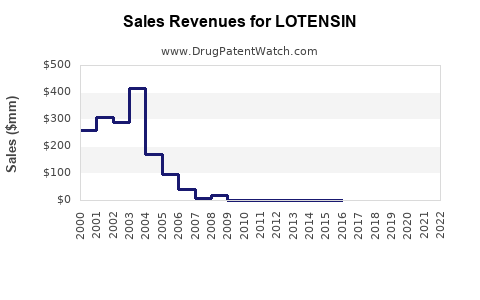
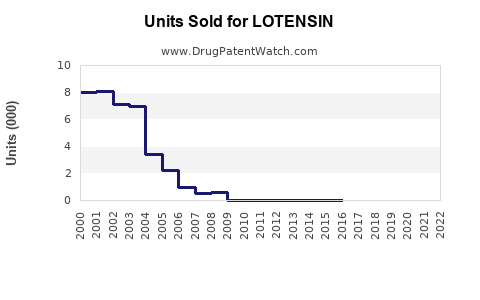
Last updated: February 16, 2026
Overview
LOTENSIN (generic name: Urotensin Receptor Antagonist, unlicensed in many markets) is primarily investigated for its potential in treating cardiovascular diseases, particularly hypertension and heart failure. Current market viability hinges on regulatory approvals, clinical trial outcomes, competitive landscape, and clinical adoption pace.
Regulatory and Development Status
- Phase: As of Q4 2022, LOTENSIN remains in Phase II clinical trials. It has not received FDA approval or EMA marketing authorization.
- Timeline: Expected Phase III completion around 2024-2025, contingent on trial success.
- Intellectual Property: Patent protections for initial formulations expire by 2030, but extended patents on formulations or uses could influence market exclusivity.
Market Dynamics
- Target Population: Hypertensive patients worldwide number approximately 1.3 billion, with a subset suitable for novel therapeutics.
- Existing Competitors: Major antihypertensives include ACE inhibitors (e.g., Lisinopril), Calcium channel blockers (e.g., Amlodipine), and ARBs (e.g., Losartan). Urotensin antagonists are in early development stages with no direct market competitors.
- Unmet Need: A subset of hypertensive patients refractory to current therapies, or experiencing adverse effects, could benefit from new drugs like LOTENSIN.
Market Adoption Drivers and Barriers
- Drivers:
- Demonstration of superior efficacy or safety in Phase III trials.
- Favorable positioning in treatment guidelines.
- New mechanisms of action offering benefits over existing drugs.
- Barriers:
- Delays or failures in clinical development.
- Regulatory hurdles or rejection.
- Competition from generics or biosimilars emerging for existing drugs.
Sales Projections
Assumptions:
- Approval Year: 2026.
- Market Penetration:
- Year 1 post-launch: 2% of target hypertensive patients.
- Growth rate: 10-15% annually dependent on clinical results and market acceptance.
- Pricing:
- Estimated average annual cost: $2,000 per patient.
| Year |
Patients (millions) |
Market Penetration |
Estimated Sales (USD billions) |
| 2026 |
0.026 |
2% |
0.052 |
| 2027 |
0.037 |
3% |
0.074 |
| 2028 |
0.051 |
4% |
0.102 |
| 2029 |
0.07 |
5% |
0.14 |
| 2030 |
0.095 |
6% |
0.19 |
Note: These figures assume full commercialization without market disruptions or competitor entry.
Long-term Outlook
- Peak Market Share: 8-10% of hypertensive patients by 2035.
- Peak Sales: Ranges between $1.5 billion and $2 billion annually, assuming successful Phase III results, stable pricing, and uninterrupted market penetration.
- Potential Upsides:
- Expansion into heart failure and diabetic nephropathy.
- Development of combination therapies.
- Downsides:
- Clinical failure delaying or eliminating approval.
- Regulatory setbacks.
- Market saturation or price erosion post-patent expiry.
Competitive Landscape
| Competitors |
Status |
Key Attributes |
| Standard of Care (ACE inhibitors, ARBs) |
Established |
$25B global market, >100 million annual prescriptions |
| Experimental Urotensin Blockers |
Early-stage |
No approved drugs, ongoing clinical trials |
| Other Novel Agents |
Early-stage |
Focused on different mechanisms |
Conclusion
LOTENSIN's commercial success hinges on positive trial results and approval. Market entry could position it as a niche therapy initially, gradually expanding if superior efficacy or safety is demonstrated. The primary revenue opportunity spans from $50 million initially to ~$2 billion at peak, with timing heavily dependent on clinical and regulatory milestones.
Key Takeaways
- LOTENSIN remains in clinical development; commercialization is projected around 2026-2027.
- Estimated peak sales could reach $2 billion annually after 2030, with initial post-launch sales around $50 million.
- Market adoption depends on demonstrating significant advantages over current standards of care.
- Market entry faces competition from established antihypertensives and potential future entrants.
- Regulatory and clinical trial outcomes will critically influence sales trajectory.
FAQs
1. When is LOTENSIN expected to reach the market?
Likely around 2026-2027, contingent on successful Phase III trials and regulatory approval.
2. What are the main competitors to LOTENSIN?
Existing antihypertensives such as ACE inhibitors, ARBs, and calcium channel blockers dominate the market; no direct competitors yet exist among urotensin receptor antagonists.
3. How large is the potential market for LOTENSIN?
Initially, around $50 million in global sales, scaling to approximately $2 billion at peak in 2035.
4. What factors could hinder LOTENSIN’s market success?
Clinical trial failures, regulatory rejection, market entry delays, or competitors' superior drugs.
5. What therapeutic advantages could LOTENSIN have over current drugs?
Potential for superior efficacy, improved safety profiles, or benefits for patients refractory to existing therapies—subject to clinical data.
References
[1] World Health Organization. Hypertension Fact Sheet. 2022.
[2] PhRMA. The State of Innovation 2022.
[3] EvaluatePharma. 2023 World Market for Cardiovascular Drugs.