Share This Page
Drug Sales Trends for GEODON
✉ Email this page to a colleague
Payment Methods and Pharmacy Types for GEODON (2012)
Revenues by Pharmacy Type
Units Sold by Pharmacy Type
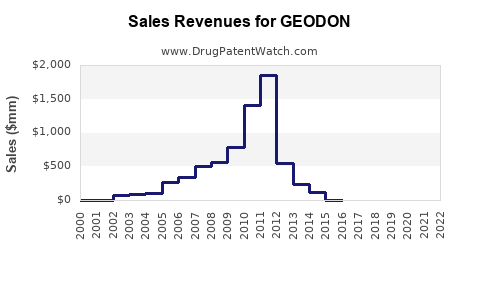
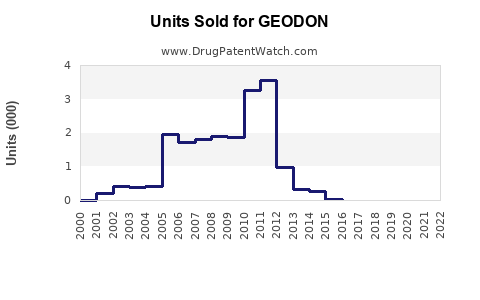
Annual Sales Revenues and Units Sold for GEODON
| Drug Name | Revenues (USD) | Units | Year |
|---|---|---|---|
| GEODON | ⤷ Start Trial | ⤷ Start Trial | 2022 |
| GEODON | ⤷ Start Trial | ⤷ Start Trial | 2021 |
| GEODON | ⤷ Start Trial | ⤷ Start Trial | 2020 |
| >Drug Name | >Revenues (USD) | >Units | >Year |
GEODON (Ziprasidone) Market Analysis, Patent Status, and Sales Projections
GEODON, the Pfizer-developed brand of ziprasidone, is a mature antipsychotic with minimal branded revenue and an established generic market. U.S. patent protection has expired, FDA generic competition is entrenched, and no biosimilar pathway applies. Future market value will depend on generic prescription volume, institutional use, pricing, and competition from aripiprazole, quetiapine, risperidone, olanzapine, lurasidone, cariprazine, and long-acting injectable therapies.
A reasonable base-case estimate places the global ziprasidone market at approximately $150 million to $300 million annually in 2025, with the U.S. generic segment representing roughly $75 million to $125 million. The market is likely to remain broadly stable in prescription volume but decline in nominal pricing as generic suppliers compete.
What is GEODON and what indications does it have?
GEODON is the brand name for ziprasidone hydrochloride, an atypical antipsychotic marketed primarily in oral capsules and intramuscular injection form.
| Product | Strengths or presentation | FDA-approved use |
|---|---|---|
| Ziprasidone capsules | 20 mg, 40 mg, 60 mg, 80 mg | Schizophrenia; acute manic or mixed episodes associated with bipolar I disorder |
| Ziprasidone injection | 20 mg/mL | Acute agitation associated with schizophrenia |
| Brand | GEODON | Pfizer-originated product |
| Generic | Ziprasidone hydrochloride | Approved through abbreviated new drug applications |
The oral formulation must be taken with food. The FDA label specifies a meal providing at least 500 calories because food materially increases exposure to ziprasidone.[1] This administration requirement limits convenience compared with products that can be taken without regard to meals.
Ziprasidone also carries a clinically important QT-prolongation warning. The product label identifies a greater capacity to prolong the QT/QTc interval than several other antipsychotics and contraindicates use in patients with known QT prolongation or certain significant cardiac risks.[1]
What is the FDA regulatory status of GEODON?
GEODON was approved by the FDA in 2001 for schizophrenia. The FDA later approved additional uses for acute manic or mixed episodes associated with bipolar disorder and intramuscular treatment of acute agitation in schizophrenia.[2]
The product is no longer a growth-stage branded asset. Its commercial status is:
| Regulatory issue | Status |
|---|---|
| Original NDA | Approved |
| Active brand development | Mature product |
| Generic availability | Established |
| Prescription route | Oral and intramuscular |
| Biosimilar eligibility | Not applicable |
| New chemical entity exclusivity | Expired |
| Pediatric exclusivity | Expired |
| U.S. brand growth profile | Declining or negligible |
| U.S. generic substitution | High |
The oral capsule and injectable products remain FDA-approved dosage forms, but approval does not imply meaningful continuing revenue for the branded product. Generic availability has shifted the economic value from the originator to manufacturers that compete on supply reliability, contracts, and distribution.
When does GEODON lose exclusivity?
GEODON lost meaningful U.S. market exclusivity after expiration of the principal ziprasidone patent estate and the launch of generic products in 2013.
Historical exclusivity timeline
| Event | Approximate timing |
|---|---|
| GEODON FDA approval | 2001 |
| Core compound patent protection | Expired in the early 2010s |
| Generic ziprasidone approvals | 2013 |
| Full generic substitution pressure | 2013 onward |
| Pediatric exclusivity | Expired |
| Current brand exclusivity | None of commercial significance |
The principal U.S. compound patent associated with ziprasidone was U.S. Patent No. 5,312,925, which had an effective term extending into 2012, subject to applicable patent-term adjustments and extensions. The FDA approved generic ziprasidone products after the relevant patent and regulatory barriers were addressed.[3][4]
Current commercial analysis should treat ziprasidone as an off-patent small molecule. There is no biologic exclusivity period and no biosimilar litigation framework relevant to the product.
What patents protect GEODON?
The core GEODON patent estate is no longer a meaningful barrier to generic entry.
| Patent category | Commercial status |
|---|---|
| Ziprasidone compound patent | Expired |
| Oral capsule claims | No effective barrier to ordinary generic entry |
| Intramuscular formulation claims | No known broad remaining barrier to established generic competition |
| Method-of-use claims | Historical protection has expired or lacks practical exclusivity value |
| Manufacturing patents | Potentially relevant to individual suppliers but not a market-wide barrier |
| Orange Book protection | No current listed patent should be treated as a material block to standard generic supply without checking the current FDA database |
The relevant distinction is between market-level protection and supplier-specific intellectual property. A generic manufacturer may hold process, polymorph, crystallization, or manufacturing know-how. Those rights can protect a particular production route but generally do not prevent other suppliers from producing approved ziprasidone through a noninfringing process.
What formulations are protected by GEODON patents?
Historical protection centered on ziprasidone as an active pharmaceutical ingredient and the approved dosage forms. The commercial opportunity today is not based on exclusivity for the original capsule formulation. Generic manufacturers can sell the same strengths if they demonstrate pharmaceutical equivalence and bioequivalence under the ANDA pathway.
Potential formulation differentiation could include:
- Modified-release oral products
- Alternative administration formats
- Improved food-independence
- Long-acting injectable formulations
- Hospital-ready injection packaging
- Combination products
No such product should be assumed to have FDA approval or commercially relevant patent protection without a separate product-specific review.
What is the Orange Book status of GEODON?
The FDA Orange Book identifies approved drug products, therapeutic equivalence information, and, where applicable, patents and exclusivity associated with listed products.[3]
For GEODON, the important commercial conclusion is that the Orange Book no longer provides the originator with a meaningful barrier to ordinary generic substitution. The product’s current risk profile is driven by approved generic equivalents rather than pending Paragraph IV challenges to a live, high-value brand patent.
Orange Book analysis should distinguish between:
- Historical patents listed for the original NDA.
- Expired patents that no longer block approval or launch.
- Current patents, if any, associated with specific listed products.
- Regulatory exclusivity, which has expired for the original product.
Which companies challenged GEODON patents?
Generic manufacturers challenged or worked around the historical GEODON patent estate during the pre-generic-entry period. The most important commercial event was not a current challenge but the subsequent FDA approval and launch of generic ziprasidone products.
The generic market has included major and specialty suppliers such as:
- Teva Pharmaceuticals
- Sandoz
- Zydus
- Lupin
- Alembic
- Dr. Reddy’s Laboratories
- Torrent Pharmaceuticals
- Other ANDA holders and contract manufacturers
The exact active supplier set changes over time because manufacturers enter, exit, discontinue specific strengths, or maintain approval without continuous commercial supply.
What Paragraph IV risk exists for GEODON?
Paragraph IV litigation is no longer the central risk. The principal Paragraph IV opportunity for ziprasidone occurred before generic entry. Current business exposure is instead linked to:
- Generic price erosion
- FDA manufacturing inspections
- Product shortages
- Supplier consolidation
- Hospital and pharmacy purchasing contracts
- Wholesaler inventory decisions
- State substitution rules
- Formulary placement
For an investor or licensee, a new Paragraph IV strategy against GEODON is unlikely to create material value because the original product is already genericized and the central patents have expired.
How large is the GEODON market?
The market is best analyzed in three segments:
| Segment | 2025 estimated annual value | Outlook |
|---|---|---|
| U.S. generic oral ziprasidone | $75 million-$125 million | Stable volume, continued price pressure |
| U.S. injectable ziprasidone | $20 million-$40 million | Supported by hospital and acute-care use |
| Non-U.S. markets | $50 million-$135 million | Fragmented, price-sensitive |
| Global total | $150 million-$300 million | Mature and largely flat |
These are market-model estimates rather than reported Pfizer brand sales. Pfizer’s public reporting historically grouped or separately reported selected pharmaceutical products, but current financial disclosures do not provide a reliable standalone revenue line for GEODON.[5]
The injectable segment may have better pricing than oral capsules because hospitals value ready availability during acute agitation episodes. It remains smaller and more operationally sensitive than the oral market.
What are GEODON sales projections through 2030?
The following base case assumes stable treated-patient volume, no major new indication, no long-acting formulation launch, and continued generic competition.
| Year | U.S. generic oral | U.S. injectable | International | Global estimated market |
|---|---|---|---|---|
| 2025 | $100 million | $30 million | $85 million | $215 million |
| 2026 | $98 million | $30 million | $86 million | $214 million |
| 2027 | $96 million | $31 million | $87 million | $214 million |
| 2028 | $95 million | $31 million | $88 million | $214 million |
| 2029 | $94 million | $32 million | $89 million | $215 million |
| 2030 | $93 million | $32 million | $90 million | $215 million |
Scenario analysis
| Scenario | 2030 global market | Principal assumptions |
|---|---|---|
| Downside | $140 million-$170 million | Further generic price erosion, lower use in schizophrenia, stronger prescribing shift to newer agents |
| Base case | $200 million-$230 million | Stable volume, modest injectable growth, flat international demand |
| Upside | $275 million-$375 million | Supply disruptions raise prices, renewed clinical use, expanded hospital utilization, or differentiated formulation |
The base case implies little or no real growth. Revenue may remain stable in nominal terms if injectable demand and international volume offset oral price erosion.
How does GEODON compare with competing antipsychotics?
Ziprasidone competes in a crowded atypical antipsychotic market.
| Drug | Commercial position | Key advantage over ziprasidone | Key limitation |
|---|---|---|---|
| Aripiprazole | Large generic and long-acting market | Lower metabolic burden and injectable maintenance options | Akathisia and impulse-control concerns |
| Quetiapine | High-volume generic | Broad use across mood and sleep-related prescribing | Sedation, weight gain, metabolic effects |
| Risperidone | High-volume generic and long-acting products | Established depot options | Prolactin and extrapyramidal effects |
| Olanzapine | High-volume generic | Strong efficacy and broad clinical familiarity | Weight gain and metabolic risk |
| Lurasidone | Branded/generic transition depending market | Bipolar depression positioning | Food requirement and higher cost |
| Cariprazine | Newer branded product | Bipolar depression and schizophrenia positioning | Price and limited generic competition |
| Ziprasidone | Mature generic | Lower weight and metabolic liability relative to some agents | QT risk, food requirement, limited long-acting options |
Ziprasidone’s clinical profile supports continued use where prescribers prioritize lower weight gain and lower metabolic impact. The food requirement, QT warning, and lack of a widely used long-acting injectable formulation constrain share expansion.[1]
What is the competitive landscape for generic ziprasidone?
Competition is fragmented and primarily price-based. Generic manufacturers compete through:
- Wholesale acquisition price
- Rebate and contract terms
- Supply continuity
- National distribution
- Hospital group purchasing organization contracts
- Availability across all four oral strengths
- Injectable product capacity
- Regulatory compliance
The largest commercial risk is supplier rationalization. A manufacturer with low volume may discontinue selected strengths, leaving the market to a smaller number of producers. That can temporarily improve pricing for remaining suppliers but creates supply and regulatory risk.
The oral capsule market has limited differentiation. An approved generic that is therapeutically equivalent to the reference product can typically be substituted under applicable state law and pharmacy rules. Competitive advantage therefore comes from cost, reliability, and distribution rather than patent exclusivity.
What patent litigation and settlement agreements affect GEODON?
Historical generic-entry litigation and settlement activity affected the timing of ziprasidone generic launch. Those matters have limited current commercial importance because generic entry occurred more than a decade ago.
No current settlement should be valued as a continuing market-exclusion asset unless it contains a surviving commercial restriction, license, or manufacturing covenant. For present-day diligence, the relevant questions are:
- Whether a supplier has an FDA-approved ANDA.
- Whether the supplier is actively shipping product.
- Whether the supplier has unresolved FDA compliance issues.
- Whether a process patent creates supplier-specific exposure.
- Whether a product liability or antitrust case affects contracting.
- Whether shortages or recalls have changed market share.
What licensing deals affect GEODON?
Pfizer developed and commercialized GEODON. The product’s licensing value has fallen sharply because the core molecule is off patent and generic suppliers have established market access.
Potential transaction value may still exist in:
- Regional distribution rights
- Hospital injectable supply contracts
- Manufacturing technology
- API supply
- Authorized-generic arrangements
- Product portfolios combining multiple generic psychiatric medicines
A licensing deal for the original branded product would generally have limited economic rationale unless it includes a differentiated formulation, supply advantage, or a high-value geographic market.
What generic launch scenarios exist for GEODON?
A new generic entrant would face a low-barrier regulatory pathway but a difficult commercial market.
Likely launch outcomes
- A low-cost oral capsule entrant captures limited share through wholesalers and discount channels.
- A supplier with reliable 20 mg, 40 mg, 60 mg, and 80 mg supply wins pharmacy contracts.
- An injectable entrant gains value through hospital purchasing agreements.
- A manufacturer exits after price erosion if it lacks scale.
- A differentiated formulation obtains greater value only if it has clinical, regulatory, or reimbursement advantages.
A generic company should not assume that FDA approval produces rapid market penetration. Ziprasidone has an established supplier base, limited brand pull, and low unit pricing.
What geographic markets offer the greatest opportunity?
The U.S. offers the largest transparent regulatory market but also the strongest generic price pressure. Europe and other developed markets provide established demand but generally lower prices and country-specific reimbursement barriers. Emerging markets may offer volume growth but have more fragmented registration, tender, and distribution conditions.
| Region | Opportunity | Main barrier |
|---|---|---|
| United States | Injectable contracts and broad pharmacy access | Low generic pricing |
| Western Europe | Stable schizophrenia and bipolar demand | National price controls |
| Latin America | Volume growth in selected markets | Registration and tender fragmentation |
| Asia-Pacific | Large patient population | Local manufacturers and low prices |
| Middle East and Africa | Institutional demand | Distribution and procurement risk |
Manufacturing and API sourcing remain more important than patent rights. A supplier dependent on a single API site or one finished-dose facility faces greater commercial exposure than a supplier with redundant capacity.
What is the revenue exposure for Pfizer?
GEODON is no longer expected to be a material contributor to Pfizer’s consolidated revenue. Generic substitution and the expiration of exclusivity have removed the original branded pricing power. Pfizer’s current pharmaceutical portfolio is concentrated in larger growth products and newer therapeutic franchises, while mature products such as GEODON have limited strategic weight.[5]
Any remaining brand revenue is likely to be small relative to Pfizer’s total sales and should not materially affect valuation, earnings forecasts, or business-development strategy.
Key Takeaways
- GEODON is an off-patent ziprasidone product with established generic competition.
- U.S. exclusivity ended after expiration of the historical patent estate and generic entry in 2013.
- No biosimilar risk applies because ziprasidone is a small-molecule drug.
- Current market value is concentrated in generic oral capsules and hospital injectable supply.
- Estimated 2025 global market value is approximately $150 million to $300 million.
- Base-case global revenue is projected at roughly $215 million annually through 2030.
- Oral pricing should remain under pressure, while injectable supply may provide modest growth.
- The principal risks are generic price erosion, supplier exits, manufacturing compliance, and competition from newer antipsychotics.
- Patent litigation and Paragraph IV challenges are historical issues rather than current market barriers.
- A new entrant would need supply reliability, low manufacturing cost, or a differentiated formulation to achieve meaningful share.
FAQs
Is GEODON still sold under the brand name?
GEODON remains an FDA-approved brand, but most U.S. prescriptions are expected to be filled with generic ziprasidone because the product has lost exclusivity.
Is ziprasidone a high-revenue generic drug?
No. Ziprasidone is a mature, mid-volume generic with significantly lower revenue than high-use antipsychotics such as aripiprazole, quetiapine, risperidone, or olanzapine.
Does GEODON have a long-acting injectable version?
The FDA-approved injectable product is an intramuscular formulation for acute agitation associated with schizophrenia. It is not the same as a long-acting maintenance injectable administered over weeks or months.
Can a generic manufacturer launch a new GEODON product without a patent license?
A manufacturer can generally pursue an ANDA for an approved generic product after applicable patents and exclusivity have expired. It must still meet FDA requirements for pharmaceutical equivalence, bioequivalence, manufacturing quality, labeling, and regulatory compliance.
What could increase the value of the ziprasidone market?
A clinically differentiated formulation, improved food independence, a long-acting delivery system, supply shortages that raise pricing, or expanded use in hospital acute-care settings could increase market value. None should be assumed without FDA approval and commercial evidence.
References
- U.S. Food and Drug Administration. (2023). Geodon (ziprasidone) prescribing information. https://www.accessdata.fda.gov
- U.S. Food and Drug Administration. (2001). FDA approves Geodon for treatment of schizophrenia. https://www.fda.gov
- U.S. Food and Drug Administration. (n.d.). Approved drug products with therapeutic equivalence evaluations: Orange Book. https://www.fda.gov/drugs/drug-approvals-and-databases/orange-book
- U.S. Food and Drug Administration. (n.d.). Drugs@FDA: FDA-approved drugs. https://www.accessdata.fda.gov/scripts/cder/daf/
- Pfizer Inc. (2013). Annual report pursuant to Section 13 or 15(d) of the Securities Exchange Act of 1934. https://www.pfizer.com/investors/financial-reports-annual-reports-and-proxy-information
More… ↓
