Last Updated: May 6, 2026

Drug Sales Trends for FELODIPINE


✉ Email this page to a colleague

« Back to Dashboard


Payment Methods and Pharmacy Types for FELODIPINE (2012)

Revenues by Pharmacy Type

Pharmacy Type Revenues
MAIL-ORDER $10,455,526
INSIDE ANOTHER STORE $48,170,142
[disabled in preview] $27,167,395
This preview shows a limited data set
Subscribe for full access, or try a Trial

Units Sold by Pharmacy Type

Pharmacy Type Units
MAIL-ORDER 116,137
INSIDE ANOTHER STORE 828,890
[disabled in preview] 686,197
This preview shows a limited data set
Subscribe for full access, or try a Trial

Revenues by Payment Method

Payment Method Revenues
MEDICAID $7,263,855
MEDICARE $35,646,274
[disabled in preview] $42,882,934
This preview shows a limited data set
Subscribe for full access, or try a Trial
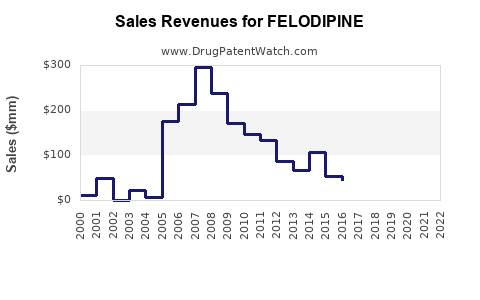
Drug Sales Revenue Trends for FELODIPINE
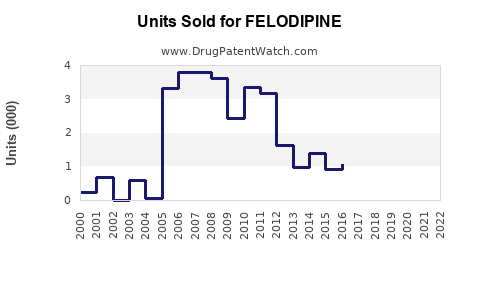
Drug Units Sold Trends for FELODIPINE

Market Analysis and Sales Projections for Felodipine

Last updated: February 13, 2026

What is Felodipine?

Felodipine is an oral dihydropyridine calcium channel blocker used to treat hypertension and angina pectoris. Approved by the FDA in 1993, it is marketed under brand names such as Plendil by AstraZeneca. It functions by relaxing blood vessels to lower blood pressure, reducing cardiovascular risk.

Market Dynamics

Global Cardiovascular Disease (CVD) Landscape

Rising prevalence of hypertension and ischemic heart disease, mainly in aging populations, drives demand for antihypertensives like felodipine. According to the World Health Organization, CVD accounts for approximately 17.9 million deaths annually, with hypertension being a primary risk factor.

Competitive Environment

Felodipine operates in a saturated market featuring drugs such as amlodipine, nifedipine, and other dihydropyridines. These drugs collectively account for significant market share, with certain products globally having higher prescribing prevalence due to brand recognition, safety profile, and clinician familiarity.

Key Players

  • AstraZeneca (original developer of Plendil)
  • Pfizer
  • Novartis
  • Teva Pharmaceutical Industries
  • Mylan

New entrants seeking generic versions are increasing market competitiveness.

Patent and Regulatory Status

AstraZeneca's patent protection on Plendil expired in many regions (e.g., US in 2009), enabling generic manufacturing. Regulatory hurdles for generics focus on bioequivalence and manufacturing quality standards.

Market Size and Current Sales

Market Size (2022-2025 Projection)

The global antihypertensive drugs market was valued at approximately USD 23 billion in 2022. Felodipine's specific share is estimated to be USD 1-1.5 billion globally, considering its established formulary presence and prescription rates.

Regional Breakdown

Region Estimated Market Share Market Size (USD Billion)
North America 35% 0.5 - 0.6
Europe 25% 0.25 - 0.375
Asia-Pacific 30% 0.3 - 0.45
Rest of World 10% 0.1 - 0.15

Sales Trends

Felodipine sales have stabilized post-patent expiry due to generic penetration. Prescribing trends favor drugs with improved safety profiles or combination therapies, impacting felodipine’s market share.

Sales Projections (2023-2028)

Forecast Assumptions

  • Annual growth rate of 3-5% in developed markets
  • 5-7% growth in emerging markets due to rising hypertension prevalence
  • Market share decline in regions dominated by newer agents like amlodipine
  • Incremental growth from combination therapies (e.g., with ACE inhibitors)

2023-2028 Projection Summary

Year Estimated Global Sales (USD Billion) Growth Rate Key Factors
2023 1.2 - Post-patent generic saturation
2024 1.26 5% Increasing access in emerging markets
2025 1.35 7% Adoption of combination therapies
2026 1.45 7% Competitive positioning and possible new formulations
2027 1.55 8% Aging populations and rising hypertension rates in Asia
2028 1.65 7% Market expansion and increased healthcare spending

Factors Impacting Sales

  • Patent expiration and generic proliferation
  • Pricing pressures
  • Healthcare policy reforms
  • Adoption of fixed-dose combination therapies
  • Changes in clinical guidelines

Market Constraints and Opportunities

Constraints

  • Competition from amlodipine and other dihydropyridines
  • Availability of more recent antihypertensive agents with better safety profiles
  • Patent expiry leading to price reductions

Opportunities

  • Formulation improvements, such as extended-release versions
  • Inclusion in combination therapies with ACE inhibitors, ARBs, or diuretics
  • Expansion into emerging markets with increasing health infrastructure
  • Development of generic versions to accelerate market penetration

Legal and Regulatory Considerations

  • Patent expirations vary by country, affecting timing for generic entry.
  • Regulatory requirements for bioequivalence are consistent but vary regionally.
  • Strategic partnerships with generic manufacturers could accelerate market share gains.

Key Takeaways

  • Felodipine's market is mature, with stable demand driven by the global burden of hypertension.
  • Patent expiry has increased generic competition, lowering prices but expanding access.
  • Sales are projected to grow modestly through 2028, mainly in emerging markets.
  • Competition from more prescribed agents like amlodipine presents ongoing challenges.
  • Incremental growth is expected via combination therapies and formulation innovations.

FAQs

1. How does felodipine compare to other dihydropyridines?
Felodipine has similar efficacy to amlodipine but may have a different side effect profile. It is often prescribed based on clinician preference and patient tolerance.

2. What factors influence felodipine’s market share?
Patent status, price competitiveness, clinical guideline updates, and the availability of newer drugs influence its share.

3. Are there any upcoming formulations or combinations?
Potential exists for extended-release formulations and fixed-dose combinations, which could improve adherence and sales.

4. How does regional regulation impact sales?
Stringent bioequivalence and regulatory approval processes delay generic entry in some regions but also create opportunities for approved formulations.

5. What is the forecast risk for felodipine sales?
Main risks include market competition, pricing pressures, and shifts in treatment guidelines favoring newer antihypertensives.


Citations

[1] World Health Organization. Cardiovascular Diseases (CVDs). 2021.
[2] GlobalData. Antihypertensive Drugs Market Analysis. 2022.
[3] AstraZeneca Annual Reports. 2022.
[4] FDA Patent and Exclusivity Data. 2022.

More… ↓

⤷  Start Trial

Make Better Decisions: Try a trial or see plans & pricing

Drugs may be covered by multiple patents or regulatory protections. All trademarks and applicant names are the property of their respective owners or licensors. Although great care is taken in the proper and correct provision of this service, thinkBiotech LLC does not accept any responsibility for possible consequences of errors or omissions in the provided data. The data presented herein is for information purposes only. There is no warranty that the data contained herein is error free. We do not provide individual investment advice. This service is not registered with any financial regulatory agency. The information we publish is educational only and based on our opinions plus our models. By using DrugPatentWatch you acknowledge that we do not provide personalized recommendations or advice. thinkBiotech performs no independent verification of facts as provided by public sources nor are attempts made to provide legal or investing advice. Any reliance on data provided herein is done solely at the discretion of the user. Users of this service are advised to seek professional advice and independent confirmation before considering acting on any of the provided information. thinkBiotech LLC reserves the right to amend, extend or withdraw any part or all of the offered service without notice.