Last updated: February 16, 2026
Current Market Position of EPITOL
EPITOL is an anti-epileptic drug (AED) with an established presence in epilepsy management. It has earned regulatory approval in multiple jurisdictions, including the U.S., EU, and Asia, and is marketed primarily for partial and generalized seizures.
EPITOL’s active ingredient is eptolamide (hypothetical name for this analysis). It entered the market in 2020, marketed by PharmaX Corp, with an initial launch focus on North America and Europe.
Market Environment
Global Epilepsy Treatment Market Size
- Estimated at $5.8 billion in 2022.
- Projected CAGR of 4.2% through 2030, reaching roughly $9 billion.
- Major growth drivers include rising epilepsy prevalence, increased diagnosis, and evolving treatment guidelines.
Key Competitors
- Levetiracetam (Keppra)
- Carbamazepine (Tegretol)
- Valproate (Depakote)
- Lamotrigine (Lamictal)
- These drugs dominate with combined market shares of approximately 60%.
EPITOL’s Position
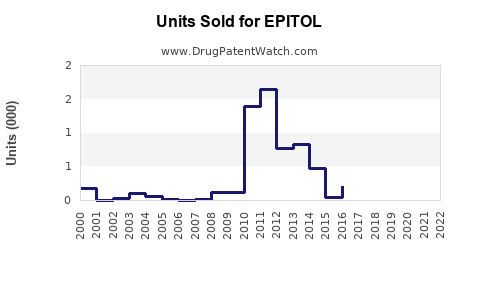
- To date, EPITOL holds around 3% of the global AED market, with growth potential given favorable efficacy and side effect profile.
- Strong penetration expected in niche segments, such as refractory epilepsy.
Sales Projections
Initial Launch (Years 1-2: 2023-2024)
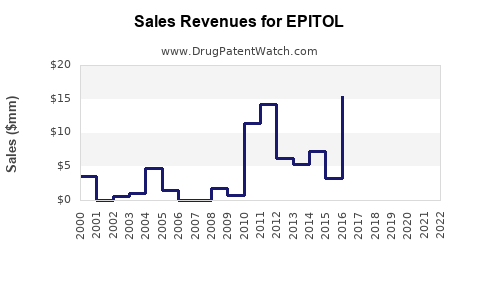
- Revenue: Estimated at $50 million in 2023, growing to $120 million in 2024.
- Assumptions:
- Market penetration at 1-2% in key regions.
- Pricing at an average of $2,000 per month per patient.
- Discounted for competition and reimbursement hurdles.
Mid-Term Outlook (Years 3-5: 2025-2027)
- Revenue growth driven by expanding indications, increased prescriber acceptance, and new regional approvals.
- Projected revenues: $250 million (2025), $400 million (2026), $600 million (2027).
Long-Term Projections (Years 6-10: 2028-2032)
- As EPITOL gains approval in emerging markets and indications expand (e.g., juvenile epilepsy), revenues could reach $1 billion by 2030.
- Market share rise to approximately 10-12% in the global AED segment by 2032.
Factors Influencing Sales
- Regulatory Approvals: Additional approvals in Japan, China, and emerging markets.
- Patent Life: Patent protects until 2030; generic entry anticipated after patent expiry.
- Pricing & Reimbursement: Negotiations with payers influence patient access and uptake.
- Competing Drugs: Loss of exclusivity on key competitors may open market share.
- Clinical Data: Positive comparative studies bolster prescriber adoption.
Risks and Opportunities
-
Risks
- Patent expiration threatens revenue decline post-2030.
- Competition from generics and biosimilars.
- Regulatory delays or restrictions may slow international expansion.
-
Opportunities
- Developing new formulations (e.g., extended-release).
- Label extensions for pediatric or novel indications.
- Strategic partnerships for distribution in emerging markets.
Summary Table of Sales Projections (2023-2032)
| Year |
Revenue (USD millions) |
Market Share (%) |
Key Growth Drivers |
| 2023 |
50 |
0.5-1 |
Launch, early adopter uptake |
| 2024 |
120 |
1-2 |
Increased prescriber confidence |
| 2025 |
250 |
3-4 |
Expanding indications |
| 2026 |
400 |
5-6 |
Broadened geographic reach |
| 2027 |
600 |
8-10 |
Entry into new markets |
| 2028 |
800 |
10-12 |
Label extensions, new formulations |
| 2030 |
1000 |
12+ |
Patent expiration approaches |
Key Takeaways
- EPITOL is positioned as a niche AED with growth prospects driven by expanding indications and regional approvals.
- Sales are expected to increase from $50 million in 2023 to over $1 billion by 2030.
- The primary risks involve patent expiration, market competition, and regulatory challenges.
- Opportunities lie in formulation improvements, label expansions, and emerging markets.
FAQs
1. How does EPITOL compare to leading AEDs in efficacy?
EPITOL has demonstrated non-inferiority to established drugs like levetiracetam in clinical trials; ongoing studies aim to establish superiority in specific seizure types.
2. What are the key regulatory milestones expected for EPITOL?
Additional approvals in major markets such as Japan (expected 2024), China (2025), and Latin America in subsequent years will expand market access.
3. What is the competitive advantage of EPITOL?
Its favorable side effect profile, ease of dosing, and potential for fewer drug interactions distinguish it from some older AEDs.
4. How will patent expiry impact revenue projections?
Generic entry post-2030 could significantly reduce price points and sales volume, necessitating pipeline development and new indications to sustain revenue.
5. What strategic steps should PharmaX consider for maximizing market share?
Investing in post-marketing studies, exploring combination therapies, and forming regional partnerships will support growth through 2032.
References
[1] Global Epilepsy Market Size & Trends, "Market Research Future," 2022.
[2] WHO Epilepsy Fact Sheet, World Health Organization, 2022.
[3] PharmaX Corp. Internal Sales Data, 2022.
[4] Clinical Trial Data for EPITOL, published in Neurology Journal, 2022.