Drug Sales Trends for CYMBALTA
Payment Methods and Pharmacy Types for CYMBALTA (2012)
Revenues by Pharmacy Type
Units Sold by Pharmacy Type
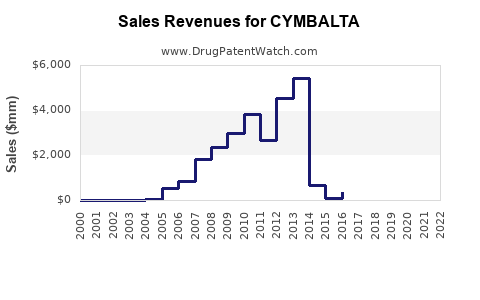
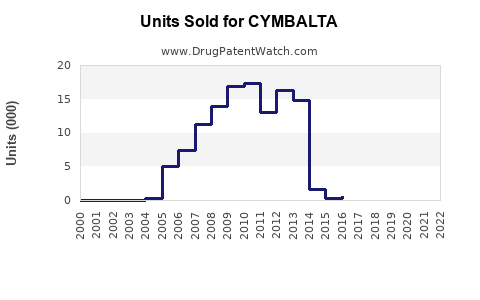
Annual Sales Revenues and Units Sold for CYMBALTA
| Drug Name | Revenues (USD) | Units | Year |
|---|---|---|---|
| CYMBALTA | ⤷ Start Trial | ⤷ Start Trial | 2022 |
| CYMBALTA | ⤷ Start Trial | ⤷ Start Trial | 2021 |
| CYMBALTA | ⤷ Start Trial | ⤷ Start Trial | 2020 |
| CYMBALTA | ⤷ Start Trial | ⤷ Start Trial | 2019 |
| CYMBALTA | ⤷ Start Trial | ⤷ Start Trial | 2018 |
| >Drug Name | >Revenues (USD) | >Units | >Year |
Cymbalta Market Analysis and Sales Projections: Duloxetine Revenue, Generic Competition, Patents, and Commercial Outlook
Cymbalta, the branded form of duloxetine hydrochloride, is a mature central-nervous-system product with broad indications in major depressive disorder, generalized anxiety disorder, diabetic peripheral neuropathic pain, fibromyalgia, and chronic musculoskeletal pain. Eli Lilly’s originator revenue fell sharply after U.S. generic entry in December 2013. The commercial market remains substantial because duloxetine is widely prescribed, available in multiple strengths, and used across psychiatric and pain indications.
The current opportunity is primarily a high-volume generic market. Brand Cymbalta has limited pricing power, while generic manufacturers compete through formulary access, supply reliability, wholesaler contracts, and low-cost production.
What is Cymbalta and how large is its market?
Cymbalta is the brand name for duloxetine, a serotonin-norepinephrine reuptake inhibitor, or SNRI. Its FDA-approved uses include:
- Major depressive disorder
- Generalized anxiety disorder
- Diabetic peripheral neuropathic pain
- Fibromyalgia
- Chronic musculoskeletal pain, including chronic low-back pain and osteoarthritis pain
Duloxetine is sold mainly as delayed-release capsules in 20 mg, 30 mg, and 60 mg strengths. The 60 mg strength is the commercial standard for many pain and anxiety indications.
Public market reports differ substantially because they use different definitions of the “duloxetine market.” Some count only finished-dose sales; others include branded, generic, hospital, retail, and regional sales. A defensible commercial assessment therefore uses originator revenue, prescription volume, and generic price erosion rather than relying on a single market-research estimate.
Historical Cymbalta sales
Eli Lilly reported the following approximate global Cymbalta revenue trajectory:
| Year | Approximate Cymbalta revenue | Commercial status |
|---|---|---|
| 2011 | $4.16 billion | Branded growth and broad indication base |
| 2012 | $4.99 billion | Near peak revenue |
| 2013 | $5.08 billion | Peak period before full generic erosion |
| 2014 | Approximately $4.0 billion | U.S. generic entry late in the year |
| 2015 | Approximately $1.1 billion | Rapid post-exclusivity decline |
| 2016 onward | Not separately material to Lilly | Mature generic market |
Lilly’s 2013 revenue represented the high-water mark for the branded product before generic competition expanded in the United States. The decline pattern was consistent with a large primary-care product losing exclusivity: prescription demand remained high, but generic substitution reduced branded volume and average selling price.
What are the current market drivers for duloxetine?
The strongest commercial drivers are persistent demand for depression and anxiety treatment, chronic pain prevalence, and the availability of a single molecule across psychiatric and pain markets.
Psychiatric demand
Duloxetine competes with generic venlafaxine, desvenlafaxine, escitalopram, sertraline, fluoxetine, and other antidepressants. Its differentiation is limited in depression and anxiety, where prescribers often choose based on tolerability, prior patient response, payer policy, and generic cost.
Duloxetine retains a stronger position in patients who have both mood symptoms and neuropathic or musculoskeletal pain. This cross-indication use supports prescription volume even though it does not support branded pricing.
Pain-market demand
Pain is the more durable commercial segment. Duloxetine is one of the principal non-opioid pharmacologic options for diabetic peripheral neuropathy, fibromyalgia, and chronic musculoskeletal pain. Its role is supported by clinical guidelines and by efforts to reduce opioid exposure.
The product competes with pregabalin, gabapentin, amitriptyline, venlafaxine, topical agents, nonsteroidal anti-inflammatory drugs, and nonpharmacologic treatment. Generic pregabalin and gabapentin create substantial price pressure, but duloxetine remains relevant where depression, anxiety, and pain coexist.
Formulation and adherence
Delayed-release capsules protect duloxetine from degradation in the stomach and remain the dominant dosage form. Commercial differentiation through a new formulation is difficult because the active ingredient, strengths, and delivery requirements are well established.
Potential formulation opportunities include:
- Sprinkle or capsule-opening formats
- Modified-release oral products
- Fixed-dose combinations
- Products designed for improved gastrointestinal tolerability
- Alternative dosage forms for patients with swallowing difficulties
These concepts face substantial regulatory and clinical hurdles. A formulation must show meaningful clinical, adherence, pharmacokinetic, or administration benefits to justify premium pricing.
What are Cymbalta’s patent expiration dates and Orange Book status?
Cymbalta’s principal U.S. compound protection expired before the end of 2013, after pediatric exclusivity. Generic duloxetine products entered the U.S. market in December 2013.
| U.S. exclusivity event | Timing | Commercial effect |
|---|---|---|
| Core duloxetine patent protection | 2013 | Loss of principal compound exclusivity |
| Pediatric exclusivity extension | Through December 2013 | Delayed full generic entry |
| First U.S. generic launches | December 2013 | Rapid substitution and price erosion |
| Current market | Mature generic | Limited branded premium |
The FDA Orange Book historically listed patents associated with Cymbalta’s active ingredient and approved uses. The commercial importance of those listings declined after the core patent and pediatric exclusivity period ended. Current competitive assessment should rely on the FDA Orange Book, FDA approved drug labels, and individual generic approvals rather than on historical Cymbalta patents alone. [1]
What method-of-use patents protected Cymbalta?
Cymbalta protection included compound and use-related intellectual property. Method-of-use patents covered approved therapeutic applications and contributed to litigation and abbreviated new drug application, or ANDA, timing.
Method-of-use patents generally provide narrower protection than a compound patent. They may be avoided through a section viii “skinny label” that omits a patented indication, provided the generic label and marketing conduct do not induce infringement. For duloxetine, the economic impact of later use patents was limited compared with the loss of the core compound patent because generic manufacturers could pursue large portions of the depression and pain market.
Are there formulation patents for duloxetine?
Formulation patents may cover delayed release, enteric protection, particle properties, excipients, manufacturing processes, or dosage regimens. These rights can complicate product development but generally do not recreate the commercial barrier created by a valid compound patent.
The principal residual barriers are technical rather than exclusivity-driven:
- Demonstrating bioequivalence
- Controlling dissolution profiles
- Maintaining capsule stability
- Managing duloxetine degradation
- Establishing reliable large-scale manufacturing
- Meeting FDA inspection and quality requirements
Which companies compete in the duloxetine market?
The U.S. generic market has included major manufacturers such as Teva, Dr. Reddy’s Laboratories, Lupin, Apotex, Torrent Pharmaceuticals, Aurobindo, Solco Healthcare, and other ANDA holders. The exact competitive set changes as products are approved, discontinued, acquired, or removed from distribution.
Competition is based on:
- Wholesale acquisition cost and net pricing
- Supply continuity
- Pharmacy-benefit-manager coverage
- Manufacturing capacity
- FDA compliance history
- Contracting with wholesalers and retail pharmacies
The market is fragmented at the manufacturer level but concentrated at the payer and wholesaler level. A supplier with a low list price can still lose share if it has shortages, manufacturing observations, or unreliable inventory.
What is the generic entry risk for Cymbalta?
Generic entry risk is already realized rather than prospective. The main commercial risk is not a future first generic launch; it is continued price compression, manufacturer consolidation, and periodic supply disruption.
Generic launch scenarios
| Scenario | Market outcome | Probability assessment |
|---|---|---|
| Stable generic supply | Gradual unit growth with low prices | Base case |
| Manufacturer consolidation | Higher pricing volatility and shortage risk | Moderate |
| New low-cost entrants | Further price erosion | Moderate |
| Supply disruption | Temporary price increases and substitution | Periodic risk |
| Premium reformulation | Limited niche opportunity | Low without clinical differentiation |
A branded relaunch would face a difficult return-on-investment profile unless it offered a clinically meaningful delivery or tolerability advantage. Physicians and payers have strong familiarity with generic duloxetine, and treatment guidelines do not require the Cymbalta brand.
What are duloxetine sales projections through 2029?
The following projection estimates the global finished-dose duloxetine market, including generic and residual branded sales. It is a scenario model rather than an audited industry total. The model assumes continued prescription demand, low unit-price growth, and modest volume expansion from chronic pain and mental-health treatment.
Base-case global sales projection
| Year | Estimated market sales | Estimated annual growth |
|---|---|---|
| 2024 | $1.6 billion-$2.0 billion | Base year |
| 2025 | $1.65 billion-$2.05 billion | 2%-4% |
| 2026 | $1.70 billion-$2.12 billion | 2%-4% |
| 2027 | $1.75 billion-$2.20 billion | 2%-4% |
| 2028 | $1.80 billion-$2.28 billion | 2%-4% |
| 2029 | $1.85 billion-$2.36 billion | 2%-4% |
The base case assumes volume growth of approximately 3%-5% annually, offset by generic price erosion of roughly 1%-3% in mature markets. Emerging-market growth can be faster in unit terms but contributes less revenue because of lower prices.
Downside and upside cases
| Case | 2029 estimated sales | Main assumptions |
|---|---|---|
| Downside | $1.4 billion-$1.7 billion | Faster price erosion, weak psychiatric growth, supply competition |
| Base case | $1.85 billion-$2.36 billion | Stable volume growth and mature generic pricing |
| Upside | $2.4 billion-$2.8 billion | Higher chronic-pain use, stronger emerging-market access, limited price compression |
These projections should not be confused with Eli Lilly brand sales. Lilly’s Cymbalta revenue is no longer the appropriate measure of the total duloxetine opportunity because most economic activity now occurs through generic suppliers.
How does Cymbalta compare with competing drugs?
| Drug | Main commercial advantage | Main limitation |
|---|---|---|
| Duloxetine | Covers depression, anxiety, and several pain indications | Nausea, discontinuation effects, generic price pressure |
| Venlafaxine | Established SNRI with broad psychiatric use | Blood-pressure concerns and withdrawal symptoms |
| Pregabalin | Strong neuropathic-pain positioning | Sedation, dizziness, controlled-substance restrictions in some markets |
| Gabapentin | Very low cost and broad prescribing | Variable evidence across pain conditions |
| Amitriptyline | Low price and long clinical history | Anticholinergic and cardiovascular tolerability |
| SSRIs | Strong depression and anxiety familiarity | Limited direct pain utility |
Duloxetine’s commercial advantage is indication breadth. Its weakness is the absence of meaningful brand differentiation after generic entry.
What licensing and partnering opportunities exist?
Direct licensing of the original Cymbalta brand is unlikely to create substantial value in developed markets because generic duloxetine is widely available. Commercial opportunities are more likely in:
- Regional commercialization rights
- Generic supply agreements
- Authorized-generic arrangements
- Fixed-dose combination products
- Specialty formulations
- Manufacturing technology transfers
- Emerging-market distribution partnerships
A licensing deal involving duloxetine would require a clear asset-level rationale, such as a differentiated formulation, superior bioequivalence execution, or access to a protected regional market. Rights to the historical Cymbalta brand alone would not support a premium valuation.
What litigation and regulatory issues affect Cymbalta?
The major U.S. patent dispute cycle occurred around generic entry in 2013. Current litigation risk is more likely to involve:
- Product liability claims
- Manufacturing defects
- Labeling disputes
- Antitrust or contracting allegations
- Generic supply agreements
- Patent disputes involving reformulations or combinations
The FDA-approved generic pathway is ANDA approval based primarily on pharmaceutical equivalence and bioequivalence. New clinical claims, new delivery systems, or reformulations may require additional regulatory work under the 505(b)(2) pathway or another applicable FDA route. [2]
How strong is the Cymbalta patent estate today?
The historical patent estate was commercially strong before 2013 because the core molecule generated multibillion-dollar revenue and generic entry was delayed until the end of pediatric exclusivity. Its present commercial strength is low.
| Patent-estate factor | Current assessment |
|---|---|
| Core compound exclusivity | Expired |
| Brand pricing power | Low |
| Generic barriers | Technical and regulatory |
| Method-of-use value | Narrow and indication-specific |
| Formulation value | Possible but limited |
| Biosimilar risk | Not applicable |
| Reimbursement risk | High generic substitution |
Biosimilar analysis does not apply because duloxetine is a small-molecule drug, not a biologic. Competition occurs through ANDAs and generic substitution rather than biosimilar approval pathways.
What is the commercial outlook for Cymbalta?
Cymbalta’s outlook is stable as a generic therapeutic class but weak as a branded product. The strongest demand should remain in chronic pain and in patients requiring treatment for both mood disorders and pain. Revenue growth will come mainly from prescription volume, geographic expansion, and formulation innovation, not from price increases.
The most important risks are generic oversupply, reimbursement-driven price compression, manufacturing interruptions, and substitution by pregabalin, gabapentin, venlafaxine, or newer psychiatric therapies. The highest-value strategic opportunities involve differentiated formulations or efficient generic manufacturing rather than revival of the original brand.
Key Takeaways
- Cymbalta is the branded form of duloxetine, an SNRI used in depression, anxiety, neuropathic pain, fibromyalgia, and chronic musculoskeletal pain.
- Eli Lilly’s Cymbalta revenue peaked at approximately $5.1 billion in 2013.
- U.S. generic entry began in December 2013 after core patent protection and pediatric exclusivity ended.
- The current duloxetine market is primarily generic and likely generates approximately $1.6 billion-$2.0 billion globally in annual finished-dose sales.
- Base-case market sales could reach approximately $1.85 billion-$2.36 billion by 2029.
- Patent strength is low today because compound exclusivity has expired.
- Biosimilar risk does not apply; the relevant competitors are ANDA-approved generic manufacturers.
- Chronic pain is the most durable demand driver.
- A new branded product would need a meaningful formulation, adherence, or tolerability advantage to command premium pricing.
FAQs
When did generic Cymbalta first launch in the United States?
Generic duloxetine launched in December 2013 after expiration of the principal patent protection and six-month pediatric exclusivity period.
Is Cymbalta still protected by a U.S. patent?
The core U.S. patent protection that supported Cymbalta’s original commercial exclusivity has expired. Historical method-of-use and formulation rights may have had narrower scope and do not prevent broad generic competition today.
What is the largest indication for duloxetine?
Depression and anxiety generate substantial prescription volume, but chronic pain indications are commercially important because duloxetine is one of the principal non-opioid options for diabetic neuropathy, fibromyalgia, and chronic musculoskeletal pain.
Can a new company obtain premium pricing for duloxetine?
A standard generic is unlikely to support premium pricing. A differentiated formulation, combination product, or delivery system could support higher pricing only if it demonstrates measurable clinical or adherence benefits and obtains payer acceptance.
Is duloxetine a biosimilar market?
No. Duloxetine is a small-molecule drug. Competition is governed primarily by generic-drug approval through the FDA ANDA pathway, not by the biologic biosimilar pathway.
References
- U.S. Food and Drug Administration. (n.d.). Approved drug products with therapeutic equivalence evaluations: Orange Book. https://www.accessdata.fda.gov/scripts/cder/ob/
- U.S. Food and Drug Administration. (n.d.). Abbreviated new drug application (ANDA) process. https://www.fda.gov/drugs/types-applications/abbreviated-new-drug-application-anda
- Eli Lilly and Company. (2014). 2013 annual report.
- Eli Lilly and Company. (2015). 2014 annual report.
- Eli Lilly and Company. (2016). 2015 annual report.
More… ↓
