Share This Page
Drug Sales Trends for CLARINEX
✉ Email this page to a colleague
Payment Methods and Pharmacy Types for CLARINEX (2012)
Revenues by Pharmacy Type
Units Sold by Pharmacy Type
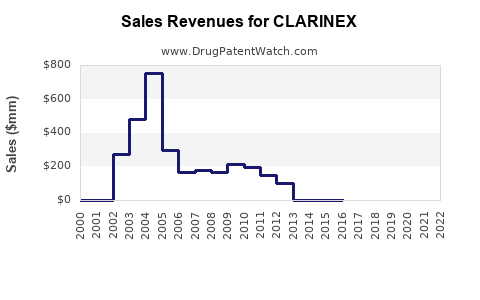
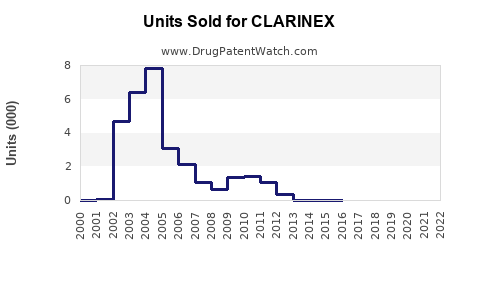
Annual Sales Revenues and Units Sold for CLARINEX
| Drug Name | Revenues (USD) | Units | Year |
|---|---|---|---|
| CLARINEX | ⤷ Start Trial | ⤷ Start Trial | 2022 |
| CLARINEX | ⤷ Start Trial | ⤷ Start Trial | 2021 |
| CLARINEX | ⤷ Start Trial | ⤷ Start Trial | 2020 |
| >Drug Name | >Revenues (USD) | >Units | >Year |
CLARINEX Market Analysis and Sales Projections: Desloratadine, Generic Competition, and Commercial Outlook
Clarinex, the branded formulation of desloratadine, has largely lost its commercial value in the United States because core patent protection expired and generic desloratadine is widely available. The product remains commercially relevant as a reference brand, but future revenue is expected to come primarily from low-priced generic prescriptions, limited branded or authorized-generic channels, and selected international markets.
A reasonable base-case forecast places global desloratadine market sales at approximately $300 million to $450 million annually through 2030, with branded Clarinex contributing a small minority of total revenue. The U.S. market is mature, price-driven, and exposed to substitution by loratadine, cetirizine, levocetirizine, and fexofenadine.
What is Clarinex and who markets desloratadine?
Clarinex is the brand name for desloratadine, a second-generation, once-daily, nonsedating antihistamine used for allergic rhinitis and chronic idiopathic urticaria. Schering-Plough introduced Clarinex in the United States. Merck later became the relevant corporate successor after its 2009 merger with Schering-Plough.
| Product | Active ingredient | Original U.S. sponsor | Primary indications | Common dosage forms |
|---|---|---|---|---|
| Clarinex | Desloratadine | Schering-Plough | Allergic rhinitis; chronic idiopathic urticaria | 5 mg tablet; orally disintegrating tablet; oral solution |
| Clarinex RediTabs | Desloratadine | Schering-Plough/Merck | Same | Orally disintegrating tablet |
| Generic desloratadine | Desloratadine | Multiple manufacturers | Same approved uses, subject to ANDA labeling | Tablets, orally disintegrating tablets, oral solution |
The product is the active metabolite of loratadine. Its clinical positioning has been based on once-daily dosing and lower sedative potential than first-generation antihistamines. In practice, prescribing decisions are heavily influenced by generic price, formulary position, and over-the-counter competition.
What is the FDA regulatory status of Clarinex?
The FDA approved Clarinex tablets in 2001. Subsequent approvals covered pediatric use, oral solution, and orally disintegrating tablets. Desloratadine is an established small-molecule active ingredient, so the principal U.S. generic pathway is an abbreviated new drug application, or ANDA, rather than a biologics license application.
The regulatory profile is mature:
| Regulatory issue | Status |
|---|---|
| FDA product type | Small-molecule drug |
| Primary generic pathway | ANDA |
| Reference listed drug | Clarinex |
| U.S. prescription status | Historically prescription; desloratadine products may also be marketed through nonprescription channels depending on product and labeling |
| Therapeutic class | Second-generation H1 antihistamine |
| Key indications | Seasonal allergic rhinitis, perennial allergic rhinitis, chronic idiopathic urticaria |
| Biosimilar exposure | None |
| Regulatory barrier | Low relative to new molecular entities |
FDA approval of generic desloratadine products has reduced the value of the original brand. Generic applicants generally rely on bioequivalence to Clarinex and do not need to repeat the full efficacy and safety program supporting the original approval. FDA’s Orange Book remains the primary source for listed patents, exclusivity, therapeutic equivalence codes, and reference-product information.[1]
When did Clarinex lose exclusivity?
Clarinex lost meaningful U.S. market exclusivity after the expiration of the principal desloratadine composition-of-matter patent. The relevant patent commonly associated with desloratadine is U.S. Patent No. 5,595,997, assigned to Schering Corporation and directed to desloratadine and related compounds.[2]
| Milestone | Approximate timing | Commercial effect |
|---|---|---|
| FDA approval of Clarinex | 2001 | Initiated branded U.S. sales |
| Core composition patent expiration | 2014 | Removed the principal compound barrier |
| Generic entry | 2012 to 2014 period, depending on challenge and settlement outcomes | Created price erosion and share loss |
| Current market | Mature generic market | Limited standalone value for the Clarinex brand |
Patent term calculations can differ because of patent-term adjustment, patent-term extension, pediatric exclusivity, and litigation settlements. The practical commercial event was the transition from protected branded sales to generic competition in the early-to-mid 2010s.
What patents protect Clarinex and desloratadine?
The core patent estate is no longer a material barrier to U.S. generic competition.
Core compound patent
U.S. Patent No. 5,595,997 is the principal patent associated with desloratadine. It covered the active compound and related chemical subject matter. Its expiration removed the strongest exclusionary right protecting the active ingredient.
Formulation and dosage-form patents
Clarinex was marketed in multiple dosage forms, including:
- 5 mg conventional tablets
- Orally disintegrating tablets marketed as Clarinex RediTabs
- Oral solution
- Pediatric formulations
Formulation patents and regulatory exclusivities may have delayed or restricted certain generic presentations at different points. They did not preserve durable protection for the basic desloratadine molecule after compound-patent expiry.
The commercial importance of formulation protection is now limited because generic manufacturers can enter with conventional tablets or other approved dosage forms once applicable patent and regulatory barriers are cleared. Formulation patents may still affect a specific product presentation, but they do not generally block all desloratadine substitution.
Method-of-use patents
Clarinex labeling covers allergic rhinitis and chronic idiopathic urticaria. Method-of-use patents, if listed for particular indications or dosing instructions, would have been relevant to Paragraph IV litigation and skinny-label strategies. Their current commercial impact is low because the product is mature and generic manufacturers have broad market access.
How many patents cover Clarinex today?
The number of Orange Book-listed patents can change as listings expire or are delisted. The commercially relevant patent estate is substantially weaker than it was before generic entry. The principal composition patent has expired, and remaining formulation or use claims do not create a broad barrier to desloratadine competition.
A current transaction or litigation decision should rely on the live Orange Book record and the FDA patent-listing history rather than historical Clarinex patent counts. An expired patent can remain visible in historical records but does not create current exclusionary protection.
Which companies challenged Clarinex patents?
Generic drug companies commonly challenge small-molecule patents through Paragraph IV certifications under the Hatch-Waxman Act. Desloratadine generic competition emerged after challenges to the relevant patent estate and the expiration or resolution of associated barriers.
The commercially important challengers were generic manufacturers with ANDA portfolios, including companies active in antihistamine products such as Teva, Mylan, Sandoz, Perrigo, Apotex, and other regional suppliers. The exact litigation and settlement rights varied by dosage form and applicant.
Paragraph IV litigation mattered most before generic entry. It has limited present-day significance because generic desloratadine is already established and the core compound patent has expired.
What is the Orange Book status of Clarinex?
Clarinex is a legacy reference product with a mature Orange Book history. The Orange Book is relevant for:
- Identifying the reference listed drug.
- Reviewing historical and active patent listings.
- Checking therapeutic equivalence codes for approved generic products.
- Confirming dosage-form-specific approvals.
- Assessing whether an ANDA applicant faced a patent certification or exclusivity barrier.
The Orange Book does not itself guarantee continuing commercial demand for the brand. Once patents expire and multiple therapeutically equivalent generics are approved, pharmacy substitution and payer pressure can reduce branded share rapidly.
How strong is the Clarinex patent estate?
The current patent estate is weak for blocking generic desloratadine in the United States.
| Patent-estate factor | Assessment |
|---|---|
| Composition-of-matter protection | Expired |
| Generic entry barrier | Low |
| Formulation protection | Limited and dosage-form-specific |
| Method-of-use protection | Limited practical impact |
| Regulatory exclusivity | Expired |
| Biosimilar protection | Not applicable |
| Manufacturing complexity | Low to moderate |
| Litigation leverage | Low |
| International protection | Country-specific and largely mature |
Desloratadine is a conventional small molecule with established manufacturing processes. It does not require sterile production, complex biologic expression systems, or specialized delivery technology. Manufacturing know-how can support quality differentiation, but it is unlikely to block competent generic manufacturers.
How large is the desloratadine market?
Desloratadine competes in the broader oral antihistamine market, which includes both prescription and nonprescription products. The category is mature, with demand linked to allergic rhinitis prevalence, seasonal pollen exposure, chronic urticaria treatment, pediatric use, and consumer preference for nonsedating products.
The main competing active ingredients are:
| Active ingredient | Representative brands | Competitive position |
|---|---|---|
| Loratadine | Claritin | Broad OTC distribution and low price |
| Cetirizine | Zyrtec | Strong OTC recognition; some sedation concerns |
| Levocetirizine | Xyzal | Premium second-generation positioning |
| Fexofenadine | Allegra | Nonsedating profile and broad OTC access |
| Desloratadine | Clarinex, generic products | Established efficacy; weaker brand economics after patent expiry |
Desloratadine has clinical continuity with loratadine but does not possess a durable exclusivity advantage. Brand equity remains useful in markets where Clarinex is still promoted or reimbursed, but that equity is insufficient to support prior protected-market pricing.
What are Clarinex sales and revenue trends?
Clarinex generated substantially higher revenue during its protected period than it does today. Exact current brand sales are difficult to isolate because Merck’s public reporting does not consistently disclose Clarinex as a separate material product line after generic erosion. Public company filings indicate that Merck’s revenue base shifted toward larger franchises, while mature allergy products became less significant.[3]
A commercial interpretation of the lifecycle is:
| Period | Revenue profile | Primary driver |
|---|---|---|
| 2001 to 2005 | Growth phase | New product adoption and branded promotion |
| 2006 to 2011 | Mature branded phase | Established allergy prescribing |
| 2012 to 2015 | Rapid erosion | Generic entry and price competition |
| 2016 onward | Residual brand phase | Limited brand loyalty, selected markets, and generic supply |
| 2025 to 2030 | Low-growth or declining brand phase | Generic substitution and OTC competition |
Clarinex should not be valued as a conventional branded growth asset. Any acquisition or licensing valuation should separate the remaining brand revenue from the much larger but lower-margin generic desloratadine opportunity.
What are the sales projections for Clarinex and desloratadine?
The following scenario model estimates global sales associated with desloratadine products, not audited Clarinex brand revenue. It assumes stable allergy demand, continued generic competition, no major new indication, and modest price erosion.
| Year | Bear case | Base case | Upside case |
|---|---|---|---|
| 2025 | $270 million | $360 million | $450 million |
| 2026 | $260 million | $355 million | $455 million |
| 2027 | $250 million | $350 million | $460 million |
| 2028 | $240 million | $345 million | $465 million |
| 2029 | $230 million | $340 million | $470 million |
| 2030 | $220 million | $335 million | $475 million |
The base case implies a low-single-digit annual decline in global value, offset partly by volume growth in emerging markets. The upside case requires stronger international demand, higher branded or premium-generic pricing, and limited additional price compression. The bear case assumes further substitution by loratadine, cetirizine, fexofenadine, and low-cost local generics.
A plausible revenue mix in the base case is:
| Segment | Estimated share of 2025 global value |
|---|---|
| U.S. generic desloratadine | 25% to 35% |
| European and other developed-market generics | 25% to 35% |
| Emerging-market branded generics | 25% to 35% |
| Residual Clarinex or branded desloratadine | Less than 10% |
These figures are market-model estimates rather than reported company revenue. The principal economic distinction is between prescription volume and net sales. Unit demand can remain stable while revenue falls because generic prices decline.
What generic entry risks exist for Clarinex?
Generic entry risk is already realized in the United States and other major markets. The remaining risks are commercial rather than exclusionary.
Price erosion
Multiple approved suppliers can reduce wholesale acquisition cost and pharmacy reimbursement. Additional entrants may increase volume but lower total market value.
Substitution risk
Pharmacists and payers can substitute generic desloratadine for Clarinex where therapeutic-equivalence rules permit. OTC alternatives create a second layer of substitution.
Dosage-form competition
Oral solution and orally disintegrating tablet products may command higher prices than standard tablets, but they remain exposed to generic formulation entry. Pediatric and adherence-oriented products can retain modest pricing premiums.
Supply-chain risk
Low-margin products can face manufacturer exits, shortages, or temporary price spikes. These events can improve short-term supplier pricing without restoring sustainable brand economics.
What patent litigation and settlements affect Clarinex?
Historical Hatch-Waxman disputes and settlement agreements were relevant during the period when generic applicants sought early entry. Their principal effects included:
- Delayed or accelerated ANDA launches.
- Allocation of 180-day generic exclusivity rights.
- Restrictions on specific dosage forms.
- Commercial launch dates before or after nominal patent expiry.
- Potential compensation, supply, or licensing arrangements.
Those agreements generally have little current effect on the U.S. market because the principal compound patent has expired and multiple suppliers are established. A historical settlement may remain relevant for damages analysis, antitrust review, or patent-litigation research, but it is unlikely to create a current barrier to ordinary generic entry.
Are biosimilars a risk to Clarinex?
No. Clarinex contains desloratadine, a chemically synthesized small molecule. Biosimilar regulation under the Public Health Service Act does not apply. Competition occurs through ANDAs, authorized generics, branded generics, and OTC products.
The absence of biosimilar risk does not improve Clarinex’s position. Small-molecule generic entry is usually faster and more extensive than biosimilar entry because the ANDA pathway relies on bioequivalence rather than a comparability program involving a biologic reference product.
What licensing deals involve Clarinex?
The key corporate transaction was Merck’s acquisition of Schering-Plough in 2009, which transferred control of Clarinex within the combined Merck portfolio.[4] Clarinex was not a major modern licensing platform comparable to a protected specialty drug or biologic.
Potential commercial arrangements today would more likely involve:
- Regional distribution of desloratadine.
- Private-label or store-brand supply.
- Authorized-generic commercialization.
- Manufacturing and packaging agreements.
- Pediatric or specialty dosage-form licensing.
The value of such agreements would depend on manufacturing cost, regulatory approvals, local brand recognition, and distribution access rather than patent exclusivity.
How does Clarinex compare with competing antihistamines?
Clarinex’s main weakness is commercial rather than clinical. It is a mature, effective second-generation antihistamine, but competing products have stronger retail recognition or lower cost.
| Product | Brand strength | Patent position | OTC exposure | Commercial outlook |
|---|---|---|---|---|
| Clarinex/desloratadine | Moderate to weak in the U.S. | Expired core protection | Generic and selected OTC exposure | Mature, price-sensitive |
| Claritin/loratadine | Strong | Expired | Very strong | Large, low-price category |
| Zyrtec/cetirizine | Strong | Expired | Very strong | High-volume category |
| Allegra/fexofenadine | Strong | Expired | Strong | Stable OTC demand |
| Xyzal/levocetirizine | Moderate | Expired or mature | Strong | Premium generic and OTC competition |
Desloratadine can retain a clinical niche where patients prefer its tolerability profile or have established response. That niche is unlikely to support meaningful U.S. brand pricing without differentiated packaging, access, or a new delivery format.
What geographic markets offer the best opportunity?
The strongest remaining opportunities are outside the highly commoditized U.S. market.
North America
The United States has high generic penetration, intense OTC competition, and limited branded revenue potential. Canada and Mexico may offer regional branded-generic opportunities, but pricing remains constrained.
Europe
European markets are fragmented by national reimbursement systems and generic substitution rules. Local market authorization, pricing negotiations, and pharmacy access determine commercial performance. Desloratadine can maintain demand, but country-level revenues are generally mature.
Asia-Pacific and Latin America
Emerging markets may offer better volume growth because of population expansion, improving allergy diagnosis, and branded-generic prescribing. Risks include local price controls, regulatory duplication, counterfeit products, and fragmented distribution.
Geographic expansion is therefore a volume strategy, not a patent-protection strategy.
What is the commercial outlook for Clarinex?
Clarinex has low standalone growth potential. The strongest commercial strategy is to treat desloratadine as a portfolio product rather than a protected branded asset.
Potential value drivers include:
- Low-cost, reliable generic manufacturing.
- Pediatric oral solution supply.
- Orally disintegrating or adherence-focused products.
- Private-label retail agreements.
- Emerging-market branded generics.
- Combination or co-packaged allergy products.
- Supply reliability during competitor shortages.
The primary downside risks are further price erosion, loss of formulary access, declining brand recognition, and substitution by inexpensive OTC antihistamines.
Key Takeaways
- Clarinex is the original branded desloratadine product.
- U.S. composition-of-matter protection has expired, with the principal patent commonly identified as U.S. Patent No. 5,595,997.
- Generic entry has permanently reduced Clarinex’s branded revenue potential.
- The product has no biosimilar exposure because desloratadine is a small molecule.
- Current competition is based on price, supply, retail access, and dosage form.
- A reasonable global desloratadine market estimate is $300 million to $450 million annually through 2030.
- Residual Clarinex brand revenue is expected to represent less than 10% of global desloratadine value in the base case.
- The best remaining opportunities are generic manufacturing, pediatric formulations, private-label supply, and emerging-market distribution.
- The U.S. market is mature and offers limited strategic value without a differentiated formulation or channel.
FAQs
Is Clarinex still sold in the United States?
Generic desloratadine is widely available. The commercial availability of the original Clarinex brand can vary by dosage form, supplier, wholesaler inventory, and market channel.
Is desloratadine more valuable than loratadine?
Desloratadine can command clinical and formulation value in selected markets, but its commercial value is generally lower than loratadine’s because loratadine has stronger OTC brand recognition and broader retail distribution.
Can a company launch a new desloratadine product without a license from Merck?
A company can generally develop an approved generic desloratadine product through the ANDA pathway if it satisfies FDA requirements and does not infringe any active, applicable patent claims.
Does Clarinex have pediatric market potential?
Pediatric oral solution and easy-to-administer dosage forms can retain niche demand. The opportunity is primarily a formulation and distribution opportunity, not a compound-patent opportunity.
Could Clarinex regain significant sales through a new indication?
A new indication could increase demand only if supported by clinical evidence, regulatory approval, payer coverage, and meaningful differentiation. Because generic desloratadine is already available, a new indication would face rapid label-based and price-based competition.
References
-
U.S. Food and Drug Administration. (2024). Approved drug products with therapeutic equivalence evaluations: Orange Book. https://www.fda.gov/drugs/drug-approvals-and-databases/orange-book-data-files
-
U.S. Patent and Trademark Office. (1997). U.S. Patent No. 5,595,997: Desloratadine and related compounds. https://patents.google.com/patent/US5595997
-
Merck & Co., Inc. (2015). Annual report pursuant to Section 13 or 15(d) of the Securities Exchange Act of 1934. U.S. Securities and Exchange Commission.
-
Merck & Co., Inc. (2009). Merck completes merger with Schering-Plough. https://www.merck.com/news/merck-completes-merger-with-schering-plough/
More… ↓
