Drug Sales Trends for ANDROGEL
Payment Methods and Pharmacy Types for ANDROGEL (2012)
Revenues by Pharmacy Type
Units Sold by Pharmacy Type
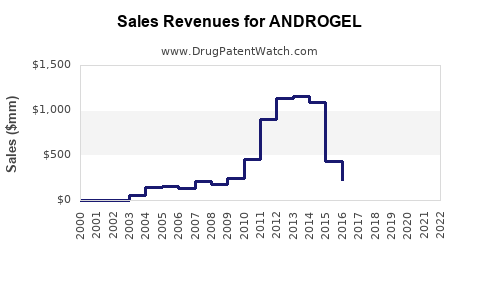
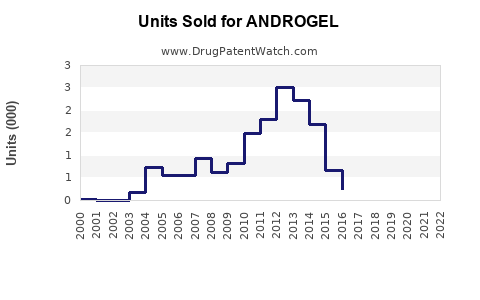
Annual Sales Revenues and Units Sold for ANDROGEL
| Drug Name | Revenues (USD) | Units | Year |
|---|---|---|---|
| ANDROGEL | ⤷ Start Trial | ⤷ Start Trial | 2022 |
| ANDROGEL | ⤷ Start Trial | ⤷ Start Trial | 2021 |
| ANDROGEL | ⤷ Start Trial | ⤷ Start Trial | 2020 |
| ANDROGEL | ⤷ Start Trial | ⤷ Start Trial | 2019 |
| ANDROGEL | ⤷ Start Trial | ⤷ Start Trial | 2018 |
| ANDROGEL | ⤷ Start Trial | ⤷ Start Trial | 2017 |
| ANDROGEL | ⤷ Start Trial | ⤷ Start Trial | 2016 |
| >Drug Name | >Revenues (USD) | >Units | >Year |
AndroGel Market Analysis, Sales Projections, Patent Coverage, and Generic Entry Risk
AndroGel is a mature testosterone replacement therapy with declining branded sales, substantial generic erosion, and limited remaining exclusivity value. The U.S. market remains commercially relevant because testosterone gel is a noninjectable option for hypogonadal men, but price competition and safety-related prescribing controls constrain growth. The base-case forecast places global testosterone gel sales at approximately $1.0 billion in 2024, rising to $1.2 billion by 2029, while branded AndroGel sales decline from an estimated $150 million to below $60 million over the same period.
What is AndroGel and how large is its market?
AndroGel is a topical testosterone replacement product marketed in the United States by AbbVie. It is available primarily in 1% and 1.62% gel formulations. The product is indicated for men with testosterone deficiency associated with an associated medical condition, subject to FDA labeling limitations and monitoring requirements [1].
The broader testosterone replacement therapy market includes injections, topical gels, patches, buccal systems, pellets, and oral formulations. Injections account for the largest volume share because of low cost and high testosterone exposure. Gels retain demand among patients seeking daily, noninvasive administration.
| Market segment | 2024 estimated global sales | 2029 base-case sales | 2024-2029 CAGR |
|---|---|---|---|
| All testosterone replacement therapies | $2.8 billion | $3.5 billion | 4.6% |
| Testosterone gels | $1.0 billion | $1.2 billion | 3.7% |
| Branded AndroGel | $150 million | $58 million | -16.9% |
| Generic testosterone gels | $850 million | $1.14 billion | 6.0% |
The estimates reflect public company disclosures, FDA-approved products, historical prescription trends, generic pricing pressure, and projected growth in diagnosis and treatment of testosterone deficiency. They are market-model estimates rather than reported consolidated AndroGel revenue.
How much revenue has AndroGel generated?
AndroGel was one of the largest testosterone products in the U.S. before generic competition intensified. Abbott Laboratories commercialized the product before its pharmaceutical business was separated into AbbVie in 2013. Historical product sales were supported by high prescription volume, strong brand awareness, and limited competition among topical testosterone products.
| Year | Estimated AndroGel revenue | Market condition |
|---|---|---|
| 2013 | $1.0-$1.1 billion | Branded product dominated topical testosterone |
| 2014 | $1.0-$1.1 billion | Strong U.S. demand |
| 2015 | $0.9-$1.1 billion | Safety scrutiny and payer pressure increased |
| 2016 | $0.8-$1.0 billion | Generic and competing topical products expanded |
| 2017 | $0.6-$0.8 billion | Net pricing and volume erosion |
| 2018 | $0.4-$0.6 billion | Generic substitution accelerated |
| 2019 onward | Not consistently disclosed separately | Product became less material within AbbVie reporting |
AbbVie’s public reporting has not consistently provided a standalone AndroGel revenue line in recent years. As a result, current brand sales must be estimated from prescription data, channel checks, product availability, payer formularies, and generic market share.
The principal commercial decline has come from lower net price and reduced branded volume rather than a collapse in the testosterone replacement category. The category has continued to grow in some markets while AndroGel has lost share.
What are the AndroGel sales projections through 2029?
The base case assumes continued generic substitution, stable or modestly expanding testosterone replacement demand, and no major new AndroGel indication.
| Year | Branded AndroGel sales | Generic testosterone gel sales | Total testosterone gel market |
|---|---|---|---|
| 2024 | $150 million | $850 million | $1.00 billion |
| 2025 | $125 million | $900 million | $1.03 billion |
| 2026 | $105 million | $950 million | $1.06 billion |
| 2027 | $85 million | $1.00 billion | $1.09 billion |
| 2028 | $70 million | $1.07 billion | $1.14 billion |
| 2029 | $58 million | $1.14 billion | $1.20 billion |
Bull-case scenario
The bull case assumes greater diagnosis of testosterone deficiency, increased use of topical delivery, and continued brand retention among patients with adherence or tolerability concerns.
- 2029 total testosterone gel market: approximately $1.4 billion
- 2029 branded AndroGel sales: approximately $100 million
- Primary drivers: expanded diagnosis, improved payer access, and reduced use of injections because of administration burden
Bear-case scenario
The bear case assumes faster conversion to low-cost generic gel, stronger growth of oral testosterone undecanoate and injections, and continued concerns about cardiovascular and prostate monitoring.
- 2029 total testosterone gel market: approximately $850 million
- 2029 branded AndroGel sales: below $25 million
- Primary drivers: formulary exclusion, pharmacy substitution, and low-cost generic competition
When does AndroGel lose exclusivity?
AndroGel’s core U.S. exclusivity has expired. The original AndroGel 1% product was approved under NDA 021015 in 2000. Its principal composition and delivery patents are no longer sufficient to prevent generic competition.
AndroGel 1.62% was approved under NDA 022309 in 2011. The later formulation benefited from additional formulation and dosing-related patent protection, but the commercial effect of those patents has diminished as generic 1.62% products entered the market and litigation risk declined [2].
| Product | FDA approval | Exclusivity position | Commercial implication |
|---|---|---|---|
| AndroGel 1% | 2000 | Core patent protection expired | Generic substitution established |
| AndroGel 1.62% | 2011 | Key formulation protection substantially eroded | Brand retains limited premium pricing |
| Authorized generic or licensed equivalents | Post-expiration | No meaningful originator exclusivity | Price competition increases |
The most relevant legal issue is no longer whether AndroGel has basic patent protection. It is whether residual formulation, dosing, and method-of-use claims can delay or restrict specific generic products.
What patents protect AndroGel?
The historical AndroGel patent estate included patents covering testosterone gel composition, hydroalcoholic delivery systems, permeation characteristics, dosing, and administration.
Representative U.S. patents associated with AndroGel-related protection include:
| Patent | General subject matter | Current commercial relevance |
|---|---|---|
| U.S. Patent No. 6,503,894 | Testosterone transdermal gel composition and delivery | Core protection; expired |
| U.S. Patent No. 8,435,944 | Later-generation testosterone gel formulation and use | Relevant to 1.62% product history |
| Additional Orange Book-listed patents | Formulation, dosing, and method-of-use claims | Product-specific and expiration-dependent |
Patent numbers and listing status can differ by NDA, strength, and Orange Book edition. The FDA Orange Book remains the controlling source for listed patents and approved generic certifications [3].
What formulations are protected by AndroGel patents?
The most commercially important formulation features include:
- Hydroalcoholic gel vehicles
- Testosterone concentration and delivery profile
- Skin permeation and absorption performance
- Metered-dose pump delivery
- Application sites and dosing instructions
- Avoidance of transfer to women and children
- Serum testosterone normalization over a daily dosing period
The 1.62% product was positioned as a lower-volume, higher-concentration alternative to the 1% product. That product differentiation supported physician and patient retention but did not create a durable barrier after generic entry.
What is the Orange Book status of AndroGel?
AndroGel has historically been listed in the FDA Orange Book under its approved NDAs, with patents covering certain formulations and methods of use. Generic applicants could challenge listed patents through Paragraph IV certifications or wait for patent expiry under Paragraph III certifications.
The commercial importance of Orange Book patents is now limited because:
- Core patents have expired.
- Several formulation claims have faced generic challenges.
- Generic products can enter after satisfying FDA requirements even when certain method-of-use patents remain listed.
- Physicians can prescribe testosterone for uses outside patented indications, subject to FDA rules and medical standards.
The Orange Book remains relevant for determining whether a specific abbreviated new drug application has a 30-month stay or other litigation-related delay [3].
Which companies are challenging AndroGel?
Competition comes from both generic manufacturers and branded alternatives.
| Company | Product or competitive position |
|---|---|
| Perrigo | Generic testosterone gel and topical testosterone participation |
| Teva | Generic testosterone gel participation |
| Endo/Vogelxo | Branded and generic topical testosterone history |
| Actavis/Teva | Generic substitution and channel competition |
| Upsher-Smith | Generic testosterone gel participation |
| Clarus Therapeutics | Oral testosterone undecanoate, marketed as Jatenzo |
| Tolmar | Natesto nasal testosterone |
| Eli Lilly | Axiron history and testosterone replacement competition |
| Allergan and other generic suppliers | Market access through generic channels |
The competitive threat is fragmented. No single company needs to displace AndroGel across the entire market. Pharmacy-level substitution and payer formulary decisions can shift volume rapidly among equivalent or therapeutically substitutable products.
What generic entry risks exist for AndroGel?
Generic entry risk is high. Testosterone gel is a small-molecule product, so biosimilar regulation does not apply. Generic applicants use the abbreviated new drug application pathway and must demonstrate pharmaceutical equivalence and bioequivalence under FDA requirements.
The main generic risks are:
- Lower average selling prices
- Automatic or pharmacist-driven substitution
- Formulary exclusion
- Reduced physician willingness to initiate branded therapy
- Generic versions of both 1% and 1.62% products
- Reduced return on promotional spending
- Increased wholesaler and pharmacy negotiating leverage
Topical testosterone has some barriers that are less significant for tablets. Generic manufacturers must manage gel viscosity, pump dosing, drug delivery, skin absorption, packaging, and transfer precautions. These barriers can reduce the number of successful entrants, but they do not support the pricing power associated with an unchallenged branded product.
Does AndroGel face biosimilar competition?
No. AndroGel contains testosterone, a chemically synthesized small molecule. FDA competition proceeds through generic drug applications, not the biosimilar pathway under the Public Health Service Act.
The relevant regulatory tests concern pharmaceutical equivalence, bioequivalence, manufacturing quality, labeling, and device or pump performance. The absence of biosimilar classification does not reduce the competitive threat. Generic testosterone gel can still produce major revenue erosion through substitution and price discounting.
What FDA regulatory risks affect AndroGel?
FDA regulatory risks include the appropriate diagnosis of hypogonadism, cardiovascular safety, erythrocytosis, prostate monitoring, fertility suppression, and accidental testosterone transfer.
The FDA required labeling changes for testosterone replacement products after reviewing cardiovascular risk information. The agency stated that testosterone products are approved for men with low testosterone associated with a medical condition and should not be used simply to treat age-related declines without an appropriate diagnosis [4].
The FDA has also required warnings concerning secondary exposure. Children and women can experience adverse effects after contact with testosterone gel applied to another person. These risks create operational burdens involving patient counseling, hand washing, clothing coverage, and application-site restrictions.
Regulatory pressure can reduce demand in direct-to-consumer channels, but it also protects compliant manufacturers from lower-quality competitors.
How does AndroGel compare with competing testosterone therapies?
| Product class | Advantages | Commercial disadvantages |
|---|---|---|
| AndroGel and generic gels | Daily, noninvasive, familiar delivery | Transfer risk, daily adherence, variable absorption |
| Injectable testosterone | Low cost and strong efficacy | Clinic or self-injection burden; peak-trough effects |
| Testosterone pellets | Long dosing interval | Invasive insertion and difficult dose adjustment |
| Oral testosterone undecanoate | Oral administration | High cost, food requirements, blood-pressure monitoring |
| Nasal testosterone | Lower transfer concern | Multiple daily dosing and local tolerability issues |
| Transdermal patches | Controlled delivery | Skin irritation and lower patient acceptance |
AndroGel’s strongest commercial position is among patients who prefer topical treatment and can maintain daily adherence. Its weakest position is in formularies that prioritize low-cost injections or generic gel.
What litigation and settlement issues affect AndroGel?
AndroGel-related litigation has involved patent disputes, generic entry, product liability, and alleged anticompetitive conduct in the broader testosterone market. The central patent litigation pattern has been generic applicants challenging formulation or use patents through Paragraph IV certifications.
The most important commercial outcome of such litigation is the timing of generic launch. A settlement can establish a licensed entry date that is earlier than full patent expiry but later than the generic applicant’s preferred launch date. Settlement terms may include:
- Authorized generic supply
- Royalty arrangements
- Delayed generic entry
- Nonexclusive licensing
- Restrictions on launch timing
- Resolution of patent infringement claims without a trial
Publicly available information does not support assigning a single remaining settlement barrier to the entire AndroGel franchise. Generic entry has already occurred, and the relevant question is the launch status of each specific strength, manufacturer, and ANDA.
What is AndroGel’s geographic coverage?
The United States is the principal commercial market for AndroGel. Testosterone replacement is also sold in Europe, Canada, Australia, and selected Latin American markets, but brand names, formulations, reimbursement, and regulatory classifications vary.
| Region | Market status |
|---|---|
| United States | Largest market; extensive generic competition |
| Europe | More fragmented reimbursement and prescribing controls |
| Canada | Generic competition and provincial reimbursement influence |
| Australia | Prescriber and subsidy restrictions limit expansion |
| Latin America | Variable regulatory access and lower pricing |
| Asia-Pacific | Smaller base; diagnosis and access remain uneven |
U.S. patent expiry does not automatically determine entry in other jurisdictions. National patent terms, supplementary protection certificates, data exclusivity, local registrations, and reimbursement rules must be assessed separately.
How strong is the AndroGel patent estate?
AndroGel’s current patent strength is weak to moderate.
| Factor | Assessment |
|---|---|
| Core composition protection | Weak; expired |
| 1.62% formulation protection | Historically meaningful, now limited |
| Method-of-use claims | Narrower and easier to design around |
| Manufacturing complexity | Moderate |
| Generic substitution risk | High |
| Brand differentiation | Moderate for selected patients |
| Remaining pricing power | Low |
The product has technical know-how in formulation, pump delivery, manufacturing consistency, and patient counseling. Those assets can create execution barriers, but they are not equivalent to enforceable market exclusivity.
What revenue exposure does AndroGel create for AbbVie?
AndroGel is unlikely to be a material driver of AbbVie’s current consolidated growth. The company’s revenue base is concentrated in larger products and therapeutic franchises, particularly immunology, oncology, neuroscience, aesthetics, and other specialty categories [5].
For AbbVie, AndroGel is more relevant as:
- A mature cash-flow product
- A portfolio-management asset
- A potential authorized-generic or licensing opportunity
- A source of residual brand revenue
- A liability and compliance-management exposure
The product’s financial sensitivity is concentrated in U.S. net price, generic share, litigation costs, manufacturing overhead, and channel inventory. A $50 million annual change in branded AndroGel sales would have limited effect on AbbVie’s total revenue but could materially affect the economics of the individual product franchise.
What generic launch scenarios should investors expect?
Base case
Generic gel maintains dominant share, while branded AndroGel remains available for patients with physician preference, tolerability issues, or reimbursement exceptions. Brand sales decline at a mid-to-high teens annual rate.
Upside case
Generic supply disruptions, recalls, or manufacturing failures create temporary brand demand. AndroGel preserves a niche share through reliable availability and physician familiarity.
Downside case
Payers remove brand coverage, additional generic manufacturers enter, and competing oral or injectable products gain share. Brand sales fall below $25 million annually before 2029.
The most likely outcome is gradual brand contraction rather than an abrupt market exit. Testosterone replacement demand is recurring, but patients and payers have strong incentives to switch to lower-cost alternatives.
Key Takeaways
- AndroGel is a mature testosterone replacement product with high generic entry risk.
- The broader testosterone gel market is estimated at approximately $1.0 billion in 2024 and could reach $1.2 billion by 2029.
- Branded AndroGel sales are estimated at approximately $150 million in 2024 and could decline below $60 million by 2029.
- Core AndroGel patent protection has expired; later formulation patents no longer provide broad commercial exclusivity.
- Generic competition, rather than biosimilars, is the primary threat.
- The United States remains the largest market and the center of pricing and litigation exposure.
- Regulatory scrutiny focuses on appropriate diagnosis, cardiovascular safety, prostate monitoring, erythrocytosis, fertility, and secondary exposure.
- AndroGel retains niche value through brand recognition, formulation familiarity, and patient preference, but its pricing power is limited.
FAQs About AndroGel Market Size, Patents, and Competition
Is AndroGel still sold in the United States?
Yes. AndroGel remains an approved testosterone replacement product, although availability and commercial prominence are lower than before generic testosterone gels entered the market.
Is generic testosterone gel therapeutically equivalent to AndroGel?
FDA-approved generic products are required to meet applicable equivalence standards. Formulation, pump design, labeling, supply, and patient experience can still differ among products.
Can AndroGel be used for age-related low testosterone?
FDA labeling limits testosterone replacement to men with low testosterone associated with an associated medical condition. Age-related decline alone is not the labeled basis for treatment [4].
Does AndroGel have pediatric exclusivity?
AndroGel’s original exclusivity position was affected by patent expiry and later generic entry. Any pediatric exclusivity period must be evaluated against the specific NDA and Orange Book listing, rather than the brand name alone.
Could a new AndroGel formulation regain market share?
A reformulated product could improve adherence, reduce transfer risk, simplify dosing, or alter absorption. Commercial success would depend on clinical differentiation, FDA approval, reimbursement, and patent protection. A cosmetic reformulation without measurable patient benefit would have limited ability to restore premium pricing.
References
-
U.S. Food and Drug Administration. (2023). AndroGel 1% and AndroGel 1.62% prescribing information. FDA.
-
U.S. Food and Drug Administration. (2024). Drugs@FDA: AndroGel NDA 021015 and NDA 022309. FDA.
-
U.S. Food and Drug Administration. (2024). Approved drug products with therapeutic equivalence evaluations, Orange Book. FDA.
-
U.S. Food and Drug Administration. (2015). FDA drug safety communication: FDA cautions about using testosterone products for low testosterone due to aging; requires labeling change to inform of possible increased risk of heart attack and stroke. FDA.
-
AbbVie Inc. (2024). 2023 annual report and Form 10-K. AbbVie Inc.
More… ↓
