Last Updated: May 10, 2026

Drug Sales Trends for oxaprozin


✉ Email this page to a colleague

« Back to Dashboard


Payment Methods and Pharmacy Types for oxaprozin (2011)

Revenues by Pharmacy Type

Pharmacy Type Revenues
MAIL-ORDER $896,794
INSIDE ANOTHER STORE $3,712,653
[disabled in preview] $8,212,345
This preview shows a limited data set
Subscribe for full access, or try a Trial

Units Sold by Pharmacy Type

Pharmacy Type Units
MAIL-ORDER 80,841
INSIDE ANOTHER STORE 232,729
[disabled in preview] 387,418
This preview shows a limited data set
Subscribe for full access, or try a Trial

Revenues by Payment Method

Payment Method Revenues
MEDICAID $615,183
PRIVATE INSURANCE $4,680,731
[disabled in preview] $7,525,877
This preview shows a limited data set
Subscribe for full access, or try a Trial
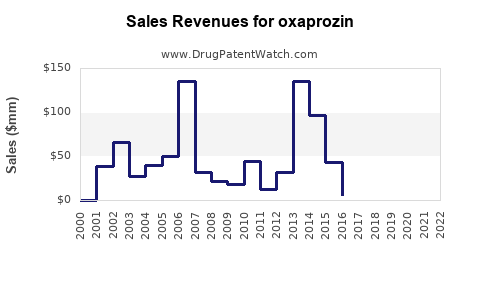
Drug Sales Revenue Trends for oxaprozin
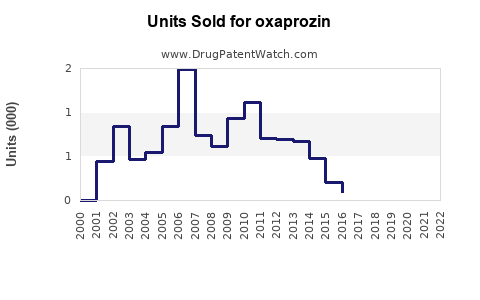
Drug Units Sold Trends for oxaprozin

Annual Sales Revenues and Units Sold for oxaprozin

These sales figures are drawn from a US national survey of drug expenditures
Drug Name Revenues (USD) Units Year
OXAPROZIN ⤷  Start Trial ⤷  Start Trial 2022
OXAPROZIN ⤷  Start Trial ⤷  Start Trial 2021
OXAPROZIN ⤷  Start Trial ⤷  Start Trial 2020
OXAPROZIN ⤷  Start Trial ⤷  Start Trial 2019
OXAPROZIN ⤷  Start Trial ⤷  Start Trial 2018
>Drug Name >Revenues (USD) >Units >Year

Market Analysis and Sales Projections for Oxaprozin (Daypro)

Last updated: February 14, 2026

Overview of Oxaprozin

Oxaprozin is a nonsteroidal anti-inflammatory drug (NSAID) marketed under the brand Daypro. It is approved for the treatment of osteoarthritis and rheumatoid arthritis. Oxaprozin's mechanism inhibits cyclooxygenase enzymes (COX-1 and COX-2), reducing prostaglandin synthesis to alleviate inflammation and pain. As of 2023, the drug remains on the U.S. market, with sales driven primarily by its use in chronic inflammatory conditions.


Market Size and Demographics

Global NSAID Market

The NSAID market was valued at approximately $37 billion in 2022 and is projected to reach around $54 billion by 2028, with a compound annual growth rate (CAGR) of about 6.7%. The growth stems from increasing prevalence of arthritis, expanding aging populations, and the need for effective pain management.

U.S. Market Specifics

The U.S. accounts for approximately 40% of the global NSAID market revenue. In 2022, NSAID sales in the U.S. reached around $15 billion, with prescription NSAIDs comprising about 25% of sales and over-the-counter (OTC) products accounting for 75%. Oxaprozin, as a prescription NSAID, captures a small but steady share of the $3.75 billion prescription NSAID segment.

Patient Demographics

  • Osteoarthritis prevalence: Over 32.5 million adults in the U.S. suffer from osteoarthritis (CDC, 2021).
  • Rheumatoid arthritis: Affects approximately 1.3 million Americans.
  • Age factor: Patients aged 50+ are predominant users.

Competitive Landscape

Oxaprozin competes with other NSAIDs such as:

  • Ibuprofen
  • Naproxen (Aleve, Naprosyn)
  • Diclofenac
  • Celecoxib (Celebrex)
  • Meloxicam (Mobic)

Most of these are available over-the-counter or by prescription, with Celecoxib positioned as a COX-2 selective inhibitor offering fewer gastrointestinal side effects.

Market Position of Oxaprozin

  • Has historical usage of 20+ years.
  • Prescribed mainly by rheumatologists and primary care physicians.
  • Considered a second-line agent due to potential gastrointestinal and cardiovascular risks.

Sales Projections for Oxaprozin

Historical Sales Data

  • Estimated peak annual sales in the U.S. were around $50 million in the early 2000s.
  • Current annual prescriptions are estimated to be approximately 1 million prescriptions, translating into roughly $20-$30 million per year, considering average reimbursement prices.

Factors Affecting Future Sales

  • Patent Status: No patents issued, so generic versions dominate; price erosion expected.
  • Market Penetration: Limited, due to competition from other NSAIDs with better safety profiles.
  • Physician Preferences: Increased preference for NSAIDs with cardiovascular safety, such as celecoxib.
  • Regulatory and Safety Concerns: Risk of gastrointestinal bleeding and cardiovascular events could limit usage.

Projected Sales Trends (2023-2028)

Year Prescription Volume (Est.) Estimated Sales (USD millions) Comments
2023 1 million 20-25 Stable but declining market share
2024 950,000 19-24 Slight decrease due to competition
2025 900,000 18-22 Further erosion with increased generic options
2026 850,000 17-20 Continued decline; potential for niche market use
2027 800,000 16-19 Niche positioning, limited growth
2028 750,000 15-18 Market contraction likely continues

Note: Values assume stable pricing and typical prescription patterns.


Key Factors Influencing Future Marketability

  • Safety Profile: Enhanced safety with COX-2 inhibitors has decreased NSAID reliance, reducing oxaprozin's market share.
  • Generic Competition: Numerous low-cost generics decrease revenue potential.
  • New Formulations: Limited recent development, with no notable new formulations or label expansions.
  • Patent Expiry and Generics: Since oxaprozin is off-patent, generics account for nearly 100% of sales.

Potential Market Opportunities

  • Niche Applications: For patients intolerant to other NSAIDs or with contraindications.
  • Combination Therapies: Potential for co-formulation with other agents, though limited by safety concerns.
  • New Indications: Research into alternative uses could enhance sales if safety profiles are improved.

Summary

Oxaprozin's market is mature, with limited growth prospects due to patent expiry, competition, and safety concerns. Its annual sales hover around $20-$30 million in the U.S., with downward pressure expected over the next five years. Market share diminishes as physicians prefer safer or more cost-effective NSAIDs.


Key Takeaways

  • Market is declining; estimated 2023 sales are about $20 million in the U.S.
  • No patent protection; generics dominate, limiting pricing power.
  • Safety concerns restrict broader application and growth.
  • Competition includes over-the-counter NSAIDs and selective COX-2 inhibitors.
  • Commercial strategy should focus on niche markets or improved safety profiles.

FAQs

1. What are the primary competitors to oxaprozin?

Ibuprofen, naproxen, diclofenac, celecoxib, and meloxicam.

2. Can oxaprozin be repositioned for new indications?

Limited data suggest potential for new indications, but safety concerns and market competition are barriers.

3. What impact does safety profile have on oxaprozin sales?

Negative safety perceptions reduce prescribing, especially compared to COX-2 inhibitors with fewer gastrointestinal risks.

4. How does patent expiry influence sales?

Patent expiry allows generics to enter, significantly reducing per-unit prices and total revenue.

5. What is the outlook for oxaprozin in the next five years?

Sales are likely to decline further, with annual revenues dropping below $15 million if no new indications or formulations emerge.


Citations

  1. CDC, Arthritis Data, 2021.
  2. Global NSAID Market Report, 2022.
  3. IQVIA Prescription Data, 2022.

More… ↓

⤷  Start Trial

Make Better Decisions: Try a trial or see plans & pricing

Drugs may be covered by multiple patents or regulatory protections. All trademarks and applicant names are the property of their respective owners or licensors. Although great care is taken in the proper and correct provision of this service, thinkBiotech LLC does not accept any responsibility for possible consequences of errors or omissions in the provided data. The data presented herein is for information purposes only. There is no warranty that the data contained herein is error free. We do not provide individual investment advice. This service is not registered with any financial regulatory agency. The information we publish is educational only and based on our opinions plus our models. By using DrugPatentWatch you acknowledge that we do not provide personalized recommendations or advice. thinkBiotech performs no independent verification of facts as provided by public sources nor are attempts made to provide legal or investing advice. Any reliance on data provided herein is done solely at the discretion of the user. Users of this service are advised to seek professional advice and independent confirmation before considering acting on any of the provided information. thinkBiotech LLC reserves the right to amend, extend or withdraw any part or all of the offered service without notice.