Share This Page
Drug Sales Trends for niacin
✉ Email this page to a colleague
Payment Methods and Pharmacy Types for niacin (2011)
Revenues by Pharmacy Type
Units Sold by Pharmacy Type
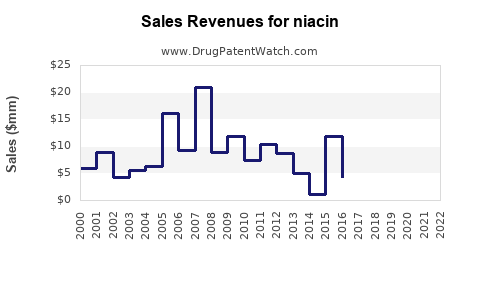
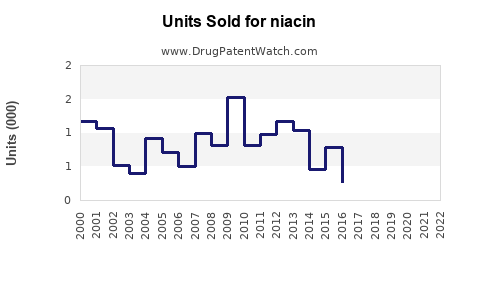
Annual Sales Revenues and Units Sold for niacin
| Drug Name | Revenues (USD) | Units | Year |
|---|---|---|---|
| NIACIN | ⤷ Start Trial | ⤷ Start Trial | 2022 |
| NIACIN | ⤷ Start Trial | ⤷ Start Trial | 2021 |
| NIACIN | ⤷ Start Trial | ⤷ Start Trial | 2020 |
| NIACIN | ⤷ Start Trial | ⤷ Start Trial | 2019 |
| NIACIN | ⤷ Start Trial | ⤷ Start Trial | 2018 |
| >Drug Name | >Revenues (USD) | >Units | >Year |
Niacin Market Analysis and Sales Projections, 2025–2030
Niacin is a mature, low-growth vitamin B3 and lipid-modifying market. Prescription demand has contracted sharply because statins and newer lipid therapies provide stronger outcome evidence, while niacin’s adverse-effect profile limits use. Future revenue will come mainly from low-cost generic prescriptions, over-the-counter supplements, fortified foods, and selected specialty nutrition products.
A reasonable base-case estimate places the global niacin market at approximately $1.1 billion to $1.4 billion in 2025, including pharmaceutical, supplement, food-fortification, and industrial-grade demand. Under current market conditions, total revenue is likely to grow at roughly 2% to 4% annually through 2030, driven by supplement consumption and emerging-market nutrition demand rather than prescription dyslipidemia treatment.
What is niacin and which products are included in the market?
Niacin is the common name for nicotinic acid, a water-soluble form of vitamin B3. The broader vitamin B3 category also includes niacinamide, or nicotinamide, which has different pharmacologic properties and is used more widely in nutrition and personal-care products.
| Segment | Principal products | Primary customers | Market outlook |
|---|---|---|---|
| Prescription lipid therapy | Immediate-release and extended-release niacin | Patients with dyslipidemia | Declining |
| OTC supplements | Niacin, niacinamide, flush-free formulations | Consumers and specialty retailers | Low-to-moderate growth |
| Food fortification | Flour, cereals, dairy substitutes, beverages | Food manufacturers | Stable growth |
| Animal nutrition | Feed premixes and supplements | Feed producers | Low-to-moderate growth |
| Cosmetics and personal care | Mainly niacinamide | Skincare manufacturers | Faster growth than pharmaceutical niacin |
| Industrial and laboratory use | Pharmaceutical and chemical intermediates | Manufacturers | Stable, limited-volume demand |
This analysis focuses on niacin and niacin-containing products, while distinguishing prescription lipid treatment from niacinamide-led consumer categories.
How large is the global niacin market?
The commercial market is fragmented and lacks a single authoritative revenue database covering all niacin uses. Market estimates differ depending on whether they include niacinamide, animal feed, industrial applications, and cosmetic-grade vitamin B3.
A practical 2025 market segmentation is:
| Segment | Estimated 2025 revenue | Share of total | 2025–2030 growth |
|---|---|---|---|
| Prescription niacin | $50 million–$100 million | 4%–7% | -5% to -10% |
| OTC niacin supplements | $250 million–$350 million | 20%–28% | 2%–4% |
| Food and beverage fortification | $350 million–$500 million | 28%–38% | 2%–4% |
| Animal nutrition | $150 million–$250 million | 12%–18% | 2%–4% |
| Cosmetics and personal care | $150 million–$250 million | 12%–18% | 5%–8% |
| Industrial and other uses | $100 million–$150 million | 8%–12% | 1%–3% |
| Total | $1.1 billion–$1.4 billion | 100% | 2%–4% |
The prescription segment is commercially small relative to the broader vitamin B3 market. Product volume remains substantial, but unit prices are low because the active ingredient is inexpensive and most formulations are generic.
What are the niacin sales projections through 2030?
The base-case model assumes continued contraction in prescription niacin, modest expansion in supplements and food fortification, and faster growth in cosmetic niacinamide applications.
| Year | Prescription | OTC supplements | Food, feed, cosmetics and other | Total estimated market |
|---|---|---|---|---|
| 2025 | $75 million | $300 million | $825 million | $1.20 billion |
| 2026 | $69 million | $309 million | $850 million | $1.23 billion |
| 2027 | $64 million | $318 million | $877 million | $1.26 billion |
| 2028 | $59 million | $328 million | $905 million | $1.29 billion |
| 2029 | $54 million | $338 million | $934 million | $1.33 billion |
| 2030 | $50 million | $348 million | $962 million | $1.36 billion |
The model produces a total compound annual growth rate of approximately 2.5% from 2025 to 2030. Prescription niacin revenue falls by about one-third during the period, while nonprescription and industrial categories offset the decline.
What could change the sales forecast?
The principal upside factors are:
- Greater consumer interest in vitamin B3 and metabolic-health supplements.
- Expansion of fortified foods in developing markets.
- Higher demand for niacinamide in skincare formulations.
- New drug-delivery technology that reduces flushing and improves adherence.
- Renewed clinical interest in residual cardiovascular risk.
The principal downside factors are:
- Continued substitution by statins, ezetimibe, PCSK9 inhibitors, and bempedoic acid.
- Negative consumer perception of flushing and hepatotoxicity.
- Clinical evidence showing limited incremental cardiovascular benefit when niacin is added to statin therapy.
- Price competition among generic manufacturers.
- Regulatory scrutiny of unsubstantiated supplement claims.
What is the outlook for prescription niacin sales?
Prescription niacin has a structurally declining outlook in the United States and other developed markets.
Niacin lowers low-density lipoprotein cholesterol and triglycerides while increasing high-density lipoprotein cholesterol. Its clinical use declined after large trials failed to show a meaningful reduction in cardiovascular events when niacin was added to effective statin therapy. The AIM-HIGH trial found no incremental cardiovascular benefit from extended-release niacin in statin-treated patients with established cardiovascular disease. The HPS2-THRIVE trial also failed to demonstrate a favorable benefit-risk profile for extended-release niacin combined with laropiprant (National Heart, Lung, and Blood Institute, 2011; HPS2-THRIVE Collaborative Group, 2014).
Current prescription demand is concentrated in:
- Patients who are statin-intolerant.
- Patients with severe hypertriglyceridemia when other options are unsuitable.
- Patients with mixed dyslipidemia in lower-income markets.
- Prescribers using legacy treatment protocols.
- Selected patients requiring low-cost therapy.
The commercial ceiling is low because the product has no meaningful patent-based price protection and competes against inexpensive generic statins and newer therapies with stronger outcomes data.
What is the FDA regulatory status of niacin?
Niacin is available in the United States as both an FDA-regulated prescription drug and an OTC dietary supplement.
Prescription formulations include:
- Immediate-release niacin.
- Extended-release niacin.
- Combination products previously marketed with statins.
Extended-release prescription niacin products were approved for lipid management, including reductions in triglycerides and LDL cholesterol and increases in HDL cholesterol. The FDA-approved labels emphasize liver toxicity, glucose effects, hyperuricemia, gastrointestinal adverse events, and flushing risks.
In 2016, the FDA concluded that there was insufficient evidence that niacin-statin combination products provided cardiovascular benefit beyond statin therapy. The agency withdrew approval of the combination indication for Advicor and Simcor and removed the corresponding rationale for their continued use with statins (U.S. Food and Drug Administration, 2016).
The FDA has not approved niacin as a replacement for statins for primary or secondary cardiovascular-risk reduction.
What is the Orange Book status of niacin?
The core niacin molecule is long off-patent. Immediate-release niacin and the underlying active ingredient have no meaningful remaining composition-of-matter exclusivity.
| Regulatory issue | Current commercial position |
|---|---|
| Active ingredient patent | Expired |
| Core composition-of-matter protection | Expired |
| Generic immediate-release products | Available |
| Generic extended-release products | Available or historically approved |
| New chemical entity exclusivity | None |
| Orphan-drug exclusivity | None for ordinary dyslipidemia use |
| Pediatric exclusivity | Not material to the market |
| Biosimilar pathway | Not applicable |
| Orange Book importance | Limited to formulation and method-of-use listings, if any remain active |
The relevant competitive barrier is formulation development rather than ownership of niacin itself. An applicant may still seek protection for release profiles, combinations, dosing methods, or manufacturing processes, but those rights do not prevent generic access to ordinary immediate-release niacin.
What formulations are protected or commercially differentiated?
The main formulation challenge is reducing niacin-induced flushing while preserving lipid effects.
Immediate-release niacin
Immediate-release niacin has rapid absorption and is associated with frequent flushing. It is inexpensive and easy to manufacture. Its low price limits commercial returns unless distributed through large generic or OTC channels.
Extended-release niacin
Extended-release formulations were developed to improve tolerability and dosing convenience. They have historically commanded higher prices than immediate-release products but carry greater liver-toxicity concerns at some doses.
Sustained-release and modified-release products
Sustained-release products may reduce peak-related flushing but can increase hepatotoxicity risk. Regulatory approval depends on the specific release profile, bioavailability, safety data, and manufacturing controls.
Flush-free products
Some OTC products use inositol hexanicotinate or other forms marketed as “flush-free niacin.” These products have weaker clinical positioning because equivalence to pharmacologically active nicotinic acid is not always established. Marketing claims must comply with applicable supplement rules and cannot imply treatment of disease without authorization.
Niacinamide and cosmetic formulations
Niacinamide is commercially stronger than nicotinic acid in skincare. It is used in products positioned for barrier support, pigmentation, acne, and anti-aging. This category has a different competitive structure, with brand, formulation, and consumer-marketing advantages rather than prescription-drug exclusivity.
How strong is the patent estate for niacin?
The patent estate is weak for the active ingredient and moderate only for specific formulations.
Core molecule
Nicotinic acid has been known and used for decades. No defensible strategy exists around blocking ordinary generic access through new composition-of-matter claims.
Formulation patents
Potentially relevant claim areas include:
- Controlled-release matrices.
- Particle-size control.
- Reduced-flushing formulations.
- Combination products.
- Dose-escalation protocols.
- Coated tablets.
- Stabilized liquid or beverage formulations.
- Manufacturing processes that improve purity or yield.
These patents typically face validity and obviousness risks because niacin has a long technical history and many prior-art formulations.
Method-of-use patents
Method-of-use protection may cover treatment of hypertriglyceridemia, mixed dyslipidemia, niacin deficiency, or specific patient populations. Commercial value is constrained by the availability of generic products and the difficulty of enforcing use patents in a low-cost, widely distributed product.
Which companies compete in the niacin market?
The market has no single dominant prescription company. Competition differs by segment.
Prescription and generic manufacturers
Generic drugmakers, including large U.S., European, Indian, and Chinese manufacturers, compete primarily on price, supply reliability, and regulatory compliance. Historical branded products included Niaspan, Niacor, Advicor, and Simcor.
OTC supplement companies
Major supplement distributors compete through:
- Dosage variety.
- “Flush-free” positioning.
- Retail pharmacy placement.
- Online sales.
- Practitioner and sports-nutrition channels.
- Bundling with cholesterol and cardiovascular products.
Ingredient suppliers
Large vitamin and fine-chemical manufacturers supply pharmaceutical, food, feed, and cosmetic customers. The key competitive factors are manufacturing scale, regulatory documentation, purity, global distribution, and cost.
What generic entry risks exist for niacin?
Generic entry risk is effectively permanent for standard niacin products. The active ingredient is commoditized, and most commercial barriers are operational rather than legal.
The main risks for a branded or reformulated product are:
- Generic substitution for immediate-release tablets.
- Price erosion after approval of multiple extended-release suppliers.
- Paragraph IV challenges against formulation patents.
- FDA scrutiny of bioequivalence for modified-release products.
- Pharmacy benefit-manager pressure on prescription reimbursement.
- OTC substitution by niacinamide or lower-cost supplements.
A differentiated formulation would need a clear clinical advantage, such as materially lower flushing, improved hepatic safety, or superior triglyceride control. A modest dosing or convenience improvement is unlikely to support a durable premium.
Are there Paragraph IV challenges or niacin litigation?
Niacin has had historical patent and regulatory disputes involving branded extended-release products and combination therapies. The commercially important disputes have largely diminished because the underlying products and technologies are old.
The present litigation risk is more likely to arise from:
- Formulation patent enforcement.
- ANDA certification disputes.
- Trademark or trade-dress claims.
- Supplement advertising claims.
- Manufacturing quality or contamination issues.
- Contract disputes involving bulk active pharmaceutical ingredient supply.
There is no current biosimilar litigation issue because niacin is a small molecule, not a biologic. Any future regulatory dispute would proceed through the conventional generic-drug framework rather than the biosimilar pathway.
What licensing deals could affect niacin sales?
Large strategic licensing transactions are unlikely for ordinary niacin. The molecule is inexpensive, widely available, and off-patent.
Potential deal structures are more likely to involve:
- Licensing of controlled-release technology.
- Contract manufacturing of high-purity niacin.
- Supply agreements for food and feed premixes.
- Co-branding of OTC supplement products.
- Cosmetic formulation partnerships involving niacinamide.
- Regional distribution agreements.
The most valuable asset would be a differentiated delivery platform supported by clinical evidence, not the niacin molecule itself.
How does niacin compare with competing lipid-lowering drugs?
| Product class | Cardiovascular-outcome evidence | Cost position | Current commercial trend |
|---|---|---|---|
| Generic statins | Strong | Very low | Stable, high volume |
| Ezetimibe | Strong when added to statins | Low to moderate | Growing |
| PCSK9 inhibitors | Strong LDL reduction and outcomes data | High | Growing |
| Bempedoic acid | Outcomes data in statin-intolerant patients | Moderate to high | Growing from smaller base |
| Fibrates | Targeted triglyceride use | Low | Stable or declining |
| Prescription omega-3 products | Product-specific evidence | Moderate to high | Mixed |
| Niacin | Limited incremental benefit with statins | Very low | Declining |
| OTC supplements | Generally limited outcomes evidence | Low | Growing in consumer channels |
Niacin retains a cost advantage but lacks the clinical positioning needed to compete effectively in premium prescription markets.
What geographic markets offer the strongest growth?
The United States and Western Europe are likely to remain mature or declining prescription markets. Growth opportunities are stronger in:
- South and Southeast Asia, where vitamin fortification and OTC supplements are expanding.
- Latin America, where low-cost lipid therapy remains relevant.
- The Middle East and Africa, where food fortification and nutrition programs support demand.
- China and India, where pharmaceutical and ingredient manufacturing capacity supports both domestic use and exports.
Geographic growth will favor food, feed, and supplement applications rather than branded prescription niacin.
What revenue exposure do pharmaceutical companies face?
For most large pharmaceutical companies, niacin contributes little revenue. The product has low average selling prices, no major exclusivity period, and a shrinking role in cardiovascular treatment.
Revenue exposure is more meaningful for:
- Generic manufacturers with high-volume low-cost portfolios.
- Vitamin-ingredient suppliers.
- Supplement brands.
- Food-fortification producers.
- Cosmetic ingredient suppliers.
A company dependent on prescription niacin would face sustained revenue erosion unless it controls a differentiated formulation or has a low-cost manufacturing advantage.
Key Takeaways
- The global niacin market is estimated at $1.1 billion to $1.4 billion in 2025 when prescription, supplement, food, feed, cosmetic, and industrial uses are combined.
- A base-case forecast places the market near $1.36 billion by 2030, representing approximately 2.5% annual growth.
- Prescription niacin revenue is expected to decline from roughly $75 million in 2025 to about $50 million in 2030.
- OTC supplements, food fortification, and cosmetics account for most future growth.
- The core niacin molecule is off-patent, and ordinary generic entry risk is permanent.
- Formulation patents can create limited differentiation but face substantial prior-art and obviousness risks.
- Niacin has no biosimilar exposure because it is a small molecule.
- Statins, ezetimibe, PCSK9 inhibitors, bempedoic acid, and selected triglyceride therapies have stronger current prescription positioning.
- The strongest commercial opportunity is in niacinamide-led cosmetics, fortified foods, and low-cost nutrition products rather than cardiovascular prescription therapy.
FAQs About Niacin Market Size and Commercial Outlook
Is niacin still prescribed for high cholesterol?
Yes, but use is limited. Clinicians may prescribe it for selected statin-intolerant patients, severe triglyceride disorders, or cases where low cost is important. Its routine use declined after large trials failed to show meaningful incremental cardiovascular benefit with statin therapy.
Does niacin have patent protection?
The active ingredient and core uses are long off-patent. Limited protection may exist for particular controlled-release formulations, combinations, manufacturing methods, or dosing regimens, but those rights do not prevent generic immediate-release niacin sales.
Is niacin a biologic or a biosimilar product?
No. Niacin is a small-molecule drug and vitamin. Generic products are regulated through the ANDA pathway, not the biosimilar pathway.
Which niacin product category has the highest growth potential?
Niacinamide in cosmetics and personal care has the strongest growth profile. Food fortification and OTC supplements offer steadier, lower-growth opportunities. Prescription extended-release niacin has the weakest outlook.
Could a new niacin formulation become commercially successful?
Yes, but it would need a measurable clinical advantage, such as significantly less flushing, better liver safety, improved adherence, or superior triglyceride reduction. Convenience alone is unlikely to support a durable premium against generic competition.
References
-
HPS2-THRIVE Collaborative Group. (2014). Effects of extended-release niacin with laropiprant in high-risk patients. New England Journal of Medicine, 371(3), 203–212.
-
National Heart, Lung, and Blood Institute. (2011). Questions and answers: AIM-HIGH study. U.S. Department of Health and Human Services.
-
U.S. Food and Drug Administration. (2016). FDA announces changes to cholesterol-lowering statin labeling and safety information for niacin-containing products. U.S. Department of Health and Human Services.
-
U.S. Food and Drug Administration. (2024). Approved drug products with therapeutic equivalence evaluations: Orange Book. U.S. Department of Health and Human Services.
-
U.S. Food and Drug Administration. (2023). Niacin extended-release prescribing information. U.S. Department of Health and Human Services.
-
National Institutes of Health, Office of Dietary Supplements. (2024). Niacin: Fact sheet for health professionals. U.S. Department of Health and Human Services.
More… ↓
