You're using a free limited version of DrugPatentWatch: Upgrade for Complete Access

Last Updated: January 1, 2026

Drug Sales Trends for metronidazole


✉ Email this page to a colleague

« Back to Dashboard


Payment Methods and Pharmacy Types for metronidazole (2011)

Revenues by Pharmacy Type

Pharmacy Type Revenues
MAIL-ORDER $131,322
INSIDE ANOTHER STORE $1,341,178
[disabled in preview] $548,913
This preview shows a limited data set
Subscribe for full access, or try a Trial

Units Sold by Pharmacy Type

Pharmacy Type Units
MAIL-ORDER 15,350
INSIDE ANOTHER STORE 90,746
[disabled in preview] 33,421
This preview shows a limited data set
Subscribe for full access, or try a Trial

Revenues by Payment Method

Payment Method Revenues
MEDICAID $97,848
MEDICARE $146,341
[disabled in preview] $1,518,099
This preview shows a limited data set
Subscribe for full access, or try a Trial
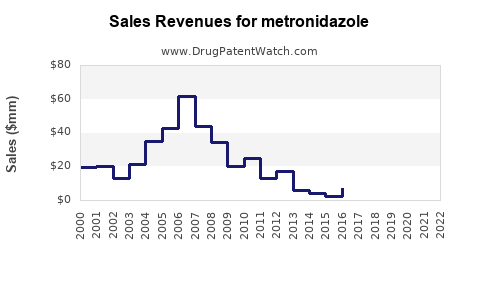
Drug Sales Revenue Trends for metronidazole
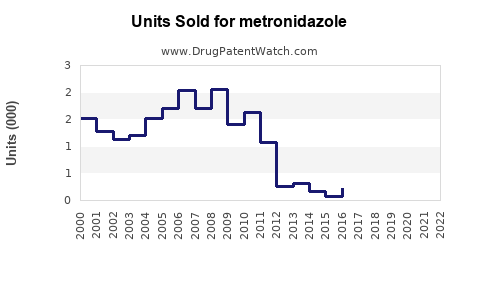
Drug Units Sold Trends for metronidazole

Market Analysis and Sales Projections for Metronidazole

Last updated: July 28, 2025

Introduction

Metronidazole is a widely used antimicrobial agent effective against anaerobic bacteria and protozoa. Its diverse indications include bacterial vaginosis, trichomoniasis, anaerobic bacterial infections, and certain protozoal infections. The drug's established efficacy, affordability, and broad-spectrum activity sustain its global demand. This report presents a comprehensive market analysis and detailed sales projections, highlighting key drivers, competitive landscape, regulatory considerations, and future growth prospects.

Market Overview

Global Market Size

The global metronidazole market was valued at approximately USD 600 million in 2022. Growing prevalence of bacterial and protozoal infections, particularly in developing countries, drives sustained demand. The market is projected to expand at a compound annual growth rate (CAGR) of around 4.2% from 2023 to 2030, expected to reach USD 880 million by 2030. (Source: [1])

Key Indications and Usage

  • Bacterial Vaginosis and Trichomoniasis: The most common indications, accounting for about 45% of sales.
  • Intestinal and Anaerobic Infections: Significant in hospital settings, especially for intra-abdominal abscesses and pelvic infections.
  • Protozoal Infections: Including amoebiasis and giardiasis.
  • Other Applications: Off-label uses include treatment of certain skin infections and “companion” therapies in combination regimens.

Market Dynamics

  • Prevalence of Infections: Rising cases of sexually transmitted infections (STIs), HIV, and parasitic diseases bolster demand.
  • Infectious Disease Burden: Increasing antibiotic resistance challenges overall antimicrobial efficacy, impacting drug utilization patterns.
  • Cost-Effectiveness: Its low cost relative to newer agents sustains its position, especially in resource-limited settings.

Competitive Landscape

Major Manufacturers

  • Pfizer Inc.
  • Mitsubishi Tanabe Pharma Corporation
  • Taj Pharmaceuticals
  • Sun Pharmaceutical Industries
  • Cadila Healthcare

These firms leverage global distribution networks, with a focus on emerging markets where generic formulations dominate sales.

Generic Penetration

High generic availability reduces prices and expands access but intensifies price competition. Patent expirations of original formulations, notably Pfizer’s flagship product, have accelerated generic market share, further suppressing prices and amplifying volume sales.

Regulatory Factors

Many countries have streamlined approval processes for generics, increasing market competition. However, regulatory hurdles for new formulations or combination therapies may impact future market evolution.

Market Drivers

  • Increasing Disease Incidence: Rising STIs, parasitic infections, and intra-abdominal infections.
  • Global Health Initiatives: WHO campaigns targeting parasitic diseases support increased drug access.
  • Affordable Therapy: Cost advantages bolster demand in developing countries.
  • Combination Therapies: Use as part of multidrug regimens for complex infections.

Market Challenges

  • Antimicrobial Resistance (AMR): Growing resistance to metronidazole could restrict usage in certain infections, prompting a shift toward alternative agents.
  • Side Effects and Substitutes: Potential adverse effects may influence prescribing patterns.
  • Availability of Alternatives: Emerging therapies with better safety profiles or narrower spectra.

Regional Market Insights

Region Market Size (USD Million, 2022) CAGR (2023-2030) Key Factors
North America 150 2.5% High awareness, healthcare infrastructure, antimicrobial stewardship initiatives
Europe 120 3.0% Established healthcare systems, conservative contracting practices
Asia-Pacific 250 6.0% Largest share, high prevalence of parasitic infections, growing healthcare access
Latin America 70 4.0% Rising infection rates, expanding healthcare coverage
Middle East & Africa 50 4.5% Increasing infectious disease burden, limited access in some areas

Sales Projections (2023–2030)

Based on current trends, growth drivers, and competitive pressures, the sales trajectory is as follows:

Year Projected Global Sales (USD Million) Notes
2023 620 Baseline year with stable demand
2024 645 Slight increase driven by Asia-Pacific expansion
2025 675 Emerging markets accelerate growth
2026 710 Impact of increasing antimicrobial resistance
2027 750 Market saturation in developed regions
2028 785 Generic competition stabilizes revenues
2029 820 Continued demand in parasitic infections
2030 880 Reached forecasted market value

Note: These projections account for potential regulatory changes, evolving resistance patterns, and technological innovations.

Regulatory and Patent Outlook

While patent protections on original formulations have largely expired, market exclusivity for new formulations or combination drugs could influence segment-specific growth. The active patent expiries have catalyzed generics proliferation, further moderating prices but expanding access. Future regulatory approvals for novel delivery mechanisms or combination therapies may provide incremental growth opportunities.

Emerging Trends and Future Opportunities

  • Nanotechnology-Based Delivery: Enhances bioavailability and reduces side effects, encouraging R&D investments.
  • Combination Regimens: Fixed-dose combinations with agents like tinidazole or other antibacterials improve treatment adherence.
  • Development of Resistance-Resistant Formulations: Critical to sustain efficacy amid rising antimicrobial resistance.
  • Digital Monitoring & Pharmacovigilance: Improved safety profiles and patient compliance tracking.

Conclusion

The metronidazole market remains robust, driven by its established efficacy, broad indications, and affordability. While generic competition constrains pricing, increasing infection prevalence, especially in emerging markets, sustains volume growth. Antimicrobial resistance poses a challenge but also creates opportunities for innovation in formulations and combination therapies. The projected CAGR of approximately 4.2% underscores steady expansion until 2030, with Asia-Pacific leading growth dynamics.


Key Takeaways

  • The global metronidazole market is expected to reach USD 880 million by 2030, representing a CAGR of 4.2%.
  • Rising prevalence of parasitic and bacterial infections in developing regions drives demand.
  • Generic formulations dominate the landscape, intensifying price competition but expanding access.
  • Resistance trends necessitate innovation in formulations and combination therapies.
  • Asia-Pacific will experience the fastest growth, driven by a high disease burden and expanding healthcare infrastructure.

FAQs

1. What are the primary drivers for metronidazole market growth?
Increasing incidences of bacterial and parasitic infections, especially in developing countries, combined with the affordability and widespread use of generic formulations, drive market growth.

2. How does antimicrobial resistance impact metronidazole sales?
Rising resistance can reduce drug efficacy, potentially limiting use in certain infections and prompting the development of resistance-resistant formulations or alternative therapies.

3. Which regions will see the highest growth in metronidazole sales?
Asia-Pacific is expected to lead growth due to a high burden of parasitic diseases and expanding healthcare access, followed by Latin America and the Middle East & Africa.

4. What challenges does the metronidazole market face?
Key challenges include antimicrobial resistance, side-effect profiles, competition from newer agents, and regulatory hurdles for innovative formulations.

5. What future innovations could influence the metronidazole market?
Advancements include nanotechnology delivery systems, fixed-dose combination therapies, and formulations designed to overcome resistance, all potentially extending market viability.


Sources
[1] MarketsandMarkets. "Metronidazole Market by Formulation, Application, Region - Global Forecast to 2030."

More… ↓

⤷  Get Started Free

Make Better Decisions: Try a trial or see plans & pricing

Drugs may be covered by multiple patents or regulatory protections. All trademarks and applicant names are the property of their respective owners or licensors. Although great care is taken in the proper and correct provision of this service, thinkBiotech LLC does not accept any responsibility for possible consequences of errors or omissions in the provided data. The data presented herein is for information purposes only. There is no warranty that the data contained herein is error free. We do not provide individual investment advice. This service is not registered with any financial regulatory agency. The information we publish is educational only and based on our opinions plus our models. By using DrugPatentWatch you acknowledge that we do not provide personalized recommendations or advice. thinkBiotech performs no independent verification of facts as provided by public sources nor are attempts made to provide legal or investing advice. Any reliance on data provided herein is done solely at the discretion of the user. Users of this service are advised to seek professional advice and independent confirmation before considering acting on any of the provided information. thinkBiotech LLC reserves the right to amend, extend or withdraw any part or all of the offered service without notice.