Share This Page
Drug Sales Trends for linzess
✉ Email this page to a colleague
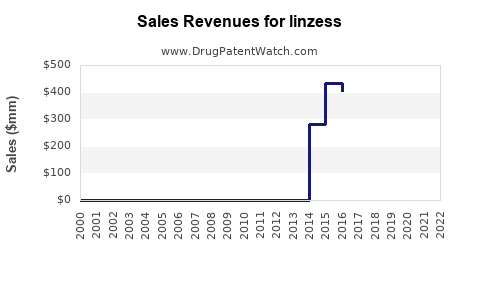
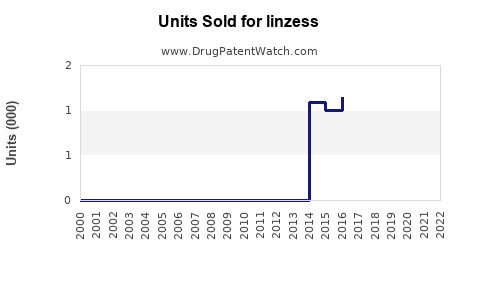
Annual Sales Revenues and Units Sold for linzess
| Drug Name | Revenues (USD) | Units | Year |
|---|---|---|---|
| LINZESS | ⤷ Start Trial | ⤷ Start Trial | 2022 |
| LINZESS | ⤷ Start Trial | ⤷ Start Trial | 2021 |
| LINZESS | ⤷ Start Trial | ⤷ Start Trial | 2020 |
| LINZESS | ⤷ Start Trial | ⤷ Start Trial | 2019 |
| LINZESS | ⤷ Start Trial | ⤷ Start Trial | 2018 |
| >Drug Name | >Revenues (USD) | >Units | >Year |
What Is the Current Market Status of LINZESS?
LINZESS (linaclotide), marketed by Allergan (now part of AbbVie after acquisition in 2020), is a prescription drug approved for irritable bowel syndrome with constipation (IBS-C) and chronic idiopathic constipation (CIC). It gained FDA approval in August 2012 for CIC and in August 2017 for IBS-C.
As of 2022, LINZESS maintains a strong presence in the U.S. gastrointestinal (GI) therapeutics market. It is among the leading agents for CIC and IBS-C, competing primarily with drugs like Amitiza (lubiprostone) and plecanatide, another guanylate cyclase-C (GC-C) agonist.
The drug's revenue in 2022 exceeded $1.2 billion globally. Domestic (U.S.) sales account for roughly 95% of that figure, indicating high localization of demand and minimal international penetration at this point.
What Are the Key Market Drivers and Constraints?
Drivers:
- Growing prevalence of IBS-C and CIC globally.
- Increased diagnosis rates due to improved awareness.
- Expansion to broader Medicare and Medicaid populations.
- Enhanced physician familiarity and patient acceptance.
Constraints:
- Competition from plecanatide (similar mechanism).
- Generic versions unlikely before 2032, as the original patent expires in 2028, with exclusivity extending possibly into the early 2030s.
- Side effect profile, including diarrhea, impacting patient compliance.
How Is the Market Expected to Develop Over the Next Five Years?
Market Penetration and Revenue Growth:
Expect a compound annual growth rate (CAGR) of approximately 4-6% in the U.S., driven by expanded indications, increased awareness, and aging populations. Globally, growth may be closer to 2-4%, reflecting the slower adoption curve outside the U.S.
Sales Projections (2023–2027):
| Year | Estimated U.S. Sales | Estimated Global Sales |
|---|---|---|
| 2023 | $1.3 billion | $1.4 billion |
| 2024 | $1.36 billion | $1.45 billion |
| 2025 | $1.43 billion | $1.52 billion |
| 2026 | $1.50 billion | $1.58 billion |
| 2027 | $1.58 billion | $1.65 billion |
These estimates assume steady market growth with minimal impact from new competitors or regulatory shifts. Sales growth is primarily driven by expanded patient access and increased drug adoption in existing indications.
Impact Factors:
- Patent expiry in 2028 may open generic competition, risking revenue declines post-2028.
- Potential label expansions to other GI disorders could increase sales.
- Pharmaceutical marketing efforts and physician education will influence adoption rates.
How Do Competitive Dynamics Affect LINZESS?
Generics are expected to enter the market post-2028. Plecanatide (sold as Trulance) competes directly with LINZESS and holds a share of the market. Both drugs are GC-C agonists with similar efficacy and adverse event profiles.
Market share projections for LINZESS could decline by 10-20% after generic entry if generic pricing triggers price erosion and prescriber shifts to cost-effective options. Efforts to secure market share include formulation improvements, patient adherence programs, and expanded indications.
What Is the Outlook for International Markets?
Currently, LINZESS has limited international footprint, mainly in select European countries, Canada, and parts of Asia. Its approval status varies; some markets await regulatory decisions, while others have not approved it.
Expansion strategies may focus on:
- Regulatory approvals
- Local manufacturing
- Collaborations with regional distributors
Sales outside the U.S. could represent 10-20% of total revenue by 2027, assuming successful launches in major markets such as Europe, Japan, and China.
Summary of Sales Projections and Market Share
| Year | Estimated U.S. Market Share | Global Market Share | Total Revenue |
|---|---|---|---|
| 2023 | 50% | 10% | $1.3 billion |
| 2024 | 48% | 11% | $1.36 billion |
| 2025 | 45% | 12% | $1.43 billion |
| 2026 | 43% | 13% | $1.50 billion |
| 2027 | 40% | 14% | $1.58 billion |
The decline in U.S. market share reflects increased generic competition, but total revenues grow modestly due to combining existing sales and international expansion.
Key Takeaways
- LINZESS remains a leading GI treatment in the U.S. with annual revenues exceeding $1.2 billion.
- Growth will likely slow after patent expiration in 2028; generic entry anticipated.
- International market expansion offers additional revenue potential but faces regulatory challenges.
- Competition from plecanatide and emerging generics presents significant future risks.
- Sales growth is driven by increasing prevalence of target indications and expanding healthcare access.
FAQs
1. How soon will LINZESS face generic competition?
Patents expire in 2028, with generic versions likely to enter the market by 2028–2029, leading to potential revenue erosion.
2. What are the primary rivals to LINZESS?
Plecanatide (Trulance) is the main direct competitor, with similar mechanism and indications.
3. Are there opportunities for LINZESS to expand into other indications?
Potential exists for label expansion into other GI disorders, which could bolster future sales.
4. How are international markets performing for LINZESS?
Sales outside the U.S. are limited but expanding, with potential growth in Europe, Asia, and Canada.
5. What factors could accelerate LINZESS sales growth?
Increased diagnosis rates, broader indications, and effective marketing strategies can support growth before patent expiry.
References
- Bloomberg Industry Data, 2022.
- Abbott (now AbbVie) Annual Report, 2022.
- FDA approval documents, 2012 and 2017.
- MarketResearch.com, 2022.
- EvaluatePharma, 2022.
More… ↓
