Drug Sales Trends for letrozole
Payment Methods and Pharmacy Types for letrozole (2011)
Revenues by Pharmacy Type
Units Sold by Pharmacy Type
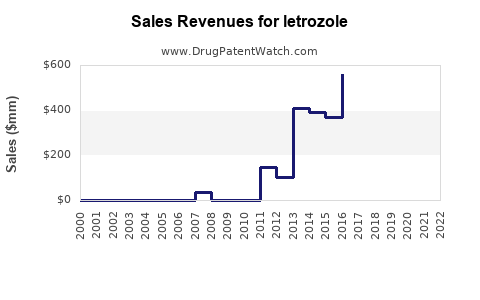
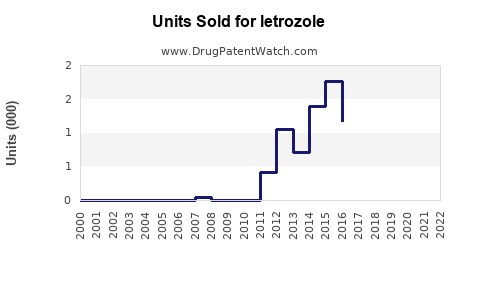
Annual Sales Revenues and Units Sold for letrozole
| Drug Name | Revenues (USD) | Units | Year |
|---|---|---|---|
| LETROZOLE | ⤷ Start Trial | ⤷ Start Trial | 2022 |
| LETROZOLE | ⤷ Start Trial | ⤷ Start Trial | 2021 |
| LETROZOLE | ⤷ Start Trial | ⤷ Start Trial | 2020 |
| LETROZOLE | ⤷ Start Trial | ⤷ Start Trial | 2019 |
| LETROZOLE | ⤷ Start Trial | ⤷ Start Trial | 2018 |
| LETROZOLE | ⤷ Start Trial | ⤷ Start Trial | 2017 |
| >Drug Name | >Revenues (USD) | >Units | >Year |
Letrozole Market Analysis, Sales Projections, Patent Status, and Competitive Outlook
Letrozole is a mature, low-cost aromatase inhibitor with broad generic availability and minimal remaining exclusivity risk. The U.S. market is no longer protected by meaningful branded patents, and commercial value is concentrated in prescription volume, supply reliability, hospital contracts, oncology distribution, and international markets. Global annual sales are likely in the low-single-digit billions of dollars across all manufacturers and channels, while originator-brand revenue is negligible compared with pre-generic levels.
The strongest demand drivers are hormone-receptor-positive breast cancer, adjuvant treatment, metastatic disease, and off-label ovulation induction in reproductive medicine. Growth is volume-led rather than price-led. Retail prices should remain under pressure, although shortages, API concentration, and procurement disruptions can create temporary price increases.
What is letrozole and how large is its addressable market?
Letrozole is an oral, nonsteroidal aromatase inhibitor marketed originally as Femara by Novartis. It suppresses estrogen production and is used primarily in postmenopausal women with hormone-receptor-positive breast cancer. The FDA-approved tablet strengths are 2.5 mg, with treatment commonly administered once daily. The drug is available as an immediate-release oral tablet and is not a biologic or complex delivery product. (U.S. Food and Drug Administration [FDA], 2024a)
Core approved indications
The FDA label covers:
- Adjuvant treatment of early breast cancer in postmenopausal women.
- Extended adjuvant treatment after approximately five years of tamoxifen therapy.
- First-line treatment of advanced or metastatic breast cancer.
- Treatment of advanced breast cancer following antiestrogen therapy. (FDA, 2024a)
Letrozole is also widely used off label for ovulation induction in patients with anovulatory infertility, including polycystic ovary syndrome. Fertility use is commercially important but is not the basis for the FDA-approved label.
Market size estimate
Public market reports produce widely different estimates because they vary in whether they include:
- Finished-dose tablets only.
- Active pharmaceutical ingredient sales.
- Hospital and retail channels.
- Fertility prescribing.
- All geographic markets or only branded sales.
- Revenue at manufacturer, wholesaler, or retail value.
A practical market range is:
| Market segment | Estimated 2024 value | Primary basis |
|---|---|---|
| Global finished-dose letrozole market | $1.2 billion-$2.0 billion | Generic oncology and fertility volume |
| U.S. finished-dose market | $250 million-$450 million | Retail, mail, specialty, and institutional sales |
| European market | $250 million-$450 million | National reimbursement and generic procurement |
| Emerging markets | $500 million-$1.0 billion | High volume, lower unit prices |
| Originator-branded Femara | Immaterial relative to total market | Post-exclusivity residual demand |
These figures are analytical market ranges rather than audited consolidated manufacturer sales. No single company reports the entire global letrozole market.
How does letrozole generate demand?
Oncology is the principal value driver, while fertility expands prescription volume. Demand is relatively resilient because letrozole is included in established clinical pathways and has low treatment cost compared with newer breast-cancer medicines.
Oncology demand
Letrozole competes with:
- Anastrozole.
- Exemestane.
- Tamoxifen.
- Fulvestrant.
- CDK4/6 inhibitor combinations.
- Oral selective estrogen receptor degraders and other endocrine therapies under development.
For early hormone-receptor-positive breast cancer, treatment duration can extend over several years. That creates a large cumulative prescription base even though the daily tablet price is low. Treatment sequencing varies by menopausal status, recurrence risk, tolerability, bone-health considerations, and prior tamoxifen exposure.
Fertility demand
Letrozole has become a major oral ovulation-induction option. Randomized evidence has supported its use in women with polycystic ovary syndrome, particularly compared with clomiphene in relevant patient populations. (Legro et al., 2014)
Fertility prescriptions can increase unit volume without materially increasing price because tablets are generally dispensed in short treatment cycles. This segment also has less dependence on oncology reimbursement rules.
What are the letrozole sales projections through 2030?
A reasonable base case is low-to-mid-single-digit annual global revenue growth through 2030, driven by patient volume and fertility use. Unit growth should exceed revenue growth because generic prices continue to decline.
Base-case projection
| Year | Global market revenue | Estimated growth | Main driver |
|---|---|---|---|
| 2024 | $1.5 billion | Baseline | Mature oncology and fertility demand |
| 2025 | $1.55 billion | 3.3% | Stable oncology use and fertility volume |
| 2026 | $1.61 billion | 3.9% | Emerging-market penetration |
| 2027 | $1.67 billion | 3.7% | Population aging and treatment persistence |
| 2028 | $1.73 billion | 3.6% | Continued volume growth |
| 2029 | $1.79 billion | 3.5% | Fertility and international expansion |
| 2030 | $1.86 billion | 3.9% | Higher treated-patient base |
The implied 2024-2030 compound annual growth rate is approximately 3.6%.
Scenario analysis
| Scenario | 2030 global revenue | CAGR from 2024 | Key assumptions |
|---|---|---|---|
| Downside | $1.25 billion | -3.0% | Accelerated price erosion and substitution by other endocrine agents |
| Base case | $1.86 billion | 3.6% | Stable clinical use and moderate patient growth |
| Upside | $2.35 billion | 7.8% | Strong fertility expansion, higher diagnosis rates, and supply-driven price increases |
The downside case is more likely in the U.S. than in lower-income markets because payer and pharmacy-benefit-manager pressure is stronger in mature generic markets. The upside case depends more on volume than on premium pricing.
When did letrozole lose exclusivity?
Letrozole lost effective U.S. market exclusivity more than a decade ago. The original Femara patent estate did not prevent broad generic entry after the principal patent and regulatory exclusivity periods ended.
Key exclusivity milestones
| Milestone | Date or period | Commercial effect |
|---|---|---|
| Original FDA approval of Femara | December 1997 | Established U.S. originator product |
| U.S. generic approvals | 2011 onward | Rapid erosion of branded sales |
| Core composition and use protection | Expired around 2011 | Broad generic entry became possible |
| Current U.S. market | Generic-dominated | Femara has limited commercial relevance |
Novartis reported substantial erosion in Femara sales after generic competition began. The company’s historical annual reports described Femara as exposed to generic competition following loss of patent protection. (Novartis AG, 2012)
Exact patent dates can vary by patent family, terminal disclaimer, pediatric extension, jurisdiction, and listed patent scope. The commercial conclusion is consistent: no material U.S. blocking patent remains for ordinary letrozole tablets.
What patents protect letrozole products today?
The active ingredient is old and chemically simple. The primary patent risk is not an active U.S. composition patent but product-specific patents covering a later formulation, manufacturing process, combination, or method of use.
Patent categories
| Patent category | Current relevance | Risk level |
|---|---|---|
| Letrozole composition of matter | Expired or commercially irrelevant | Very low |
| Standard 2.5 mg tablet | Broadly unprotected | Very low |
| Specific excipient formulation | Potentially relevant to a particular product | Low |
| Manufacturing process | Can affect a supplier or product, not the entire market | Low to moderate |
| Combination treatment | May cover a regimen rather than letrozole itself | Moderate for the named use |
| Fertility method of use | Generally weak where use is off label and patents are limited | Low |
| Pediatric or new indication patent | Product-specific and scope-limited | Low |
| International formulation patent | Jurisdiction-specific | Low to moderate |
A company commercializing a conventional letrozole tablet generally faces little freedom-to-operate risk from the original Femara estate. Risk rises when the product uses a proprietary delivery system, a novel fixed-dose combination, a differentiated dosage form, or a patented manufacturing process.
What is the Orange Book status of letrozole?
The FDA Orange Book historically listed Femara and approved generic equivalents. The reference product is letrozole tablets, 2.5 mg. The current commercial market is dominated by abbreviated new drug application products rather than the originator.
Generic applicants could use an ANDA because letrozole is a small-molecule drug with an established reference product and conventional oral dosage form. The primary regulatory requirements are pharmaceutical equivalence, bioequivalence, quality manufacturing, labeling compliance, and facility inspection.
Paragraph IV challenge risk
Paragraph IV litigation risk is now limited for the basic product because generic entry already occurred. A later applicant may still file a Paragraph IV certification if it challenges a newly listed patent associated with:
- A new formulation.
- A new indication.
- A combination therapy.
- A manufacturing process.
- A branded reformulation.
For ordinary letrozole 2.5 mg tablets, Paragraph IV activity is not a central market event. The commercial question is usually supply, price, and procurement access rather than litigation timing.
Which companies compete in the letrozole market?
The market has a fragmented generic supplier base. Suppliers vary by geography and may change as contracts, manufacturing approvals, and drug-shortage conditions change.
Representative competitors
| Company or supplier group | Market role |
|---|---|
| Novartis | Original Femara developer; limited residual branded role |
| Teva Pharmaceuticals | Generic oncology supplier in multiple markets |
| Mylan/Viatris | Generic letrozole supplier and institutional competitor |
| Dr. Reddy’s Laboratories | Generic supply, particularly in U.S. and international markets |
| Sandoz | Generic and hospital-channel competition |
| Cipla | International generic and emerging-market supplier |
| Sun Pharma | Generic oncology distribution |
| Accord Healthcare | Generic oncology supply in selected markets |
| Hikma | Hospital and generic channel participation |
| Regional manufacturers | Country-specific supply and tender competition |
Market shares are not consistently disclosed, and supplier ranking can shift quickly after manufacturing interruptions or contract changes.
How strong is the patent estate for letrozole?
The patent estate is weak for standard generic letrozole tablets and stronger only for narrow product modifications.
Patent-strength assessment
| Asset | Strength | Commercial assessment |
|---|---|---|
| Original Femara molecule patent | Expired | No blocking value |
| Standard tablet formulation | Weak | Easily substituted by approved generics |
| New formulation patent | Moderate if clinically differentiated | May support a niche product |
| Method-of-use patent | Narrow | Enforceability depends on labeling and induced-use evidence |
| Process patent | Moderate against a named process | Does not block alternative manufacturing routes |
| Combination patent | Moderate to strong within a defined regimen | Limited impact on standalone letrozole sales |
| Trade secret manufacturing know-how | Potentially valuable | Can reduce cost but is not market exclusivity |
A conventional generic manufacturer’s competitive moat is operational, not patent-based. The most durable advantages are low-cost API access, validated production, regulatory compliance, reliable fill rates, and established payer or hospital contracts.
What manufacturing and intellectual-property barriers affect generic entry?
Generic entry is technically feasible, but commercial supply is not frictionless. Letrozole requires controlled synthesis, impurity management, validated analytical methods, and compliance with current good manufacturing practices.
Main barriers
- API supplier qualification.
- Control of genotoxic and related impurities.
- Consistent tablet content uniformity at low dosage strength.
- Stability under multiple climatic conditions.
- FDA, EMA, and local inspection compliance.
- Serialization and packaging requirements.
- Procurement qualification in hospital systems.
- Working-capital requirements for low-margin inventory.
- Exposure to API concentration in India and China.
- Contract loss when several suppliers compete on price.
These barriers can cause short-term shortages without creating durable patent exclusivity. A shortage may improve realized pricing for a supplier, but it rarely changes the long-term competitive structure.
What regulatory status does letrozole have?
Letrozole is FDA approved as a prescription tablet for breast-cancer indications. It is not FDA approved for infertility treatment, although fertility specialists commonly prescribe it off label. The drug is also approved or marketed in numerous jurisdictions outside the United States under national regulatory frameworks. (FDA, 2024a)
The regulatory profile is favorable for generic manufacturers because:
- The reference product is well established.
- The dosage form is conventional.
- Clinical safety and efficacy data are extensive.
- Bioequivalence can support an ANDA.
- No biosimilar pathway is involved.
- No cold-chain or specialized administration infrastructure is required.
Biosimilar risk
Biosimilar competition is not relevant to letrozole. Letrozole is a small molecule, not a biologic. Competitive risk comes from generic ANDA products, national generic approvals, parallel trade, and therapeutic substitution.
How does letrozole compare with anastrozole and exemestane?
Letrozole, anastrozole, and exemestane are established endocrine therapies, but their chemical classes and clinical profiles differ.
| Attribute | Letrozole | Anastrozole | Exemestane |
|---|---|---|---|
| Drug class | Nonsteroidal aromatase inhibitor | Nonsteroidal aromatase inhibitor | Steroidal aromatase inactivator |
| Common strength | 2.5 mg | 1 mg | 25 mg |
| Administration | Oral, generally once daily | Oral, generally once daily | Oral, generally once daily |
| Generic availability | Broad | Broad | Broad |
| Main use | Hormone-receptor-positive breast cancer; fertility off label | Breast cancer | Breast cancer, including post-tamoxifen use |
| Fertility use | Established off-label use | Limited relative use | Limited relative use |
| Patent exposure | Minimal for standard tablets | Minimal for standard tablets | Minimal for standard tablets |
| Commercial differentiation | Fertility demand and clinical familiarity | Broad oncology substitution | Steroidal mechanism and sequencing |
The principal competitive advantage of letrozole is not price. All three products are generic. Letrozole benefits from strong recognition in fertility practice and continued use in endocrine breast-cancer treatment.
What litigation and settlement agreements affect letrozole?
There is no major current U.S. patent litigation barrier preventing ordinary generic letrozole tablet sales. Historical ANDA disputes may have occurred around the launch of generic products, but those cases no longer determine market access.
Settlement agreements are more relevant to branded reformulations or new combination products than to standard letrozole. A settlement involving a particular manufacturer would generally affect that company’s launch date, authorized generic arrangement, or formulation, not the entire letrozole market.
What generic launch scenarios exist for letrozole?
The market supports three practical launch strategies.
Commodity generic
A manufacturer launches a conventional 2.5 mg tablet through an ANDA or local generic pathway. This approach requires low manufacturing cost and dependable supply. Margins are thin, and success depends on procurement scale.
Specialty fertility channel
A supplier targets reproductive endocrinology clinics, fertility pharmacies, and cash-pay patients. Packaging, availability, and reliable short-cycle dispensing matter more than oncology contracting. The channel can support stronger net pricing in selected markets, but total volume is smaller than broad pharmacy distribution.
Differentiated formulation
A company develops a combination, modified-release product, or patient-specific formulation. This strategy can support patent protection, but clinical differentiation and reimbursement are difficult to establish for a low-cost generic molecule. Regulatory and development costs could exceed the addressable premium market.
What revenue exposure exists for manufacturers and investors?
For most generic manufacturers, letrozole is unlikely to be a material standalone revenue driver. It is usually part of a broader oncology portfolio. Revenue exposure is greatest for companies with:
- Large generic pharmacy contracts.
- Oncology-focused institutional sales.
- Fertility distribution networks.
- Low-cost API integration.
- Strong presence in countries with limited access to newer endocrine therapies.
Originator revenue exposure is minimal. Novartis’s economics are no longer driven by Femara, while generic manufacturers face price competition and supply volatility. The market is more relevant as a stable, recurring-volume product than as a high-margin growth asset.
Key Takeaways
- Letrozole is a mature generic aromatase inhibitor with broad global demand.
- The core U.S. composition and tablet market lost meaningful exclusivity around 2011.
- Standard letrozole tablets have low patent risk and no meaningful biosimilar risk.
- The global market is reasonably modeled at about $1.2 billion-$2.0 billion in 2024.
- A base-case projection reaches approximately $1.86 billion by 2030, implying about 3.6% annual growth.
- Volume growth should exceed revenue growth because generic prices remain under pressure.
- Oncology is the principal revenue base; fertility prescribing is an important volume contributor.
- Manufacturing reliability, API access, quality compliance, and procurement contracts are stronger competitive advantages than patents.
- Paragraph IV litigation is unlikely to materially delay ordinary generic entry.
- The highest-value opportunities involve supply reliability, fertility-channel access, emerging markets, and differentiated formulations.
FAQs About Letrozole Market Size and Exclusivity
Is letrozole still under patent in the United States?
The original letrozole and Femara patent protections no longer block ordinary generic 2.5 mg tablet sales. Product-specific patents could still apply to a later formulation, combination, or manufacturing process.
Does letrozole have FDA approval for infertility?
No. Letrozole is FDA approved for breast-cancer treatment. Infertility use is off label, although it is widely used for ovulation induction.
What is the expected U.S. price trend for generic letrozole?
The long-term trend is downward because multiple generic suppliers compete for pharmacy and institutional contracts. Temporary price increases can occur during shortages or supplier withdrawals.
Can a company obtain new patent protection for letrozole?
Potentially, but protection would need to cover a novel formulation, combination, manufacturing method, or specific therapeutic use. A new patent would not restore broad exclusivity for the existing molecule and conventional tablet.
Is letrozole a good target for a generic manufacturer?
It can be attractive as part of a diversified oncology or fertility portfolio. It is less attractive as a standalone premium product because competition is broad, patent barriers are weak, and pricing is highly sensitive to supply and procurement conditions.
References
Food and Drug Administration. (2024a). Femara (letrozole) prescribing information. U.S. Department of Health and Human Services. https://www.accessdata.fda.gov
Food and Drug Administration. (2024b). Approved drug products with therapeutic equivalence evaluations: Orange Book. U.S. Department of Health and Human Services. https://www.accessdata.fda.gov/scripts/cder/ob/
Legro, R. S., Brzyski, R. G., Diamond, M. P., Coutifaris, C., Schlaff, W. D., Casson, P., Christman, G. M., Huang, H., Yan, Q., Alvero, R., Haisenleder, D. J., Krawetz, S. A., Barnhart, K. T., Bates, G. W., Usadi, R., Lucidi, R. S., Baker, V. L., Trussell, J. C., Santoro, N., ... Zhang, H. (2014). Letrozole versus clomiphene for infertility in the polycystic ovary syndrome. New England Journal of Medicine, 371(2), 119-129. https://doi.org/10.1056/NEJMoa1313517
Novartis AG. (2012). Annual report 2011. https://www.novartis.com/investors/financial-data/annual-reporting-performance
U.S. Food and Drug Administration. (2023). Abbreviated new drug application process. U.S. Department of Health and Human Services. https://www.fda.gov/drugs/types-applications/abbreviated-new-drug-application-anda
More… ↓
