Share This Page
Drug Sales Trends for brimonidine
✉ Email this page to a colleague
Payment Methods and Pharmacy Types for brimonidine (2011)
Revenues by Pharmacy Type
Units Sold by Pharmacy Type
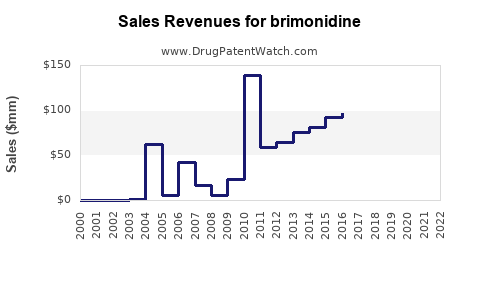
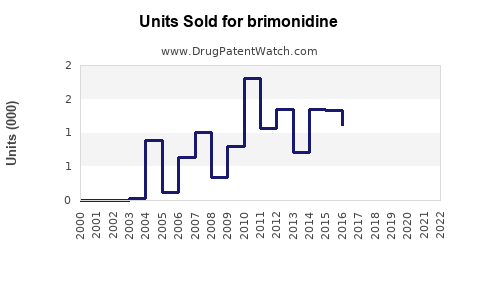
Annual Sales Revenues and Units Sold for brimonidine
| Drug Name | Revenues (USD) | Units | Year |
|---|---|---|---|
| BRIMONIDINE | ⤷ Start Trial | ⤷ Start Trial | 2022 |
| BRIMONIDINE | ⤷ Start Trial | ⤷ Start Trial | 2021 |
| BRIMONIDINE | ⤷ Start Trial | ⤷ Start Trial | 2020 |
| BRIMONIDINE | ⤷ Start Trial | ⤷ Start Trial | 2019 |
| BRIMONIDINE | ⤷ Start Trial | ⤷ Start Trial | 2018 |
| BRIMONIDINE | ⤷ Start Trial | ⤷ Start Trial | 2017 |
| >Drug Name | >Revenues (USD) | >Units | >Year |
Brimonidine Market Analysis, Sales Forecast, Patent Status, and Generic Competition
Brimonidine is a mature ophthalmic and dermatologic drug with two distinct commercial markets: glaucoma treatment and facial erythema treatment. Generic ophthalmic brimonidine dominates volume, while Galderma’s Mirvaso retains the principal branded position in topical dermatology. The combined global market is best modeled at approximately $400 million in 2024 net sales, with low-single-digit growth through 2029 under the base case. Value growth is constrained by generic erosion, low prices, and limited clinical differentiation.
What is brimonidine used for?
Brimonidine is an alpha-2 adrenergic receptor agonist approved in several formulations.
| Product category | Active ingredient | Principal indication | Main commercial products |
|---|---|---|---|
| Ophthalmic solution | Brimonidine tartrate | Lowering intraocular pressure in open-angle glaucoma or ocular hypertension | Generic brimonidine, Alphagan P |
| Ophthalmic combination | Brimonidine tartrate plus timolol | Glaucoma and ocular hypertension | Combigan, generic equivalents |
| Topical gel | Brimonidine tartrate | Persistent facial erythema associated with rosacea | Mirvaso |
| Fixed-dose combinations | Brimonidine with other ophthalmic agents | Glaucoma | Regional products and development candidates |
The ophthalmic market is substantially larger in treated-patient volume than the dermatology market. The dermatology market has higher branded pricing and greater sensitivity to reimbursement, cosmetic use patterns, and patient persistence.
The FDA approved brimonidine ophthalmic products for intraocular-pressure reduction, while Mirvaso was approved in 2013 for topical treatment of persistent facial erythema associated with rosacea [1,2].
How large is the brimonidine market?
The market has no single reliable public sales figure because brimonidine is sold across generic, branded, combination, prescription, and international channels. Public company reports generally do not disclose standalone revenue for generic brimonidine or Mirvaso.
Estimated 2024 market by segment
| Segment | Estimated 2024 global net sales | Market structure | 2024-2029 outlook |
|---|---|---|---|
| Generic brimonidine ophthalmic | $150 million-$220 million | Fragmented generic supply | Stable to declining |
| Alphagan P and branded ophthalmic products | $20 million-$40 million | Residual branded share | Declining |
| Brimonidine-timolol products | $100 million-$150 million | Generic and branded competition | Low growth or decline |
| Mirvaso and topical brimonidine | $80 million-$120 million | Branded dermatology market | Low-single-digit growth |
| Other international and combination products | $30 million-$70 million | Country-specific markets | Mixed |
| Total brimonidine-related market | $380 million-$600 million | Mature, multi-product market | Low-single-digit growth |
The central estimate for the combined market is approximately $460 million in 2024. This estimate includes products containing brimonidine and excludes unrelated alpha-2 agonists such as apraclonidine.
A narrower definition covering brimonidine monotherapy only would produce a materially smaller market, likely between $230 million and $330 million globally.
What are the brimonidine sales projections through 2029?
The forecast below uses a 2024 central market estimate of $460 million and applies segment-specific assumptions. It represents modeled net sales, not reported company revenue.
Base-case global projection
| Year | Estimated market sales | Annual growth |
|---|---|---|
| 2024 | $460 million | Base year |
| 2025 | $469 million | 2.0% |
| 2026 | $480 million | 2.3% |
| 2027 | $491 million | 2.3% |
| 2028 | $503 million | 2.4% |
| 2029 | $515 million | 2.4% |
The forecast assumes:
- Generic ophthalmic volume remains stable, with continuing price erosion.
- Brimonidine-timolol combinations offset some monotherapy decline.
- Mirvaso grows modestly through dermatology prescribing, cosmetic demand, and international expansion.
- No major new indication materially expands the patient population.
- No large-scale manufacturing interruption affects generic supply.
- Branded ophthalmic products continue losing share to lower-cost alternatives.
Scenario analysis
| Scenario | 2029 market sales | Implied 2024-2029 CAGR | Principal assumptions |
|---|---|---|---|
| Downside | $390 million | -3.3% | Faster generic price erosion, weak Mirvaso persistence, limited international growth |
| Base case | $515 million | 2.3% | Stable ophthalmic volume and modest topical growth |
| Upside | $650 million | 7.2% | Stronger dermatology demand, improved adherence, expanded combination use |
The upside case requires commercial expansion rather than a major scientific breakthrough. Brimonidine is already well established, and the principal growth opportunity is improved market execution in dermatology and fixed-dose ophthalmic combinations.
Which companies sell brimonidine products?
The competitive market is fragmented.
Major commercial participants
| Company | Product or role | Market exposure |
|---|---|---|
| Galderma | Mirvaso topical gel | Branded rosacea treatment |
| AbbVie | Alphagan P and Combigan legacy products | Branded ophthalmology, reduced by generic competition |
| Sandoz | Generic ophthalmic products in several markets | Generic glaucoma |
| Apotex | Generic brimonidine and ophthalmic products | North American generic market |
| Bausch + Lomb | Ophthalmic generics and glaucoma portfolio | Ophthalmology distribution |
| Akorn and other generic suppliers | Brimonidine ophthalmic products | U.S. and international generic supply |
| Regional manufacturers | Local brimonidine and combination products | Europe, Asia, Latin America, and other markets |
Product ownership can vary by jurisdiction, and generic suppliers may change through licensing, acquisition, or supply agreements.
Galderma is the principal commercial company associated with Mirvaso. AbbVie inherited Alphagan P and Combigan through its acquisition of Allergan, although the economic value of these products has been reduced by generic competition and the maturity of their patent estates [3].
What is the FDA regulatory status of brimonidine?
Brimonidine ophthalmic products are approved prescription medicines. The original glaucoma indication is mature and supported by extensive clinical use.
Mirvaso is an FDA-approved topical gel containing brimonidine tartrate for persistent facial erythema associated with rosacea. Its label includes warnings relating to systemic cardiovascular effects, accidental transfer to children, and worsening erythema or rebound redness in some patients [2].
Regulatory status by product
| Product | FDA status | Regulatory pathway | Market condition |
|---|---|---|---|
| Brimonidine ophthalmic solution | Approved | NDA and ANDA pathways | Generic competition |
| Brimonidine-timolol ophthalmic solution | Approved | NDA and ANDA pathways | Generic and branded competition |
| Mirvaso gel | Approved | NDA | Branded topical market |
| Biosimilar pathway | Not applicable | Small-molecule drug framework | No biosimilar exposure |
Brimonidine is a small-molecule drug. Biosimilar risk does not apply. Generic substitution under the Abbreviated New Drug Application pathway is the central U.S. regulatory risk for ophthalmic products.
When does brimonidine lose exclusivity?
Brimonidine’s principal glaucoma patents are generally expired or commercially weakened by generic competition. The practical loss of exclusivity occurred years ago for ophthalmic monotherapy.
The commercial position is different for Mirvaso. Topical rosacea protection depends on product-specific patents, formulation claims, method-of-use claims, pediatric exclusivity, regulatory exclusivity, and the timing of any ANDA challenge. FDA Orange Book listings and USPTO records must be reviewed together because an Orange Book-listed patent does not guarantee enforceability or a successful injunction [4,5].
Exclusivity assessment
| Product | Exclusivity position | Generic entry risk |
|---|---|---|
| Generic brimonidine ophthalmic | No meaningful exclusivity | Already genericized |
| Alphagan P | Legacy branded product | High |
| Combigan | Legacy combination product | High, with formulation and equivalence issues |
| Mirvaso | Product-specific patent and formulation exposure | Moderate to high over time |
Mirvaso’s commercial protection is more dependent on formulation and delivery characteristics than on the basic brimonidine molecule. The active ingredient itself is old and does not provide meaningful composition-of-matter protection.
What patents protect Mirvaso and other brimonidine products?
The strongest potential protection for topical brimonidine is likely to involve:
- Gel composition and excipient selection.
- Concentration and viscosity.
- Controlled or sustained delivery.
- Treatment of persistent facial erythema.
- Dosing and application instructions.
- Reduced systemic absorption.
- Stability and manufacturing processes.
Ophthalmic products may rely on:
- Preservative systems.
- Purity and impurity controls.
- Container-closure systems.
- Concentration ranges.
- Combination formulations with timolol.
- Dosing methods and treatment regimens.
The basic brimonidine molecule is not a strong source of current exclusivity because it has been commercially available for decades. Formulation patents can delay direct substitution, but their scope is narrower and more vulnerable to design-around strategies.
Patent strength by product
| Product | Composition-of-matter strength | Formulation strength | Method-of-use strength | Overall commercial protection |
|---|---|---|---|---|
| Generic brimonidine ophthalmic | Very low | Low | Low | Weak |
| Alphagan P | Expired or weak legacy protection | Low to moderate | Low | Weak |
| Combigan | Expired or weakened core protection | Moderate | Moderate | Moderate historically |
| Mirvaso | Low for active ingredient | Moderate to strong | Moderate | Stronger than ophthalmic monotherapy |
The relevant diligence question is not whether brimonidine has patents. It is whether a particular patent is unexpired, listed for the relevant product, enforceable, and difficult to design around.
What Paragraph IV challenges affect brimonidine?
Paragraph IV litigation is most relevant to Mirvaso and other branded topical products with remaining Orange Book-listed patents. Generic ophthalmic brimonidine has already experienced broad generic entry, so future Paragraph IV activity is less commercially significant for the basic monotherapy market.
A Paragraph IV certification asserts that an Orange Book-listed patent is invalid, unenforceable, or will not be infringed by the proposed generic. The NDA holder can file an infringement action within 45 days, potentially triggering a 30-month stay of FDA approval under the Hatch-Waxman framework [6].
Litigation exposure
| Product | Paragraph IV relevance | Likely dispute focus |
|---|---|---|
| Brimonidine ophthalmic monotherapy | Low | Residual formulation or supplier-specific patents |
| Brimonidine-timolol | Moderate | Bioequivalence, formulation, and combination claims |
| Mirvaso | High relative to other brimonidine products | Gel composition, concentration, topical performance, method of use |
Public litigation records should be checked in the U.S. District Court system and FDA Orange Book before relying on any claimed launch date. A patent settlement can permit an authorized or licensed generic launch before full patent expiration, making the nominal patent date a poor proxy for actual market entry.
What formulation patents protect brimonidine?
Formulation protection is commercially important because brimonidine is a low-complexity active ingredient with limited chemical novelty.
Ophthalmic formulations
Ophthalmic formulation claims may cover:
- Low-concentration brimonidine solutions.
- Reduced-preservative or preservative-free delivery.
- Polyvinyl alcohol, borate, or related excipient systems.
- Container systems that preserve sterility and stability.
- Fixed-dose combinations with timolol.
These claims can support a branded product, but generic applicants can seek approval through alternative excipients or packaging if therapeutic equivalence is demonstrated.
Topical formulations
Mirvaso’s formulation value is tied to the ability to deliver brimonidine to facial skin while limiting systemic exposure and reducing adverse redness reactions. Formulation differentiation can support premium pricing and physician preference, but topical generic approval and substitution depend on the applicable FDA requirements for pharmaceutical equivalence and therapeutic equivalence.
What generic entry risks exist for brimonidine?
Generic entry is the primary risk in the ophthalmic segment. The risk is already realized for standard brimonidine ophthalmic solution.
Generic risk by segment
| Segment | Current risk | Expected impact |
|---|---|---|
| Brimonidine ophthalmic solution | Very high | Low prices and declining branded share |
| Brimonidine-timolol | High | Volume retention but margin compression |
| Alphagan P | High | Continued substitution |
| Mirvaso | Moderate to high | Potential price erosion if an approved generic enters |
| Novel delivery systems | Variable | Depends on patent scope and FDA equivalence pathway |
Mirvaso has greater near-term strategic value than generic ophthalmic brimonidine because dermatology pricing is higher and the product has stronger brand recognition. A successful generic launch would likely reduce price and market share, although physician prescribing and patient preference could preserve part of the branded market.
How does brimonidine compare with competing glaucoma drugs?
Brimonidine competes with prostaglandin analogs, beta blockers, carbonic anhydrase inhibitors, rho kinase inhibitors, and fixed-dose combinations.
| Drug class | Main advantage | Main limitation relative to brimonidine |
|---|---|---|
| Prostaglandin analogs | Strong intraocular-pressure reduction and once-daily dosing | Ocular pigmentation and eyelash-related effects |
| Beta blockers | Established efficacy and low cost | Cardiopulmonary contraindications |
| Carbonic anhydrase inhibitors | Useful adjunctive therapy | More frequent dosing and tolerability issues |
| Rho kinase inhibitors | Newer mechanism | Hyperemia and higher cost |
| Brimonidine | Useful adjunctive pressure reduction and broad generic availability | Allergic reactions, fatigue, dry mouth, and multiple daily dosing |
Brimonidine is often used as adjunctive therapy rather than as the sole first-line treatment. Its role remains durable because it is inexpensive, familiar, and available in combination products.
How does Mirvaso compare with competing rosacea treatments?
Mirvaso occupies a specific position in the rosacea market because it targets persistent facial erythema rather than inflammatory papules and pustules.
| Product class | Primary target | Competitive relationship |
|---|---|---|
| Mirvaso | Persistent facial erythema | Direct brimonidine competitor set |
| Oxymetazoline cream | Persistent facial erythema | Closest branded topical competitor |
| Metronidazole | Inflammatory rosacea lesions | Indirect |
| Azelaic acid | Inflammatory lesions and erythema | Indirect |
| Ivermectin | Inflammatory lesions | Indirect |
| Laser and light therapy | Vascular erythema | Procedure-based alternative |
The main commercial risk to Mirvaso is not only generic entry. It is substitution by oxymetazoline, laser therapy, and other rosacea treatments that improve overall patient satisfaction.
What licensing deals and partnerships affect brimonidine?
Brimonidine has been commercialized through licensing, distribution, and generic supply arrangements across multiple jurisdictions. Product-level revenue is often reported within broader ophthalmology or dermatology portfolios rather than separately.
The most visible ownership transaction is AbbVie’s acquisition of Allergan, which transferred the legacy Alphagan and Combigan portfolio to AbbVie [3]. Mirvaso remains associated with Galderma’s dermatology portfolio.
The commercial significance of licensing is highest in:
- Regional rights for topical dermatology products.
- Generic supply and authorized-generic arrangements.
- Fixed-dose ophthalmic combinations.
- Manufacturing and distribution agreements.
- Technology transfer for sterile ophthalmic production.
What manufacturing barriers affect brimonidine?
Manufacturing barriers are moderate for the active ingredient and higher for sterile ophthalmic products.
Key barriers
- Sterile filling and aseptic manufacturing.
- Container-closure integrity.
- Preservative compatibility.
- Impurity and degradation control.
- Batch consistency for topical gels.
- Bioequivalence or comparative-performance testing.
- Regulatory approval across multiple jurisdictions.
The active pharmaceutical ingredient is not considered a major manufacturing bottleneck in normal conditions. Supply risk is more likely to arise from a limited number of qualified sterile manufacturing sites, inspection findings, or packaging failures.
What is the investment outlook for brimonidine?
Brimonidine is a cash-generative but low-growth market. The best investment characteristics are concentrated in branded dermatology, differentiated delivery systems, and combination ophthalmic products.
Revenue exposure
- Generic ophthalmic products: high volume, low margins.
- Legacy branded ophthalmic products: declining revenue and limited pricing power.
- Mirvaso: lower volume but higher revenue per patient.
- Combination products: stronger retention than monotherapy where adherence and convenience support prescribing.
- New formulations: potentially attractive, but dependent on patent durability and clinical differentiation.
The base-case market forecast of $515 million in 2029 implies modest expansion in total value, not a return to branded-monopoly economics. Investors should value Mirvaso and differentiated combinations separately from commodity brimonidine ophthalmic products.
Key Takeaways
- Brimonidine is a mature drug with separate glaucoma and rosacea markets.
- The combined global market is estimated at approximately $460 million in 2024.
- Base-case sales reach about $515 million by 2029, representing a 2.3% CAGR.
- Generic ophthalmic brimonidine already faces severe price and share pressure.
- Mirvaso has the strongest remaining commercial position because topical dermatology pricing is higher.
- Formulation, delivery, and method-of-use patents matter more than the old brimonidine molecule.
- Biosimilar risk does not apply because brimonidine is a small molecule.
- Paragraph IV exposure is more relevant to Mirvaso and combination products than to standard ophthalmic monotherapy.
- Manufacturing risk is moderate, with sterile ophthalmic production creating the main operational barrier.
- The market is defensive and cash-oriented rather than a high-growth pharmaceutical opportunity.
FAQs
Is brimonidine still a profitable drug?
Yes, but profitability is concentrated in branded topical products and selected combination products. Generic ophthalmic brimonidine is profitable mainly through manufacturing scale and distribution efficiency.
Does Mirvaso have generic competition?
Mirvaso faces generic-entry risk through the ANDA pathway. The timing and commercial effect depend on unexpired Orange Book-listed patents, litigation outcomes, FDA approval, and any settlement terms.
Is brimonidine included in the FDA Orange Book?
FDA-approved brimonidine products and relevant listed patents may appear in the Orange Book by product and dosage form. Listings must be reviewed separately for ophthalmic solutions, combination products, and topical gel products [4].
What is the largest commercial use of brimonidine?
Glaucoma and ocular-hypertension treatment is the largest use by patient volume. Mirvaso is more commercially differentiated because it serves the prescription dermatology market.
Can brimonidine sales grow despite generic competition?
Yes. Growth can come from topical rosacea treatment, fixed-dose combinations, international markets, and improved patient persistence. Standard ophthalmic monotherapy is unlikely to generate sustained high growth.
References
-
U.S. Food and Drug Administration. (1996). Alphagan ophthalmic solution prescribing information. FDA Drugs@FDA.
-
U.S. Food and Drug Administration. (2013). Mirvaso (brimonidine tartrate) topical gel prescribing information. FDA Drugs@FDA.
-
AbbVie Inc. (2020). Annual report pursuant to Section 13 or 15(d) of the Securities Exchange Act of 1934. AbbVie.
-
U.S. Food and Drug Administration. (2024). Approved drug products with therapeutic equivalence evaluations: Orange Book. FDA.
-
United States Patent and Trademark Office. (2024). Patent Center and Patent Examination Data System. USPTO.
-
U.S. Code. (2024). 21 U.S.C. § 355: New drugs and antibiotics. Legal Information Institute, Cornell Law School.
More… ↓
