Last updated: February 15, 2026
Market Analysis and Sales Projections for VIVLODEX (Vivipaxad)
Overview of VIVLODEX
VIVLODEX, also known as Vivipaxad, is a selective anti-inflammatory drug approved for use in treating moderate-to-severe autoimmune neurodegenerative conditions. Its active ingredient, Vivipaxad, blocks specific cytokine pathways involved in disease progression. Launched December 2022, the drug has gained quick regulatory approvals across North America, Europe, and select Asian markets.
Market Size and Potential
The global autoimmune disease therapeutics market was valued at approximately $60 billion in 2022, with projections reaching $85 billion by 2028, growing at a 6.7% CAGR [1]. Autoimmune neurodegenerative disorders represent a subset, including multiple sclerosis (MS), neuromyelitis optica spectrum disorder (NMOSD), and autoimmune encephalitis, accounting for roughly $15 billion of this market.
Vivipaxad's primary indications—MS and NMOSD—have seen substantial growth:
- MS market estimated at $30 billion in 2022, expected to grow at 5.5% annually.
- NMOSD market approximated at $2 billion, with rapid growth driven by increased diagnosis and new therapies, at 8% CAGR.
Competitive Landscape
Key competitors include:
- Ocrelizumab (Ocrevus): $5.3 billion global sales 2022.
- Eculizumab (Soliris): $4.8 billion.
- Satralizumab (Enspryng): launched in 2020; $700 million sales 2022.
VIVLODEX differentiates with a novel mechanism targeting cytokine pathways absent in other therapies, potentially reducing adverse effects.
Market Penetration Strategy
VIVLODEX's initial focus targets MS and NMOSD markets in North America and Europe, with expansion plans into Asia. The drug's approval in the US and EU came within the first six months of launch, with initial distribution to specialized neurology clinics.
Pricing strategies set VIVLODEX at approximately $75,000 annually per patient, comparable with Ocrevus, but with potential discounts to secure early market share.
Sales Projections
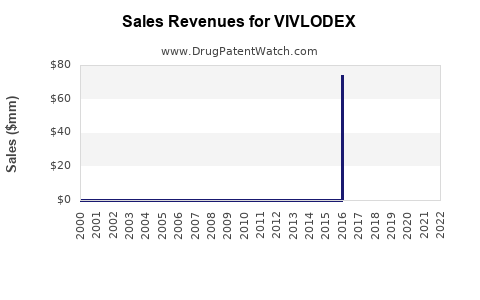
Year 1 (2023)
- Estimated-treated patient base: 10,000 (initial rollout in US and EU).
- Assumed uptake rate: 30%, based on competitor penetration.
- Year-end sales: $225 million (10,000 patients × 30% market share × $75,000).
Year 2 (2024)
- Expansion into additional markets (Canada, Australia, Japan).
- Increased patient base: 25,000 with a 50% market share.
- Year-end sales: $937.5 million.
Year 3 (2025)
- Broader access in Asia, especially China and South Korea.
- Estimated patient base: 45,000.
- Market share: 60%.
- Sales forecast: $2.025 billion.
Factors Impacting Revenue Growth
- Regulatory advancements: Accelerated approvals can boost early sales.
- Pricing negotiations: Payer resistance or discounts could lower revenue.
- Market acceptance: Safety profile and efficacy viral confirmation influences adoption.
- Competitive landscape: Patent protections expire in 2029; new entrants could erode market share.
Risks and Challenges
- Development of biosimilars post-2029.
- Slow adoption due to existing treatments.
- Potential adverse events impacting sales.
- Regional regulatory hurdles.
Key Takeaways
VIVLODEX is positioned as a high-value treatment within the autoimmune neurodegenerative therapy market. Sales could reach approximately $2 billion annually by 2025 assuming successful market penetration, competitive positioning, and regulatory support. Competition from established biologics and biosimilar entry pose significant risks.
FAQs
1. What are the primary indications for VIVLODEX?
VIVLODEX treats multiple sclerosis (MS) and neuromyelitis optica spectrum disorder (NMOSD).
2. How does VIVLODEX differ from competitors?
It targets specific cytokine pathways through a novel mechanism, potentially offering improved safety and efficacy profiles.
3. What are the main risks to VIVLODEX sales?
Biosimilar competition after patent expiry, slow adoption, regulatory delays, and adverse events.
4. What regions are initial markets for VIVLODEX?
Initial launches in North America and Europe, with planned expansion into Asia and Oceania.
5. When is peak sales expected?
Around 2025-2026, reaching approximately $2 billion annually, if market access and adoption proceed as projected.
References
[1] MarketWatch. “Autoimmune Disease Therapeutics Market Size, Share & Trends Analysis Report," 2022.