Share This Page
Drug Sales Trends for VASOTEC
✉ Email this page to a colleague
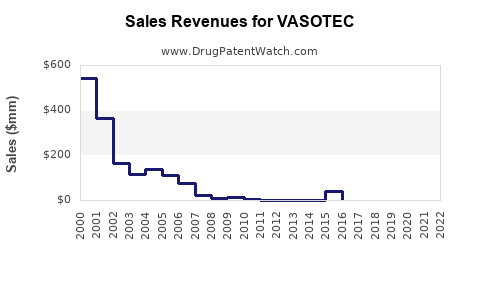
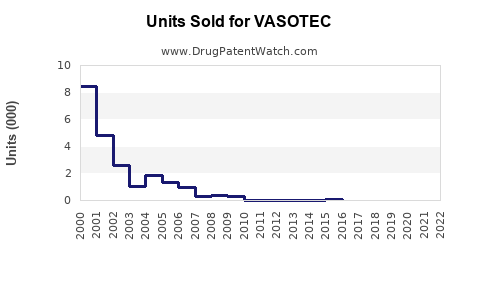
Annual Sales Revenues and Units Sold for VASOTEC
| Drug Name | Revenues (USD) | Units | Year |
|---|---|---|---|
| VASOTEC | ⤷ Start Trial | ⤷ Start Trial | 2022 |
| VASOTEC | ⤷ Start Trial | ⤷ Start Trial | 2021 |
| VASOTEC | ⤷ Start Trial | ⤷ Start Trial | 2020 |
| VASOTEC | ⤷ Start Trial | ⤷ Start Trial | 2019 |
| VASOTEC | ⤷ Start Trial | ⤷ Start Trial | 2018 |
| VASOTEC | ⤷ Start Trial | ⤷ Start Trial | 2017 |
| VASOTEC | ⤷ Start Trial | ⤷ Start Trial | 2016 |
| >Drug Name | >Revenues (USD) | >Units | >Year |
Vasotec is no longer a conventional branded-growth product. The drug, enalapril maleate, has faced generic competition in the United States for decades, leaving commercial value concentrated in low-price tablets, limited oral-solution demand and hospital injectable use. A reasonable base-case model places the global enalapril market, including generic products and specialized formulations, at approximately $120 million to $180 million in 2025, with low-single-digit annual erosion through 2030. Branded Vasotec revenue is expected to remain negligible.
Vasotec Market Analysis and Sales Projections Through 2030
What is Vasotec and how is it used?
Vasotec is the brand name for enalapril maleate, an angiotensin-converting enzyme inhibitor marketed primarily for hypertension and heart failure. Enalapril is administered orally as tablets or an oral solution. Enalaprilat, the active injectable metabolite, is used intravenously when oral administration is not practical.
The product’s primary clinical uses are:
| Indication | Commercial relevance |
|---|---|
| Hypertension | High volume, low price |
| Heart failure | Moderate volume and clinically established |
| Asymptomatic left-ventricular dysfunction | Lower commercial contribution |
| Pediatric hypertension | Small but specialized oral-solution segment |
| Acute hospital use through enalaprilat injection | Low volume, higher unit economics |
The original Vasotec product was developed by Merck. The active ingredient is now widely supplied by generic manufacturers. FDA labeling identifies enalapril maleate as an ACE inhibitor that is converted in vivo to enalaprilat, which produces the pharmacologic effect through inhibition of angiotensin-converting enzyme.[1]
When did Vasotec lose market exclusivity?
Vasotec lost meaningful U.S. market exclusivity in the 1990s. Generic enalapril maleate products have been available for many years, and the market is now characterized by multiple abbreviated new drug application holders, pharmacy substitution and limited brand recognition.
| Event | Approximate timing | Commercial effect |
|---|---|---|
| Original Vasotec approval | 1980s | Established Merck brand |
| Generic enalapril tablet approvals | 1990s | Initiated rapid price erosion |
| Broad pharmacy substitution | 1990s-2000s | Reduced branded Vasotec volume |
| Mature generic market | 2000s onward | Fragmented low-price supply |
| Current market | 2025 | Generic-driven, with niche formulation demand |
Vasotec does not have a credible remaining period of U.S. small-molecule market exclusivity. Any commercial protection associated with historic composition-of-matter, formulation or use patents has expired or ceased to be economically relevant.
What is the Orange Book status of Vasotec?
Vasotec is not protected by a current branded patent position that would prevent generic substitution in the standard tablet market. FDA Orange Book listings for legacy products can contain historical patent and exclusivity information, but those entries do not establish current commercial protection where listed rights have expired.[2]
The relevant regulatory position is:
- Enalapril tablets are approved through generic ANDAs.
- Standard strengths generally include 2.5 mg, 5 mg, 10 mg and 20 mg tablets.
- Enalapril oral solution has a smaller regulatory and commercial base.
- Enalaprilat injection is a separate hospital product and should not be treated as interchangeable with oral Vasotec.
- No biosimilar pathway applies because enalapril is a synthetic small molecule, not a biologic.
The practical Orange Book conclusion is that generic applicants do not face a meaningful current Vasotec patent barrier for ordinary enalapril tablets.
What patents protect Vasotec and enalapril products?
The original Vasotec patent estate was built around enalapril, its salts, pharmaceutical compositions and therapeutic use. Those rights are historic rather than commercially active.
Patent categories associated with enalapril
| Patent category | Current strategic value |
|---|---|
| Enalapril compound patents | Expired |
| Enalapril maleate salt patents | Expired or commercially exhausted |
| Hypertension method-of-use patents | Expired |
| Heart-failure method-of-use patents | Expired |
| Standard tablet formulations | Low |
| Oral-solution formulations | Potentially relevant for current suppliers |
| Injectable enalaprilat formulations | Product-specific and niche |
| Manufacturing processes | May create operational barriers, not market exclusivity |
The strongest current intellectual-property positions in the enalapril sector are more likely to relate to formulation design, pediatric dosing, taste masking, stability, container-closure systems and manufacturing efficiency than to the active pharmaceutical ingredient itself.
What formulations are protected in the enalapril market?
The standard immediate-release tablet is commoditized. Differentiation is more plausible in formulations that address administration, stability or patient populations.
Oral tablets
Tablets represent the largest volume segment. They are easy to manufacture, widely substitutable and exposed to intense price competition. The commercial value per prescription is low, and the principal competitive variables are:
- Wholesale acquisition price
- Contract manufacturing cost
- Supply reliability
- Pharmacy channel access
- Product availability across multiple strengths
- State Medicaid and managed-care formulary status
Oral solution
Enalapril oral solution has a smaller market but can command a higher price per unit because it is used in pediatric patients, patients with swallowing difficulties and hospital or specialty-care settings.
The oral-solution segment can support product differentiation through:
- Concentration selection
- Preservative system
- Stability after opening
- Dosing-device design
- Palatability
- Pediatric labeling
- Packaging and dispensing controls
Intravenous enalaprilat
Enalaprilat injection is a hospital product with limited demand. It may retain value where patients cannot take oral medication, but the market is exposed to hospital purchasing pressure and substitution by other intravenous antihypertensive agents.
How large is the Vasotec and enalapril market?
Public company reporting does not generally provide a standalone current revenue line for Vasotec. The commercially relevant market therefore must be divided into branded Vasotec, generic enalapril and related formulations.
Estimated 2025 market structure
| Segment | Estimated 2025 global sales | Market characteristics |
|---|---|---|
| Branded Vasotec | Less than $5 million | Minimal brand pull and limited direct commercial presence |
| Generic enalapril tablets | $80 million-$120 million | High volume, low price |
| Enalapril oral solutions | $20 million-$35 million | Smaller volume, higher price per unit |
| Enalaprilat injection | $15 million-$25 million | Hospital and specialty use |
| Total enalapril-related market | $120 million-$180 million | Mature and price-sensitive |
These estimates represent market modeling rather than reported Vasotec sales. They include generic products and related enalapril dosage forms because the original brand no longer captures the economic value of the active ingredient.
What are Vasotec sales projections for 2025 through 2030?
The base case assumes continued generic substitution, stable use of ACE inhibitors in hypertension and heart failure, modest migration to alternative renin-angiotensin drugs, and no major supply disruption.
Base-case global sales projection
| Year | Branded Vasotec | Generic tablets | Oral solution | Enalaprilat injection | Total enalapril market |
|---|---|---|---|---|---|
| 2025 | $1m-$3m | $80m-$120m | $20m-$35m | $15m-$25m | $120m-$180m |
| 2026 | $1m-$3m | $78m-$117m | $20m-$35m | $15m-$25m | $114m-$180m |
| 2027 | $1m-$3m | $76m-$114m | $20m-$34m | $15m-$24m | $112m-$175m |
| 2028 | $1m-$3m | $74m-$111m | $19m-$34m | $15m-$24m | $109m-$172m |
| 2029 | $1m-$3m | $72m-$108m | $19m-$33m | $14m-$24m | $106m-$168m |
| 2030 | $1m-$3m | $70m-$105m | $19m-$32m | $14m-$23m | $104m-$163m |
The base case implies a global compound annual decline of approximately 1% to 3%, driven mainly by tablet price compression and substitution by angiotensin receptor blockers, angiotensin receptor-neprilysin inhibitors and newer heart-failure therapies.
Scenario analysis
| Scenario | 2030 global market | Main drivers |
|---|---|---|
| Upside | $170m-$210m | Supply shortages, renewed ACE-inhibitor use, higher oral-solution demand |
| Base case | $104m-$163m | Stable clinical use and gradual price erosion |
| Downside | $75m-$105m | Faster substitution, additional generic entrants and hospital price cuts |
Branded Vasotec does not have a credible upside scenario based on product innovation alone. Growth would require a new commercial owner, a differentiated formulation or a market with limited generic penetration.
Which companies compete with Vasotec?
The competitive landscape consists of generic enalapril manufacturers and companies selling alternative cardiovascular therapies.
Direct competitors
Direct competitors include manufacturers of:
- Enalapril maleate tablets
- Enalapril maleate oral solution
- Enalaprilat injection
The U.S. generic market has historically included large generic suppliers such as Teva, Sandoz, Lupin, Aurobindo, Dr. Reddy’s Laboratories and other ANDA holders. Participation varies by dosage form, manufacturing site and supply period. The number of approved products does not equal the number of actively marketed products.
Therapeutic competitors
Vasotec also competes with:
- Lisinopril
- Ramipril
- Benazepril
- Perindopril
- Losartan
- Valsartan
- Sacubitril/valsartan
- Beta blockers
- Mineralocorticoid receptor antagonists
- Sodium-glucose cotransporter-2 inhibitors in heart failure
Lisinopril is the strongest low-cost ACE-inhibitor comparator in many markets. Losartan and other ARBs compete where cough or ACE-inhibitor intolerance limits enalapril use. Sacubitril/valsartan competes in selected heart-failure patients at a substantially higher price point.
Which companies are challenging Vasotec through Paragraph IV filings?
Paragraph IV litigation is no longer a central risk for standard enalapril tablets because the principal market barriers expired long ago. Generic entrants typically compete through ANDA approval and commercial launch rather than a new Paragraph IV campaign against an active Vasotec patent.
The relevant litigation risk is therefore operational rather than exclusivity-based:
- Product-specific patent disputes involving oral solutions
- Manufacturing-process disputes
- Hatch-Waxman challenges to newer enalapril formulations
- Antitrust or supply-related disputes
- Patent claims directed to delivery devices or packaging
No current Paragraph IV event is expected to materially delay ordinary generic enalapril tablet competition.
What patent litigation affects Vasotec?
Historic Vasotec patent litigation helped establish the product’s original exclusivity position, but it does not drive the current commercial outlook. Current legal exposure is more likely to arise from:
- Formulation patents for liquid enalapril products.
- Stability and packaging claims.
- Process patents covering manufacturing or purification.
- ANDA litigation involving a newer branded formulation.
- Product liability claims involving hypotension, renal impairment, hyperkalemia or fetal toxicity.
Because the active ingredient is old and widely available, a process or formulation patent would need to cover a commercially important presentation to support meaningful market power.
Are there licensing deals for Vasotec or enalapril?
The original commercial value of Vasotec was associated with Merck’s development and commercialization. Current generic enalapril economics are more likely to involve:
- API supply agreements
- Contract manufacturing
- ANDA asset transfers
- Regional distribution agreements
- Hospital purchasing contracts
- Oral-solution licensing
- Co-development of pediatric formulations
A licensing transaction involving standard enalapril tablets would generally have limited strategic value unless it included manufacturing capacity, regulatory approvals or protected distribution rights. The higher-value licensing opportunity is in differentiated liquid formulations or combination products rather than the legacy Vasotec brand.
What FDA regulatory status does Vasotec have?
Enalapril is an FDA-approved prescription cardiovascular therapy. Regulatory considerations include:
- Prescription-only status
- Approved tablet dosage strengths
- Approved oral-solution products in selected markets
- Separate approval status for enalaprilat injection
- Contraindication in pregnancy
- Warnings for angioedema, renal impairment, hyperkalemia and hypotension
- Need for dose management in renal impairment
- Drug-interaction considerations with potassium supplements, potassium-sparing diuretics, lithium and certain diabetes medicines
FDA approval does not confer current commercial exclusivity. The market is governed by generic substitution and supplier economics.
How strong is the Vasotec patent estate?
The current Vasotec patent estate is weak as a commercial defense.
| Factor | Assessment |
|---|---|
| Active compound protection | None of practical relevance |
| Tablet formulation protection | Weak |
| Method-of-use protection | Expired |
| Orange Book leverage | Minimal |
| Generic entry barrier | Low |
| Manufacturing complexity | Low to moderate |
| Oral-solution differentiation | Moderate |
| Brand loyalty | Low |
| Regulatory risk | Moderate because of established safety warnings |
| Commercial durability | Limited for tablets; better for niche formulations |
The strongest remaining competitive advantage is not patent exclusivity. It is reliable supply, regulatory compliance, low manufacturing cost and access to institutional buyers.
What generic launch scenarios exist for Vasotec?
Standard tablet launch
A new generic tablet launch would likely produce rapid price competition. Pharmacy substitution would limit the ability to build a premium, while market share would depend on wholesaler access, shortages and payer contracts.
Oral-solution launch
An oral-solution entrant could achieve better revenue per prescription but would face a smaller patient population, greater formulation requirements and possible incumbent relationships with pediatric and specialty pharmacies.
Hospital injection launch
An enalaprilat entrant would compete for formulary placement and group purchasing contracts. Hospital demand is more stable than retail demand but highly price-sensitive.
Regional launch
Markets with weaker generic penetration or limited access to ACE inhibitors may offer better pricing. Europe, Latin America, Asia-Pacific and selected Middle Eastern markets differ substantially in reimbursement, brand persistence and regulatory requirements.
How does Vasotec compare with lisinopril and losartan?
| Product | Market position | Price pressure | Main advantage |
|---|---|---|---|
| Enalapril | Mature ACE inhibitor | Very high | Long clinical history and low cost |
| Lisinopril | High-volume ACE inhibitor | Very high | Simple dosing and broad generic supply |
| Losartan | Mature ARB | High | Lower cough risk than ACE inhibitors |
| Valsartan | Mature ARB | High | Broad cardiovascular use |
| Sacubitril/valsartan | Branded or limited-generic heart-failure product | Lower | Differentiated heart-failure positioning |
Enalapril remains clinically relevant, but its commercial position is weaker than its medical familiarity suggests. Lisinopril often has greater prescription scale, while losartan captures patients who cannot tolerate ACE-inhibitor cough.
What is the revenue exposure for manufacturers?
For a generic manufacturer, standard enalapril tablets are unlikely to represent a material corporate revenue driver unless the company has a large portfolio, unusually strong supply availability or a temporary competitor shortage.
Potential revenue profiles are:
| Business model | Revenue potential | Margin outlook |
|---|---|---|
| Commodity tablets | Low to moderate | Low |
| Oral solution | Moderate | Moderate |
| Enalaprilat injection | Low | Moderate |
| Branded legacy Vasotec | Minimal | Limited |
| API supply | Moderate at scale | Low to moderate |
| Differentiated pediatric product | Moderate | Higher if protected |
The most attractive commercial strategy is a reliable, low-cost supply platform combined with a differentiated liquid or specialty presentation. A standalone relaunch of the Vasotec brand would have limited return potential.
Key Takeaways
- Vasotec is the legacy brand for enalapril maleate and is no longer protected by meaningful U.S. exclusivity.
- The commercial market is generic-driven, not brand-driven.
- Estimated global enalapril-related sales are approximately $120 million to $180 million in 2025.
- The base-case market is projected to decline to approximately $104 million to $163 million by 2030.
- Standard tablets have low margins and little patent protection.
- Oral solutions and enalaprilat injection provide the most credible niche opportunities.
- No biosimilar risk applies because enalapril is a synthetic small molecule.
- Paragraph IV litigation is not expected to be a material barrier for ordinary generic tablets.
- Competitive risk comes from lisinopril, losartan, valsartan and newer heart-failure therapies.
- Supply reliability, manufacturing cost and formulation differentiation matter more than the historic Vasotec patent estate.
FAQs about Vasotec market size, patents and sales
Is Vasotec still sold as a brand?
Vasotec has little commercial importance as a branded product in the United States. Enalapril is primarily obtained through generic products.
Does Vasotec have an active U.S. patent?
No active patent is expected to provide meaningful exclusivity for ordinary enalapril tablets. Historic compound and use patents have expired.
Is enalapril a biosimilar product?
No. Enalapril is a synthetic small-molecule drug approved through the conventional generic-drug pathway, not the biosimilar pathway.
Which enalapril formulation has the best commercial opportunity?
Oral solution has the strongest differentiation potential because of pediatric use, swallowing limitations, dosing requirements and formulation complexity.
Can a company profitably relaunch Vasotec?
A conventional branded relaunch would have limited potential. A strategy based on licensed rights, reliable supply, specialty distribution or a differentiated formulation would have a stronger commercial rationale.
Sources:
- U.S. Food and Drug Administration. (2023). Vasotec (enalapril maleate) prescribing information. FDA.
- U.S. Food and Drug Administration. (2024). Approved drug products with therapeutic equivalence evaluations: Orange Book. FDA.
- U.S. Food and Drug Administration. (2024). Drugs@FDA: FDA-approved drugs database. FDA.
- Merck & Co., Inc. (1985). Vasotec product information. Merck.
- U.S. Food and Drug Administration. (2024). Enalapril maleate and enalaprilat drug labeling and safety information. FDA.
More… ↓
