Share This Page
Drug Sales Trends for VAGIFEM
✉ Email this page to a colleague
Payment Methods and Pharmacy Types for VAGIFEM (2011)
Revenues by Pharmacy Type
Units Sold by Pharmacy Type
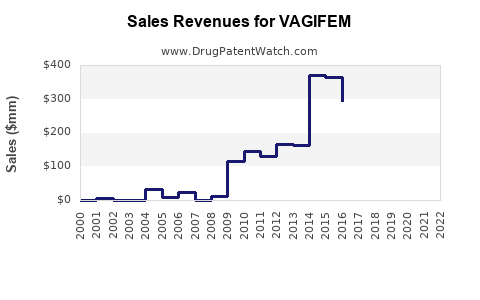
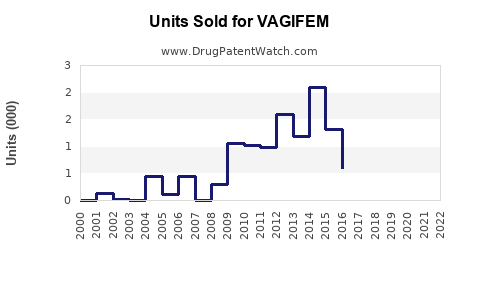
Annual Sales Revenues and Units Sold for VAGIFEM
| Drug Name | Revenues (USD) | Units | Year |
|---|---|---|---|
| VAGIFEM | ⤷ Start Trial | ⤷ Start Trial | 2022 |
| VAGIFEM | ⤷ Start Trial | ⤷ Start Trial | 2021 |
| VAGIFEM | ⤷ Start Trial | ⤷ Start Trial | 2020 |
| VAGIFEM | ⤷ Start Trial | ⤷ Start Trial | 2019 |
| VAGIFEM | ⤷ Start Trial | ⤷ Start Trial | 2018 |
| VAGIFEM | ⤷ Start Trial | ⤷ Start Trial | 2017 |
| >Drug Name | >Revenues (USD) | >Units | >Year |
VAGIFEM Market Analysis, Sales Projections, Patent Exposure, and Competitive Outlook
VAGIFEM is a low-dose vaginal estradiol product used to treat moderate-to-severe vulvar and vaginal atrophy associated with menopause. Its commercial outlook is supported by an aging female population, underdiagnosis of genitourinary syndrome of menopause, and preference for local estrogen therapy. The primary constraints are generic competition, low product differentiation, payer substitution, and limited standalone revenue disclosure by Novo Nordisk.
VAGIFEM sales are not separately reported in Novo Nordisk’s public financial statements. The company reports selected products within broader portfolio categories, preventing a verified product-level revenue baseline. The most defensible projection is therefore an indexed model rather than a false-precision dollar forecast.
Under a base case, VAGIFEM’s branded revenue index declines gradually through 2030 as generic estradiol vaginal inserts gain share. Total category demand expands, but most growth accrues to generic and alternative branded products.
What is VAGIFEM and how is it used?
VAGIFEM is an estradiol vaginal insert. The product is administered intravaginally using a disposable applicator. The U.S. product is available in a 10-microgram dose, with an initial daily dosing period followed by twice-weekly maintenance dosing under the FDA label.[1]
What condition does VAGIFEM treat?
VAGIFEM is indicated for moderate-to-severe symptoms of vulvar and vaginal atrophy due to menopause. Current clinical terminology increasingly uses genitourinary syndrome of menopause, or GSM, which includes vaginal dryness, irritation, dyspareunia, urinary symptoms, and recurrent urinary discomfort.
The product delivers low-dose estrogen locally. It competes with vaginal creams, vaginal rings, soft-gel inserts, tablets, and nonhormonal moisturizers.
Who markets VAGIFEM?
VAGIFEM is marketed in the United States by Novo Nordisk. The brand originated with Novo Nordisk’s hormone therapy portfolio and remains a mature product relative to the company’s diabetes and obesity franchises.
| Product | Active ingredient | Dosage form | Primary commercial position |
|---|---|---|---|
| VAGIFEM | Estradiol | Vaginal insert/tablet | Low-dose local estrogen |
| Yuvafem | Estradiol | Vaginal insert/tablet | Generic or authorized-generic alternative |
| Imvexxy | Estradiol | Soft-gel vaginal insert | Branded local estrogen |
| Estring | Estradiol | Vaginal ring | Three-month delivery system |
| Premarin Vaginal Cream | Conjugated estrogens | Cream | Established branded vaginal estrogen |
| Estradiol cream | Estradiol | Cream | Generic, flexible dosing |
How large is the VAGIFEM market?
The relevant market is the broader vaginal estrogen and GSM treatment segment, not VAGIFEM alone. Market growth is driven by demographics and diagnosis rates rather than major innovation in the core molecule.
What factors drive demand for vaginal estrogen?
The main demand drivers are:
- Growth in the postmenopausal population.
- Increased recognition of GSM by primary-care physicians, gynecologists, and patients.
- Persistent symptoms requiring maintenance treatment.
- Greater use of local rather than systemic estrogen for isolated vaginal symptoms.
- Treatment adherence advantages for low-dose, twice-weekly products.
- Expanded consumer awareness of menopause care.
The North American market is commercially important because diagnosis and prescription rates are comparatively high, reimbursement infrastructure is established, and branded therapies maintain visibility. Europe and other developed markets provide additional demand, but pricing and reimbursement are generally more regulated.
What limits VAGIFEM growth?
VAGIFEM faces four structural limitations.
First, estradiol is an old active ingredient with limited molecular exclusivity. Second, generic alternatives create direct price competition. Third, physicians can substitute among several local estrogen delivery systems. Fourth, some patients and prescribers remain concerned about estrogen exposure despite the low-dose local route.
The product also competes with nonprescription vaginal moisturizers and lubricants. Those products do not provide an equivalent pharmacologic effect, but they can delay prescription treatment or reduce refill frequency.
What are VAGIFEM sales and revenue projections?
Novo Nordisk does not disclose standalone VAGIFEM revenue in its principal public reporting. A product-specific historical revenue series therefore cannot be independently established from company filings.
The following projection uses an indexed 2024 branded-revenue baseline of 100. It is a market model, not reported company guidance.
| Year | Bear case index | Base case index | Bull case index | Primary assumption |
|---|---|---|---|---|
| 2024 | 100 | 100 | 100 | Baseline |
| 2025 | 91 | 95 | 101 | Generic substitution accelerates |
| 2026 | 82 | 90 | 103 | Brand maintains selected payer access |
| 2027 | 74 | 86 | 104 | Category growth offsets part of share loss |
| 2028 | 67 | 82 | 105 | Mature generic market |
| 2029 | 60 | 78 | 105 | Lower branded refill volume |
| 2030 | 54 | 75 | 106 | Bull case assumes stable premium positioning |
What does the base-case forecast imply?
The base case assumes:
- Total vaginal estrogen demand grows approximately 3% to 5% annually.
- VAGIFEM unit demand is broadly stable to slightly declining.
- Generic products capture additional prescriptions.
- Net realized price declines because of payer pressure and rebates.
- No major new indication materially expands the label.
- Novo Nordisk continues commercial support but prioritizes higher-growth franchises.
Under these assumptions, VAGIFEM branded revenue falls at roughly 4% to 5% annually from the indexed 2024 baseline through 2030.
The bull case requires stronger diagnosis growth, favorable reimbursement, persistent physician preference for the branded insert, and limited generic substitution. The bear case reflects rapid generic uptake, loss of formulary position, and switching to lower-cost creams or alternative inserts.
How should investors estimate dollar sales?
A dollar estimate should be calculated as:
Annual prescriptions × average units per prescription × net price per unit
The model must adjust for:
- New-patient prescriptions.
- Maintenance refills.
- Generic substitution.
- Commercial and government payer mix.
- Manufacturer rebates.
- Specialty or retail distribution.
- Patient assistance and cash-pay volume.
List price is not a reliable measure of manufacturer revenue. VAGIFEM’s net sales can be materially lower than gross pharmacy acquisition cost because of rebates, discounts, returns, and wholesaler terms.
What is the FDA regulatory status of VAGIFEM?
VAGIFEM is an FDA-approved prescription estradiol vaginal insert. The FDA-approved indication is moderate-to-severe vulvar and vaginal atrophy caused by menopause.[1]
Is VAGIFEM a biologic?
No. VAGIFEM is a small-molecule estradiol product. Biosimilar rules do not apply. Competitive entry occurs through the generic drug approval pathway, including abbreviated new drug applications, rather than through the biosimilar pathway.
What is the Orange Book status of VAGIFEM?
VAGIFEM is a small-molecule prescription drug subject to Orange Book listing analysis. The commercial importance of any listed patent depends on its current expiration date, enforceability, pediatric exclusivity, and whether a generic applicant files a Paragraph IV certification.
Because the product is mature and generic estradiol vaginal inserts have entered the market, the principal market risk is post-exclusivity generic substitution rather than a future biosimilar challenge.
What patents protect VAGIFEM?
VAGIFEM’s historical protection was based on product, formulation, delivery-system, and manufacturing claims associated with vaginal estradiol administration. The core estradiol molecule is long off patent.
What formulation patents matter?
Potentially relevant claim categories include:
- Estradiol dosage strength and release characteristics.
- Vaginal insert composition.
- Low-dose local delivery.
- Applicator configuration.
- Manufacturing and stability processes.
- Packaging and product presentation.
Formulation patents generally provide narrower protection than active-ingredient patents. Their value depends on whether a generic product uses the claimed excipients, dosage form, manufacturing process, or delivery configuration.
Are method-of-use patents a major VAGIFEM barrier?
Method-of-use patents are unlikely to create a durable barrier comparable to an active-ingredient patent. The underlying menopausal indication is established, and generic applicants can often pursue label strategies that omit protected uses where permitted.
A method-of-use patent can still affect litigation timing if it is listed in the Orange Book and a generic applicant files a Paragraph IV certification. Its practical value depends on claim breadth, induced-infringement exposure, and the ability of the generic manufacturer to use a carve-out label.
Which companies compete with or challenge VAGIFEM?
The competitive field includes generic manufacturers, established women’s-health companies, and manufacturers of alternative delivery systems.
| Competitor | Product type | Competitive effect |
|---|---|---|
| Generic estradiol manufacturers | Vaginal inserts, tablets, creams | Price erosion and formulary substitution |
| TherapeuticsMD, now associated with Mayne Pharma assets | Imvexxy soft-gel insert | Differentiated delivery and branded positioning |
| Organon and related commercial partners | Estring in relevant markets | Longer-duration administration |
| Pfizer | Premarin vaginal cream | Established brand and physician familiarity |
| Generic cream manufacturers | Estradiol cream | Low-cost, flexible dosing |
| Nonprescription manufacturers | Moisturizers and lubricants | Substitution for mild or self-managed symptoms |
VAGIFEM’s most direct competitors are generic estradiol inserts and Yuvafem-type products. Imvexxy competes more on formulation, packaging, and patient experience than on active ingredient.
What generic entry risks exist for VAGIFEM?
Generic entry creates three distinct risks:
- Prescription switching at the pharmacy counter.
- Formulary preference for lower-cost estradiol products.
- Lower branded refill retention after the initial prescription.
The timing of generic erosion depends on whether an applicant receives tentative or final FDA approval, whether Paragraph IV litigation is filed, and whether a settlement delays launch. An authorized generic, if commercially launched, could preserve some manufacturer economics while reducing third-party generic share.
What is the likely generic launch scenario?
The most probable scenario is gradual rather than catastrophic erosion because local estrogen users can be sticky once a delivery system is tolerated. The erosion rate will vary by payer:
- Commercial plans may require generic substitution.
- Medicare plans may impose tiering and prior authorization.
- Cash-pay patients may retain the brand if affordability programs reduce the price gap.
- Physicians may continue prescribing the branded product when applicator familiarity or patient response matters.
A 10% to 20% annual decline in branded net revenue is plausible during periods of active generic conversion, but the outcome depends on the starting level of generic penetration and contracting strategy.
How strong is the VAGIFEM patent estate?
VAGIFEM has a weak-to-moderate current patent position from a commercial defense perspective.
| Patent-estate factor | Assessment |
|---|---|
| Active ingredient exclusivity | Weak; estradiol is long off patent |
| Core indication exclusivity | Weak; menopausal vaginal atrophy is established |
| Dosage-form protection | Limited and potentially meaningful only for specific inserts |
| Delivery-system protection | Moderate for distinct applicator or release claims |
| Manufacturing protection | Narrow; depends on process overlap |
| Generic substitution risk | High |
| Biosimilar risk | Not applicable |
| Litigation leverage | More dependent on listed patents and claim scope than molecule exclusivity |
The main remaining defense is product differentiation, brand recognition, physician familiarity, and payer contracting. Those tools can delay revenue erosion but rarely recreate monopoly economics for a mature small-molecule product.
What licensing deals affect VAGIFEM?
No major current licensing transaction is a central driver of the VAGIFEM outlook in Novo Nordisk’s public disclosures. The product’s commercial performance is primarily determined by Novo Nordisk’s marketing, distribution, pricing, and portfolio prioritization.
Licensing analysis should distinguish between:
- Ownership of the VAGIFEM brand.
- Regional commercialization rights.
- Generic or authorized-generic distribution agreements.
- Manufacturing contracts.
- Co-promotion arrangements for competing vaginal estrogen products.
A third-party agreement could alter regional revenue recognition without changing the underlying demand for vaginal estradiol.
What litigation and settlement issues affect VAGIFEM?
The most relevant legal issues are Paragraph IV patent challenges, ANDA litigation, settlement agreements, and potential antitrust scrutiny of delayed generic entry.
No litigation event should be treated as financially material without confirming:
- The patent number and Orange Book listing.
- The generic applicant.
- The Paragraph IV filing date.
- The district-court complaint date.
- The statutory 30-month stay.
- The settlement’s launch date and business terms.
- Whether the settlement permits an authorized generic.
For a mature product, the commercial impact of litigation is often concentrated in the launch date and settlement economics rather than in damages exposure.
How does VAGIFEM compare with Imvexxy, Estring, and Premarin?
| Factor | VAGIFEM | Imvexxy | Estring | Premarin cream |
|---|---|---|---|---|
| Active ingredient | Estradiol | Estradiol | Estradiol | Conjugated estrogens |
| Administration | Insert, typically twice weekly after initiation | Soft-gel insert | Ring changed periodically | Cream |
| Main advantage | Familiar tablet-style local delivery | Soft-gel formulation and applicator-free positioning | Longer duration | Established brand and flexible application |
| Main weakness | Generic substitution | Higher branded cost | Device tolerance and insertion | Messier application and dosing |
| Generic pressure | High | Moderate | Moderate | High in cream segment |
| Likely commercial role | Mature branded product | Differentiated branded competitor | Niche delivery-system competitor | Established alternative |
VAGIFEM has stronger direct comparability to generic estradiol inserts than to Estring. Its commercial defense depends on convenience and patient continuity rather than a unique pharmacologic mechanism.
What is the geographic outlook for VAGIFEM?
The United States remains the most commercially important market for branded VAGIFEM because of prescription volume, private insurance coverage, and established menopause-care channels.
Europe has meaningful demand but faces country-specific reimbursement, reference pricing, and procurement rules. Generic substitution can be more aggressive in markets with centralized purchasing. Emerging markets offer volume potential but generally lower net prices and less predictable access.
Geographic revenue should therefore be modeled separately by:
- Regulatory approval status.
- Reimbursement coverage.
- Generic penetration.
- Local pricing controls.
- Distribution structure.
- Brand ownership and commercialization rights.
Key Takeaways
- VAGIFEM is a mature low-dose vaginal estradiol product marketed by Novo Nordisk.
- Novo Nordisk does not separately disclose VAGIFEM revenue, so indexed scenario analysis is more reliable than an unsupported dollar forecast.
- The base case indicates branded revenue declines to approximately 75% of a 2024 baseline by 2030.
- Total vaginal estrogen demand should grow modestly as GSM diagnosis and treatment expand.
- Generic estradiol inserts are the principal competitive threat.
- Biosimilar risk does not apply because VAGIFEM is a small-molecule drug.
- The current patent estate is weaker than an active-ingredient estate and is unlikely to prevent long-term generic substitution.
- Product differentiation, patient persistence, payer contracting, and delivery-system familiarity are more important than new molecular exclusivity.
- The most material legal variables are Orange Book listings, Paragraph IV filings, litigation stays, and settlement launch dates.
FAQs About VAGIFEM Market and Sales
When does VAGIFEM lose exclusivity?
Core estradiol exclusivity has already expired. Remaining protection depends on any active formulation, delivery-system, manufacturing, or method-of-use patents and their current Orange Book status.
Can a generic manufacturer launch estradiol vaginal inserts?
Yes. Generic estradiol vaginal inserts can enter through the ANDA pathway if they meet FDA requirements and resolve applicable patent certifications or litigation barriers.
Is VAGIFEM safer than systemic estrogen?
VAGIFEM is designed for low-dose local vaginal administration, but safety and prescribing decisions depend on the patient’s medical history, symptoms, and FDA labeling. It should not be treated as interchangeable with systemic hormone therapy.
What will most affect VAGIFEM revenue through 2030?
Generic share growth, payer formulary decisions, branded net pricing, refill persistence, and the rate at which physicians diagnose and treat GSM will be the main variables.
Does VAGIFEM have biosimilar competition?
No. VAGIFEM contains estradiol, a small molecule. Competition is governed by generic-drug rules rather than the FDA biosimilar pathway.
References
- U.S. Food and Drug Administration. (2022). Vagifem prescribing information. Novo Nordisk Inc. https://www.accessdata.fda.gov
- U.S. Food and Drug Administration. (2024). Approved drug products with therapeutic equivalence evaluations: Orange Book. https://www.accessdata.fda.gov/scripts/cder/ob/
- Novo Nordisk A/S. (2024). Annual report 2023. https://www.novonordisk.com/investors/annual-report.html
- The North American Menopause Society. (2022). The 2022 hormone therapy position statement of The North American Menopause Society. Menopause, 29(7), 767-794.
- American College of Obstetricians and Gynecologists. (2020). Treatment of the symptoms of menopause: ACOG clinical practice bulletin. Obstetrics & Gynecology.
More… ↓
