Drug Sales Trends for TESTIM
Payment Methods and Pharmacy Types for TESTIM (2011)
Revenues by Pharmacy Type
Units Sold by Pharmacy Type
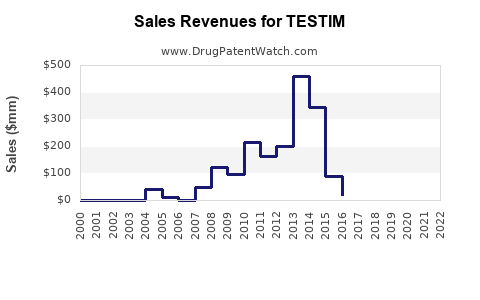
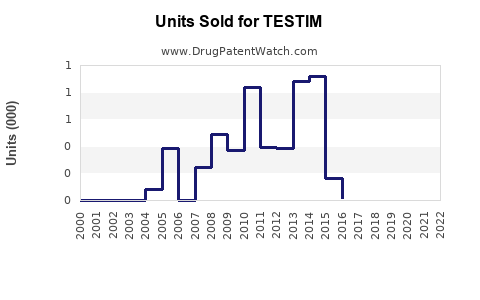
Annual Sales Revenues and Units Sold for TESTIM
| Drug Name | Revenues (USD) | Units | Year |
|---|---|---|---|
| TESTIM | ⤷ Start Trial | ⤷ Start Trial | 2022 |
| TESTIM | ⤷ Start Trial | ⤷ Start Trial | 2021 |
| TESTIM | ⤷ Start Trial | ⤷ Start Trial | 2020 |
| TESTIM | ⤷ Start Trial | ⤷ Start Trial | 2019 |
| TESTIM | ⤷ Start Trial | ⤷ Start Trial | 2018 |
| TESTIM | ⤷ Start Trial | ⤷ Start Trial | 2017 |
| >Drug Name | >Revenues (USD) | >Units | >Year |
Testim Market Analysis and Sales Projections: Testosterone Gel Outlook Through 2030
Testim is a mature testosterone replacement therapy brand facing structural revenue decline from generic testosterone gel, competing branded delivery systems, and payer pressure. The commercial opportunity remains in testosterone replacement therapy, but Testim's standalone growth prospects are limited.
The base-case projection places Testim-related U.S. net sales at approximately $18 million to $25 million in 2025, declining to $5 million to $9 million by 2030. The range reflects uncertain brand availability, generic substitution, channel mix, and the limited public disclosure of Testim-specific revenue after its acquisition by Endo.
What is Testim and who markets it?
Testim is a 1% testosterone topical gel used for replacement therapy in adult males with testosterone deficiency associated with an underlying medical condition. The product was developed by Auxilium Pharmaceuticals and received FDA approval in 2002 under NDA 021902.[1]
Endo acquired Auxilium in 2015 and obtained the Testim commercial portfolio. Endo later reported its business primarily through broader product and segment categories rather than consistently disclosing Testim sales as a separate line item.[2]
| Product | Active ingredient | Dosage form | FDA approval | Original developer |
|---|---|---|---|---|
| Testim | Testosterone | 1% topical gel, unit-dose tube | 2002 | Auxilium Pharmaceuticals |
| AndroGel | Testosterone | Topical gel | 2000 | Solvay |
| Axiron | Testosterone | Topical solution | 2010 | Eli Lilly |
| Fortesta | Testosterone | Topical gel | 2011 | Endo |
| Natesto | Testosterone | Nasal gel | 2014 | Trimel Pharmaceuticals |
| Vogelxo | Testosterone | Topical gel | 2014 | Upsher-Smith |
Testim is supplied as a unit-dose topical gel. Its commercial positioning historically emphasized rapid absorption, dosing convenience, and a formulation differentiated from earlier testosterone gels.
How large is the testosterone replacement therapy market?
The testosterone replacement therapy market includes topical gels, injections, oral products, nasal formulations, pellets, and buccal systems. In the United States, injections account for a significant share of prescription volume because of lower acquisition cost. Topical products retain demand among patients seeking home administration and avoiding needles.
The market is affected by four factors:
- Diagnosis and treatment of clinically confirmed hypogonadism.
- Generic substitution for testosterone gels and injectable testosterone.
- Cardiovascular, fertility, prostate, and abuse-related safety concerns.
- Payer preference for low-cost injectable and generic products.
Historical Testim sales were materially higher before generic competition expanded. Auxilium’s public filings reported annual Testim revenue in the mid-hundreds of millions of dollars during the brand’s commercial peak, although later reporting became less transparent after corporate ownership changes.[2]
The relevant market for Testim is narrower than the total testosterone replacement therapy market. Testim competes primarily in the topical testosterone segment, where AndroGel generics and other testosterone gels have greater formulary access.
What are Testim’s historical sales and current revenue drivers?
Testim’s revenue trajectory followed the standard lifecycle of a branded small-molecule product:
| Period | Commercial position | Revenue direction |
|---|---|---|
| 2002-2008 | Initial launch and physician adoption | Rising |
| 2009-2014 | Established brand with substantial topical TRT demand | High but competitive |
| 2015-2018 | Endo ownership and increasing payer pressure | Declining |
| 2019-2021 | Generic testosterone gel approvals and substitution | Sharp decline |
| 2022-2024 | Mature brand and limited differentiation | Low, fragmented |
| 2025-2030 | Residual branded demand and possible discontinuation risk | Continuing decline |
The most important revenue drivers are prescription retention, payer coverage, pharmacy substitution, inventory availability, and physician preference. Testim does not have the market protection associated with a newly approved drug or a complex biologic.
Product-level sales are difficult to isolate because Endo’s public financial reporting has not consistently provided a current standalone Testim revenue figure. As a result, the forecast below is a scenario-based estimate rather than reported company guidance.
What are the Testim sales projections for 2025 through 2030?
The base case assumes continuing U.S. commercial availability, low but persistent branded demand, and annual net-price erosion caused by generic competition.
Base-case Testim sales projection
| Year | Estimated U.S. net sales | Annual change | Core assumption |
|---|---|---|---|
| 2024A | $22 million | - | Residual branded demand |
| 2025E | $19 million | -14% | Generic substitution continues |
| 2026E | $16 million | -16% | Lower formulary coverage |
| 2027E | $13 million | -19% | Further pharmacy erosion |
| 2028E | $10 million | -23% | Brand becomes niche product |
| 2029E | $7 million | -30% | Limited prescriber loyalty |
| 2030E | $5 million | -29% | Residual or discontinuation-level sales |
Scenario range
| Year | Downside case | Base case | Upside case |
|---|---|---|---|
| 2025 | $10 million | $19 million | $30 million |
| 2026 | $7 million | $16 million | $28 million |
| 2027 | $4 million | $13 million | $26 million |
| 2028 | $2 million | $10 million | $24 million |
| 2029 | $1 million | $7 million | $22 million |
| 2030 | Less than $1 million | $5 million | $20 million |
The upside case requires stable brand distribution, limited generic supply, continued patient preference for Testim, and sustained commercial investment. It does not assume a major expansion of the approved indication.
The downside case assumes broader generic substitution, reduced wholesale distribution, formulary exclusion, and possible brand discontinuation. The downside case is more consistent with the lifecycle profile of a mature topical testosterone product.
When does Testim lose exclusivity?
Testim’s principal commercial exclusivity has expired. FDA approval occurred in 2002, and the product is no longer protected by meaningful regulatory exclusivity. Small-molecule exclusivity periods do not provide current protection for a product of this age.
Patent-based protection has also ceased to be a meaningful barrier to generic testosterone gel. Historical Testim patents covered testosterone gel compositions and related delivery technologies, but the key commercial issue is no longer patent duration. It is the ability of generic manufacturers to obtain approval, achieve pharmacy substitution, and secure payer coverage.
| Exclusivity category | Testim status |
|---|---|
| New chemical entity exclusivity | Expired |
| Orphan-drug exclusivity | Not applicable |
| Pediatric exclusivity | Expired or not commercially relevant |
| Formulation patent protection | No material current barrier assumed |
| Method-of-use protection | No material current barrier assumed |
| Generic availability | Yes, for testosterone gel products |
| Current commercial protection | Brand recognition and residual prescriptions |
What generic products compete with Testim?
Generic testosterone gel 1% is the primary threat. FDA-approved generic products can be substituted for branded testosterone gel when state substitution rules, product equivalence, and payer policies permit.
The generic market reduces Testim revenue through:
- Lower pharmacy reimbursement.
- Automatic substitution.
- Formulary exclusion or higher patient copay for the brand.
- Increased wholesaler preference for generic inventory.
- Reduced physician incentive to prescribe a branded gel.
Testosterone injections are also an indirect competitive threat. Generic testosterone cypionate and testosterone enanthate are substantially cheaper and widely used. Patients who prioritize acquisition cost often move from topical therapy to injectable treatment.
How does Testim compare with competing testosterone products?
| Product category | Competitive advantage | Competitive weakness versus Testim |
|---|---|---|
| Generic testosterone gel | Low price and pharmacy substitution | Less brand differentiation |
| AndroGel generics | Strong historical prescription base | Same broad topical category |
| Testosterone cypionate injection | Low cost and established use | Requires injections and office or home administration |
| Testosterone pellets | Long dosing interval | Invasive procedure |
| Oral testosterone undecanoate | Oral administration | Higher cost and monitoring requirements |
| Natesto nasal gel | Localized delivery and lower skin-transfer concern | More frequent dosing and narrower adoption |
| Xyosted autoinjector | At-home injection with standardized dosing | Higher cost and device dependence |
Testim’s strongest remaining advantage is familiarity among prescribers and patients. Its principal weakness is the absence of a clear economic or clinical advantage over lower-cost generic alternatives.
What is the FDA regulatory status of Testim?
Testim is an FDA-approved testosterone replacement product. Its approved use is treatment of males with testosterone deficiency associated with an underlying medical condition. It is not approved for routine treatment of age-related testosterone decline without an associated medical cause.[1]
Testosterone products carry class-wide safety and monitoring considerations. FDA labeling has addressed blood-pressure effects, erythrocytosis, prostate monitoring, misuse, abuse, dependence, and transfer risk for topical products.[3]
The regulatory environment affects prescribing through:
- Diagnostic confirmation requirements.
- Monitoring of serum testosterone.
- Hematocrit and prostate surveillance.
- Restrictions related to transfer of topical testosterone to women and children.
- Controlled-substance handling.
- Payer controls over medical necessity.
These requirements constrain rapid volume expansion. They also favor products with simpler administration, reliable supply, and clear reimbursement.
What patents and Orange Book listings protect Testim?
Testim’s historical patent estate focused on the testosterone gel formulation and transdermal delivery. The relevant legal position has shifted from exclusivity defense to lifecycle management and commercial maintenance.
Current investment analysis should distinguish between:
- Original composition and formulation patents.
- Expired delivery-system patents.
- Any later patents covering packaging, dosing, or manufacturing.
- FDA Orange Book listings.
- Abbreviated New Drug Application approvals for generic testosterone gel.
No current patent-based barrier should be assumed to prevent generic competition. Any live Orange Book listing would need to be evaluated against its expiration date, pediatric extensions, certification history, and the specific generic product approved against the reference listed drug.[4]
Have companies challenged Testim through Paragraph IV litigation?
Generic testosterone gel approvals create the potential for Paragraph IV certifications, but the principal commercial event is generic entry rather than continuing patent litigation. Because Testim’s core exclusivity period has expired, a current Paragraph IV litigation strategy is unlikely to support a significant long-term revenue recovery.
The relevant litigation risks are:
- Patent infringement claims involving formulation or delivery technology.
- Product liability claims involving testosterone exposure or cardiovascular events.
- False-marketing or promotional claims.
- Antitrust allegations involving generic supply or distribution.
- Contract disputes involving manufacturers and distributors.
No major active litigation should be included in a valuation model unless it has a direct effect on supply, approval timing, or damages exposure.
What manufacturing and intellectual-property barriers remain?
Manufacturing barriers are moderate. Testosterone gel production requires controlled handling of an active hormonal substance, uniform dose delivery, container compatibility, microbial controls, and measures to prevent worker exposure and product transfer.
These requirements may limit the number of qualified manufacturers, but they do not create the barrier associated with sterile injectables, complex biologics, or advanced drug-device combinations.
The remaining commercial barriers are mainly operational:
- Consistent supply of testosterone API.
- Validated gel manufacturing.
- Unit-dose packaging.
- Stability and preservative control.
- Distribution controls.
- Pharmacovigilance and controlled-substance compliance.
Manufacturing capability can protect short-term supply share, but it is unlikely to restore Testim’s historic pricing power.
What licensing deals affect Testim?
Testim was commercially developed and marketed through Auxilium before Endo acquired the product portfolio. The principal strategic transaction was Endo’s acquisition of Auxilium in 2015, which transferred Testim and other men’s health assets to Endo.[2]
No licensing transaction should be assumed to create a new growth platform for Testim. A licensing deal would have greater value if it added:
- A differentiated testosterone delivery system.
- A new indication.
- A lower-cost manufacturing platform.
- A device-based formulation.
- A geographically protected commercial market.
A standalone Testim licensing transaction would likely be judged on cash flow preservation rather than growth.
What generic launch scenarios exist for Testim?
Scenario 1: Continued generic substitution
This is the base case. Generic testosterone gel captures additional prescriptions, while Testim retains a small branded segment through physician preference and patients who resist switching.
Scenario 2: Brand withdrawal or supply reduction
If distribution costs exceed contribution margin, the brand may be reduced to selected wholesalers or discontinued. Sales would fall rapidly, but the product could continue through residual inventory and specialty channels.
Scenario 3: Branded niche defense
Testim could retain a larger share if the sponsor maintains reliable supply, patient support, copay assistance, and targeted physician promotion. This scenario supports the upside forecast but does not reverse long-term erosion.
Scenario 4: Reformulation or commercial relaunch
A reformulated product with improved transfer protection, dosing convenience, or delivery performance could extend the franchise. Such a strategy would require new clinical, regulatory, manufacturing, and reimbursement investment.
What is Testim’s revenue exposure and investment value?
Testim is unlikely to be a material growth asset for a diversified pharmaceutical company. Its value is concentrated in residual cash flow, manufacturing rights, brand recognition, and possible portfolio synergies.
| Value driver | Assessment |
|---|---|
| Market growth | Low to moderate for TRT overall |
| Testim unit growth | Negative |
| Pricing power | Weak |
| Generic exposure | High |
| Regulatory risk | Moderate |
| Manufacturing complexity | Moderate |
| Patent strength | Weak as a current barrier |
| Litigation value | Low unless supply or patent claims arise |
| Strategic value | Limited without reformulation |
| Revenue durability | Declining but potentially persistent |
The asset could have value for a specialty generic or niche men’s-health company with a low-cost commercial infrastructure. It is less attractive for a high-cost branded pharmaceutical platform.
Key Takeaways
- Testim is a mature 1% topical testosterone gel approved by the FDA in 2002.
- Its current commercial challenge is generic substitution, not pending loss of a major patent.
- Historical Testim revenue reached the mid-hundreds of millions of dollars annually before broad generic pressure.
- A reasonable base case estimates $19 million in 2025 U.S. sales, declining to about $5 million by 2030.
- The total testosterone replacement therapy market remains commercially relevant, but injections and generic products capture much of the value.
- Testim’s patent estate is unlikely to provide a current barrier to generic entry.
- A reformulation, device improvement, or new delivery platform would be required to support meaningful franchise growth.
- The most likely investment profile is declining residual cash flow rather than a growth asset.
FAQs
Is Testim still available in the United States?
Testim has historically remained an FDA-approved testosterone gel product, but commercial availability can vary by manufacturer, wholesaler inventory, pharmacy channel, and market decisions by the sponsor.
Is generic testosterone gel therapeutically equivalent to Testim?
FDA-approved generic testosterone gel products are generally approved as therapeutically equivalent or substitutable alternatives to the reference product, subject to product-specific FDA determinations and state pharmacy law.
Can Testim sales recover if testosterone replacement therapy demand grows?
Market growth alone is unlikely to restore Testim sales because generic products and injectable testosterone are positioned to capture much of the incremental demand.
Does Testim have biosimilar competition?
No. Testim is a chemically synthesized small-molecule drug, not a biologic. Its competitive threat comes from generic testosterone products rather than biosimilars.
What would increase the value of the Testim franchise?
The most credible value drivers are a differentiated formulation, lower-cost manufacturing, improved transfer protection, a new delivery device, stronger payer coverage, or a transaction that reduces commercial overhead.
References
-
U.S. Food and Drug Administration. (2002). Testim (testosterone) gel prescribing information, NDA 021902. FDA.
-
Endo International plc. (2015). Annual report and Form 10-K. Endo International plc.
-
U.S. Food and Drug Administration. (2015). FDA cautions about using testosterone products for low testosterone due to aging; requires labeling change to inform of possible increased risk of heart attack and stroke. FDA Drug Safety Communication.
-
U.S. Food and Drug Administration. (n.d.). Approved drug products with therapeutic equivalence evaluations: Orange Book. FDA.
More… ↓
