Drug Sales Trends for NOVOLOG
Payment Methods and Pharmacy Types for NOVOLOG (2011)
Revenues by Pharmacy Type
Units Sold by Pharmacy Type
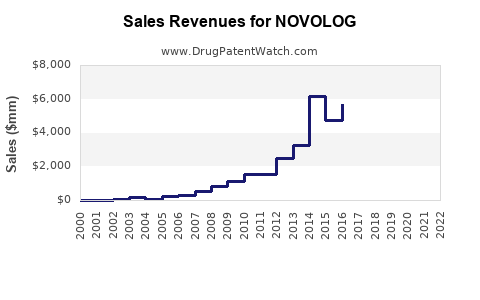
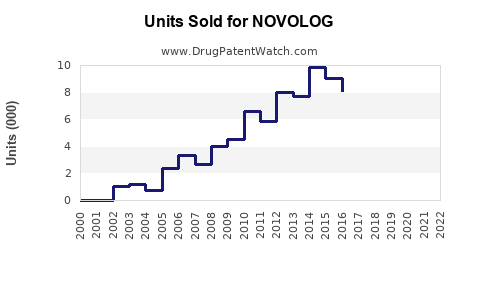
Annual Sales Revenues and Units Sold for NOVOLOG
| Drug Name | Revenues (USD) | Units | Year |
|---|---|---|---|
| NOVOLOG | ⤷ Start Trial | ⤷ Start Trial | 2022 |
| NOVOLOG | ⤷ Start Trial | ⤷ Start Trial | 2021 |
| NOVOLOG | ⤷ Start Trial | ⤷ Start Trial | 2020 |
| NOVOLOG | ⤷ Start Trial | ⤷ Start Trial | 2019 |
| NOVOLOG | ⤷ Start Trial | ⤷ Start Trial | 2018 |
| NOVOLOG | ⤷ Start Trial | ⤷ Start Trial | 2017 |
| >Drug Name | >Revenues (USD) | >Units | >Year |
NovoLog Market Analysis, Sales Projections, Patent Position and Generic Entry Risk
NovoLog, known as NovoRapid outside the United States, is insulin aspart, a rapid-acting recombinant insulin marketed by Novo Nordisk. Its market is mature and declining in value as U.S. insulin price reductions, formulary pressure, biosimilar-style competition and conversion to newer delivery systems reduce net pricing. Volume remains supported by the global diabetes population and continued use in insulin pumps.
NovoLog’s commercial outlook depends less on patent exclusivity than on manufacturing scale, payer contracts, device compatibility, supply reliability and Novo Nordisk’s ability to retain patients within its broader insulin portfolio. A base-case model indicates global NovoLog/NovoRapid sales could decline at approximately 4% to 7% annually through 2029, with slower volume erosion partly offset by emerging-market growth.
What is NovoLog and how is it used?
NovoLog is a rapid-acting insulin analog containing insulin aspart. It is administered by subcutaneous injection or continuous subcutaneous insulin infusion through an insulin pump. NovoLog is approved for improving glycemic control in adults and children with diabetes mellitus. The product is also supplied in FlexPen, FlexTouch and vial presentations, subject to market-specific availability.
| Product | Active ingredient | Developer and marketer | Primary use | U.S. regulatory status |
|---|---|---|---|---|
| NovoLog | Insulin aspart | Novo Nordisk | Type 1 and type 2 diabetes | FDA-approved NDA product |
| NovoRapid | Insulin aspart | Novo Nordisk | Type 1 and type 2 diabetes | International brand |
| Fiasp | Faster-acting insulin aspart | Novo Nordisk | Mealtime and pump insulin | FDA-approved |
| Humalog | Insulin lispro | Eli Lilly | Rapid-acting insulin | FDA-approved |
| Lyumjev | Faster-acting insulin lispro | Eli Lilly | Mealtime insulin | FDA-approved |
| Apidra | Insulin glulisine | Sanofi | Rapid-acting insulin | FDA-approved |
NovoLog has a shorter onset and duration than regular human insulin. Its principal commercial advantages are established pump use, broad physician familiarity, global distribution and compatibility with multiple insulin-delivery systems.
How large is the insulin aspart market?
The global insulin market is mature but structurally expanding in volume. Growth is driven by diabetes prevalence, improved diagnosis, longer patient survival and wider insulin access in emerging markets. Value growth is constrained by lower U.S. net prices and government purchasing programs.
Novo Nordisk reports NovoRapid sales under its modern insulins portfolio rather than always presenting NovoLog as a separate worldwide line. Historical annual reports have placed NovoRapid sales in the low-teens billions of Danish kroner annually, with subsequent pressure from lower realized prices and competition from other rapid-acting products [1][2].
The U.S. market is commercially important but difficult. Pharmacy benefit managers increasingly use insulin as a rebate-driven formulary product. NovoLog competes against Humalog, generic or authorized-generic insulin lispro products, Fiasp, Lyumjev and lower-priced human insulin.
NovoLog market drivers
The principal volume drivers are:
- Growth in insulin-treated type 1 diabetes.
- Greater insulin use among people with type 2 diabetes.
- Expansion of insulin pump therapy.
- Increased adoption of continuous glucose monitoring and automated insulin delivery.
- Demand for prefilled pens and other lower-burden delivery formats.
- Insulin access programs in the United States and lower-income markets.
The main negative drivers are:
- U.S. list-price reductions and rebate compression.
- Conversion to competing rapid-acting insulins.
- Greater use of GLP-1 and GLP-1/GIP therapies in type 2 diabetes.
- Expanded use of concentrated or alternative insulin products.
- Government price controls and tender-based purchasing.
- Loss of differentiation between rapid-acting insulin analogs.
What are NovoLog sales and revenue projections?
Novo Nordisk does not consistently disclose a standalone global NovoLog figure that separates U.S. NovoLog from international NovoRapid sales. The following projection is therefore an analytical estimate based on reported NovoRapid sales, product maturity, insulin-market trends and expected price pressure.
Base-case NovoLog/NovoRapid sales projection
| Fiscal year | Estimated global sales | Year-over-year change | Primary assumption |
|---|---|---|---|
| 2023A | DKK 11.5-12.5 billion | - | Historical reported range and product-line allocation |
| 2024E | DKK 10.7-11.8 billion | -4% to -7% | U.S. pricing and formulary pressure |
| 2025E | DKK 10.2-11.3 billion | -3% to -6% | Stable volume, lower net price |
| 2026E | DKK 9.7-10.8 billion | -4% to -5% | Mature-market erosion |
| 2027E | DKK 9.2-10.3 billion | -4% to -5% | Continued contracting pressure |
| 2028E | DKK 8.8-9.8 billion | -4% to -5% | Market substitution and lower pricing |
| 2029E | DKK 8.4-9.4 billion | -3% to -5% | Emerging-market volume offsets part of decline |
The model implies a 2023-2029 compound annual decline of approximately 4% to 5% in nominal sales. A bear case would produce a decline of 7% to 10% annually if U.S. reimbursement deteriorates rapidly or insulin aspart loses major formularies. A more favorable case would approach flat sales if pump usage and emerging-market volume offset U.S. net-price erosion.
U.S. revenue exposure
The United States is likely to contribute a disproportionate share of NovoLog’s profit relative to volume because it historically carried higher gross prices. That advantage is weakening. Novo Nordisk announced significant U.S. insulin list-price reductions beginning in 2024, including a reduction of the NovoLog list price to improve affordability and align with a $35 monthly out-of-pocket cap for eligible patients [3].
Lower list prices can reduce gross-to-net complexity but also reduce reported revenue per unit. The impact on operating profit depends on manufacturer rebates, distribution fees, patient assistance and payer mix.
When does NovoLog lose exclusivity?
NovoLog’s core U.S. regulatory exclusivity and early patent protection expired years ago. NovoLog was approved by the FDA in 2000 under NDA 020986 [4]. The product is therefore a mature biologic with no realistic reliance on original market exclusivity.
The commercially relevant question is not whether NovoLog has exclusivity in the conventional small-molecule sense. It is whether competing insulin aspart products can secure FDA approval, interchangeability and payer access at sufficient manufacturing scale.
NovoLog exclusivity timeline
| Event | Date or period |
|---|---|
| FDA approval of NovoLog | June 2000 |
| Core product maturity | More than two decades |
| Conventional new-drug exclusivity | Expired |
| Patent-led launch protection | Expired or commercially limited |
| Current barrier | Manufacturing, approval, substitution and contracting |
| Principal competitive threat | Lower-priced insulin analogs and rapid-acting alternatives |
Insulin products are regulated as biologics under the Public Health Service Act framework. FDA guidance allows insulin products to use the 351(a) biologics license application pathway or, in applicable circumstances, the 351(k) biosimilar pathway [5]. The absence of active market exclusivity does not automatically create rapid generic substitution.
What patents protect NovoLog?
NovoLog’s historic protection included composition, recombinant production, formulation, manufacturing and delivery-related intellectual property. Many early patents have expired or have limited practical value because insulin aspart is a mature molecule.
Current protection is more likely to arise from:
- Prefilled pen architecture.
- Cartridge and injection-device configurations.
- Pump delivery systems.
- Formulation stability and storage.
- Manufacturing and purification processes.
- Combination use with glucose-monitoring or automated-delivery systems.
- Brand and trade dress rights.
The patent estate should be assessed by product presentation rather than by the insulin aspart molecule alone. A competitor may be able to market insulin aspart while avoiding a specific pen, cartridge or device patent.
How strong is the NovoLog patent estate?
The estate is moderate to weak for the active ingredient and stronger for selected delivery systems. The molecule itself has limited remaining exclusivity value. Novo Nordisk’s manufacturing know-how, quality systems and scale are more important barriers than composition patents.
| Estate component | Commercial strength | Reason |
|---|---|---|
| Insulin aspart molecule | Low | Mature active ingredient |
| Core formulation | Low to moderate | Many formulation concepts are established |
| Pen and cartridge systems | Moderate | Device-specific claims can delay or complicate copying |
| Pump compatibility | Moderate | Depends on device and labeling claims |
| Manufacturing process | Moderate to high | Process know-how is difficult to reproduce |
| Brand and trade dress | High for branding only | Does not block competing insulin |
A patent expiration date alone does not predict generic entry. FDA approval, insulin comparability, immunogenicity data, manufacturing validation and payer acceptance remain material.
What is the Orange Book status of NovoLog?
NovoLog is a biologic insulin product approved under an NDA. FDA’s Orange Book primarily organizes approved drug products and patent information for conventional drug applications, while biologic reference-product and biosimilar issues are handled through the Purple Book and applicable FDA biologics regulations [6][7].
Orange Book patent listings therefore have less commercial importance for NovoLog than they would for a small-molecule product. Any current patent dispute must be evaluated across FDA listing records, Purple Book status, device patents, manufacturing patents and litigation filings.
NovoLog does not have the same type of automatic generic-substitution framework associated with a conventional small-molecule ANDA. A competing insulin aspart product must establish the appropriate regulatory relationship and obtain state-level substitution treatment where applicable.
Which companies are challenging NovoLog?
The principal competitive companies are Eli Lilly, Sanofi, Biocon Biologics, Viatris and regional insulin manufacturers.
Competitive landscape
Eli Lilly competes through Humalog and Lyumjev. Humalog is the most direct branded rapid-acting analog competitor. Lilly has used lower-priced authorized and unbranded insulin strategies to defend access and volume.
Sanofi markets Apidra, although its commercial position is smaller than NovoLog or Humalog in many markets.
Biocon Biologics and Viatris have expanded their biosimilar and follow-on insulin capabilities. Their competitive impact depends on product-specific approval, interchangeability, supply scale and payer contracts.
Wockhardt, Ypsomed and regional manufacturers participate in selected international markets. Their ability to pressure NovoLog depends on tender access, local manufacturing and regulatory approval.
Biosimilar risk
Biosimilar risk is real but gradual. Insulin is technically complex to manufacture, and regulators require robust analytical, clinical and quality evidence. An approved biosimilar may still fail to gain meaningful share if it lacks:
- Interchangeable status.
- Distribution scale.
- Pump labeling.
- Payer placement.
- Reliable supply.
- A competitive net price.
The highest-risk segment is U.S. pharmacy benefit management, where a lower-priced insulin can gain access through formulary preference. The lowest-risk segment is highly regulated pump use and markets where physicians remain loyal to established devices and brands.
What generic launch scenarios exist for NovoLog?
Scenario 1: Price-led insulin aspart entry
A lower-priced insulin aspart product obtains FDA approval and contracts with a major payer. It captures 5% to 10% of U.S. volume within three years. NovoLog sales decline faster than the base case, with U.S. revenue falling 8% to 12% annually.
Scenario 2: Limited biosimilar entry
A competing product receives approval but lacks automatic substitution or broad pump labeling. It captures hospital, cash-pay and selected tender business. NovoLog experiences a 2% to 4% annual sales decline.
Scenario 3: Formulary-led conversion
A major pharmacy benefit manager replaces NovoLog with Humalog, a lower-priced insulin aspart product or another rapid-acting analog. The loss of one large contract can produce a material quarterly revenue impact because insulin purchasing is concentrated.
Scenario 4: Stable incumbent position
Novo Nordisk retains preferred formulary status, maintains supply reliability and supports pump-channel demand. Volume remains stable while lower U.S. pricing drives a 2% to 4% annual revenue decline.
What patent litigation affects NovoLog?
No active, high-impact patent litigation is required to explain the current NovoLog outlook. The primary risk is commercial substitution rather than an imminent patent cliff. Litigation could still arise over:
- Insulin aspart formulation claims.
- Pen and cartridge patents.
- Pump-use labeling.
- Manufacturing processes.
- Biosimilar patent disclosures and launch timing.
- State substitution or interchangeability disputes.
For investors and licensing teams, FDA approval dates and payer contracting milestones are more important than historical NovoLog molecule patents. A competitor can create revenue pressure without winning a major patent case if it obtains approval and favorable formulary placement.
How does NovoLog compare with Humalog, Fiasp and Lyumjev?
| Product | Company | Differentiation | Commercial position |
|---|---|---|---|
| NovoLog/NovoRapid | Novo Nordisk | Established insulin aspart; broad pump use | Mature, large installed base |
| Fiasp | Novo Nordisk | Faster onset formulation of insulin aspart | Protects Novo Nordisk’s rapid-acting franchise |
| Humalog | Eli Lilly | Established insulin lispro | Direct large-scale competitor |
| Lyumjev | Eli Lilly | Faster-acting insulin lispro | Newer differentiated formulation |
| Apidra | Sanofi | Insulin glulisine | Smaller competing franchise |
Fiasp and Lyumjev allow Novo Nordisk and Lilly to shift some patients toward newer products with greater differentiation. That strategy can reduce direct price competition, but it also risks cannibalizing NovoLog and Humalog.
What FDA regulatory factors affect NovoLog sales?
FDA factors include:
- Labeling for pediatric use.
- Pump compatibility.
- Interchangeability determinations.
- Manufacturing supplements.
- Device approvals for pens and cartridges.
- Supply-chain compliance.
- Changes to insulin affordability programs.
- Biosimilar approval under Section 351(k).
NovoLog’s long regulatory history supports physician confidence. Its disadvantage is that mature insulin products receive limited regulatory differentiation unless supported by delivery technology, faster onset claims or new combination systems.
What geographic markets are most important?
The United States remains the highest-value market but has the greatest price risk. Europe is more exposed to tendering and centralized purchasing. China, Latin America, the Middle East and parts of Asia offer volume growth but generally lower realized prices.
| Region | Revenue outlook | Key risk |
|---|---|---|
| United States | Declining value, stable-to-declining volume | Rebates, $35 pricing, formulary changes |
| Europe | Low growth or decline | Tendering and reimbursement controls |
| China | Moderate volume opportunity | Local competition and price regulation |
| Latin America | Volume growth | Currency and access constraints |
| Middle East and Asia | Selective growth | Procurement and regulatory variation |
What manufacturing and intellectual-property barriers protect NovoLog?
NovoLog’s strongest barriers are manufacturing consistency and quality control. Recombinant insulin production requires validated cell-culture or microbial processes, purification, folding or processing control, analytical characterization and reliable sterile filling.
For a competing manufacturer, the main execution risks are:
- Batch-to-batch potency variation.
- Aggregation and degradation.
- Impurity control.
- Device compatibility.
- Cold-chain distribution.
- Stability after opening.
- Regulatory inspection readiness.
- Supply continuity during demand shifts.
These barriers favor established manufacturers even after legal exclusivity ends.
Key Takeaways
- NovoLog is a mature insulin aspart product with more than 20 years of FDA market history.
- Core molecule exclusivity is no longer the main commercial defense.
- Global NovoLog/NovoRapid sales are likely to decline approximately 4% to 5% annually through 2029 in the base case.
- U.S. price reductions and pharmacy benefit manager contracting are the largest near-term revenue risks.
- Biosimilar and follow-on insulin competition is credible but may enter gradually because approval does not guarantee interchangeability or payer access.
- Fiasp protects Novo Nordisk’s rapid-acting insulin franchise but can cannibalize NovoLog.
- Manufacturing scale, pump labeling, supply reliability and formulary access are stronger barriers than legacy composition patents.
- The most material downside scenario is a major U.S. formulary conversion to a lower-priced rapid-acting insulin.
FAQs about NovoLog market outlook and patent risk
Is NovoLog still commercially protected by patents?
The insulin aspart molecule has limited remaining patent protection value. Current protection is more likely to involve delivery devices, formulations, manufacturing methods and product-specific technologies.
Can a generic company automatically substitute for NovoLog?
No. A competing insulin product generally requires an appropriate FDA approval pathway and may need interchangeable status or other legal and state-level requirements before automatic substitution.
Is Fiasp a generic version of NovoLog?
No. Fiasp is a faster-acting insulin aspart formulation marketed by Novo Nordisk. It is a related product, not a generic version of NovoLog.
Which drug is NovoLog’s closest competitor?
Humalog, insulin lispro from Eli Lilly, is the closest large-scale branded competitor. Fiasp and Lyumjev compete through faster-acting formulations.
What would cause NovoLog sales to decline faster than projected?
The largest risks are loss of a major U.S. formulary contract, rapid uptake of lower-priced insulin aspart, broader use of competing rapid-acting analogs and continued reduction in U.S. net pricing.
References
-
Novo Nordisk A/S. (2024). Annual report 2023. Novo Nordisk.
-
Novo Nordisk A/S. (2025). Annual report 2024. Novo Nordisk.
-
Novo Nordisk. (2023, December 1). Novo Nordisk announces affordability initiatives for insulin in the United States. Novo Nordisk.
-
U.S. Food and Drug Administration. (2000). NovoLog insulin aspart injection, NDA 020986: Approval letter and prescribing information. FDA.
-
U.S. Food and Drug Administration. (2015). Product development under the 351(k) pathway. FDA.
-
U.S. Food and Drug Administration. (2024). Approved drug products with therapeutic equivalence evaluations: Orange Book. FDA.
-
U.S. Food and Drug Administration. (2024). Purple Book: Database of licensed biological products. FDA.
More… ↓
