Share This Page
Drug Sales Trends for MISOPROSTOL
✉ Email this page to a colleague
Payment Methods and Pharmacy Types for MISOPROSTOL (2011)
Revenues by Pharmacy Type
Units Sold by Pharmacy Type
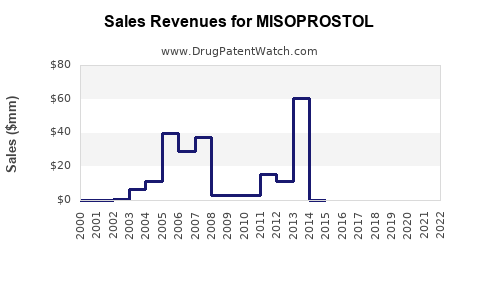
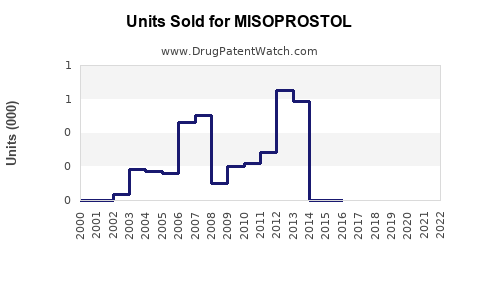
Annual Sales Revenues and Units Sold for MISOPROSTOL
| Drug Name | Revenues (USD) | Units | Year |
|---|---|---|---|
| MISOPROSTOL | ⤷ Start Trial | ⤷ Start Trial | 2022 |
| MISOPROSTOL | ⤷ Start Trial | ⤷ Start Trial | 2021 |
| MISOPROSTOL | ⤷ Start Trial | ⤷ Start Trial | 2020 |
| MISOPROSTOL | ⤷ Start Trial | ⤷ Start Trial | 2019 |
| MISOPROSTOL | ⤷ Start Trial | ⤷ Start Trial | 2018 |
| MISOPROSTOL | ⤷ Start Trial | ⤷ Start Trial | 2017 |
| MISOPROSTOL | ⤷ Start Trial | ⤷ Start Trial | 2016 |
| >Drug Name | >Revenues (USD) | >Units | >Year |
Misoprostol Market Analysis, Sales Forecast, Patent Status, and Competitive Landscape
Misoprostol is a low-cost, off-patent prostaglandin E1 analogue sold primarily as a generic tablet. Its commercial market is fragmented across gastric-ulcer prevention, obstetric care, miscarriage management, medical abortion, labor induction, and postpartum hemorrhage prevention. The drug has high unit demand but low average selling prices, limited brand pricing power, and no meaningful biosimilar exposure.
A modeled global ex-manufacturer market estimate places misoprostol sales at approximately $150 million to $250 million in 2024. Under a base-case scenario, the market could reach about $220 million by 2030, reflecting a 3% to 7% compound annual growth rate. Volume growth is likely to exceed value growth because procurement prices remain under pressure.
| Metric | 2024 estimate | 2030 base case |
|---|---|---|
| Global ex-manufacturer market value | $150 million-$250 million | Approximately $220 million |
| Base-case growth | — | 3%-7% CAGR |
| Core dosage form | 100 mcg and 200 mcg tablets | Tablets remain dominant |
| Main commercial channels | Government procurement, hospitals, pharmacies, reproductive-health programs | Same |
| Patent risk | Low | Low |
| Generic competition | High | High |
| Biosimilar risk | None | None |
The market estimates are modeled rather than reported consolidated sales because manufacturers generally do not disclose misoprostol revenue separately, and international sales occur through public tenders, nonprofit procurement, hospital systems, and generic distributors.
What is misoprostol used for commercially?
Misoprostol is approved in the United States for reducing the risk of gastric ulcers induced by nonsteroidal anti-inflammatory drugs in high-risk patients. Its obstetric and gynecologic uses are broader in clinical practice and public-health programs.
Major demand segments
| Segment | Commercial role | Demand outlook |
|---|---|---|
| NSAID-induced gastric-ulcer prevention | FDA-approved gastric indication | Mature and relatively stable |
| Medical abortion | Used with mifepristone or alone where mifepristone access is limited | Growth depends on regulation and access |
| Miscarriage management | Used for medical management of early pregnancy loss | Moderate growth |
| Labor induction | Hospital and maternity-care use | Stable to moderate growth |
| Postpartum hemorrhage prevention or treatment | Public-health and hospital procurement | Growth in low- and middle-income markets |
| Cervical ripening and gynecologic procedures | Institutional use | Stable, localized demand |
The World Health Organization includes misoprostol in essential-medicines guidance for several reproductive-health applications, supporting procurement demand in countries with constrained access to more expensive alternatives (World Health Organization, 2023).
How large is the misoprostol market?
No authoritative global sales database captures all misoprostol revenue. The drug is sold under numerous generic labels, and the same product may be purchased through retail pharmacies, hospital formularies, international tenders, and reproductive-health organizations.
A bottom-up estimate is more reliable than a single syndicated-market figure:
- Gastric indications contribute a declining but durable retail and hospital market.
- Obstetric and gynecologic demand generates the majority of volume in many emerging markets.
- Reproductive-health procurement often has very low tablet prices but large order volumes.
- Regulatory restrictions limit commercial availability in some countries despite clinical demand.
Regional market profile
| Region | Market characteristics | Commercial outlook |
|---|---|---|
| United States | Generic prescription market; obstetric use may be off-label or governed by institutional protocols | Low-value, stable market |
| Europe | Generic and hospital procurement market with country-specific access rules | Stable, with moderate reproductive-health demand |
| Latin America | Strong obstetric and reproductive-health demand; uneven regulation | Volume growth potential |
| Asia-Pacific | Large population base, hospital use, and generic manufacturing capacity | Highest unit-volume potential |
| Africa and low-income markets | Public-health procurement and donor-supported access are important | High unmet need, low realized pricing |
| Middle East | Hospital and reproductive-health demand varies by national regulation | Fragmented |
The highest growth opportunity is in markets where misoprostol is incorporated into national maternal-health protocols and where procurement systems can secure quality-assured tablets.
What are the sales projections for misoprostol through 2030?
The commercial outlook is volume-led rather than price-led. A base-case forecast assumes increased use in reproductive health, stable gastric-ulcer demand, continued generic competition, and modest manufacturing-cost inflation.
| Scenario | 2024 market | 2030 market | CAGR | Key assumptions |
|---|---|---|---|---|
| Downside | $150 million | $165 million | 1.6% | Price erosion, tighter access rules, weak procurement growth |
| Base case | $200 million | $240 million | 3.1% | Moderate volume expansion and stable tender demand |
| Upside | $250 million | $335 million | 5.0% | Greater public-health adoption and expanded reproductive-health access |
A broader range of approximately $130 million to $320 million is reasonable when different definitions are used for market boundaries, including or excluding hospital procurement, nonprofit supply, and products sold in combination with other agents.
Expected sales drivers
- Expanded use in postpartum hemorrhage prevention and treatment protocols.
- Greater availability of quality-assured products in low- and middle-income countries.
- Continued use of misoprostol-only regimens where mifepristone is unavailable.
- Growth in telemedicine and pharmacy-based reproductive-health services where legally permitted.
- Increased demand for low-cost obstetric medicines in public hospitals.
- Additional generic registrations in countries that rely on imported finished dosage forms.
Expected sales constraints
- Very low generic prices.
- Tenders that favor the lowest qualified supplier.
- Fragmented regulatory requirements.
- Restrictions on abortion-related indications.
- Product shortages caused by low margins and limited supplier inventories.
- Substitution by dinoprostone, oxytocin, carboprost, mifepristone, or mechanical methods depending on indication.
What is the FDA regulatory status of misoprostol?
The FDA approved Cytotec, the original branded misoprostol product, for reducing the risk of gastric ulcers caused by NSAID therapy in patients at high risk of complications. Current U.S. products are primarily generic misoprostol tablets in 100 microgram and 200 microgram strengths.
The main FDA regulatory issues are:
- Prescription status in the United States.
- Labeling that distinguishes the approved gastric indication from obstetric and gynecologic off-label use.
- Product quality and dose uniformity at very low tablet strengths.
- Distribution controls imposed by individual institutions or jurisdictions.
- Combination-product regulation when misoprostol is packaged with another active ingredient.
The FDA-approved product label warns against use during pregnancy for the gastric-ulcer indication because uterine contractions and pregnancy loss can occur (U.S. Food and Drug Administration, 2002).
What is the Orange Book status of misoprostol?
Misoprostol has a mature generic market with no meaningful remaining brand exclusivity barrier. The original Cytotec exclusivity and patent period ended many years ago. Current commercial competition depends on abbreviated new drug applications, manufacturing economics, product quality, and distribution rather than on brand patent protection.
| Orange Book issue | Misoprostol status |
|---|---|
| Reference listed drug | Cytotec |
| Current market structure | Multiple generic products |
| New chemical entity exclusivity | Expired |
| Original patent protection | Expired |
| Active brand-market exclusivity | None of commercial significance |
| Paragraph IV risk | Low for the mature product |
| Generic substitution | Broadly available where approved |
The Orange Book remains the controlling source for current listed products, therapeutic-equivalence codes, patents, and exclusivity entries. Product-specific status can differ by strength and applicant (U.S. Food and Drug Administration, 2024a).
What patents protect misoprostol?
The core composition-of-matter protection for misoprostol has expired. The commercially relevant product is a small molecule, not a biologic, and no active core patent is expected to prevent generic manufacture.
Potential secondary intellectual-property issues include:
- Tablet formulation and stability.
- Manufacturing processes.
- Packaging that protects the drug from humidity and temperature exposure.
- Combination products containing misoprostol and another active ingredient.
- Delivery devices or specialty dosage forms.
- Country-specific process patents.
- Trademark rights for branded products.
These rights are unlikely to create a broad global barrier because standard immediate-release misoprostol tablets are technically mature and can be manufactured by multiple suppliers.
What formulations are protected by misoprostol patents?
The principal commercial product is an immediate-release tablet. Formulation differentiation may involve:
- Improved stability in humid environments.
- Unit-dose blister packaging.
- Vaginal or sublingual administration formats.
- Fixed-dose combinations.
- Modified-release systems.
- Products designed for hospital or community distribution.
A company seeking premium pricing would need to show a clinically meaningful benefit, such as longer shelf life, improved heat stability, easier administration, or reduced dosing errors. A minor tablet change is unlikely to support durable pricing power without regulatory and clinical differentiation.
Are there Paragraph IV challenges to misoprostol?
Paragraph IV litigation is not a central market risk for standard misoprostol tablets because the original brand protections expired long ago and multiple generic products already compete. New Paragraph IV disputes would be more plausible for a newly approved combination product, delivery system, or reformulated product than for conventional misoprostol tablets.
Potential litigation could involve:
- An innovator’s alleged formulation patent.
- A fixed-dose combination with mifepristone or another active ingredient.
- A novel delivery route.
- Packaging or stability claims.
- A patent listed against a newly commercialized product rather than the old Cytotec formulation.
For standard 100 microgram and 200 microgram tablets, the probability of a commercially significant patent dispute is low.
Which companies compete in the misoprostol market?
Competition is distributed among generic pharmaceutical manufacturers, contract manufacturers, national suppliers, and nonprofit or public-health procurement organizations. No single company is likely to control the global market.
Competitive advantages include:
- FDA, European, or stringent regulatory approval.
- Reliable supply at low tender prices.
- Demonstrated stability in hot and humid climates.
- Small-batch flexibility for public-health procurement.
- Registration in multiple jurisdictions.
- Established hospital and pharmacy distribution.
- Ability to manufacture both 100 microgram and 200 microgram strengths.
The most important competitive distinction is quality-assured supply rather than brand recognition. A manufacturer with a low-cost, validated product and strong regulatory registrations can compete effectively against larger pharmaceutical companies.
What is the biosimilar and generic entry risk?
Misoprostol has no biosimilar risk because it is a chemically synthesized small molecule. Generic substitution risk is high because:
- The active ingredient is well characterized.
- The main dosage form is a conventional tablet.
- The original product is off patent.
- Manufacturing technology is widely available.
- Clinical differentiation is limited.
- Buyers are price sensitive.
Generic entry can reduce prices rapidly, particularly in public tenders. The main barriers are regulatory registration, product-quality validation, supply reliability, and local distribution.
What manufacturing and intellectual-property barriers exist?
Manufacturing barriers are moderate at the operational level but low at the patent level. Misoprostol is sensitive to degradation, making stability and packaging important. Manufacturers must manage:
- Temperature and humidity exposure.
- API degradation during storage.
- Dose uniformity at microgram strengths.
- Tablet content uniformity.
- Packaging integrity.
- Stability testing across intended markets.
- Good manufacturing practice compliance.
The strongest defensible asset is usually a validated manufacturing process and reliable supply chain, not a broad patent estate. A supplier that cannot maintain potency through distribution may lose tenders even when its nominal production cost is lower.
What patent litigation and settlement agreements affect misoprostol?
There is no major current patent-litigation framework comparable to that surrounding high-value branded drugs. Historical Cytotec patent protection is no longer a practical barrier to generic entry. Settlement agreements involving the original brand are unlikely to determine present market access for standard misoprostol tablets.
Future disputes could arise if a company commercializes:
- A proprietary misoprostol-mifepristone combination.
- A new route of administration.
- A long-acting formulation.
- A hospital delivery system.
- A product supported by new clinical data and method-of-use claims.
How does misoprostol compare with competing drugs?
| Product | Primary role | Relative cost | Competitive position |
|---|---|---|---|
| Misoprostol | Cervical ripening, abortion, miscarriage, postpartum care, gastric protection | Very low | Strong access and procurement position |
| Mifepristone | Medical abortion and some miscarriage protocols | Higher | Important complement, subject to greater regulatory and legal exposure |
| Oxytocin | Labor induction and postpartum hemorrhage treatment | Low to moderate | Strong hospital competitor; requires injection and cold-chain considerations in some settings |
| Dinoprostone | Cervical ripening and labor induction | Higher | More expensive and often less accessible |
| Carboprost | Postpartum hemorrhage treatment | Higher | Used when clinically appropriate; side-effect and administration constraints |
| NSAID gastroprotection alternatives | Gastric-ulcer prevention | Variable | Compete with misoprostol in the mature gastric market |
Misoprostol’s main advantage is low cost and multiple administration pathways. Its disadvantages include adverse effects, uterine activity, regimen-specific dosing, and regulatory sensitivity around reproductive-health uses.
What revenue exposure exists for manufacturers and investors?
Revenue exposure is generally modest on a per-product basis. Misoprostol can be strategically important for companies with:
- Large government-tender businesses.
- Reproductive-health portfolios.
- Hospital generic portfolios.
- API and finished-dose manufacturing capacity.
- Distribution networks in emerging markets.
For a diversified generic company, misoprostol is unlikely to be a major revenue driver unless the company has a large institutional contract or a differentiated combination product. The market can still generate attractive manufacturing utilization because production technology is mature and demand is recurring.
A premium valuation case would require more than standard-tablet sales. It would likely depend on a protected combination product, specialty formulation, exclusive procurement agreement, or regulatory advantage in a large market.
Key Takeaways
- Misoprostol is an off-patent, low-cost generic medicine with substantial unit demand and limited pricing power.
- A modeled 2024 global market is approximately $150 million to $250 million.
- Base-case market value could reach about $240 million by 2030, with growth driven mainly by volume.
- Obstetric and reproductive-health uses are more important for future growth than gastric-ulcer prevention.
- The core composition-of-matter patent and original brand exclusivity have expired.
- Standard tablets face high generic-entry risk and low Paragraph IV litigation risk.
- Biosimilar competition is not relevant because misoprostol is a small-molecule drug.
- Manufacturing quality, stability, packaging, tender access, and distribution are more important than core patent ownership.
- The strongest commercial opportunities are in public-health procurement, hospital supply, and quality-assured products for emerging markets.
- Premium pricing would require a differentiated formulation, combination product, delivery system, or protected regulatory position.
FAQs
Is misoprostol still commercially profitable after patent expiry?
Yes, but profitability depends on manufacturing scale, procurement access, and supply reliability. Standard tablets usually produce low margins because buyers can switch among multiple generic suppliers.
Does misoprostol have exclusivity in the United States?
The original brand exclusivity has expired. Current sales are based mainly on generic approvals and therapeutic-equivalence status rather than market exclusivity.
Can misoprostol be sold over the counter?
Status varies by country. In the United States, misoprostol is prescription regulated. Other jurisdictions may permit pharmacy access or impose controls tied to reproductive-health use.
Is misoprostol included in the WHO essential medicines framework?
Misoprostol is included in WHO essential-medicines guidance for selected maternal, reproductive-health, and gastrointestinal applications, subject to formulation and indication (World Health Organization, 2023).
What would increase the value of a misoprostol product?
The strongest value drivers would be a stable heat-resistant formulation, a protected combination product, a differentiated delivery system, broad regulatory registration, or a long-term institutional procurement contract.
References
-
U.S. Food and Drug Administration. (2002). Cytotec (misoprostol) prescribing information. FDA.
-
U.S. Food and Drug Administration. (2024a). Approved drug products with therapeutic equivalence evaluations: Orange Book. FDA.
-
U.S. Food and Drug Administration. (2024b). Drugs@FDA: FDA-approved drugs database. FDA.
-
World Health Organization. (2023). WHO model list of essential medicines: 23rd list. World Health Organization.
-
World Health Organization. (2022). WHO recommendations for care of the preterm or low-birth-weight infant. World Health Organization.
More… ↓
