Share This Page
Drug Sales Trends for LATANOPROST
✉ Email this page to a colleague
Payment Methods and Pharmacy Types for LATANOPROST (2011)
Revenues by Pharmacy Type
Units Sold by Pharmacy Type
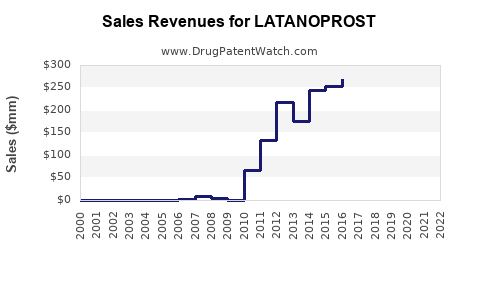
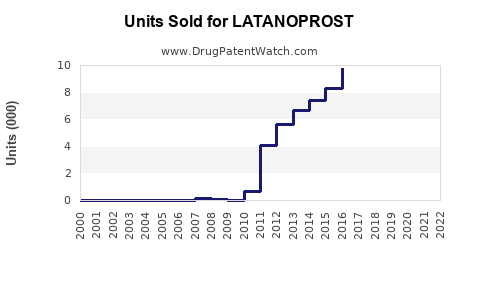
Annual Sales Revenues and Units Sold for LATANOPROST
| Drug Name | Revenues (USD) | Units | Year |
|---|---|---|---|
| LATANOPROST | ⤷ Start Trial | ⤷ Start Trial | 2022 |
| LATANOPROST | ⤷ Start Trial | ⤷ Start Trial | 2021 |
| LATANOPROST | ⤷ Start Trial | ⤷ Start Trial | 2020 |
| LATANOPROST | ⤷ Start Trial | ⤷ Start Trial | 2019 |
| LATANOPROST | ⤷ Start Trial | ⤷ Start Trial | 2018 |
| >Drug Name | >Revenues (USD) | >Units | >Year |
Latanoprost Market Analysis, Patent Status, Competitive Landscape, and Sales Projections
Latanoprost is a mature, high-volume prostaglandin analogue used primarily to reduce intraocular pressure in open-angle glaucoma and ocular hypertension. The product has lost its core U.S. patent protection and faces extensive generic competition. Market value is driven by patient volume, preservative-free formulations, combination products, and emerging markets rather than branded price growth.
A base-case model estimates global latanoprost product sales of approximately $1.0 billion to $1.2 billion in 2025, rising to $1.2 billion to $1.5 billion by 2030 at a 3% to 5% compound annual growth rate. Unit demand should grow faster than revenue because generic pricing remains under pressure.
What is the current market position of latanoprost?
Latanoprost is one of the most established topical glaucoma medicines. It is administered once daily and lowers intraocular pressure by increasing uveoscleral outflow. Its main branded product is Xalatan, originally developed and commercialized by Pharmacia, later acquired by Pfizer.
The drug competes in the prostaglandin analogue class against:
- Travoprost, marketed as Travatan Z and generic travoprost
- Bimatoprost, marketed as Lumigan and generic bimatoprost
- Tafluprost, marketed as Zioptan and generic tafluprost in selected markets
- Unoprostone, which has a smaller commercial role
- Fixed combinations containing a prostaglandin analogue and a beta blocker, carbonic anhydrase inhibitor, or alpha agonist
Latanoprost remains commercially important because of its long clinical history, once-daily dosing, broad physician familiarity, and low generic price. It is frequently used as first-line therapy for primary open-angle glaucoma and ocular hypertension.
Global market status
The commercial market has shifted from a branded-product model to a multi-source generic model.
| Market segment | 2025 estimated value | Market characteristics |
|---|---|---|
| Latanoprost monotherapy | $650 million-$800 million | High generic volume, low average selling price |
| Preservative-free latanoprost | $100 million-$180 million | Higher pricing and stronger growth |
| Latanoprost fixed combinations | $150 million-$250 million | Fragmented market, regional variation |
| Branded or premium products | Less than $150 million | Concentrated in selected markets |
| Total latanoprost-related market | $1.0 billion-$1.2 billion | Includes products containing latanoprost |
These figures are market-model estimates rather than reported company revenue. Public companies generally do not disclose global sales for individual generic latanoprost products.
How large is the latanoprost market and what are the sales projections?
The most likely growth profile is volume-led rather than price-led. Glaucoma prevalence is increasing with population aging, while diagnosis and treatment access are expanding in China, India, Latin America, the Middle East, and Southeast Asia. Generic competition limits the ability of manufacturers to capture the full benefit of volume growth.
Base-case sales projection
| Year | Global latanoprost market | Annual growth | Primary driver |
|---|---|---|---|
| 2024 | $0.95B-$1.15B | - | Mature generic market |
| 2025 | $1.00B-$1.20B | 3%-5% | Patient growth and emerging markets |
| 2026 | $1.04B-$1.26B | 3%-5% | Increased diagnosis and treatment |
| 2027 | $1.08B-$1.32B | 3%-5% | Preservative-free uptake |
| 2028 | $1.12B-$1.39B | 3%-5% | Combination products and market expansion |
| 2029 | $1.16B-$1.45B | 3%-5% | Volume growth offsets price erosion |
| 2030 | $1.20B-$1.52B | 3%-5% | Aging population and wider access |
The model assumes that unit demand grows by approximately 5% to 7% annually, while average realized prices decline by 1% to 3% annually in mature markets. This produces lower revenue growth than prescription growth.
Bull and bear scenarios
| Scenario | 2030 market estimate | Assumptions |
|---|---|---|
| Bear case | $950M-$1.15B | Faster generic price erosion, weak premium adoption, reimbursement pressure |
| Base case | $1.20B-$1.52B | Stable volume growth and moderate preservative-free adoption |
| Bull case | $1.55B-$1.85B | Strong emerging-market diagnosis, premium formulations, higher treatment persistence |
The principal risk to the bull case is that latanoprost is already heavily commoditized. The principal risk to the bear case is limited. Even when prices fall, glaucoma treatment is chronic, widely accepted, and supported by a large installed patient base.
Which companies sell latanoprost?
Latanoprost is supplied by branded manufacturers, generic pharmaceutical companies, ophthalmic specialists, and regional distributors.
Major commercial participants
| Company | Product or role | Commercial position |
|---|---|---|
| Pfizer | Xalatan | Original branded product; limited strategic growth after patent expiry |
| Viatris | Generic latanoprost and ophthalmic products | Broad generic distribution |
| Sandoz | Generic ophthalmic products | Significant hospital and retail presence in multiple markets |
| Teva | Generic latanoprost | Large U.S. and international generic platform |
| Apotex | Generic latanoprost | Strong ophthalmic generic presence in selected jurisdictions |
| Hikma | Generic ophthalmic medicines | Regional and institutional exposure |
| Sun Pharma | Generic ophthalmic products | Strong India and international distribution |
| Cipla | Generic ophthalmic products | Important emerging-market supplier |
| Micro Labs and regional manufacturers | Generic latanoprost | Strong local-market participation |
The competitive set differs by jurisdiction. U.S. supply is concentrated among a smaller number of approved manufacturers and authorized generic channels, while India, China, Latin America, and Southeast Asia have more fragmented supplier bases.
What patents protect latanoprost?
The principal composition patent for latanoprost has expired. The core U.S. patent is generally identified as U.S. Patent No. 5,296,504, associated with latanoprost and related prostaglandin derivatives. Its effective U.S. term ended in 2011, subject to applicable patent-term and regulatory adjustments.
| Patent category | Status | Commercial implication |
|---|---|---|
| Core latanoprost composition | Expired | No meaningful composition-level barrier |
| Original branded formulation | Expired or no longer commercially decisive | Generic substitution is established |
| Method-of-use protection | Largely expired or weak for ordinary glaucoma use | Limited barrier to standard prescribing |
| Preservative-free formulations | Product- and jurisdiction-specific | Potential protection through formulation, device, or process patents |
| Fixed-dose combinations | Separate product-specific rights | May create narrower barriers |
| Manufacturing processes | Potentially active in some jurisdictions | Usually difficult to enforce against routine generic supply |
Patent protection is no longer the primary determinant of market access for standard latanoprost ophthalmic solution. Regulatory approval, manufacturing capacity, preservative-free technology, device design, and contracting position are more important.
When did latanoprost lose exclusivity?
Xalatan lost meaningful U.S. market exclusivity after the expiration of its core patent protection and the approval of generic latanoprost products. FDA generic approvals began to reshape the U.S. market around 2011.
The original product also received pediatric exclusivity associated with the FDA approval framework, but that period did not prevent eventual generic entry. The commercial effect of patent expiry was substantial because latanoprost is a chemically synthesized small molecule with a straightforward generic pathway compared with biologics or complex drug-device combinations.
Exclusivity timeline
| Event | Approximate date | Effect |
|---|---|---|
| U.S. approval of Xalatan | 1996 | Established branded latanoprost market |
| Core patent issuance | 1994 | Created composition-level protection |
| Core patent expiry | 2011 | Removed principal U.S. patent barrier |
| Generic approvals and launches | 2011 onward | Accelerated price competition |
| Broad generic substitution | 2012 onward | Reduced branded revenue and market share |
| Premium formulation development | 2010s onward | Created narrower commercial niches |
The original brand no longer controls the overall category. Pfizer retains brand recognition, but generic prescribing and pharmacy substitution determine most U.S. demand.
What is the FDA and Orange Book status of latanoprost?
FDA-approved latanoprost products are generally prescription ophthalmic solutions administered as eye drops. The reference listed drug is Xalatan. Generic products have entered through the abbreviated new drug application pathway.
The Orange Book historically included the patents associated with Xalatan and its approved indications. Those core listings are no longer an effective barrier to generic approval because the relevant patents expired. Current Orange Book treatment can differ by product, formulation, and listing history, especially for newer preservative-free or combination products.
Regulatory factors affecting competition
Generic applicants must demonstrate pharmaceutical equivalence and bioequivalence under the applicable FDA requirements. Ophthalmic products also face manufacturing and quality risks that can limit supply:
- Sterility assurance
- Particulate control
- Container-closure integrity
- Drop-size consistency
- Preservative concentration
- Stability of the active ingredient
- Manufacturing-site inspection status
These requirements create operational barriers even where patent barriers are absent. A manufacturer may have an approved product but still lose market share because of warning letters, recalls, supply interruptions, or limited production capacity.
What formulation patents protect latanoprost?
Formulation protection is more commercially relevant than the expired core composition patent.
Preservative-free latanoprost
Traditional latanoprost products commonly use benzalkonium chloride or another preservative. Long-term exposure to preservatives can contribute to ocular-surface irritation, particularly in patients using multiple glaucoma medications.
Preservative-free products seek to differentiate through:
- Improved tolerability
- Single-dose containers
- Multidose bottles with specialized valve systems
- Alternative antimicrobial systems
- Reduced exposure to benzalkonium chloride
- Improved adherence among chronic-use patients
Preservative-free products can command higher prices, but their market share depends on reimbursement, physician preference, container usability, and patient persistence.
Fixed-dose combinations
Latanoprost combinations with timolol are among the most commercially relevant combination products. Other combinations may use carbonic anhydrase inhibitors or alpha agonists, depending on local approvals.
Combination products can reduce administration burden and improve adherence. Their patents, regulatory exclusivity, and market barriers are separate from those of plain latanoprost. Generic competition is present but may be less immediate because each combination requires its own approval and manufacturing capabilities.
Which companies are challenging the latanoprost market?
The market is challenged by both generic suppliers and alternative therapies.
Generic competition
Generic manufacturers compete primarily on:
- Contract pricing
- Pharmacy and wholesaler access
- Supply reliability
- State and payer formulary positioning
- Bottle design and drop delivery
- Regulatory compliance
- Ability to maintain multiple manufacturing sites
Price competition is strongest in the United States and other mature markets with automatic substitution. In lower-income markets, branded generics may retain substantial share despite the absence of patent protection.
Therapeutic competition
Latanoprost competes with other prostaglandin analogues and with non-prostaglandin therapies, including:
- Beta blockers such as timolol
- Alpha-2 agonists such as brimonidine
- Carbonic anhydrase inhibitors such as dorzolamide and brinzolamide
- Rho kinase inhibitors such as netarsudil
- Laser trabeculoplasty
- Surgical and minimally invasive glaucoma procedures
Rho kinase inhibitors and advanced combination products may capture premium revenue, but they are unlikely to displace latanoprost across the broad first-line market because of higher price, tolerability issues, or more limited long-term utilization.
Are there Paragraph IV challenges for latanoprost?
Paragraph IV litigation was most relevant during the original generic entry period. Generic applicants could challenge listed patents by asserting that patents were invalid, unenforceable, or not infringed.
For the core latanoprost product, the commercial importance of Paragraph IV litigation has largely passed because the principal patents expired and generic products are established. New disputes may arise around:
- Preservative-free formulations
- Drug-delivery devices
- Fixed-dose combinations
- Specific manufacturing processes
- Reformulated branded products
A patent dispute involving a new formulation would not necessarily restore exclusivity for ordinary latanoprost solution. It would generally affect only the protected formulation, device, or combination.
What is the litigation and settlement outlook?
The litigation risk for standard latanoprost is low. The market has already experienced generic entry, and there is no broad composition patent preventing competition.
Potential disputes are more likely to involve:
- Product quality and sterility
- Abbreviated new drug application certifications
- Formulation or device patents
- Trade secrets involving manufacturing
- False patent marking or product labeling
- Distribution contracts and supply obligations
Settlement agreements are less likely to produce a delayed generic-entry event for the basic molecule because generic competition is already mature. Any settlement involving a newer formulation should be analyzed at the product level rather than applied to the entire latanoprost category.
Is there biosimilar risk for latanoprost?
There is no conventional biosimilar risk because latanoprost is a chemically synthesized small molecule, not a biologic. Competition occurs through generic drug approvals rather than the biosimilar pathway.
The relevant regulatory risks are generic substitution, abbreviated applications, product-specific exclusivity, and manufacturing disruption. Investors should not apply biologic exclusivity or biosimilar frameworks to standard latanoprost.
How strong is the latanoprost patent estate?
The patent estate is weak for standard latanoprost and stronger only for selected reformulations.
| Asset type | Patent strength | Market protection |
|---|---|---|
| Standard latanoprost molecule | Low | None after expiration |
| Conventional multidose solution | Low to moderate | Limited unless tied to a newer claim |
| Preservative-free formulation | Moderate | Depends on claim scope and enforceability |
| Multidose preservative-free device | Moderate to strong | Device and formulation barriers may apply |
| Fixed-dose combination | Moderate | Product-specific regulatory and patent barriers |
| Manufacturing process | Variable | Enforcement and detection can be difficult |
Commercial durability depends more on product quality, payer coverage, and manufacturing execution than on legacy composition patents.
What generic launch scenarios exist?
Three launch scenarios are commercially relevant.
Base-case scenario
Generic manufacturers retain most unit volume, while market revenue grows slowly from emerging-market expansion and premium preservative-free products. Standard solution pricing declines gradually.
Downside scenario
Multiple manufacturers enter remaining regional markets, leading to rapid price erosion. Hospitals and public tenders shift toward the lowest-cost supplier. Premium products lose reimbursement support.
Upside scenario
Preservative-free products gain broader reimbursement, combination products improve adherence, and diagnosis rates rise in underpenetrated markets. Revenue growth reaches the upper end of the projected range despite standard-generic price declines.
What geographic markets offer the most growth?
| Region | Outlook | Commercial rationale |
|---|---|---|
| United States | Stable to low growth | Mature diagnosis, generic substitution, low prices |
| Western Europe | Stable | High treatment access and strong generic penetration |
| Japan | Moderate | Aging population and established ophthalmology market |
| China | High volume growth | Aging population, rising diagnosis, expanded healthcare access |
| India | High volume growth | Large patient base, branded-generic distribution |
| Latin America | Moderate to high | Uneven access but expanding private and public treatment |
| Southeast Asia | Moderate to high | Growing healthcare coverage and urban ophthalmology capacity |
| Middle East and Africa | High from a low base | Access expansion, but tender pricing limits value capture |
China and India offer the greatest unit-growth potential. The United States and Europe remain important for regulatory reference, institutional purchasing, and premium formulations but provide limited pricing upside.
What revenue exposure do manufacturers have?
For the original innovator, latanoprost is no longer a major growth asset. Pfizer’s commercial exposure is primarily associated with residual branded demand and the strategic value of maintaining a recognized ophthalmic brand.
For generic manufacturers, the molecule is usually a portfolio product rather than a standalone revenue driver. Exposure is measured by:
- Number of approved manufacturing sites
- Government and hospital contracts
- Retail pharmacy access
- Product availability during shortages
- Share of preservative-free and combination sales
- Ability to bundle ophthalmic products across a broader portfolio
A supply interruption can temporarily improve pricing for remaining suppliers, but persistent profitability is constrained by the number of approved competitors.
Key Takeaways
- Latanoprost is a mature, globally established glaucoma medicine with high unit demand and low generic pricing.
- Estimated global latanoprost-related sales are approximately $1.0 billion to $1.2 billion in 2025.
- Base-case revenue is projected to reach $1.2 billion to $1.52 billion by 2030.
- Unit volume should grow faster than revenue because generic price erosion continues.
- The principal U.S. composition patent, U.S. Patent No. 5,296,504, expired in 2011.
- Standard latanoprost has low patent protection and low litigation risk.
- Preservative-free formulations, delivery devices, and fixed-dose combinations offer the strongest remaining IP opportunities.
- Biosimilar risk does not apply because latanoprost is a synthetic small molecule.
- China, India, Latin America, and Southeast Asia offer the strongest volume-growth potential.
- Commercial success depends on regulatory compliance, sterility, supply reliability, reimbursement, and formulation differentiation.
FAQs
What was the peak sales level of Xalatan?
Xalatan reached blockbuster-level annual sales before generic erosion, with historical sales commonly reported in the range of approximately $1 billion to more than $1.5 billion annually, depending on the reporting year and geographic scope.
Is latanoprost still profitable for generic manufacturers?
Yes, but profitability varies sharply by market. Standard U.S. products have limited margins because of price competition. Preservative-free products, hospital contracts, branded generics, and emerging-market distribution can produce better returns.
Can a new company obtain patent protection for latanoprost?
A company cannot obtain a new composition patent for the known latanoprost molecule merely by commercializing it. It may obtain narrower protection for a novel formulation, delivery device, manufacturing process, combination, or dosing regimen that satisfies patentability requirements.
Which product has the strongest premium opportunity against generic latanoprost?
Preservative-free multidose or single-dose products have the clearest premium opportunity. Their commercial success depends on clinical tolerability, reimbursement, device usability, and demonstrated adherence benefits.
Will glaucoma prevalence increase latanoprost demand?
Yes. Aging populations and improved diagnosis should increase the number of treated glaucoma and ocular-hypertension patients. The revenue impact will be moderated by generic substitution and declining average prices.
References
-
European Medicines Agency. (n.d.). Xalatan: EPAR product information. European Medicines Agency.
-
Food and Drug Administration. (n.d.). Orange Book: Approved drug products with therapeutic equivalence evaluations. U.S. Department of Health and Human Services.
-
Food and Drug Administration. (n.d.). Drugs@FDA: FDA-approved drugs. U.S. Department of Health and Human Services.
-
Pfizer Inc. (1996-2011). Annual reports and product information for Xalatan. Pfizer.
-
U.S. Patent and Trademark Office. (1994). U.S. Patent No. 5,296,504: 13,14-dihydro-15-keto-20-ethyl-prostaglandin F2 alpha derivatives. U.S. Department of Commerce.
-
World Health Organization. (2023). World report on vision and global eye care indicators. World Health Organization.
-
World Health Organization. (2023). Blindness and vision impairment. World Health Organization.
More… ↓
