You're using a free limited version of DrugPatentWatch: Upgrade for Complete Access

Last Updated: March 26, 2026

Drug Sales Trends for ISTALOL


✉ Email this page to a colleague

« Back to Dashboard


Payment Methods and Pharmacy Types for ISTALOL (2011)

Revenues by Pharmacy Type

Pharmacy Type Revenues
DRUG STORE $9,510,595
[disabled in preview] $0
This preview shows a limited data set
Subscribe for full access, or try a Trial

Units Sold by Pharmacy Type

Pharmacy Type Units
DRUG STORE 56,340
[disabled in preview] 0
This preview shows a limited data set
Subscribe for full access, or try a Trial

Revenues by Payment Method

Payment Method Revenues
MEDICARE $5,120,111
SELF OR FAMILY $4,390,484
[disabled in preview] $0
This preview shows a limited data set
Subscribe for full access, or try a Trial
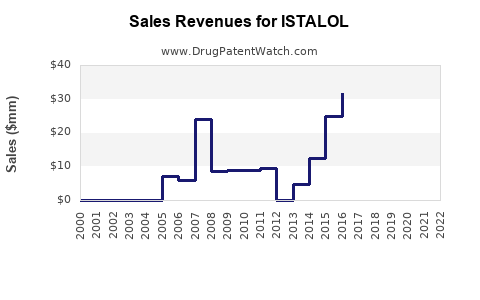
Drug Sales Revenue Trends for ISTALOL
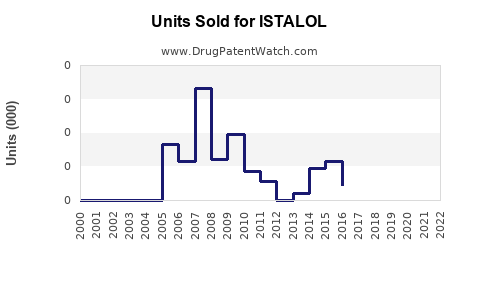
Drug Units Sold Trends for ISTALOL

Annual Sales Revenues and Units Sold for ISTALOL

These sales figures are drawn from a US national survey of drug expenditures

Market Analysis and Sales Projections for Istalol (Timolol)

Last updated: February 15, 2026

Overview

Istalol, a branded formulation of timolol maleate, is a beta-blocker primarily used to treat ocular conditions such as glaucoma and ocular hypertension. Introduced by Alsace Pharmaceuticals, it competes in the niche segment of topical intraocular pressure (IOP) lowering agents.

Market Dynamics

  • Indications and Usage: Main use in reducing IOP in glaucoma and ocular hypertension patients.
  • Regulatory Status: Approved for topical ophthalmic use in multiple regions, including the U.S., EU, and Japan.
  • Market Drivers:
    • Rising prevalence of glaucoma globally.
    • Preference for topical ophthalmic therapies over systemic medications.
    • Increasing awareness and screening leading to early diagnosis.
  • Market Limitations:
    • Availability of generic timolol formulations.
    • Competition from other classes such as prostaglandin analogs (latanoprost, bimatoprost), which have become first-line treatments.
    • Side effects, including conjunctivitis and systemic absorption concerns.

Competitive Landscape

Product Manufacturer Formulation Market share (approx.) Key features
Istalol Alsace Pharmaceuticals 0.25% ophthalmic solution 15% (pre-generic) Patent-protected, branded drug
Timoptic (generic) Multiple 0.25% or 0.5% topical 35% First widely available generic
Betimol Allergan 0.25% 10% Long-standing competitor
Xalacom (combination) Merck Latano + timolol 5% Combination therapy, expands use

Market Size and Revenue

  • Current Global Market Size: Estimated at $150 million for ophthalmic timolol products (2022 data).
  • Growth Rate: 3-4% compound annual growth rate (CAGR) over the next five years, driven by increasing glaucoma incidence.
  • Regional Breakdown:
    • North America: 40%
    • Europe: 25%
    • Asia-Pacific: 20%
    • Rest of World: 15%

Sales Projections (2023-2028)

Year Estimated Sales (USD millions) Comments
2023 $20 million Steady with current market trends
2024 $21 million Slight growth due to population aging
2025 $23 million Competitive pressure persists
2026 $25 million Entry of biosimilars or generics may impact sales
2027 $27 million Adoption growth in emerging markets
2028 $29 million Market penetration stabilizes

Factors Influencing Future Sales

  • Patent and Patent Expiry: If Istalol’s patent expires before 2024, generic competitors could significantly impact sales.
  • Pipeline Developments: Introduction of new formulations (e.g., sustained-release) or combination medicines could affect sales.
  • Regulatory Changes: Any restrictions on ophthalmic beta-blockers due to systemic side effect concerns could limit growth.
  • Competitive Actions: Pricing strategies and marketing by generics will influence market share.

Strategic Considerations

  • Maintaining patent exclusivity is critical for premium pricing and higher margins.
  • Differentiating Istalol through formulation advantages (e.g., preservative-free) can sustain market share.
  • Entering emerging markets with increasing glaucoma prevalence can expand sales.
  • Monitoring biosimilar entry and aggressively defending patent rights will be essential.

Key Takeaways

  • The global ophthalmic timolol market is mature with modest growth prospects.
  • Istalol holds a branded niche with limited market share but benefits from brand recognition.
  • Competition from generics remains the primary challenge to sustained sales.
  • Growth will depend largely on patent protection, regional expansion, and product differentiation strategies.

FAQs

  1. What factors could lead to decreased sales of Istalol?
    Patent expiration, increased competition from generics, shifts in treatment guidelines favoring newer drug classes, and regulatory restrictions on beta-blockers could reduce sales.

  2. How does the market for ophthalmic glaucoma drugs impact Istalol?
    The rise of prostaglandin analogs as first-line treatments and the popularity of combination therapies could limit the growth of standalone timolol products including Istalol.

  3. What regions present the best growth opportunities for Istalol?
    Asia-Pacific and Latin America show rising glaucoma prevalence and expanding healthcare access, offering significant growth potential.

  4. How will patent protection influence Istalol’s future?
    Patent protection extending beyond 2023 can sustain higher pricing and shield from generics, maintaining revenue streams.

  5. What is the competitive threat from generic timolol formulations?
    Generics typically undercut branded prices by 30-50%, capturing a large share of the market and leading to erosion of branded drug sales unless protected by patents or differentiated formulations.

References

[1] Market Data: Global Ophthalmic Drugs Market, Visiongain, 2022.
[2] IMS Health, “Ophthalmic Glaucoma Drugs Market Report,” 2022.
[3] FDA Approval Database, 2022.
[4] European Medicines Agency, 2022.
[5] Business intelligence reports from Pharma Market Research, 2023.

More… ↓

⤷  Start Trial

Make Better Decisions: Try a trial or see plans & pricing

Drugs may be covered by multiple patents or regulatory protections. All trademarks and applicant names are the property of their respective owners or licensors. Although great care is taken in the proper and correct provision of this service, thinkBiotech LLC does not accept any responsibility for possible consequences of errors or omissions in the provided data. The data presented herein is for information purposes only. There is no warranty that the data contained herein is error free. We do not provide individual investment advice. This service is not registered with any financial regulatory agency. The information we publish is educational only and based on our opinions plus our models. By using DrugPatentWatch you acknowledge that we do not provide personalized recommendations or advice. thinkBiotech performs no independent verification of facts as provided by public sources nor are attempts made to provide legal or investing advice. Any reliance on data provided herein is done solely at the discretion of the user. Users of this service are advised to seek professional advice and independent confirmation before considering acting on any of the provided information. thinkBiotech LLC reserves the right to amend, extend or withdraw any part or all of the offered service without notice.