Share This Page
Drug Sales Trends for IMURAN
✉ Email this page to a colleague
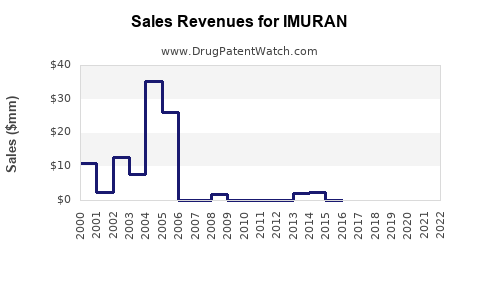
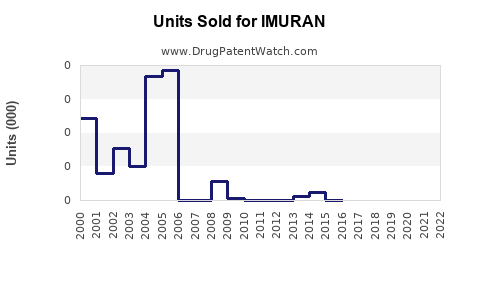
Annual Sales Revenues and Units Sold for IMURAN
| Drug Name | Revenues (USD) | Units | Year |
|---|---|---|---|
| IMURAN | ⤷ Start Trial | ⤷ Start Trial | 2022 |
| IMURAN | ⤷ Start Trial | ⤷ Start Trial | 2021 |
| IMURAN | ⤷ Start Trial | ⤷ Start Trial | 2020 |
| IMURAN | ⤷ Start Trial | ⤷ Start Trial | 2019 |
| IMURAN | ⤷ Start Trial | ⤷ Start Trial | 2018 |
| IMURAN | ⤷ Start Trial | ⤷ Start Trial | 2017 |
| >Drug Name | >Revenues (USD) | >Units | >Year |
Imuran Market Analysis, Patent Status, Competitive Landscape, and Sales Projections
Imuran is the branded form of azathioprine, an off-patent immunosuppressant used in organ transplantation and autoimmune diseases. Its commercial value is concentrated in low-cost generic azathioprine rather than the brand. The U.S. market has no material patent barrier to generic entry, no biologic or biosimilar exposure, and limited opportunity for price expansion. A reasonable base-case forecast is flat-to-declining unit demand through 2030, with nominal market revenue supported only by mix, supply conditions, and inflation.
What is Imuran and how is azathioprine used?
Imuran contains azathioprine, a purine antimetabolite that suppresses immune-cell proliferation. FDA-approved uses include adjunctive prevention of renal-transplant rejection and management of active rheumatoid arthritis in patients who have failed or cannot tolerate other therapies.[1]
| Attribute | Imuran and azathioprine |
|---|---|
| Active ingredient | Azathioprine |
| Drug class | Immunosuppressant; purine antimetabolite |
| Main dosage form | Oral tablets |
| Common strengths | 50 mg tablets; generic products may vary by market |
| Major uses | Kidney transplantation, rheumatoid arthritis, autoimmune disorders |
| FDA approval history | Original approval dates to the 1960s |
| Current competitive status | Mature generic market |
| Biologic status | Small molecule, not a biologic |
| Biosimilar exposure | None |
| Prescription channel | Retail, specialty, hospital, and transplant care |
Azathioprine is also used off-label in inflammatory bowel disease, autoimmune hepatitis, systemic lupus erythematosus, dermatologic conditions, and other immune-mediated disorders. Off-label use broadens the prescriber base but does not create meaningful product differentiation because generic azathioprine is widely available.
What is the Orange Book status of Imuran?
Imuran has no meaningful remaining FDA exclusivity or patent protection that prevents approved generic azathioprine products from competing in the United States.
The relevant commercial conclusion is that Imuran is a legacy brand facing a fully mature generic market. Any current brand value depends on prescriber familiarity, supply reliability, contracting, and formulary placement rather than regulatory exclusivity.
| Regulatory issue | Imuran status |
|---|---|
| New chemical entity exclusivity | Expired |
| Orphan-drug exclusivity | None identified for the core product |
| Pediatric exclusivity | Expired or not commercially relevant |
| Active composition patent | Expired |
| Active formulation patent | No material barrier identified |
| Method-of-use exclusivity | No material barrier identified for core indications |
| Generic competition | Established |
| Orange Book blocking risk | Low |
The FDA Orange Book records patents and exclusivities that may affect abbreviated new drug applications. For a mature product such as azathioprine, the commercial assessment must focus on approved generic supply, manufacturing quality, and reimbursement rather than patent expiry.[2]
When did Imuran lose exclusivity?
Imuran lost meaningful exclusivity decades ago. Azathioprine was first introduced in the 1960s, and the original compound and early product protections are no longer capable of supporting a branded monopoly.
The principal U.S. market transition occurred when abbreviated new drug applications for azathioprine tablets became available. Generic manufacturers could rely on the reference product’s safety and efficacy findings through the ANDA pathway, subject to demonstrating pharmaceutical equivalence and bioequivalence.[3]
Patent and exclusivity timeline
| Period | Event | Commercial effect |
|---|---|---|
| 1950s-1960s | Azathioprine developed and commercialized | Original scientific and product protection established |
| 1960s | Imuran approved in the United States | Branded market begins |
| 1980s-1990s | Generic development becomes commercially feasible | Brand pricing pressure increases |
| 2000s | Generic azathioprine becomes established | Brand share contracts |
| 2010s-present | Mature multi-source market | Competition shifts to price, supply, and contracting |
| 2025-2030 | No expected patent-led market reset | Stable or declining demand expected |
What patents protect Imuran today?
No active patent estate is expected to protect the basic azathioprine molecule or standard immediate-release oral tablets in the United States.
Composition patents
The azathioprine active ingredient is an established small molecule. Any original composition or synthesis patents have expired. A new patent covering the same active ingredient would generally require a qualifying improvement, such as a novel formulation, manufacturing process, delivery technology, or therapeutic use.
Formulation patents
The standard immediate-release tablet is not associated with a commercially significant, current formulation patent moat. A future modified-release formulation could obtain patent protection if it met novelty, non-obviousness, written-description, enablement, and other U.S. patentability standards. That would protect only the qualifying formulation, not ordinary azathioprine tablets.
Method-of-use patents
Azathioprine has long-standing uses in transplantation and autoimmune disease. New method-of-use patents could theoretically cover a narrowly defined patient population, biomarker, dosing schedule, or combination regimen. Such patents would not ordinarily prevent generic substitution for the established indications unless they were listed and enforceable under applicable FDA and patent-law procedures.
Are there Paragraph IV challenges to Imuran?
A meaningful current Paragraph IV campaign against Imuran is unlikely because the core product is already off patent and generic azathioprine products are established.
Paragraph IV litigation is generally most important when a branded product has unexpired Orange Book-listed patents. For Imuran, the absence of a material patent barrier means that market entry does not depend on a new challenge to a remaining monopoly.
| Litigation issue | Assessment |
|---|---|
| Active Paragraph IV threat to the core product | Low |
| Need for a first generic launch | None |
| Hatch-Waxman settlement value | Low |
| Brand injunction risk | Low |
| Generic approval risk | Primarily regulatory and manufacturing-related |
No major recent U.S. litigation event is commercially central to the azathioprine market. Potential disputes would more likely concern manufacturing quality, labeling, distribution, product liability, or a specific formulation than the core compound.
What is the competitive landscape for azathioprine?
Competition is based on generic availability, supplier reliability, tablet strength, wholesaler relationships, and formulary economics.
Potential competitors include multiple ANDA holders and contract manufacturers supplying azathioprine tablets. The commercial set can change as manufacturers discontinue products, transfer approvals, or enter and exit low-margin markets. FDA approval does not guarantee continuous commercial supply.
Competitive advantages in the market
| Competitive factor | Importance |
|---|---|
| Low acquisition cost | High |
| Reliable API supply | High |
| Consistent tablet availability | High |
| FDA-compliant manufacturing | High |
| Hospital and transplant-account access | Moderate |
| Brand recognition | Low to moderate |
| Differentiated formulation | Low |
| Patent protection | None for standard product |
Transplant centers may value continuity of supply because treatment interruption can create clinical risk. This may support some supplier stickiness, but it rarely supports large brand premiums.
What manufacturing and intellectual-property barriers affect Imuran?
The main barriers are operational rather than patent-based.
Azathioprine manufacturing requires control of API quality, impurity profiles, batch consistency, and stability. Suppliers also must maintain compliant facilities, validated processes, adequate documentation, and reliable distribution. These requirements can produce temporary shortages or supplier concentration even when the product is legally open to competition.
Potential manufacturing risks include:
- API sourcing interruptions
- FDA warning letters or import restrictions
- Manufacturing-site changes
- Batch failures and recalls
- Low-margin economics that discourage redundant capacity
- Hospital and wholesaler inventory constraints
These barriers can create short-term pricing opportunities, but they do not support durable monopoly pricing.
How strong is the Imuran patent estate?
The patent estate is weak for commercial purposes.
| Patent-estate category | Strength |
|---|---|
| Core molecule | None remaining |
| Standard tablet | Weak or none |
| Transplant indication | No material exclusivity |
| Rheumatoid arthritis indication | No material exclusivity |
| New formulation potential | Possible but unproven |
| Manufacturing process | Potentially narrow and design-around risk |
| Geographic enforceability | Limited by expiration and jurisdiction |
The principal asset is the established clinical position of azathioprine, not intellectual property. Generic manufacturers can generally compete without licensing the original brand owner.
What licensing deals affect Imuran?
No major current licensing transaction is required to commercialize standard azathioprine tablets in the United States. Historical rights may differ by country and by product presentation, but the core generic market does not depend on a continuing license from the original Imuran developer.
A licensing opportunity would be more plausible for:
- A novel sustained-release formulation
- A combination product
- A transplant-specific delivery system
- A low-toxicity prodrug
- A pharmacogenomic dosing platform
- A new regional distribution arrangement
These opportunities would involve new intellectual property or commercial infrastructure. They would not restore exclusivity to conventional Imuran tablets.
What is the FDA regulatory status of Imuran?
Imuran is an FDA-approved prescription drug. Azathioprine carries clinically significant warnings, including risks related to myelosuppression, serious infections, malignancy, hepatotoxicity, and hypersensitivity. TPMT and NUDT15 genetic variation can affect toxicity risk in some patients, although testing and dosing decisions are clinical matters governed by the product label and professional judgment.[1]
The FDA-approved generic pathway supports competition when products demonstrate pharmaceutical equivalence and bioequivalence to the reference product. Generic azathioprine must comply with applicable current good manufacturing practice requirements and labeling standards.[3]
What are Imuran and azathioprine sales projections?
Public companies generally do not report Imuran brand sales as a standalone financial line. The relevant commercial forecast is therefore an indexed market projection rather than a verified brand-sales figure.
The base case assumes:
- No new patent protection for standard tablets
- Stable transplant demand
- Gradual substitution toward less expensive immunosuppressants where clinically appropriate
- Continued off-label autoimmune use
- Periodic supply disruptions
- Low single-digit generic price movement
- No major new formulation launch
Indexed market forecast
| Year | Total azathioprine market index | Estimated annual change | Brand Imuran index |
|---|---|---|---|
| 2024 | 100 | Base year | 100 |
| 2025 | 99-101 | -1% to 1% | 90-96 |
| 2026 | 97-101 | -2% to 0% | 82-92 |
| 2027 | 95-100 | -2% to -1% | 74-88 |
| 2028 | 93-99 | -2% to -1% | 67-84 |
| 2029 | 91-98 | -2% to -1% | 60-80 |
| 2030 | 88-97 | -3% to -1% | 54-76 |
The base-case total-market compound annual growth rate is approximately negative 1% to negative 2% through 2030. Brand Imuran is likely to decline faster than total azathioprine demand because generic substitution is already established.
Scenario analysis
| Scenario | 2030 total-market outcome | Main drivers |
|---|---|---|
| Upside | 100-108 index | Supply shortages, stable transplant use, limited substitution |
| Base case | 88-97 index | Mature demand and gradual generic price erosion |
| Downside | 75-88 index | Faster migration to mycophenolate, biologics, targeted therapies, and alternative immunosuppressants |
The addressable market is more resilient in transplantation than in some autoimmune indications. Transplant patients may remain on long-term immunosuppression, while autoimmune treatment increasingly competes with biologics, JAK inhibitors, methotrexate, mycophenolate, and other targeted therapies.
How does Imuran compare with competing immunosuppressants?
| Product or class | Relative commercial position |
|---|---|
| Azathioprine | Low-cost, mature, established safety experience |
| Mycophenolate mofetil | Strong transplant competitor; generic and branded versions |
| Mycophenolic acid | Alternative oral transplant therapy |
| Tacrolimus | Core transplant immunosuppressant; stronger market position |
| Cyclosporine | Established transplant therapy with generic competition |
| Methotrexate | Major autoimmune competitor |
| Biologics | Higher-cost alternatives in autoimmune diseases |
| JAK inhibitors | Targeted competitors in selected inflammatory diseases |
Azathioprine’s advantages are cost, familiarity, and long clinical experience. Its disadvantages include toxicity monitoring, slower onset in some autoimmune uses, and competition from newer or more targeted therapies.
What generic launch risks exist for Imuran?
A new generic entrant would face low legal risk but meaningful commercial risk.
The principal risks are:
- Limited market size and low achievable price.
- Difficulty securing reliable API supply.
- Established supplier relationships.
- Potential FDA manufacturing scrutiny.
- Wholesaler and pharmacy substitution dynamics.
- Low return on investment after launch.
- Volume volatility caused by tenders, shortages, and product discontinuations.
A generic entrant could gain share if it offers reliable supply, competitive pricing, and multiple tablet strengths. It would not need a differentiated patent strategy for standard azathioprine.
What is the geographic outlook for Imuran?
The United States is a mature generic market. Europe, Canada, Australia, and other developed markets also have established azathioprine competition. Growth opportunities are more likely in emerging markets where transplant programs, autoimmune diagnosis, and access to chronic immunosuppression are expanding.
Geographic commercial value depends on:
- National reimbursement
- Local registration requirements
- Hospital procurement
- API import rules
- Local manufacturing
- Pharmacovigilance obligations
- Brand substitution rules
A regional brand can retain value in markets where physicians prescribe by brand or where generic supply is inconsistent. That value is commercial and distribution-based, not patent-based.
Key Takeaways
- Imuran is an established azathioprine brand with no material remaining exclusivity.
- Standard azathioprine tablets face generic competition and have low patent strength.
- The U.S. market is driven by transplantation, autoimmune use, price, and supply reliability.
- No meaningful current Paragraph IV or biosimilar threat defines the market.
- Brand Imuran sales are likely to decline faster than total azathioprine demand.
- Base-case total-market demand is projected to decline approximately 1% to 2% annually through 2030.
- The main barriers are manufacturing quality, API supply, and contracting, not intellectual property.
- Any material growth would require a differentiated formulation, new delivery system, or new clinical positioning.
FAQs
Is Imuran still sold in the United States?
Azathioprine remains available in the United States through generic products. Brand availability and distribution can vary by supplier and channel.
Is azathioprine a biologic or biosimilar product?
No. Azathioprine is a conventional small-molecule drug. It is regulated through the generic-drug pathway rather than the biosimilar pathway.
Can a company patent a new azathioprine formulation?
Yes, a genuinely novel formulation could potentially receive patent protection. The patent would cover the qualifying formulation, not ordinary immediate-release azathioprine tablets.
Why might Imuran remain commercially relevant after patent expiry?
Clinical familiarity, long-term transplant use, low cost, and physician experience can preserve demand after patent expiry. Those factors do not prevent generic substitution.
What is the largest commercial risk for an azathioprine manufacturer?
The largest risk is weak market economics combined with supply-chain or manufacturing disruption. A manufacturer can obtain regulatory approval yet fail to achieve attractive returns because the market is mature and price-sensitive.
References
- U.S. Food and Drug Administration. (2023). Imuran (azathioprine) tablets: Prescribing information.
- U.S. Food and Drug Administration. (2025). Approved drug products with therapeutic equivalence evaluations: Orange Book.
- U.S. Food and Drug Administration. (2024). Generic drugs: Questions and answers.
- National Library of Medicine. (2025). DailyMed: Azathioprine drug labeling.
More… ↓
