Share This Page
Drug Sales Trends for GELNIQUE
✉ Email this page to a colleague
Payment Methods and Pharmacy Types for GELNIQUE (2011)
Revenues by Pharmacy Type
Units Sold by Pharmacy Type
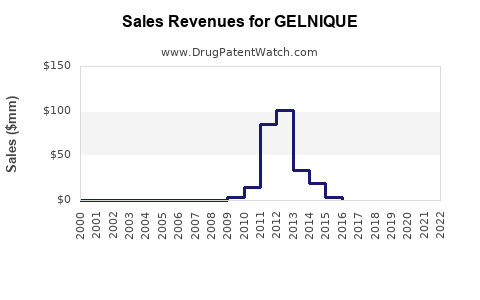
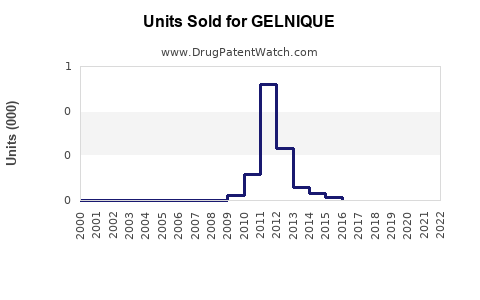
Annual Sales Revenues and Units Sold for GELNIQUE
| Drug Name | Revenues (USD) | Units | Year |
|---|---|---|---|
| GELNIQUE | ⤷ Start Trial | ⤷ Start Trial | 2022 |
| GELNIQUE | ⤷ Start Trial | ⤷ Start Trial | 2021 |
| GELNIQUE | ⤷ Start Trial | ⤷ Start Trial | 2020 |
| GELNIQUE | ⤷ Start Trial | ⤷ Start Trial | 2019 |
| GELNIQUE | ⤷ Start Trial | ⤷ Start Trial | 2018 |
| GELNIQUE | ⤷ Start Trial | ⤷ Start Trial | 2017 |
| GELNIQUE | ⤷ Start Trial | ⤷ Start Trial | 2016 |
| >Drug Name | >Revenues (USD) | >Units | >Year |
Gelnique Market Analysis, Sales Projections, Patent Position, and Generic Competition
Gelnique is a topical oxybutynin chloride gel approved for overactive bladder with urge urinary incontinence, urgency, and frequency. Its commercial opportunity is limited by low-cost oral oxybutynin, competing transdermal products, branded beta-3 agonists, generic availability, and the small size of the topical oxybutynin segment. Gelnique can support a niche specialty business, but it is unlikely to become a major revenue product without a materially broader payer position, a lower net price, or a new commercial partner.
Public sources do not disclose reliable standalone Gelnique revenue. The projections below are scenario estimates based on prescription volume, estimated net price, and market-share assumptions rather than reported manufacturer sales.
What is Gelnique and what is its FDA status?
Gelnique is a prescription topical gel containing oxybutynin chloride. Oxybutynin is an antimuscarinic used to reduce involuntary bladder contractions.
| Attribute | Gelnique |
|---|---|
| Active ingredient | Oxybutynin chloride |
| Drug class | Antimuscarinic |
| Dosage form | Topical transdermal gel |
| Primary indication | Overactive bladder |
| FDA application | NDA 022204 |
| Administration | Once daily topical application |
| Reference product | Gelnique |
| Main alternatives | Generic oral oxybutynin, oxybutynin ER, oxybutynin patch, mirabegron, vibegron, trospium, solifenacin, darifenacin |
| Regulatory pathway | New drug application |
| Biosimilar exposure | None |
| Generic exposure | High |
FDA labeling describes Gelnique as a topical formulation intended to deliver oxybutynin through the skin while reducing some gastrointestinal exposure associated with oral administration.[1]
The product’s commercial rationale is based on delivery-system differentiation. Patients who cannot tolerate oral oxybutynin because of dry mouth, constipation, or gastrointestinal effects may prefer a topical product. The main tradeoff is application-site risk, transfer precautions, skin reactions, and higher product cost.
How large is the overactive bladder market?
The U.S. overactive bladder market is large in patient terms but fragmented in revenue terms. Millions of adults experience urgency, frequency, or urge urinary incontinence, but treatment is divided across generic antimuscarinics, branded beta-3 agonists, behavioral therapy, botulinum toxin, neuromodulation, and surgical interventions.
The market has three commercial tiers:
- Low-cost generic antimuscarinics, including oral oxybutynin.
- Branded oral therapies, particularly beta-3 agonists such as Myrbetriq and Gemtesa.
- Nonoral and procedural therapies, including topical oxybutynin, transdermal patches, Botox, and sacral neuromodulation.
Gelnique competes primarily in the second and third tiers, although its therapeutic ingredient is generic and its delivery technology has limited exclusivity value.
Competitive positioning
| Product category | Typical commercial advantage | Main limitation versus Gelnique |
|---|---|---|
| Generic oral oxybutynin | Very low cost | Anticholinergic adverse effects and adherence problems |
| Oxybutynin ER | Once-daily oral dosing | Still exposes patients to systemic anticholinergic effects |
| Oxybutynin patch | Nonoral delivery | Skin irritation and patch adherence |
| Gelnique | Nonoral, once-daily gel | Higher cost, transfer precautions, limited awareness |
| Mirabegron | No anticholinergic mechanism | Price, hypertension warnings, payer controls |
| Vibegron | Beta-3 mechanism and strong tolerability profile | Premium pricing and formulary restrictions |
| Trospium and solifenacin | Established clinical use | Oral administration and class-related adverse effects |
| Botox | High efficacy for selected patients | Procedure, monitoring, and repeat treatment |
The American Urological Association and Society of Urodynamics, Female Pelvic Medicine & Urogenital Reconstruction identify antimuscarinic and beta-3 agonist therapies as pharmacologic options for overactive bladder, with treatment selection driven by efficacy, tolerability, patient preference, and shared decision-making.[2]
What are the main demand drivers for Gelnique?
Gelnique demand is likely to come from patients who meet one or more of the following conditions:
- Intolerance of oral antimuscarinics.
- Difficulty swallowing tablets.
- Preference for nonoral administration.
- Prior failure of oral oxybutynin.
- Concern about systemic gastrointestinal effects.
- Need for an alternative to an oxybutynin patch.
- Physician preference for a transdermal antimuscarinic before procedural treatment.
The addressable population is much smaller than the total overactive bladder population. Gelnique must compete for patients already diagnosed, treated, and willing to use a topical product. The product also faces a switching barrier because patients and clinicians may prefer familiar oral products or newer beta-3 agonists.
Commercial demand is more sensitive to reimbursement than to disease prevalence. A patient may be clinically appropriate for Gelnique but still receive oral generic oxybutynin if the insurer places Gelnique on a nonpreferred tier or requires prior authorization.
What limits Gelnique sales growth?
The largest constraints are price, generic substitution, and limited differentiation.
Generic oxybutynin pressure
The active ingredient is not commercially differentiated from generic oxybutynin. Gelnique’s value comes from the delivery system, not from a new pharmacologic mechanism. This limits pricing power and makes payer negotiations difficult.
Beta-3 agonist competition
Myrbetriq and Gemtesa give physicians non-anticholinergic alternatives. Concerns about cognitive effects and cumulative anticholinergic burden may shift some older patients away from oxybutynin-based products, even when Gelnique has a nonoral delivery route.
Patient-use friction
Topical administration creates practical burdens:
- Application to clean, dry skin.
- Avoidance of contact with other people until the gel dries.
- Covering the application site.
- Handwashing after application.
- Management of skin irritation.
- Compliance with daily use.
These requirements can reduce persistence compared with an oral tablet.
Limited prescriber awareness
The product is not a standard first-line choice in many treatment algorithms. Gelnique requires a targeted marketing strategy focused on urologists, urogynecologists, primary care physicians, and patients with oral antimuscarinic intolerance.
What are Gelnique’s current and potential revenue levels?
No authoritative public source reports standalone Gelnique net sales. Brand revenue should therefore be modeled rather than presented as a historical fact.
A practical forecast uses annual treated patients multiplied by annual net revenue per patient.
| Scenario | Annual treated patients | Estimated annual net revenue per patient | Estimated annual U.S. net sales |
|---|---|---|---|
| Downside | 20,000 | $900 | $18 million |
| Base case | 35,000 | $1,200 | $42 million |
| Upside | 60,000 | $1,500 | $90 million |
These figures represent an analytical range, not reported sales.
Five-year sales projection
| Year | Downside | Base case | Upside |
|---|---|---|---|
| Year 1 | $16 million | $35 million | $55 million |
| Year 2 | $17 million | $38 million | $63 million |
| Year 3 | $18 million | $42 million | $72 million |
| Year 4 | $18 million | $45 million | $81 million |
| Year 5 | $19 million | $48 million | $90 million |
The base case assumes modest patient growth, relatively stable net pricing, and no major improvement in formulary access. The upside case requires stronger prescriber promotion, improved coverage, successful targeting of oral antimuscarinic-intolerant patients, and limited additional generic erosion.
The downside case reflects declining brand awareness, greater use of beta-3 agonists, payer restrictions, and substitution by lower-cost oxybutynin products.
What is the likely U.S. market share for Gelnique?
Gelnique is likely to hold a low-single-digit share of pharmacologic overactive bladder prescriptions and a higher share within the narrow topical oxybutynin segment.
A reasonable commercial model is:
| Segment | Estimated Gelnique position |
|---|---|
| Total overactive bladder drug market | Niche, below 1% by patient volume |
| Antimuscarinic market | Low-single-digit share |
| Oxybutynin market | Higher share in the nonoral segment |
| Topical oxybutynin market | Potential leading or co-leading branded position |
| Premium branded OAB market | Limited by competition from beta-3 agonists |
The product’s economic value depends less on broad market share than on retaining a defensible subgroup of patients who require nonoral oxybutynin and have adequate reimbursement.
What patents protect Gelnique?
Gelnique’s patent value is concentrated in the topical formulation, delivery system, and method of use rather than in oxybutynin itself.
The relevant intellectual-property categories include:
- Topical gel composition.
- Skin permeation and drug-delivery technology.
- Concentration and dosing regimen.
- Application-site restrictions and administration methods.
- Manufacturing and packaging processes.
- Potential method-of-use claims for patients with overactive bladder.
FDA Orange Book records are the relevant source for determining whether a particular patent is listed against the approved NDA and whether any listed patent remains unexpired.[3] Patent protection must be assessed by jurisdiction, patent family, terminal disclaimers, patent-term adjustments, and any later litigation or settlement activity.
A formulation patent can support an ANDA challenge even when the active ingredient is old. Its commercial strength depends on whether the challenger can design around the claim or invalidate it, not merely on the existence of an Orange Book listing.
When does Gelnique lose exclusivity?
Gelnique’s active ingredient has long been off-patent. Any remaining exclusivity value therefore depends on formulation, delivery, regulatory, or contractual rights.
| Exclusivity type | Commercial relevance |
|---|---|
| Active-ingredient exclusivity | Expired or commercially immaterial |
| New chemical entity exclusivity | Not applicable to oxybutynin |
| Formulation patents | Potentially relevant if unexpired and listed |
| Method-of-use patents | Relevant only if enforceable and commercially meaningful |
| Regulatory exclusivity | Limited for an older active ingredient |
| Trademark protection | Does not prevent generic approval |
| Trade secrets | May protect manufacturing but not necessarily block an ANDA |
There is no basis to treat Gelnique as having biologic-style exclusivity. Biosimilar rules do not apply. Any generic entrant would proceed through the abbreviated new drug application pathway, subject to FDA requirements and any valid listed patent certifications.
Are there Paragraph IV challenges to Gelnique?
A Paragraph IV challenge is possible when an ANDA applicant certifies that a listed patent is invalid, unenforceable, or will not be infringed. The commercial consequences depend on the specific Orange Book-listed patents and the timing of any litigation.
Potential outcomes include:
- No litigation, allowing approval after the relevant regulatory waiting period.
- Patent litigation with a 30-month stay of FDA approval in qualifying circumstances.
- Settlement with a negotiated launch date.
- Early launch after a favorable court decision.
- At-risk launch before final resolution, exposing the generic company to damages and injunction risk.
Public market analysis should not assume that an Orange Book listing guarantees a long delay. Gelnique’s underlying molecule is old, and a challenger may focus on formulation noninfringement, invalidity, or a different concentration and delivery design.
What generic launch risks exist for Gelnique?
Generic risk is high over the medium term because the product has an established active ingredient, a relatively small commercial market, and limited mechanism-based differentiation.
The most likely generic strategies are:
- A generic version of the same topical gel.
- A formulation with a different excipient system.
- A different concentration with equivalent clinical performance.
- A competing topical oxybutynin product using an alternative delivery technology.
- A lower-cost transdermal product that targets the same patients.
The risk is commercially significant even if only one approved generic enters the market. A single generic entrant can trigger rapid price reductions, payer substitution, and loss of pharmacy preference.
How does Gelnique compare with oxybutynin patches and oral oxybutynin?
Gelnique has a differentiated route of administration but does not have a differentiated active ingredient.
| Factor | Gelnique | Oral oxybutynin | Oxybutynin patch |
|---|---|---|---|
| Administration | Daily topical gel | Tablet or extended-release tablet | Scheduled patch application |
| Generic price pressure | High | Very high | High |
| Gastrointestinal exposure | Potentially lower than oral | Higher | Lower than oral in some patients |
| Skin burden | Gel transfer and irritation risk | None | Adhesive and skin irritation |
| Patient convenience | Moderate | High | Moderate |
| Payer attractiveness | Limited | Strong | Moderate |
| Switching rationale | Oral intolerance or swallowing difficulty | Low cost and familiarity | Nonoral preference |
| Long-term growth potential | Niche | Mature generic market | Niche |
Gelnique’s best commercial position is not as a universal replacement for oral oxybutynin. It is as a targeted option for patients who need topical delivery and have a reason to avoid oral therapy or patches.
What licensing and commercial partnership opportunities exist?
The most credible licensing strategy would involve a company with an established urology, women’s health, or specialty-pharmacy sales force. A partner could improve:
- Urologist and urogynecologist coverage.
- Prior-authorization support.
- Specialty-pharmacy distribution.
- Patient copay assistance.
- Conversion from oral oxybutynin or patch therapy.
- International registration and commercialization.
The asset is more attractive as part of a portfolio than as a standalone launch. A buyer would likely value recurring niche revenue, manufacturing reliability, and a clear patent position more than broad market growth.
Potential transaction structures include:
- Regional commercialization licensing.
- Co-promotion in urology.
- Asset acquisition with supply agreement.
- Royalty-bearing license tied to net sales.
- Authorized-generic arrangement.
- Lifecycle reformulation partnership.
Reported deal value should not be assumed without a public transaction announcement. The likely valuation ceiling is constrained by generic exposure and the absence of a novel active ingredient.
What is the outlook for Gelnique through 2030?
Gelnique’s most probable outlook is stable-to-declining nominal sales with continued niche demand.
The base-case forecast is approximately $35 million to $48 million in annual U.S. net sales over a five-year period. A stronger outcome could approach $75 million to $100 million if the product secures better payer coverage and captures patients concerned about oral anticholinergic tolerability. A generic launch or major loss of formulary access could reduce net sales below $20 million.
The main value drivers are:
- Current Orange Book-listed patent status.
- Actual generic development activity.
- Reimbursement and preferred-tier placement.
- Manufacturer commitment to urology promotion.
- Patient persistence relative to oral oxybutynin.
- Competition from beta-3 agonists.
- Manufacturing cost per dose.
- Availability of authorized or branded generic alternatives.
Key Takeaways
- Gelnique is a topical oxybutynin chloride product for overactive bladder.
- Its commercial differentiation comes from delivery, not the active ingredient.
- Public sources do not provide reliable standalone Gelnique sales.
- A reasonable modeled U.S. base case is $35 million to $48 million in annual net sales over five years.
- Upside could reach $75 million to $100 million with improved reimbursement and focused specialty promotion.
- Generic and payer risks are high because oxybutynin is an established, low-cost active ingredient.
- The strongest target population is patients who cannot tolerate or do not prefer oral oxybutynin.
- Patent value depends on unexpired formulation, delivery, and method-of-use claims listed against the NDA.
- The product is more attractive as a specialty portfolio asset than as a broad-market growth product.
- Biosimilar risk does not apply; ANDA-based generic risk does.
FAQs
Is Gelnique still commercially relevant?
Yes, but primarily as a niche nonoral therapy for patients who cannot tolerate oral oxybutynin or prefer topical treatment. Its market is unlikely to expand rapidly without better reimbursement or a stronger commercial platform.
Is Gelnique more effective than oral oxybutynin?
Gelnique contains the same active ingredient, so its main differentiation is route of administration and tolerability profile rather than a fundamentally different mechanism. Comparative treatment selection depends on patient response, adverse effects, adherence, and payer access.
Can a generic company copy Gelnique?
A generic company may pursue an ANDA if it can meet FDA requirements and address any listed patents. The active ingredient is not a strong barrier, but formulation and delivery claims may affect timing and design.
Is Gelnique covered by Medicare Part D?
Coverage varies by plan, formulary tier, prior-authorization rules, and product availability. A plan may cover Gelnique while requiring failure of generic oxybutynin or another antimuscarinic first.
What would make Gelnique more valuable to a licensee?
The strongest value drivers would be verified remaining patent protection, stable supply, favorable payer coverage, demonstrated persistence advantages, and access to a urology-focused sales force.
References
- U.S. Food and Drug Administration. (n.d.). Gelnique 10% prescribing information: Oxybutynin chloride gel. FDA.
- American Urological Association & Society of Urodynamics, Female Pelvic Medicine & Urogenital Reconstruction. (2024). Diagnosis and treatment of idiopathic overactive bladder guideline.
- U.S. Food and Drug Administration. (n.d.). Approved drug products with therapeutic equivalence evaluations: Orange Book. FDA.
- U.S. Food and Drug Administration. (n.d.). Drugs@FDA: Gelnique, NDA 022204. FDA.
More… ↓
