Share This Page
Drug Sales Trends for CHLORHEXIDINE
✉ Email this page to a colleague
Payment Methods and Pharmacy Types for CHLORHEXIDINE (2011)
Revenues by Pharmacy Type
Units Sold by Pharmacy Type
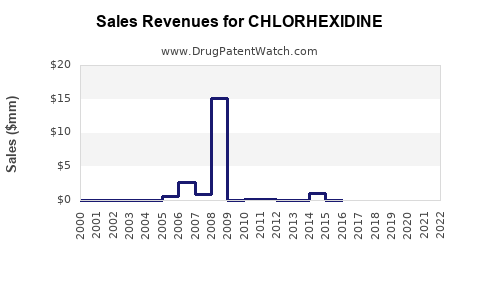
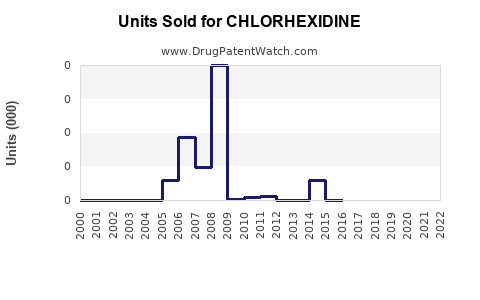
Annual Sales Revenues and Units Sold for CHLORHEXIDINE
| Drug Name | Revenues (USD) | Units | Year |
|---|---|---|---|
| CHLORHEXIDINE | ⤷ Start Trial | ⤷ Start Trial | 2022 |
| CHLORHEXIDINE | ⤷ Start Trial | ⤷ Start Trial | 2021 |
| CHLORHEXIDINE | ⤷ Start Trial | ⤷ Start Trial | 2020 |
| CHLORHEXIDINE | ⤷ Start Trial | ⤷ Start Trial | 2019 |
| >Drug Name | >Revenues (USD) | >Units | >Year |
Chlorhexidine Market Analysis, Sales Forecast, Patent Status, and Competitive Outlook
Chlorhexidine is a mature antiseptic active ingredient with broad use in oral rinses, surgical skin preparation, preoperative bathing, catheter care, wound care, and veterinary products. Its commercial market is fragmented across branded, generic, hospital, consumer, and private-label products. Global chlorhexidine product sales are estimated at approximately $1.6 billion to $1.9 billion in 2025, with a base-case projection of about $2.3 billion by 2030.
Growth is driven by infection-prevention protocols, dental disease, hospital-acquired infection controls, and demand for preoperative skin antisepsis. Price competition, safety warnings, generic substitution, regulatory restrictions in some markets, and substitution by povidone-iodine and alcohol-based products limit pricing power.
What is chlorhexidine and where is it used?
Chlorhexidine is a cationic bisbiguanide antiseptic. Commercial products commonly use chlorhexidine gluconate, also called chlorhexidine digluconate or CHG. The ingredient disrupts microbial cell membranes and has persistent activity on skin and mucosal surfaces.
| Product category | Typical concentration or format | Main customers | Commercial role |
|---|---|---|---|
| Oral rinse | 0.12% chlorhexidine gluconate | Dental practices, patients, hospitals | Prescription dental and periodontal treatment |
| Skin cleanser | 2% to 4% CHG | Hospitals, surgery centers, consumers | Surgical preparation, bathing, catheter-care protocols |
| CHG-impregnated cloths | Usually 2% CHG | Hospitals and ambulatory surgery centers | Preoperative and intensive-care use |
| Surgical prep applicators | CHG with alcohol | Hospitals and operating rooms | Preoperative skin antisepsis |
| Wound and topical products | Multiple concentrations | Hospitals, long-term care, veterinary users | Local antisepsis and infection control |
| Medical-device coatings | Device-specific | Device manufacturers and hospitals | Catheter and implant infection prevention |
| Veterinary products | Shampoos, sprays, wipes | Veterinary clinics and pet owners | Skin and ear infections |
The highest-value applications are hospital skin antisepsis, CHG bathing products, and branded or private-label oral-care products. Oral rinses are more exposed to generic competition and lower average selling prices.
How large is the chlorhexidine market in 2025?
Public market reports do not use a single market definition. Some count chlorhexidine active pharmaceutical ingredients, while others include finished antiseptic products, CHG-impregnated devices, veterinary products, or adjacent oral-care categories. A practical product-market estimate is:
| Market segment | Estimated 2025 global sales | 2025-2030 expected CAGR | 2030 base-case sales |
|---|---|---|---|
| Hospital skin antisepsis | $650 million | 5.5% | $850 million |
| CHG bathing cloths and wipes | $300 million | 6.5% | $410 million |
| Dental and oral-rinse products | $275 million | 3.5% | $326 million |
| Medical-device and catheter applications | $190 million | 5.0% | $243 million |
| Wound care and topical products | $190 million | 4.5% | $237 million |
| Veterinary and consumer products | $145 million | 4.0% | $176 million |
| Total | $1.75 billion | 5.4% | $2.24 billion |
These figures represent a bottom-up commercial estimate for products containing chlorhexidine, rather than sales of the active pharmaceutical ingredient alone. Published commercial research reports generally place the broader chlorhexidine market in the low-single-digit billions, but totals differ because of category definitions and inclusion of related antiseptic products. Grand View Research, for example, identifies continued growth in chlorhexidine demand across medical, dental, and consumer applications (Grand View Research, 2024).
What are the main growth drivers?
The strongest growth drivers are hospital infection-prevention programs, increased use of preoperative CHG bathing, expanding dental care in emerging markets, and demand for ready-to-use antiseptic delivery systems.
The hospital segment benefits from protocol-driven purchasing. A hospital may standardize on CHG cloths, CHG-alcohol applicators, and CHG bathing kits even when the underlying molecule is generic. This shifts value from chemical exclusivity to packaging, clinical workflow, procurement contracts, and infection-control evidence.
Dental demand is more volume-driven. Chlorhexidine remains widely used for short-term management of gingivitis, periodontal inflammation, and oral bacterial load. Long-term use is limited by tooth staining, taste disturbance, mucosal irritation, and altered taste perception.
What are the sales projections for chlorhexidine through 2030?
The base case assumes a 2025 global product market of $1.75 billion and a 5.4% compound annual growth rate.
| Year | Low case, 3.5% CAGR | Base case, 5.4% CAGR | High case, 7.0% CAGR |
|---|---|---|---|
| 2025 | $1.75B | $1.75B | $1.75B |
| 2026 | $1.81B | $1.84B | $1.87B |
| 2027 | $1.87B | $1.94B | $2.00B |
| 2028 | $1.94B | $2.04B | $2.14B |
| 2029 | $2.01B | $2.15B | $2.29B |
| 2030 | $2.07B | $2.24B | $2.45B |
The base case implies approximately $490 million in incremental annual sales between 2025 and 2030. Hospital skin antisepsis and CHG cloths are expected to contribute about 60% of that increase.
Which regions will grow fastest?
| Region | Estimated 2025 share | Outlook through 2030 | Principal demand factors |
|---|---|---|---|
| North America | 38% | Moderate growth | Hospital protocols, dental prescriptions, premium applicators |
| Europe | 27% | Moderate growth | Surgical antisepsis, public-health procurement, dental use |
| Asia-Pacific | 24% | Above-market growth | Hospital expansion, dental access, local manufacturing |
| Latin America | 6% | Above-market growth from smaller base | Surgical and dental demand |
| Middle East and Africa | 5% | Above-market growth from smaller base | Hospital construction and infection control |
Asia-Pacific is the most likely source of incremental volume growth. North America and Europe retain higher average selling prices because of branded applicators, prepackaged CHG cloths, regulatory compliance requirements, and hospital procurement standards.
Which companies sell chlorhexidine products?
The market has no single dominant global chlorhexidine manufacturer. Competition is divided among pharmaceutical companies, medical-device companies, contract manufacturers, and local antiseptic suppliers.
Relevant commercial participants include:
- 3M, through CHG-containing skin-preparation and bathing products historically associated with the SoluPrep and related infection-prevention businesses.
- BD, through CHG-containing skin preparation, catheter-care, and vascular-access products.
- Mölnlycke Health Care, through CHG-impregnated bathing products such as HiBiClens-related and disposable bathing offerings in selected markets.
- B. Braun, through surgical antisepsis and hospital infection-control products.
- Cardinal Health, Medline, and other distributors and private-label suppliers.
- Perigo, Sunstar, Kerr, and other dental-product companies involved in chlorhexidine oral-rinse products, depending on jurisdiction and brand.
- Local generic manufacturers in India, China, Latin America, Europe, and Southeast Asia.
- API manufacturers supplying chlorhexidine salts and intermediates to finished-dose producers.
Brand ownership and distribution rights vary by country. A product may be manufactured by one company, marketed under a second company’s label, and distributed by a hospital-supply company.
What FDA products contain chlorhexidine?
The FDA regulates chlorhexidine products through several pathways. The regulatory status depends on concentration, route of administration, indication, delivery system, and whether the product is a drug, device, cosmetic, or combination product.
Prescription oral rinse
Peridex, a 0.12% chlorhexidine gluconate oral rinse, was approved for reducing oral bacteria associated with gingivitis. The product is marketed under NDA 019982, and generic equivalents have entered the U.S. market. The FDA labeling identifies tooth staining, calculus formation, taste disturbance, and oral irritation as important adverse effects (U.S. Food and Drug Administration, 2020).
Topical skin antisepsis
CHG products are sold as prescription, over-the-counter, institutional, or device-associated products depending on their formulation and claims. Common commercial formats include:
- 2% CHG in alcohol for preoperative preparation.
- 4% aqueous CHG for skin cleansing.
- 2% CHG cloths for bathing.
- CHG applicators for surgical preparation.
- CHG dressings and catheter-related products.
FDA regulation of topical antiseptics has evolved through the OTC monograph system, new drug applications, device clearances, and combination-product pathways. A company cannot assume that an old chlorhexidine formulation can be marketed for every new claim or delivery system.
FDA safety status
The FDA issued a safety communication in 2017 warning that rare but serious allergic reactions, including anaphylaxis, can occur with topical chlorhexidine products. The agency advised manufacturers to strengthen warnings and labeling (FDA, 2017). This has not removed chlorhexidine from the U.S. market, but it increases pharmacovigilance, labeling, hospital screening, and product-selection requirements.
What patents protect chlorhexidine products?
The active ingredient is not protected by meaningful composition-of-matter exclusivity in major markets. Chlorhexidine was developed and commercialized decades ago, and the original molecule, salt, and core antiseptic uses are long outside their patent terms.
Current commercial protection generally comes from:
- Formulation patents.
- Delivery-system patents.
- CHG-alcohol combinations.
- Impregnated cloth and dressing construction.
- Catheter and medical-device coatings.
- Manufacturing and purification processes.
- Packaging and applicator designs.
- Method-of-use claims for defined clinical protocols.
| IP category | Current relevance | Generic-entry risk |
|---|---|---|
| Chlorhexidine composition | Low | Very high |
| Chlorhexidine gluconate salt | Low | Very high |
| Basic oral-rinse formulation | Low to moderate | High |
| CHG-alcohol surgical prep | Moderate | Moderate |
| CHG cloth or applicator | Moderate to high | Depends on device claims |
| Catheter or implant coating | Moderate to high | Depends on device and combination-product claims |
| Manufacturing process | Low to moderate | Process-specific |
| Method of use | Moderate | Depends on claim scope and clinical evidence |
| Trademark and trade dress | Commercially relevant | Does not prevent technical substitution |
A patent search must be conducted at the product and jurisdiction level. “Chlorhexidine patents” is too broad to identify enforceable rights because the same molecule appears in thousands of formulations, devices, and national filings. The most commercially significant rights are typically tied to a delivery system rather than the active ingredient.
When does chlorhexidine lose exclusivity?
Chlorhexidine has already lost active-ingredient exclusivity. There is no single future patent-expiration date comparable to a modern branded small molecule.
Oral-rinse exclusivity
Peridex and equivalent 0.12% chlorhexidine oral rinses are mature prescription products. Generic competition is established or commercially available in major markets. The relevant barriers are FDA approval, bioequivalence or pharmaceutical equivalence, manufacturing compliance, dental-channel access, and payer contracts rather than patent duration.
Hospital skin-preparation exclusivity
Hospital CHG products can retain commercial differentiation through proprietary applicators, cloth materials, packaging, combination formulations, clinical evidence, and hospital contracts. These rights may expire at different times. A competitor may still enter with a technically different product even while a particular applicator patent remains active.
Orange Book status
Chlorhexidine products may have FDA-approved drug listings, but Orange Book relevance depends on the specific NDA and product. Orange Book listing does not mean that the chlorhexidine molecule remains patented. Peridex-type products are subject to the normal generic-drug framework, including potential Paragraph IV certifications against any listed patents.
Are there Paragraph IV challenges to chlorhexidine products?
Paragraph IV exposure is concentrated in specific branded formulations, combinations, or delivery systems. The basic chlorhexidine oral-rinse market is mature, and generic entry has already reduced the strategic importance of the original product patents.
For a new CHG product, potential Paragraph IV issues include:
- A generic oral rinse challenging listed formulation patents.
- A competing topical product challenging patents on a CHG-alcohol combination.
- A drug-device combination product challenging applicator or delivery claims.
- A manufacturer asserting non-infringement or invalidity against a listed patent.
- A patent owner relying on method-of-use claims with limited practical enforceability.
No broad, molecule-wide Paragraph IV barrier should be assumed for chlorhexidine. The analysis must be performed against the current Orange Book listing and the specific NDA holder.
What patent litigation affects chlorhexidine?
Chlorhexidine litigation is more likely to involve product-specific formulation, device, trade dress, manufacturing, or regulatory issues than core-molecule patent claims.
The most relevant disputes typically concern:
- CHG-impregnated dressings and catheters.
- Surgical preparation applicators.
- Hospital bathing cloths.
- Formulation stability and compatibility.
- Trade dress and trademark rights.
- Contract manufacturing and distribution territories.
- Product liability involving allergic reactions.
- Regulatory status of antiseptic claims.
A company assessing entry should search U.S. district court records, the Federal Circuit docket, FDA Orange Book listings, FDA Drugs@FDA records, and patent databases for each branded product. A molecule-level patent search will understate device and combination-product risk.
How strong is the chlorhexidine patent estate?
The core chlorhexidine patent estate is weak because the active ingredient is old and widely available. The commercial estate around premium delivery systems is stronger but fragmented.
A practical strength assessment is:
| Patent-estate component | Strength | Reason |
|---|---|---|
| Active ingredient | Very weak | Long-expired foundational rights |
| Generic oral rinse | Weak | Mature products and established substitution |
| CHG skin prep | Moderate | Formulation and delivery differentiation |
| CHG cloths | Moderate to strong | Product architecture and hospital workflow |
| Catheter coatings | Moderate to strong | Device claims and clinical-performance evidence |
| Manufacturing know-how | Moderate | Can affect quality, cost, and scale |
| Trademark portfolio | Moderate | Supports brand retention but not technical exclusivity |
The strongest business moat is often procurement integration. Hospitals may prefer validated products with established protocols, training materials, safety documentation, and supply continuity. That advantage can persist after patent expiry but is vulnerable to tenders and distributor substitution.
What generic entry risks exist for chlorhexidine?
Generic entry risk is high for standard chlorhexidine products and moderate for specialized formats.
High-risk products
- 0.12% chlorhexidine oral rinses.
- Standard aqueous CHG solutions.
- Basic CHG shampoos, washes, and veterinary products.
- Commodity chlorhexidine gluconate API.
- Private-label antiseptic products.
Moderate-risk products
- CHG-alcohol surgical preps.
- CHG bathing cloths.
- Unit-dose applicators.
- CHG wound products with proprietary packaging.
Lower near-term substitution risk
- Catheter and implant products with clinical claims.
- Integrated infection-prevention kits.
- Products supported by hospital protocols and outcomes data.
- Combination products with complex device manufacturing.
The primary launch risks are regulatory approval, sterile manufacturing, extractables and leachables, stability, packaging validation, hospital qualification, and supply-chain reliability. Patent infringement is only one part of the entry analysis.
How does chlorhexidine compare with competing antiseptics?
| Attribute | Chlorhexidine | Povidone-iodine | Alcohol-based antiseptics | Octenidine |
|---|---|---|---|---|
| Residual activity | Strong | Limited | Limited | Strong |
| Broad antimicrobial activity | Strong | Strong | Strong but short-lived | Strong |
| Skin persistence | High | Lower | Low | High |
| Major limitation | Allergy, staining, irritation | Iodine sensitivity, staining, variable persistence | Flammability and skin irritation | Geographic availability |
| Hospital use | High | High | High, often in combination | Stronger in selected European markets |
| Generic pricing pressure | High | High | High | Moderate in some regions |
| Patent differentiation | Mainly delivery systems | Formulation and device | Combination and applicator | Regional formulation rights |
Chlorhexidine has an advantage where persistent antimicrobial activity matters. Alcohol-based products remain strong competitors for rapid surgical skin preparation, while povidone-iodine retains broad use because of price, familiarity, and extensive availability.
What licensing deals and commercial partnerships matter?
Licensing activity is more likely to involve delivery systems, medical devices, branded distribution, and regional rights than the chlorhexidine molecule itself.
Commercial arrangements may include:
- Hospital distribution agreements.
- Private-label manufacturing contracts.
- Regional rights for dental products.
- Co-development of CHG-coated catheters.
- Contract manufacturing of CHG wipes and applicators.
- Bundled sales with surgical kits or vascular-access products.
- Licensing of antimicrobial coating technology.
The active ingredient is generally a procurement input rather than a licensable innovation. A licensing valuation should focus on formulation know-how, regulatory dossiers, clinical data, device integration, manufacturing capacity, and customer contracts.
What is the revenue exposure for manufacturers?
For a manufacturer, chlorhexidine revenue exposure depends on product mix rather than API volume.
| Business profile | Revenue exposure | Main risk |
|---|---|---|
| Generic oral-rinse producer | High volume, low margin | Price erosion and pharmacy substitution |
| Hospital skin-prep supplier | Moderate to high value | Tender losses and competitor qualification |
| CHG cloth manufacturer | Higher margin | Hospital budget pressure and device competition |
| API supplier | Commodity exposure | Capacity, purity, and regional pricing |
| Catheter or dressing company | Embedded exposure | Clinical claims and device regulation |
| Branded dental company | Moderate | Generic substitution and consumer side effects |
The best-margin opportunities are likely to remain in differentiated hospital formats, not in bulk chlorhexidine solution. Manufacturers with integrated packaging, applicator production, clinical evidence, and direct hospital contracts should capture more value than API-only suppliers.
What are the likely chlorhexidine launch scenarios?
Base-case scenario
The market grows at approximately 5% to 6% annually. Hospital CHG bathing and surgical-preparation products expand, while oral-rinse prices decline. Asia-Pacific grows faster than North America and Europe.
Downside scenario
Growth falls toward 3% to 4% annually because of hospital budget reductions, safety concerns, increased use of povidone-iodine, and procurement-driven price erosion. Standard CHG products experience continued commoditization.
Upside scenario
Growth reaches approximately 7% annually if hospital-acquired infection initiatives expand, CHG bathing becomes more standardized in emerging markets, and new device applications increase consumption. Premium product growth would depend on clinical evidence rather than a new molecule patent.
Key Takeaways
- Global chlorhexidine product sales are estimated at approximately $1.75 billion in 2025.
- Base-case sales reach about $2.24 billion by 2030, implying a 5.4% CAGR.
- Hospital skin antisepsis and CHG bathing products are the main growth segments.
- Chlorhexidine’s core composition-of-matter exclusivity has expired.
- Generic risk is high for oral rinses, commodity solutions, and standard topical products.
- The strongest remaining commercial protection is in applicators, cloths, dressings, catheters, device coatings, and integrated hospital protocols.
- FDA safety warnings concerning rare serious allergic reactions affect labeling, screening, and procurement decisions.
- Povidone-iodine and alcohol-based antiseptics are the main substitutes.
- Revenue growth will depend more on delivery systems, hospital contracts, clinical evidence, and manufacturing scale than on molecule-level patent rights.
FAQs
Is chlorhexidine still patent protected?
The chlorhexidine molecule and core antiseptic uses are no longer protected by meaningful active-ingredient patents. Product-specific patents may still cover formulations, delivery systems, applicators, cloths, dressings, catheters, or manufacturing methods.
Is chlorhexidine a generic drug?
Many chlorhexidine products are generic or commodity products, but regulatory classification varies. A 0.12% oral rinse can be an FDA-approved prescription drug, while a CHG cloth or catheter coating may be regulated as a device or combination product.
What is the most profitable chlorhexidine market segment?
CHG-impregnated cloths, surgical-preparation applicators, and medical-device applications generally offer higher margins than bulk solutions and generic oral rinses because they combine the active ingredient with packaging, workflow, regulatory, and clinical-value components.
Can chlorhexidine be replaced by povidone-iodine?
Yes. Povidone-iodine is a major alternative, particularly where price, broad availability, or iodine-based protocols favor substitution. Chlorhexidine remains preferred in applications requiring persistent antimicrobial activity.
Does chlorhexidine have biosimilar competition?
No. Chlorhexidine is a small-molecule antiseptic, not a biologic. Biosimilar rules do not apply. Competition occurs through generic drugs, equivalent antiseptic products, medical devices, and private-label formulations.
References
-
Grand View Research. (2024). Chlorhexidine gluconate market size, share and trends analysis report. https://www.grandviewresearch.com/
-
U.S. Food and Drug Administration. (2017). FDA warns about rare but serious allergic reactions with chlorhexidine gluconate. https://www.fda.gov/drugs/drug-safety-and-availability/fda-warns-about-rare-serious-allergic-reactions-chlorhexidine-gluconate
-
U.S. Food and Drug Administration. (2020). Peridex chlorhexidine gluconate oral rinse prescribing information. Drugs@FDA. https://www.accessdata.fda.gov/scripts/cder/daf/
-
U.S. Food and Drug Administration. (2024). Orange Book: Approved drug products with therapeutic equivalence evaluations. https://www.accessdata.fda.gov/scripts/cder/ob/
-
Centers for Disease Control and Prevention. (2017). Guidelines for the prevention of intravascular catheter-related infections. https://www.cdc.gov/infection-control/
-
World Health Organization. (2016). Global guidelines for the prevention of surgical site infection. World Health Organization. https://www.who.int/publications/i/item/9789241549882
-
National Library of Medicine. (2024). DailyMed: Chlorhexidine gluconate drug labeling. https://dailymed.nlm.nih.gov/dailymed/
More… ↓
