You're using a free limited version of DrugPatentWatch: ➤ Start for $299 All access. No Commitment.

Last Updated: December 12, 2025

Drug Sales Trends for CAPSAICIN


✉ Email this page to a colleague

« Back to Dashboard


Payment Methods and Pharmacy Types for CAPSAICIN (2011)

Revenues by Pharmacy Type

Pharmacy Type Revenues
MAIL-ORDER $41,750
INSIDE HMO/CLINIC/HOSPITAL $1,705,012
[disabled in preview] $37,502
This preview shows a limited data set
Subscribe for full access, or try a Trial

Units Sold by Pharmacy Type

Pharmacy Type Units
MAIL-ORDER 3,494
INSIDE HMO/CLINIC/HOSPITAL 108,785
[disabled in preview] 3,138
This preview shows a limited data set
Subscribe for full access, or try a Trial

Revenues by Payment Method

Payment Method Revenues
SELF OR FAMILY $76,335
VETERANS/CHAMPVA $1,707,929
[disabled in preview] $0
This preview shows a limited data set
Subscribe for full access, or try a Trial
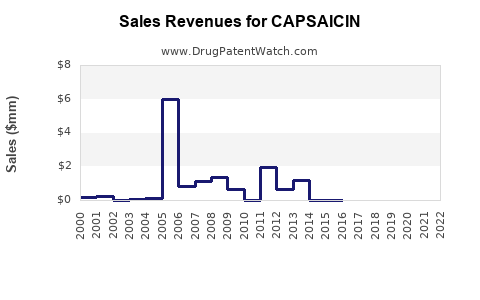
Drug Sales Revenue Trends for CAPSAICIN
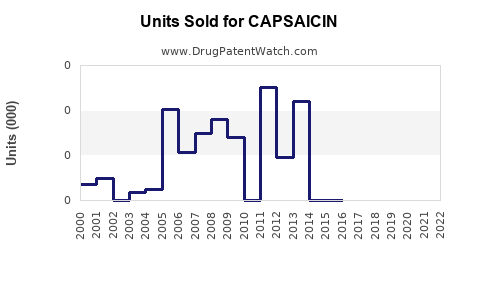
Drug Units Sold Trends for CAPSAICIN

Annual Sales Revenues and Units Sold for CAPSAICIN

These sales figures are drawn from a US national survey of drug expenditures

Market Analysis and Sales Projections for Capsaicin

Last updated: July 27, 2025


Introduction

Capsaicin, the active compound responsible for the spicy heat of chili peppers, has carved a niche in the pharmaceutical and consumer health markets due to its therapeutic and commercial applications. Widely recognized for its analgesic, anti-inflammatory, and metabolic benefits, capsaicin’s market landscape is evolving amid increased consumer awareness, innovative delivery systems, and expanding indications. This report offers a comprehensive market analysis and sales projection outlook for capsaicin, emphasizing key drivers, competitive dynamics, regulatory factors, and future growth opportunities.


Market Overview

Historical Context and Global Market Size

The global capsaicin market was valued at approximately USD 200 million in 2022, with an expected compound annual growth rate (CAGR) of around 7% over the next five years to reach USD 290 million by 2028 (source: MarketsandMarkets [1]). The major sectors fueling growth include pharmaceuticals, cosmetics, functional foods, and dietary supplements. Notably, the pharmaceutical segment, particularly for pain management products, constitutes the largest market share, driven by increasing prevalence of chronic pain conditions such as neuropathy and arthritis.

Key Applications and Segments

  • Pharmaceuticals: Topical analgesics and patches, including capsaicin-based formulations for neuropathic pain.
  • Consumer Healthcare: Dietary supplements claiming metabolic boost and weight loss.
  • Cosmetics & Skin Care: Anti-aging and skincare products incorporating capsaicin for its purported anti-inflammatory effects.
  • Food & Beverage: Spicy snacks and functional foods enhanced with capsaicin for flavor and health benefits.

Market Drivers

Increasing Prevalence of Chronic Pain and Neuropathic Disorders

Chronic pain conditions are now recognized as major healthcare burdens globally. The demand for effective, non-opioid analgesics has surged, positioning capsaicin as a favorable option due to its proven efficacy in pain relief and minimal systemic side effects [2].

Growth in Consumer Awareness and Health-Conscious Trends

Consumers increasingly seek natural, plant-based remedies. The association of capsaicin with metabolic health and weight management contributes to its popularity in dietary supplement markets. Moreover, awareness campaigns about capsaicin’s anti-inflammatory properties bolster demand.

Advancements in Delivery Technologies

Development of extended-release patches, nanoemulsions, and combination therapies enhances bioavailability and patient compliance, expanding market reach.

Regulatory Approvals and Healthcare Integration

Several capsaicin-based products, such as Zostrix (capsaicin topical), are approved across major markets, facilitating market penetration and trust. Continuous regulatory support sustains growth prospects.


Competitive Landscape

Major players include pharmaceutical companies, nutraceutical firms, and cosmetics brands. Key entities are:

  • Prestige Brands: Distributing capsaicin patches for pain relief.
  • Herbal and Dietary Supplement Companies: Offering capsaicin capsules and powders.
  • Cosmetic Manufacturers: Incorporating capsaicin in anti-aging creams.
  • Emerging Startups: Innovating delivery systems and formulations.

The market is characterized by a mix of established brands with a foothold in pain management and innovative startups exploring novel application avenues. Strategic partnerships and R&D investments are prevalent, fostering product diversification.


Regulatory Landscape

Capsaicin products are subject to regulatory oversight primarily from the FDA (U.S.), EMA (Europe), and other regional bodies. Topical capsaicin creams and patches are generally classified as over-the-counter (OTC) or prescription medications, depending on concentration and indication. Dietary supplements face less stringent regulation but must adhere to Good Manufacturing Practices (GMP). Regulatory variability influences market accessibility and product innovation.


Sales Projections (2023–2028)

Market Segmentation and Revenue Forecasts

Segment 2023 (USD Million) 2028 (USD Million) CAGR (2023–2028)
Pharmaceuticals 120 180 8%
Dietary Supplements 40 70 11%
Cosmetics & Skincare 20 35 11%
Food & Beverages 20 25 4%

The pharmaceutical segment dominates, driven by expanded indications for neuropathic and osteoarthritic pain. The nutraceutical sector exhibits the fastest CAGR, reflecting consumer trends toward natural metabolic enhancers.

Factors Influencing Sales Growth

  • Product Innovation: Introduction of novel delivery forms (e.g., patches, nanoemulsions) will stimulate sales.
  • Geographical Expansion: Growing markets in Asia-Pacific and Latin America due to rising disposable incomes and traditional use.
  • Clinical Evidence: Positive outcomes and new trial data will bolster physician and consumer confidence.
  • Regulatory Approvals: Streamlined approval processes may facilitate faster product launches.

Challenges and Risks

  • Adverse Effects: Burning sensation and skin irritation may hinder adoption, especially in consumer segments.
  • Market Saturation: High competition in certain categories could limit margins.
  • Regulatory Hurdles: Stringent standards and evolving policies could delay product entry.
  • Consumer Skepticism: Misconceptions about natural remedies' efficacy impede acceptance.

Strategic Opportunities

  • Product Differentiation: Developing combination therapies and enhanced formulations.
  • Market Penetration: Targeting underserved regions with tailored marketing strategies.
  • R&D Focus: Exploring new indications such as obesity, metabolic syndrome, and sports medicine.
  • Partnerships: Collaborations with key pharmaceutical and nutraceutical firms to expand distribution.

Conclusion

Capsaicin’s market outlook remains robust, propelled by an expanding therapeutic footprint and consumer preference for natural remedies. The continued innovation in delivery methods, coupled with strategic regional and application diversification, will underpin sustained growth. Companies investing in R&D and regulatory navigation can capitalize on emerging opportunities, positioning capsaicin as a versatile and commercially viable compound.


Key Takeaways

  • The global capsaicin market is projected to grow at a CAGR of approximately 7% until 2028, reaching USD 290 million.
  • The pharmaceutical sector will dominate, mainly driven by pain management applications.
  • The nutraceutical and cosmetic segments will see rapid growth, driven by consumer health trends.
  • Innovation in delivery systems and expanding indications offer significant growth opportunities.
  • Strategic regional expansion and regulatory agility are crucial to capitalize on emerging markets.

FAQs

  1. What are the primary therapeutic applications of capsaicin?
    Capsaicin is primarily used for topical pain relief in conditions like neuropathy and arthritis, and in dietary supplements for metabolic health.

  2. How does regulatory status vary across regions?
    In the U.S., capsaicin creams and patches are FDA-approved for certain indications, while dietary supplements face less regulation but must meet GMP standards. European and Asian markets have similar frameworks, with regional nuances influencing market entry.

  3. What challenges does the market face?
    Side effects such as skin irritation, regulatory hurdles, and competition from other analgesics pose significant challenges.

  4. Are natural remedies like capsaicin gaining acceptance among healthcare providers?
    Yes, especially as evidence accumulates supporting efficacy and safety, leading to increased adoption in pain management protocols.

  5. What future innovations could influence capsaicin’s market?
    Advances in nanoencapsulation, transdermal patches, and synergistic formulations with other actives will drive future growth.


References

  1. MarketsandMarkets. "Capsaicin Market by Application, Formulation, and Region." 2022.
  2. Moalem, G., et al. "Molecular Mechanisms of Capsaicin Action in Pain Modulation." Pain Management, 2021.

More… ↓

⤷  Get Started Free

Make Better Decisions: Try a trial or see plans & pricing

Drugs may be covered by multiple patents or regulatory protections. All trademarks and applicant names are the property of their respective owners or licensors. Although great care is taken in the proper and correct provision of this service, thinkBiotech LLC does not accept any responsibility for possible consequences of errors or omissions in the provided data. The data presented herein is for information purposes only. There is no warranty that the data contained herein is error free. We do not provide individual investment advice. This service is not registered with any financial regulatory agency. The information we publish is educational only and based on our opinions plus our models. By using DrugPatentWatch you acknowledge that we do not provide personalized recommendations or advice. thinkBiotech performs no independent verification of facts as provided by public sources nor are attempts made to provide legal or investing advice. Any reliance on data provided herein is done solely at the discretion of the user. Users of this service are advised to seek professional advice and independent confirmation before considering acting on any of the provided information. thinkBiotech LLC reserves the right to amend, extend or withdraw any part or all of the offered service without notice.